If you’re good, you get XP for giving gold to benefit the poor or needy. For example, starting a soup kitchen, tithing to a church, donating to an orphanage.
If you’re neutral, you get XP for spending gold to benefit the betterment of your body or mind. For example, researching a spell, buying a horse, or training a new skill.
If you’re evil, you get XP for spending gold on your own comfort or pleasure. For example, eating an expensive meal, indulging in narcotics, or paying for a personal valet.
Note: I’m not here to argue about the meaning of alignment in elfgames. if you’re concerned about words like “good” and “evil”, change them. Make suggestions in the comments. The point is, if alignment exists, I want it to mean something, and introducing a rule like this gives them a meaning in a way I like. This isn’t a particularly novel take — XP variants for different classes are common — but it’s fun to make different parts of the design bear weight, instead of everything belonging to class.
Bathtub Reviews are an excuse for me to read modules a little more closely. I’m doing them to critique a wide range of modules from the perspective of my own table and to learn for my own module design. They’re stream of consciousness and unedited critiques. I’m writing them on my phone in the bath.
Vileplume Mountain is a 34 page module for Into the Oddish, written Warren F Smith and illustrated by Hodag. In this Pokopia-esque postapocalyptic Kanto, you venture into the complex beneath Vileplume mountain, to rescue kidnapped pokémon from a Mewtwo that exists only in legend. Both Warren and Hodag are friends of mine, but I ordered this for its preorder campaign.
This module is a a self-described parody of White Plume Mountain, the classic module by Lawrence Schick. I’m not as familiar with or feel as much affection towards this module as the author clearly is and does, and I suspect that tempers my experience of this module. Everything in this down to the layout is inspired by that original, and I’m sure there a plenty of very clever jokes and allusions that I missed. It features a bunch of commentary that speaks to the connections between the two, which I enjoy from both a design perspective and from the perspective of a referee, but about which your mileage may vary.
The module itself is 18 pages long, with the tail end of the book being stat blocks for new pokémon, and new moves (this systems equivalent of spells). It’s a 27 room, single level dungeon, with 3 separate wings, each between 5 and 9 rooms, exactly as the module upon which it is based. This gives the approach a lot of agency, although the north wing can only be easily accessed from the north. These rooms are, to a degree, a direct translation of the original rooms to ones with pokémon theming and slightly better game design, which sounds like more of a criticism than it is: They’re fun and they present this postapocalyptic world of only pokémon in a way that renders it concrete. What else is the “starter” module of a new game supposed to achieve? My main objection is the ending: Unlike most of the other game design “fixes”, the unsatisfying ending of White Plume Mountain remains. In that era, the expectation that referees supplement and expand written modules was baked in, but not adjusting the ending (and which is to be clear adapted with a huge degree of affection for the source material) was a little bit of a disappointment to me.
The layout is a fond homage to both its inspirations, which means it’s not especially easy to run or legible to read, but the simplicity of the dungeon cuts through that easily. Hodag’s artwork (as will surprise no one who follows his blog, which has featured multiple pokémon months) is full of love for the subject matter and in addition feels appropriate to the era and graphic design. It’s a nostalgic design, for those who have nostalgia for the subjects.
If you’re looking for a module to run a one-shot of Into the Oddish in, Vileplume Mountain is the module for you. If your group has been gasping for an OSR pokémon campaign, however, and you’re looking to kick off said campaign, this module ends in disaster for your team of pokémon. Irregardless, this is a charming little homage to White Plume Mountain, filled with advice on how to run it, and gorgeous art. If you’re a fan of Pokopia and the OSR, I’d probably check Vileplume Mountain out. Limited stocks last.
I Read Games reviews are me reading games when I have nothing better to do, like read a module or write or play a game. I don’t seriously believe that I can judge a game without playing it, usually a lot, so I don’t take these very seriously. But I can talk about its choices and whether or not it gets me excited about bringing it to the table.
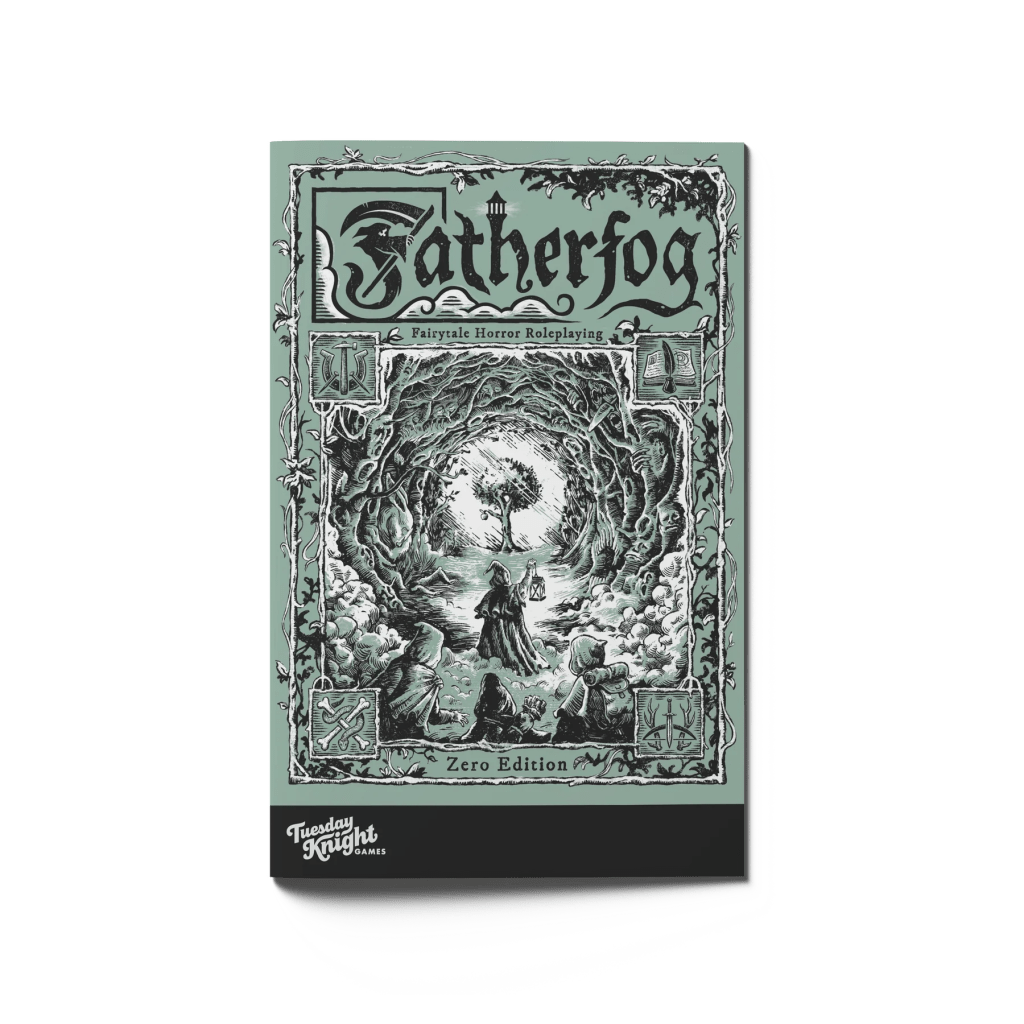
I’m feeling a little overwhelmed after going shopping for work outfits, so rather than go home, I’m going to sit in my favourite cafe, eat a hash brown sandwich, and read Fatherfog. Fatherfog is a 64 page roleplaying game by Alan Gerding, and it’s the first new roleplaying game from Tuesday Knight Games since Mothership in 2018. Like Mothership, it’s styled as 0E. In it, you’re trying to survive in a world where the fairytales you know and love exist in their original, horrifying forms, while you try to recover the dying resource “hope” for your village, the only place of safety you’ve ever known. I was sent a copy of Fatherfog by Tuesday Knight Games.
Fatherfog is, at a glance, an adaptation of the panic system (Mothership’s SRD), but while it keeps the d100 checks and saves and the skill trees, it makes meaningful changes: Skill points are now a resource used across multiple systems, you can give up entire skill trees for unnatural abilities, resting is an important and potentially engaging subsystem, you can freeze in combat, “bits” add more meaning to dice rolls (I’ll explain that a little more in a moment), and there are now significant travel and death rules. Lots of these rules feel specific to the world of Fatherfog in a really pleasing way that is very different from the more broadly applicable rules choices that Mothership has made with very good reason. There are a lot of things that have changed less, that I feel work well nevertheless: I was doubtful to see skill trees effectively applied to fairytale horror, but it feels good; the lateral translation of fear and panic to hope and despair is thematically sound and gives mechanical weight to a lot of choices across play; the clarity over the fact that enemies don’t roll to attack, but rather player characters roll to save. Some of these new rules are really elegant, in particular, the system called “bits”. The “ones” die of a d100 is called a “bit”; if you roll a mind save and succeed, you still lose a “bit of hope”; providing successful medical care heals a “bit of health”, if a failed save might cause damage, it causes a “bit of damage”. They’re a little underutilised — these bits could also refer out to subtables for unique checks or attacks against specific monsters, but this either hasn’t been conceptualised yet or is going to appear in a future module. I also like the very specific combat rules of the referee passing you if you don’t have an idea, until you have a second chance, but that if you still don’t know how to act, you “freeze” and do nothing this round. Instead of tracking all of your equipment, you must describe everything you’re carrying and how; an “equipment check”, failure of which causes a penalty; this rule is a little vague and referee-specific, and I think it needs a little workshopping, but I like where it’s at. It’s worth mentioning that although it’s not mentioned, the character sheet design here really limits your equipment carrying capacity, although that would bear mentioning in the text if it’s an intended part of the design. Overall, I really like the adaptations given to the Panic system here, and I think it’s significantly more thematic and interesting in terms of rules design than the only other Panic system game I’m familiar with, Cloud Empress.
The thing I always have the most trouble reviewing in fantasy roleplaying games is the content, because it tends to blur together. Our stats here are strength, intellect and will; our saves are body, mind and spirit. There are four classes: Workers, Philosophers, Hunters and Strangers. These each have a unique trait that usually occurs when you roll a critical success and sometimes on a critical failure. You choose a “subclass” by choosing a set of equipment (a “rucksack”), and further develop your character by choosing (or rolling) a colour for your cloak, the broach the holds it in place, a personal trinket, and how you gained what coin you have. Equipment here is unremarkable, although your player (not the character) receives a legacy artifact that is passed from character to character, which is encouraged to be kept secret, which is a lovely touch (and a mystery associated with the world that you’re encouraged to hash out amongst yourselves). You earn skill points for a variety of things, most interestingly for keeping watch; you can spend these on new skills, or can scrap your capacity to gain new skills in a certain tree to take an unnatural ability — a highly specific power that doesn’t provide a bonus, and is designed in collaboration with the referee. Only a few foes are listed in this core book, although little guidance is given to create more, although it must be said that I really like the foe structure — with every foe given not just a motive but a trick associated with how to defeat it that the player characters will have to discover. It’s worth noting, to me, that there’s an implication in the introduction (which I mentioned in my introduction as well), that you’re going to be dealing with hope as a resource at a level beyond simply the character sheet, but rather at the level of your home village. I do think that this game would benefit from some kind of additional system or referral back to this; the structure and implied narrative is begging for more focus on the village and what it might mean to save it, and it’s a disappointment this is missing, although I wonder if it once existed and was lost to page count. My overall impression of Father Fog as a statement, is that it’s the equivalent of a “Player’s Guide”, with no known “Referee’s Guide” planned. This is a similar approach to the original Mothership, but it should be noted it leaves a lot to the referee’s imagination and planning and this stage in the release schedule.
I’m a little mixed on the writing and content of Fatherfog. On one hand, the worldbuilding is compelling and raises some big questions that your campaign is likely to revolve around, particularly around the fog and the Fogtower keepers, and it plants seeds that are very easy for most referees to work from in terms of inspiration for adventures — after all, everyone knows a few fairytales, don’t they? If you’re a skilled referee, just buy Grimm’s Fairy Tales and have at it. Setting elements are alluded to throughout the book which are very intriguing in the best possible way — I imagine player characters finding foglines and following them to who knows where. I imagine what the consequence might be if you break the law of the foghouses. Why do legacy artifacts mysteriously appear in the possession when one dies? Where do the strangers come from? These are all compelling questions. On the other hand, it’s a little workmanlike, where I’d love it to feel a little more, well, folk-tale-like and florid; the phrase “Trained in combat and/or survival” shouldn’t be in a fairy tale themed book; I love the clarity, but it sacrifices atmosphere and relegates it to clever ideas; I think with the right team, one wouldn’t need to be sacrificed for the other. That said, it’s still evocative at times, particularly in the character-building coin and trinkets tables (“Your attempt to sell flowers, while appreciated by some, has left you with little.”, “Wonderfully crafted shoes appeared in your home overnight; their sale earned you a hefty sum.”, or “Thing sealed in a murky jar“, and often funny (in the death table — “Your right hand can’t help but feel your left hand is mocking it.”). One thing that is featured heavily is the character of Death — there’s a whole section devoted to Death, and how characters might interact with Death when you die, and Death is featured in the logo, which makes me suspect it’s supposed to be a core mystery as well. This is an interesting direction, although it’s not explored thoroughly. One thing that there is not in Fatherfog is any beginner’s module — and for good reason, it’s maxing out the potential size of a zine at 64 pages. This means, if you pick this up immediately, you’re going to be designing your own adventures — that said, I think that once again, Tuesday Knight Games has chosen a core theme here that is likely to invite a lot of creativity from the community, given the huge number of potential fairytales and interpretations of them that could be adapted into modules for Fatherfog.
Fatherfog is the first thing I’ve seen that brings the full weight of the Tuesday Knight Games visual and game design team to an aesthetic that isn’t the hyper-dense Mothership visual signature, and they manage to make it work, feel fairy-tale, while keeping the clever design that made Mothership so easy to pick up in the first place. Smart typeface choices, a cohesive colour palette, and It reproduces the intuitive “play straight from” character sheet without sacrificing that identity, and I especially like the implications of colouring and drawing on that character sheet. Layout conventions are appropriately broken to describe things like the character sheet and classes. Art is used to break up dense areas like d100 tables, while those tables all scream colour in the same way Mothership’s patches do. Iconography is used for game phases and for skill levels in a pretty intuitive way (although I think whether or not they’re a stroke of genius or simply flash probably won’t become evident until we start seeing modules and expansions to Fatherfog and see how they’re incorporated there). A suite of excellent artists including Conner Fawcett and Ryan Lynch, all create a distinct visual identity for Fatherfog. Colour is used to differentiate sections so that those playing party members don’t stumble into the referees section. The back cover is a summary of how to play that covers all the major mechanics, elegantly and clearly. The biggest miss in terms of layout and design is the lack of page references; 64 pages is enough to get lost in for me. That said, the table of contents is clear and thorough. The physical product itself is exactly what I’ve come to expect from Tuesday Knight Games: This may be a zine, but the cardstock is thick, well textured, and will stand up to a bunch of use.
We have no shortage of high-lethality horror fantasy games in the hobby — there are at least two heavy-hitters in Trophy Gold and Cairn 2e that feature a fairy tale aesthetic. Trophy Gold released with a cornucopia of incursions (although a quick search on itch.io gives me the impression ongoing development of more incursions by the community may be dead in the water); Cairn’s own print store lists around 60 modules. The cumulative weight of the communities of these competitors is hard to compete against, but Tuesday Knight Games has in Mothership a very strong track record of support. What Fatherfog offers is a strong aesthetic, some clever mechanical twists, a familiar overall system with some welcome clarifications, and a unique and more specific setting than either Trophy Gold or Cairn have to offer (sorry, Vald). I obviously can’t recommend Fatherfog as an exosystem right now, but I think it’s really promising as a system to develop for, and I suspect people will be excited to develop for it given it has a far more specific angle than anything else out there right now, and that angle allows creators to demonstrate how unique their own upbringings are in a way that’s pretty unique. That’s an exciting future, if it eventuates.
I like Fatherfog, a lot. As someone without a lot of time to design my own adventures on a weekly basis, its’ specific theming is a detriment to me bringing it to the table. It won’t be, however, for people who get excited at the idea of rifling through a book of fairy tales as their weekly prep, and if the community gets as excited for Fatherfog as I feel after reading it, it won’t be long before I won’t have to design my own adventures. It’s a take on the Panic system with a bunch of unique and clever mechanical innovations that I’m excited to see expanded upon and implemented, while remaining familiar enough to be easy to put into play without a fuss. It’s also full of a bunch of really interesting seeds and evocative concepts that are really compelling in terms of world-building. If you love fairy tales, and have yearned for an on-ramp into running them in an OSR style, if you’ve bounced off Cairn and Trophy Dark as fantasy horror games but are familiar with Mothership, or, if you’re excited by the baked in mysteries that Fatherfog is offering, Fatherfog is probably for you.
Bathtub Reviews are an excuse for me to read modules a little more closely. I’m doing them to critique a wide range of modules from the perspective of my own table and to learn for my own module design. They’re stream of consciousness and unedited critiques. I’m writing them on my phone in the bath.
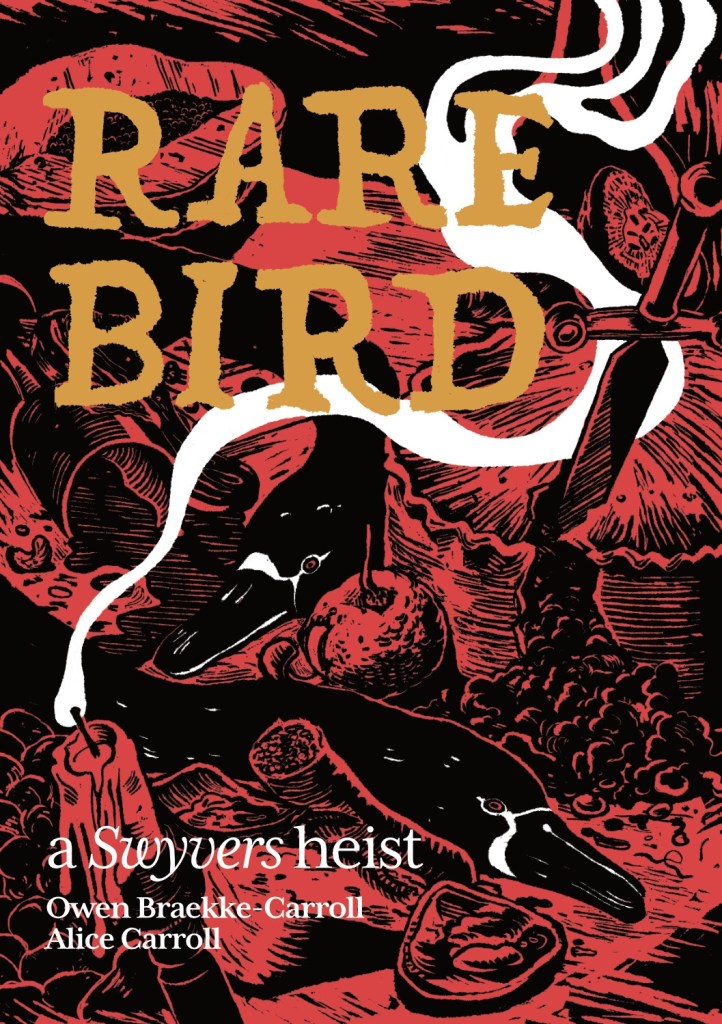
Rare Bird is a 39 page module for Swyvers by Owen Braekke-Carroll with art and cartography by Alice Carroll. In it, you steal a rare and massive bird from a well-protected mansion. It’s pay what you want.
I love a module with a solid moral dilemma at its’ heart, and while in Swyvers you’re generally not good guys, and here you know you’re working for the bad guys, the moral dilemma that can ensue if you succeed in stealing the bird is a very, very juicy one. The added complication of the rival crew of Swyvers with a similar but not identical goal, makes things even juicier. This is clever set-up, and adds a sense of tension to the module. I often look to be excited by the first few pages of summary, and Rare Bird got me excited in the first few pages.
We open with about 10 pages of personalities and their stat blocks. Your mileage may vary, but it uses its words to imply a lot in a way that I like: “Foolishly invested in one gold tooth after a night of successful gambling, now spends his days talking with his lips held low in a very strange manner to avoid anyone seeing it.” Then we have our random encounters, which advance on a pair of parallel timelines that interact with each other. This seems neat, with the math propelling things forward every three rooms or so. There are 12 events and 21 rooms, which means we can expect most of these events to crop up across the totality of the module. The final events are pretty grim and end the module themselves, so if you want the swyvers to have a chance of getting out with their quarry, you might want to soften this to only on a roll of 1, or make one event table 1 and the other 2, as really you’re expecting to finish this module in about 36 turns as is, which feels like it might be tight. The key makes up most of the book, and has a tight, clear layout with some nice internal paragraphs decisions that make for good informational design without being overly structured, which will appeal to the “I like paragraphs” crowd. In a sidebar, there’s always loot and exits listed, a habit I appreciate generally but not here specifically. Why? There’s no additional information attached to these exits — smells or noises or the like — so an inset map would be a more beneficial use of the space. These rooms, aside from the loot in them, are not incredibly interactive — they’re intended as backgrounds for the characters and swyvers to interact around. The writing here isn’t as good as Swyvers itself, but it’s still good, consistently funny, and it suits the world perfectly.
There are a few little disappointments around the book, though. The major villain isn’t defined in a way that feels dismissive “what does it look like? What does it do? Ultimately this is up to you and your Smoke.”. There’s a weirdly placed list of rumours — don’t know why they’re situated between the events and the explanation of the events. One repeating issue throughout Rare Bird is referencing forward. It would benefit from hyperlinks or page references, because the placement is reasonable, for the most part — this is a big book, and co-locating things is not the wrong choice. It’s workable if you’re in digital — you can word search for specifics, but if you had the printed version you’d need to spend some solid time annotating what’s going on. This is an easily fixed problem, but it makes running a little more challenging.
If there has been a large community of Swyvers developers pumping out modules, I’ve missed it. On my first impressions, it is a solid game, and while Rare Bird isn’t perfect, this is a module I’d really enjoy running. I think I’d need a little more than just this to persuade me to start a Swyvers campaign — but I remember when Mothership just had the one module. If you’re looking to run Swyvers, or you’re looking for a fun heist to run and don’t mind converting, Rare Bird is a fun heist with a lot of potential conflict and drama.
If you have a medical kit, it contains five tools a tincture (d4), a tourniquet (d6), a lancet (d8), a trephine (d10), and a bonesaw (d12). When you’ve used one to stabilise someone, cross it out.
When you go to stabilise someone, secretly choose a tool. The person being stabilised secretly chooses a number of HP between 1 and 12. You can tell the referee if either of you aren’t trustworthy.
Roll your tool die. If you roll over the number of HP the dying person chose, they are healed to that number of HP. If you do not, they bleed out.
You must repair your tools if you use it. They cost that dice size to repair.
Bathtub Reviews are an excuse for me to read modules a little more closely. I’m doing them to critique a wide range of modules from the perspective of my own table and to learn for my own module design. They’re stream of consciousness and unedited critiques. I’m writing them on my phone in the bath.
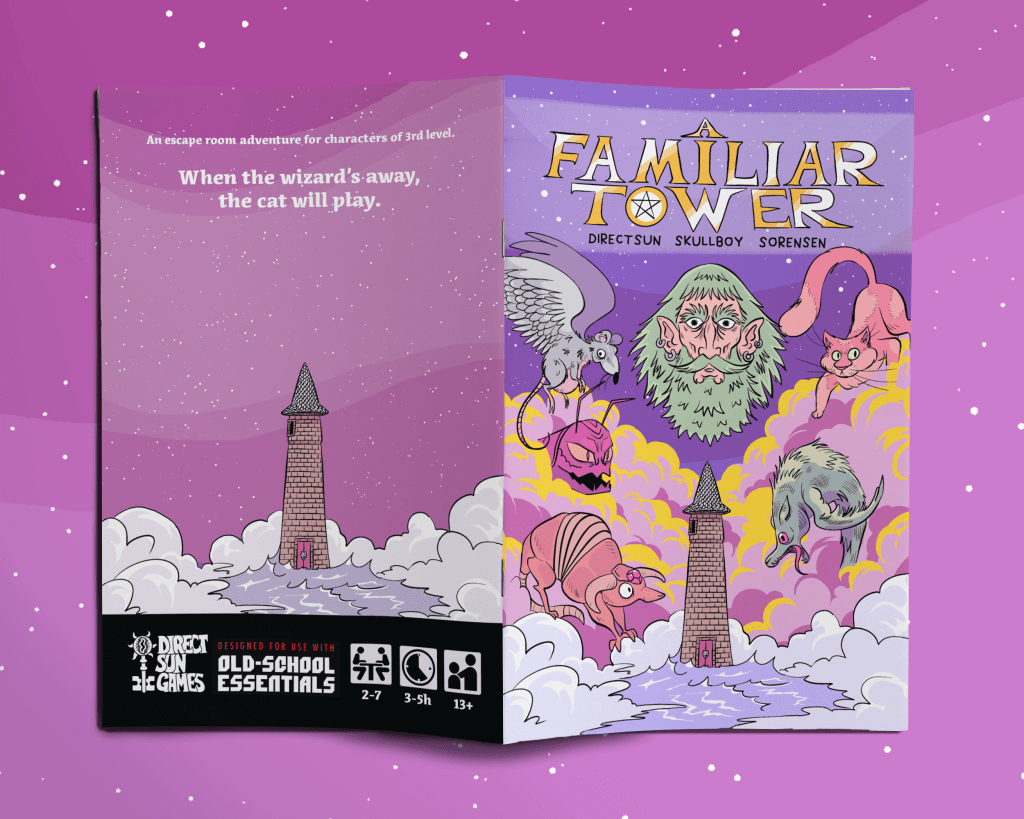
A Familiar Tower is a 39 page module for Old School Essentials by Directsun, with art by Skullboy and graphic design and development by Sam Sorenson. In it, you’re trapped inside a tower, and you need to get out. I can’t really review this in any meaningful capacity without spoiling the puzzle you’re trying to solve, so fair warning there be spoilers ahead.
Layout and information design here varies between choices that obscure and clarify; the inner cover is two maps, one a not-quite isometric view, showing the rooms and their page numbers; the other showing, in addition, the floor plans of each level in a traditional 5 foot grid. Good, clear. But features that hold true for the whole tower are on the copyright page, which I don’t like as a design decision; honestly I don’t typically read the copyright page and I only noticed this because I was reading in digital. Headings are bold, minimaps are reproduced, read-aloud text is bolded and other locations or features are page referenced. Good, clear. It should be noted, though, that you’re going to do a lot of page-turning given that all stat blocks and items are in an appendix that these references point to. It was very difficult to make heads or tails of this module digitally, although thank goodness the page references have hyperlinks (I did a lot of scrolling back and forth even with that blessing, though). The choice to put Advanced Tower Mechanics — only 2 paragraphs — at the end of the key, instead of at the beginning, honestly makes it a little more difficult to understand, as it describes things that should be other keys, and details a few events that should probably be detailed in the main text, although I don’t disagree that it be duplicated elsewhere. But the result is that it’s unclear. Skullboy’s art and maps both are peerless, and suit the humour of the book in a way that feels like a collaboration rather than simply an illustration. It’s excellent stuff.
Directsun specialises in puzzle dungeons, and the mechanic you’re playing with here is one of size, however, unlike typically, how the mechanic works isn’t crystal clear: “Entering or leaving the tower changes an object’s size by a factor of fifty.“. Enlarges it, or shrinks it? Well, it’s not clear from the explanatory text, which is entirely by reference to the replica tower (well, technically not a replica, through magic): If something enters the replica tower, it appears in “your” tower as fifty times larger, and if something leaves the replica tower, it is retrieved at fifty times larger. The puzzles include a variety of options to use this mechanism, including remaining large and shrinking yourselves down, and changing item sizes in either direction. I recognise that not providing the solutions to the puzzles is an intentional choice; however the fact that I struggled to figure out the mechanisms doesn’t work for me as a referee; this is a book that wants you to read it’s entirety before understanding it. No more is this book’s insistence on your reading it in it’s absolute entirety and understanding it as a whole more frustrating to me that where it reveals how to escape the tower at all: This is first described on page 35 in an appendix, although it’s alluded to on page 13, which I admittedly missed until my second read through. While, after struggling through this challenging information design for this review, I wouldn’t have trouble running this module, I don’t know that I’ll remember in a week, and it took me over an hour to decipher exactly how to approach this fairly short book.
If you power on through that lack of clarity better than I did, though, the rooms themselves are absolutely choc-a-block with interactive content; typically at least 2 or 3 things to interact with. There are 14 locations in all, and at least each of the five floors features a puzzle for the players to figure out, ranging from very simple (the marble puzzle on level 2 feels introductory), to more challenging (the giant switch in the basement will take a lot more planning). This level of complexity does have its’ negatives: There’s a lot of text, and a lot to parse and then communicate back to the players; I think that an alternative approach to the keying would work better for such complexity, as this approach would have me leaping from paragraph to paragraph and then back again as the players ask questions, not to mention to the appendix and back to grasp the NPCs that are described in considerable detail. Frustratingly, these really compelling and funny characters often have their descriptions split across sections — it’s on page 15 you find out that you’re gien a quest to cross items off Carbuncle’s bucket list, but what the bucket list is? Page 28. There’s a bunch of information like this that should have been co-located, in my opinion. But the characters themselves are the kind to sink your teeth into, so long as you don’t mind a module that leans into the lighthearted — most of these are Wonderland-esque speaking animals. I think they’re a pleasure.
A Familiar Tower is an excellent puzzle, but it’s not a module for someone like me who likes to run things blind, because it wants to be the kind of module that doesn’t explain itself ahead of time. For a module whose location content is less than 25 pages, honestly, I don’t see why it doesn’t want to spend more time explaining itself. The puzzle itself, and the humour in the characters within, are excellent and would be a pleasure to run. If you’ve the time and capacity to parse the module, though, A Familiar Tower will be an incredibly memorable few sessions of fun characters to play and meet, and the promise of plenty of shenanigans.
Bathtub Reviews are an excuse for me to read modules a little more closely. I’m doing them to critique a wide range of modules from the perspective of my own table and to learn for my own module design. They’re stream of consciousness and unedited critiques. I’m writing them on my phone in the bath.
Hot Property is a 3 page module by Norgad for Mausritter, released for Mausritter month in 2025. It details the vault of a mysterious company, which you’re likely to be breaking into to steal everything you can hold. I was provided a community copy by the author.
The map of the surrounds of the Iron Fortress take about half a page, in typical Mausritter (and let’s be frank, Norgad), terseness. Here, the terseness causes some glitches, for example, a timer triggers when the party enters the inspection area, but the inspection area isn’t actually mentioned (although you can assume it’s the access dock where “No weapons [are] allowed.“). You’ve got to be willing to improvise to run a Mausritter module. The other half of the page covers encounters — all of which feature one of the 2 factions interacting — and how to escalate them in line with the timer, a few odd treasures, and stats for the two factions. The second page covers the key for the 16 room Iron Fortress. The map has a lot of character, and honestly we don’t see enough side-view maps of dungeons, and it has some interesting loops, interactive elements and potential secret doors to hidden treasures to keep it interesting. It’s clever with folding a little depth into its’ rooms with few words — “suspiciously muddy prisoners” are a hint for an escape tunnel, for example, but a lot of these are blink and you’ll miss it, and I suspect under the pressure of the timer, and the fact that you’ve only got 20 turns to get in and out of a 16 room dungeon, means that the players will likely be rushing.
Or at least, I think they should be. The timer aspect of this module elevates it, although I wish there were a more concrete way of indicating to the players included exactly how long they have to achieve their goals. As it is, there’s a chance that they might realise they need to flee 3 turns before the entire fortress collapses and they have to find a way to escape the eels that occupy the lake that serves as its’ moat. There’s a bit of unused space on the third page of this module, and I think it would be better to spend that space to provide a little in-world illustration of the risks of being in the vault in the form of little notes between the managers. You could include these in certain rooms and refer out to the back page to preserve the tight layout, or you could indicate that the workers have an idea of what’s in the bottom of the fortress, and then it wouldn’t be a surprise, but rather the resolution to a developing dread. As written, the climax is likely to be a fight for the few seats on the barge between the party, the workers who are explicitly not bad people, and the group of revolutionaries who are at least against the masterminds of the scheme. I think if I ran it, I’d need to tweak something to prevent that grim ending.
The layout here is tight and usable, and comes in 2 versions. I’m not sure exactly what the format of the primary layout actually is (it’s called “A5 wide pamphlet”), but from the itch.io page it looks like a trifold. The 3-page makes more sense to me, although in neither of the versions is the space fully utilised, and in a way that feels a little unintentional. That said, in a 3 page version, I’d run it off just the middle 2 pages, and I’d have everything I need so long as I was able to improvise, so this would be my preference given the content on the other pages. And the art — primarily maps aside from the cover which is excellent and evocative of the timer-oriented heist that is intended — is clear, cute and useful. Precisely what you need to run the module. I feel obligated to add that while I don’t have the physical version of this, every physical Norgad product I’ve own is absurdly high quality in physical, and if you like a hefty pamphlet, it might be worth looking into the physical version if there are any available.
Overall, I like Hot Property a lot, and I like it’s themes and the lack of a clear villain, as well as the timer elements. It stands out from the crowd of short pamphlet adventures because of these additions. I’m always on the look out for yet another Mausritter one-shot to run, and if you’re looking for a little, one-shot heist, I’d check it out, so long as you’re happy for that little bit of tweaking.
Bathtub Reviews are an excuse for me to read modules a little more closely. I’m doing them to critique a wide range of modules from the perspective of my own table and to learn for my own module design. They’re stream of consciousness and unedited critiques. I’m writing them on my phone in the bath.
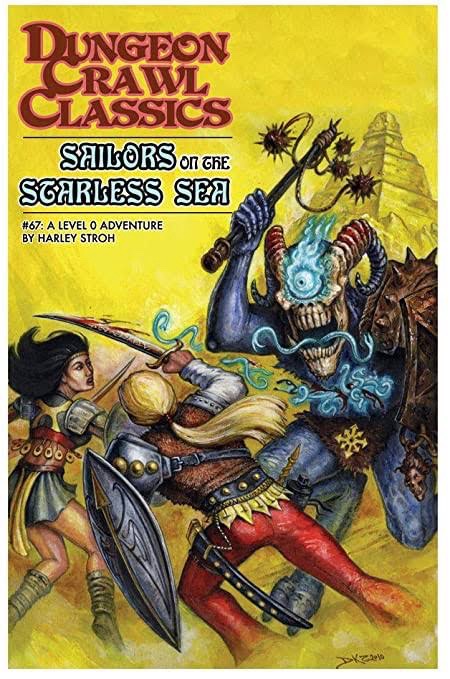
Sailors on the Starless Sea is a 15 page module for Dungeon Crawl Classics by Harley Stroh. It’s a funnel, designed to cull a score of level-zero characters to a party of level-1 ones. I’ve run a few funnels before, and a few in the rules-adjacent Mutant Crawl Classic, a game I should probably review by itself. I haven’t delved into the deep archives that are the DCC line of modules, but I find this being recommended repeatedly.
A chaos god is returning to life, and the characters must prevent them and brace an underground sea to save the people of their village. The backstory is wordy and flavour fully pulpy, but is really an excuse to flavour the adventure with chaos, and from then it jumps straight to rumours and an encounter table, which initially I thought was random but actually it’s just a list of encounters categorised by type — trap, creature, or puzzle. I’m really not sure the utility of this, and while I know this is a funnel, I’d appreciate a random encounter table given the homage to classic play suggested by…well, everything.
In the text we have 17 locations. Those locations are good, interesting almost without fail, and despite this written with all the flaws of a module in dungeon magazine: Block text, long-form undifferentiated text, with no highlights to help find relevant information. It’s not completely without finesse, but it’s minimalist to the point of challenging to scan. Certainly an example like Tomb of the Fallen, an entire A4 page, has differentiated text totally six bullet points and four read-aloud text blocks, is an interesting puzzle room, but challenging to parse. It’s a short adventure, and I suspect if you ran it a few times at a con you’d have it by heart quickly (which is how this was playtested, from the acknowledgments), but to run straight from the page I’d be thumbing through trying to work these puzzles out, while my players sat in doldrums.
With the obvious homage to classic modules from cover to cover, it’s worth delving into the layout I think first. It’s sparsely but excellently illustrated with beautifully detailed, bold and janky art in perfect homage to the days of the Fiend Folio. Block, A4 walls of text are presented directly to you sometimes for 2 or 3 pages at a go. This approach means it packs a lot of content into 15 pages. I’m reading this digitally, and it’s hell on my phone; after I finished my bath I pulled it up on my big screen at 100%, and it’s equally difficult to read; perhaps it is better on the page. Hopefully the content is designed around these barriers.
I like this module, to be honest. We’ve got some stellar encounters, a cool puzzle and some interesting traps and it’s deadly as hell in a pleasurable way. The vibes are immaculate. But the layout and approach is profoundly flawed, if intentionally or perhaps dogmatically so. I know that I can run an adventure like this — I’m a fan of Dungeon Magazine enough to make a podcast out of it — but why, with so many innovations in how to make these more playable, is dogmaticism and homage limiting the usability of modules? It’s disappointing to me. Harley Stroh, given a different approach and an inventive layout artist rather than being trapped in homage, would be sweet as pie. This is frozen lemon: If you squeeze it hard enough, and add some extra love and attention, you’ll get lemonade. But I can buy lemonade. So why would I turn first to Sailors on the Sunless Sea?
Bathtub Reviews are an excuse for me to read modules a little more closely. I’m doing them to critique a wide range of modules from the perspective of my own table and to learn for my own module design. They’re stream of consciousness and unedited critiques. I’m writing them on my phone in the bath.
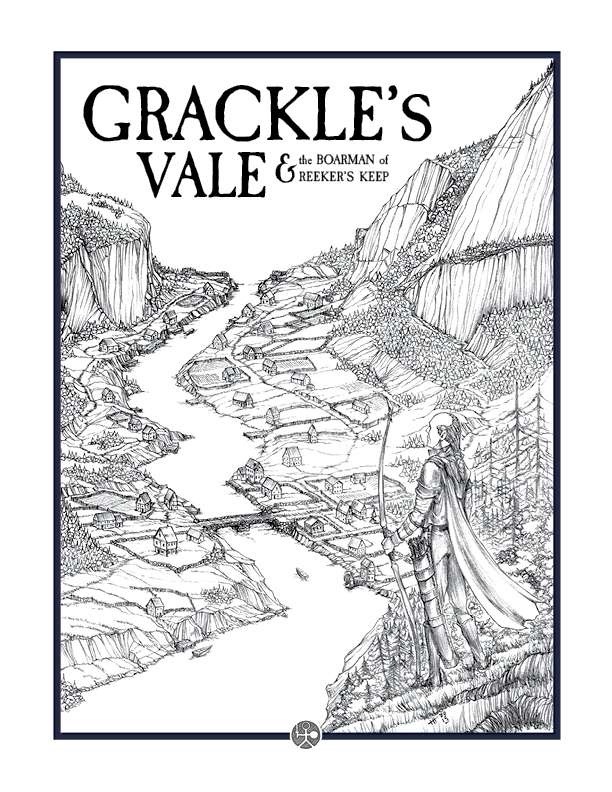
Grackles’ Vale is a 20 page module for a custom OSR system, by Randy Musseau with illustration, maps, layout and design by Roan Studio. In it, you seek bounty on a Boar-man that has been terrorising the village or Grackle’s Vale. I purchased this myself.
I’m a little mixed on the layout. It’s in A4 format, but only available in digital, and at the size choices, I can’t easily read it on either my phone or tablet. That’s a hell of a drag as that’s how I tend to run things, but if you run on a full sized monitor or are likely to print it out, it won’t be a problem. Within that format choice, it looks good — clear headings, use of bullets for tables, lovely art and clear and gorgeous maps. If you’re happy to wade through paragraph text in a double column A4 like the good old days, this will work well for you.
We open with a list of rumours and a brief high level description of the town. The rumours aren’t terribly juicy and often are things the players will already know if they’re not new to the genre. The 3 NPCs in this section could be communicated more clearly — none of them have clear agendas, and are pretty light on personality traits. This particular flaw rolls on throughout the module — even where there are characterised NPCs, they don’t tend to be characterised in a way that’s awfully useful to me as a referee. We then have a list of about 16 locations, which are intentionally written as independent from the adventure portion, and hence don’t give you much to dig your claws into. The second half of the module is the adventure itself. This consists a fairly linear trek up a valley, with a potential detour into a 20-odd room goblin catacomb, before encountering the boar-man, at which point you have achieved the objective. The writing here is purple, but effective, and if your preference is longer form prose, you’ll probably enjoy this.
Honestly, this feels like a module written by someone who’s only read Gygax and decided to write a module (the description of the innkeeper as “an attractive woman in her mid-thirties” clinched that for me, but the owl who pickpockets the PCs to “lighten the load of overburdened adventurers” is such a gygaxian impulse). The only point in the linear crawl up the valley where you’re making a decision is when you go into the unconnected dungeon; this could’ve been the point of the whole module, but instead that’s slaying a boss in another keep, a boss who to be honest it’s not clear you need to kill to claim the bounty, as there are plenty of boar-men about, and the torc that is the actual cause of the curse is a forsaken easter egg — I don’t actually see how it can be identified as the root cause in-world. It would be far better if the hooks provided rhyme or reason to enter to goblin dungeon, or if that dungeon gave you clues to the final battle, or if you were told that the torc not the boar-man was your target. If you need a village this one’s fine, but it’s not full enough of petty intrigues or holds into the boarmen or goblins to make me want to use it; the adventure part could be used with any village, with minimal modification.
And that’s my issue here in a nutshell: I don’t hate the gygaxian bent here — honestly it’s lovely the author has a distinct voice — I like the layout and like the art a lot, but no single part of this is magnetic or interconnected enough for me to feel a need to run it. Could I have run a fun few sessions with any of these changes? Yes, I could. And, there are some nice touches here. If you’re willing to put in the effort to make those changes, or you’re pretty happy to have something to cover your next few weeks of planned sessions without putting in too much thought, you could do worse than Grackles’ Vale.
Bathtub Reviews are an excuse for me to read modules a little more closely. I’m doing them to critique a wide range of modules from the perspective of my own table and to learn for my own module design. They’re stream of consciousness and unedited critiques. I’m writing them on my phone in the bath.
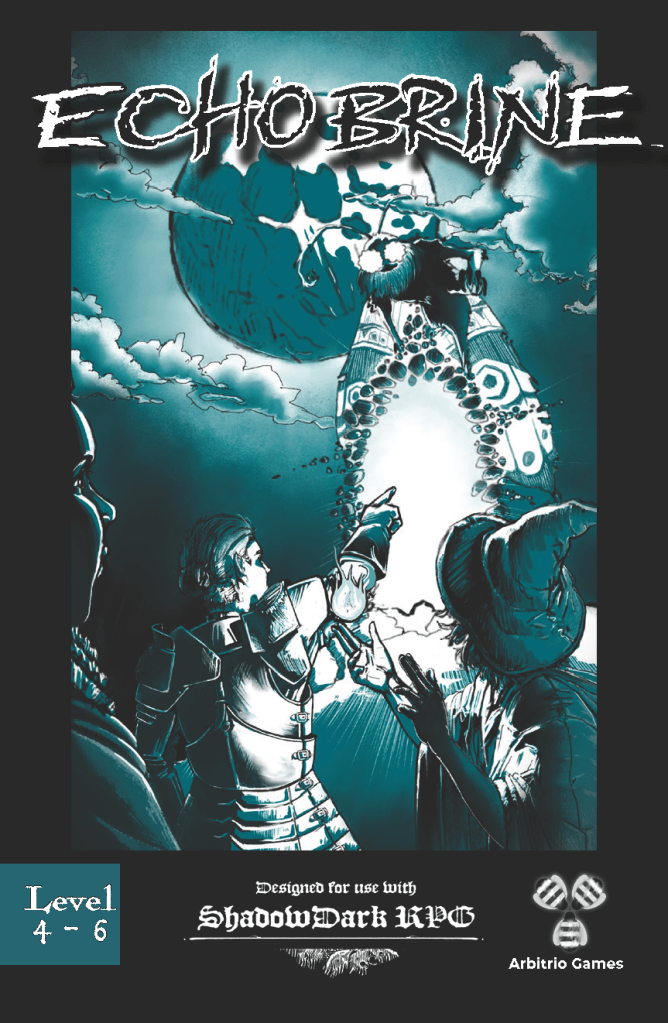
Echo Brine is a 57 page module for Shadowdark by Michael Faulk, Jeff Mitchell, and Scott Slater, with set by Michael Faulk and Graham Sternberg. In it, you seek for idols to destroy in order to bring down the barrier around the cursed Hemlock Cove. I think I was provided a complementary copy by the author.
Echo Brine opens with a 3 page, full text explanation of what’s going on. It’s a lot, and I think it could be both simplified and more clearly communicated to the players through a solid hook. In a nutshell, an intelligent, psychic meteor fell into the sea by the town of Hemlock Cove. These shards of rock corrupted the townsfolk to build a portal out of idols so that witches could summon a dark god. Also worshipping this dark god are squid-people and come to destroy the portal are the moth-people. The local mayor got a famous adventuring party in to solve the problem, which forced the god to retreat. There are also some witch-hunters who’re scouring the town for the witches. Here, the player characters enter, prompted by a random rumour, or else invited by a dead adventurer, witch-hunter, or the mayor. This is a complex set-up, but I do think that part of the issue here is not that it’s too complex, but rather it’s hard to track in the way it’s presented.
The rumours I’m mixed on; individually they provide players with unique sub-goals, something I really like — they change the way the players engage in a way I write about in Juicy Worms. But nothing here (aside from the note “Conversely, they can have been sent a letter from Kess Harrow before they died, Mayor Must before he was lost, or Inquisitor Steele“) actually links them up to the XP goals or provides them with any information about what’s going on in Hemlock Cove. Deeper in, I find issues with the barrier, and these rumours could’ve been a fun way to point the player characters towards the tunnel, the beach or the Dowager for entry — but only one of these rumours points anyone there, and that one doesn’t actually tell you the goal is in the Dowager. It’s great that they provide a way into the world of the module, but why is this module leaving it up to the referee to come up with why the player characters are there in the first place?
Next up are some special rules and random encounters. I like these random encounters, which vary from a monster to very specific situations. There are 15 encounters, with 3 of those having 4-8 sub-encounters that you roll again. You’re going to roll every 3 rounds while crawling, 50% chance when moving between locations. If moving between locations means moving around the village, then you’ve 15 locations here, 31 if you include the crawling, which means — you’ll start repeating some of these random encounters, and some of them are really one-off events, so you should be crossing them off. I suspect a different approach to random encounters was needed, perhaps using a curve to increase the less specific encounters probability of occurring, or perhaps one of Warren’s RAMdom tables given a lot of these events are one-off.
The town is walled off with a magical barrier. There are three points of entry, but there’s no effort put into entering the town in the introductory pages, and the broader landscape isn’t explored, so this isn’t an interesting puzzle to solve. Not a single rumour helps access the barrier. You’re going to face the player characters wandering around this barrier aimlessly for a while, which is not an interesting start to the adventure in my opinion. I think for this to work, I’d have to give them some clues, or expand the map considerably to facilitate a whole adventure about accessing Hemlock Cove in the first place.
I quite like the key itself. Boxed text with bolded points of interest are followed by their deeper descriptions. Larger locations have an inside and outside boxed text, which is nice and clear. Ordering can be a bit off — where this bolded points of interest exist, they’re not always at the top of the description, which I think is a mistake, but it’s legible and usable. NPCs found within these descriptions aren’t too thorough, but I like that they all at least have information on what they want from the party. I really, like, however, the change in format for dungeon type locations, where overall detail and specific denizens as well as “what can change” are provided, before the specifics of the rooms in in the location. These area also called out in colour, which helps signalling for navigation. All NPCs are detailed at the back of the book, which I don’t love given they’re almost all location specific; their descriptions are a perhaps a little too background-heavy for me — I don’t care about Inquisitor Steele’s childhood — but I do care about what her agenda is, and that is highlighted clearly. If they’d been briefer, they’d likely have fit in the main text more cleanly.
The layout here isn’t pleasing to my eye, but is clever. I think a lot of thought has been put into highlighting and signalling for ease of play, but limited budget means repeated art for these purposes, dungeon scrawl maps, and some jarring spacing and ordering choices. But, it all works and is readable, with the only major issue being the information ordering issues that recur throughout. These really occur primarily within spreads or pages, though, so you’re not flipping through pages searching for things.
Echo Brine is a mixed bag, for me. I love the nautical theme, I love the search for idols as a goal for the player characters, and I like that there are factions buried in here, with individual characters that interact with each other in interesting ways. But, the information design here made it hard to process a lot of what is good here, and to run it I’d have to put some effort into expanding the module as it’s short on hooks and clues to make it a well-paced few sessions. If you’re looking for a nautical-themed, character-heavy, fetch-quest style module, and particularly if you’re interested in the Shadowdark ecosystem, there’s a few sessions of fun in Echo Brine for you.
I use affiliate links where I can, to keep reviewing sustainable! Please click them if you’re considering buying something I’ve reviewed! Want to know more?
Have a module, adventure or supplement you’d like me to review? Read my review policy here, and then email me at idle dot cartulary at gmail dot com, or direct message me on Discord!