Bathtub Reviews are an excuse for me to read modules a little more closely. I’m doing them to critique a wide range of modules from the perspective of my own table and to learn for my own module design. They’re stream of consciousness and unedited critiques. I’m writing them on my phone in the bath.
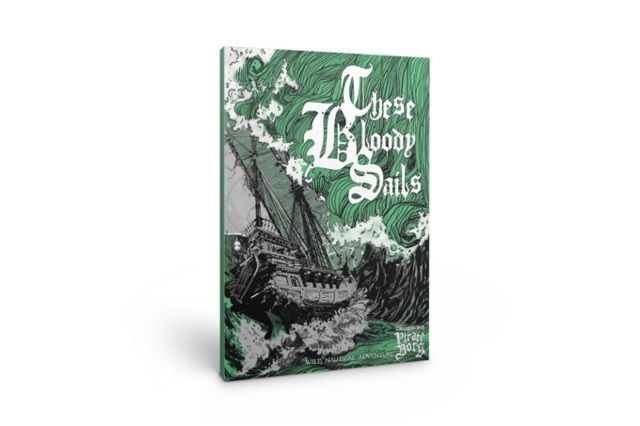
These Bloody Sails is a 50-odd page module for Pirate Borg, by John Christoffersen and William Tramp. In it, you have been hired to steal back a ship that was lost in a wager, and to do so you must sail deep into the dark caribbean. I backed this on Kickstarter.
These Bloody Sails doesn’t start well. It opens with 7 pages (not including the inside cover tables) of rules content before it ever actually starts to tell you what the module is about. It makes my first impression that the design process started at “can we make a depth-crawl for a nautical adventure?” and that the content itself is an afterthought. It was really disconcerting having to search for the actual story being told here — it’s not even on the back cover blurb. Those rules themselves don’t really work for me. I’ve said before, in my review of The Undying Sea by Joseph R Lewis, that depthcrawl as a procedure doesn’t work in my opinion for sailing modules. At least the Undying Sea has a conceit that made the depthcrawl more relevant: Here, it’s just the sea (unless maybe the “dark” caribbean is in fact dark, but that’s not clearly communicated if that’s the case). The procedure isn’t clearly communicated (I assume the “part” is the part of the book, but that terminology is very unclear to me). A lot of the procedure refers out to the core Pirate Borg book, which might work for people who keep a stack of books on the table to run with, but it also consists so much of this ruleset that it makes the content feel awfully generic. The forefronting of these rules rather than relegating them as secondary to the module itself, really leaves me underwhelmed moving forward through the text. Frustratingly, there are also four pages of rules at the end of the book, some of which are genuinely confusing to me, most of which are simply bonus content. The confusing part to me, is where it decides to re-describe each “part” as a journey of about 15 hexes, and then goes on to complicate things with additional locations and events that aren’t the ones referred to in the earlier section. These are perplexing choices to me.
I think those “journeys” are there, because the truth is the “parts” appear to simply be locations. The Part 1 is the ship you’re pursuing, the Gilded Swine, and details the battle for it. There’s an unkeyed map of the ship, but no characters or details about the crew. The Part 2 is your escape into the open sea, where you are inevitably going to encounter an island with 3 locations, “filled” with evil, bloodthirsty flamingos. The last of those is a 4 room dungeon, with little purpose to it. Part 3 is the port of Tortuga, where you must careen your ship (ah! this is why those rules are there — but put them here!), and nameless pirate crew members (again, no named characters) pick a fight with your crew, accusing them of cheating. In part 4, you face off against the Captain you stole the Gilded Swine from, in a climactic naval battle. We then have a few pages of stat blocks, and 3 apparently unrelated locations that might exist on your journeys. The entire series is only cursorily a depth-crawl, given it’s filled with statements such as “Once this encounter has completed, move on to Part III of the journey.” I don’t object to a railroad, but These Bloody Sails claims to be something else entirely. The content, however, might be compelling to you and worth poaching for your own sea-faring campaign.
In terms of graphic design and layout, I find this challenging in a number of ways. The big formatting drag for me is that the digital version is only available in spreads — no pages. You can’t read this on your ipad or your phone, and that limits your capacity to print from certain home printers. The graphic design choices are clearly inspired by Pirate Borg, so you know what to expect in terms of text placement and bold choices, however while I don’t have the background in visual design to clearly articulate what doesn’t work here, I really struggle with the choices of highlighting, typeface choices that seem random rather than on theme (I count 8 on the page 14 spread alone, for example), broken words, and low-contrast place-setting ( page 16 has white text on white art, and then black text on black art, rendering it challenging to read despite giving that text an outline — not a solution I prefer for body text). The art fluctuates tonally from wood cuts that seem public domain, really lovely line art that seems perfectly in theme for a dark pirate book, and character art that wouldn’t feel out of place in a comic book. Definitely not bad art, but jarring in terms of art direction. Overall, the layout doesn’t doom the book because the text it’s managing is brief and terse, but it doesn’t make running the book easy, at all, and reveals how clever Nohr’s stellar Mork Borg layout is, because this one superficially mimics a lot of its traits, without maintaining it’s legibility.
Overall, These Bloody Sails is a module that screams “I wrote down my home game”, even though the crowdfunding campaign and the credits suggest it’s been edited and well play-tested. What you’re getting is 4 locations, 4 scenes, and a few bonus rules that you can apply to your Pirate Borg game. If you’re looking for additional locations to add to your pirate ocean, these 4 will do well, and the 4 scenes and overall module wouldn’t go out of place if it were interspersed amongst other modules and a broader campaign, if you put some effort in. The idea of Captain Malchaneux as a foe hunting your crew over many months is a compelling one, but the content of These Bloody Sails simply doesn’t have the content to fulfil that building tension. What you could do, is use the first encounter of this module as an explosive opening to your campaign, use Malchaneux as a recurring villain, driving your crew from adventure to adventure out of revenge, and you’ve got a fun premise and plot for your campaign. If you’re looking for something like that These Bloody Sails will satisfy your needs. If you’re looking for something to run for a few sessions and then move on, or are looking for something that is truly an ocean world that you can explore, there are other pirate themed modules that will support you better.
Bathtub Reviews are an excuse for me to read modules a little more closely. I’m doing them to critique a wide range of modules from the perspective of my own table and to learn for my own module design. They’re stream of consciousness and unedited critiques. I’m writing them on my phone in the bath.
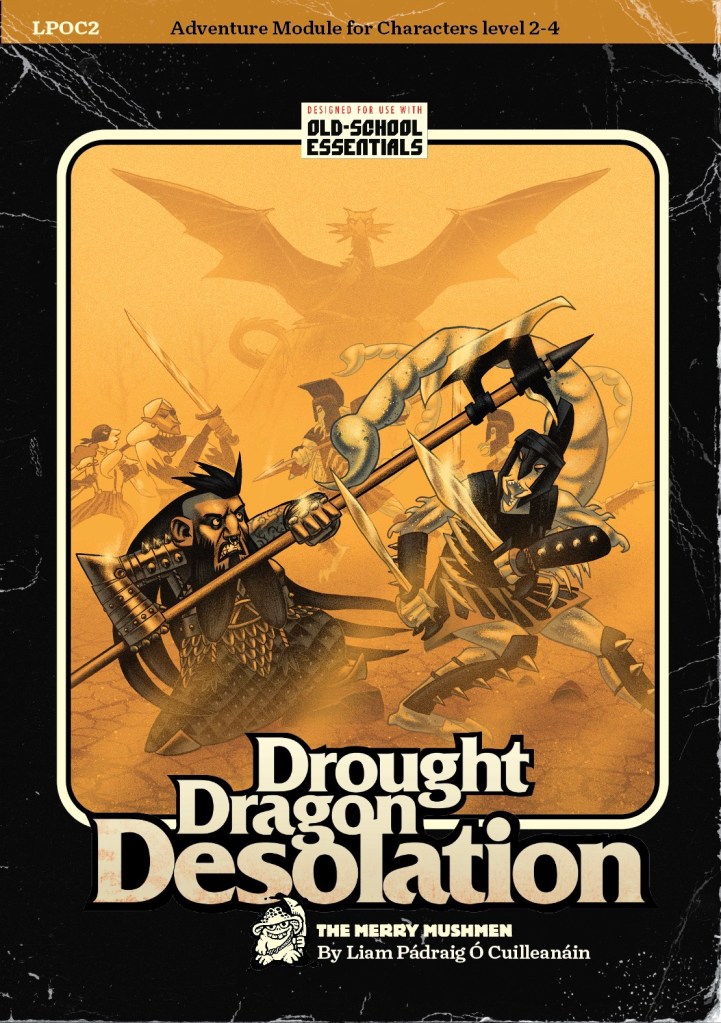
Drought Dragon Desolation is a 72 page module by Liam Pádraig Ó Cuilleanáin, with art by Bruno Prosaiko. In it you explore a dried sea for a dragon’s horde. I backed this on a crowdfunding campaign at some point.
Liam’s writing here (sorry, Liam, but your surname will extend my word count by a lot if I don’t refer to you by your first) doesn’t sacrifice great description, and characters are clearly differentiated (“lawful stupid” vs. “happily slit their mother’s throats for a copper”). It isn’t terse though, you want to like a fair bit of prose littering your module to enjoy this. Hooks here are excellent, with very juicy worms that change what the player characters are trying to achieve in a way that’s really meaningful in a sandbox like this. Rumours are perhaps less meaningful, but the completely unnecessary random happenings are amazing and I’d bend over backwards to include them; I’d regret the ones I didn’t roll. This book is dense; both positive and negative. The introduction is almost too much: A timeline, 5 factions and 2 rival parties in 6 pages (with most of that being stat blocks for those rival parties at OSE length). That density means it isn’t confirmed that “Lady Drybones” is the dragon in question for 5 pages, and even then it’s only implied. You’re left questioning a fair bit, but not so much you’re lost. It treads a fine line that would be disastrous if fully crossed and it plays with that line: Why did the bandits not take Tatiana’s money (or did they, in which case are you supposed to recover it)? Is one of many questions that are left unanswered, that don’t feel unintentionally so. Also, what the hell is Appendix 1? The weight of my experience this book falls heavily on the side of enjoyment and excitement rather than frustration, but the frustration with lapses like this are definitely present, and might impact your experience of the book.
In terms of locations, Drought Dragon Desolation overachieves; Sweetwater is incredibly interesting for a 4 location town. The 25-hex crawl balances the brevity and usefulness of short locations and larger expanded locations well. The encounter table combined with the rival party table makes the 60% chance you have of missing a location flavourful and compelling, although a few of them will cause problems, as they’re clearly not intended to recur, and the probabilities are high they will (this is why I did my little dice math series — you need to think about these things!). I think you may need to tweak a few more entries, but in the overall context of the module it’s a minor problem. The main issue with the expanded locations is that a lot of them have boring maps: Ships and towers just aren’t spatially interesting. It’s made up for with interesting keying and characters, and clever random encounters that change things up, but the exploration here won’t be the thing that keeps you engaged.
I don’t usually care too much about systems when reviewing modules, but this leverages OSE to the hilt, and you’d have to put a fair bit of effort into adapting it to another system. It has been a long time since I’ve felt that way. There’s not a single stat block here that isn’t meaningfully bespoke, and the additional rules work incredibly well to support the world. The only negative there is that you’ve got to like OSE (and be familiar with it) to run it.
I have the print edition of Drought Dragon Desolation, and it’s in the same format as recent Merry Mushmen modules; the detachable referee’s screen cover with single-colour accent printing. It’s a good format, if a little prone to damage when travelling. This one has a hex map, town map, and 1d12 dragons on the front cover, with maps of 4 dungeons on the inside. These maps are good quality, but the front-facing stuff has information I probably wouldn’t prefer showing my eternally curious players, so while it’s useful laid out flat on the table as the referee, it’s not really fit for purpose as a screen. The internal layout is solid, and if you liked previous work by the Merry Mushmen, you’ll feel right at home. The page referencing is something I appreciate, although a few of the references are wrong, which doesn’t help in the running, but luckily nothing critical. Bruno Prosaiko’s art is as stylish as ever, and the maps are clear and have flavour without compromising utility.
I’ve got to say that the previous books by Merry Mushmen I’ve read I all fell short in various ways significant enough that I’d be reluctant to run them. Drought Dragon Desolation is an exciting book to read, irregardless of its flaws. If you plan on converting it, it’ll take a bit of effort, so consider carefully before picking this up. If you want something with a very direct narrative drive that will fit in a short or predictable time frame, this probably isn’t what you’re looking for. If you’re looking for a hex crawl which you can run for a dozen or so sessions at least, you’re happy to run OSE, and you’ve got players who will delight in finding their own way, I’d pick Drought Dragon Desolation up.
Bathtub Reviews are an excuse for me to read modules a little more closely. I’m doing them to critique a wide range of modules from the perspective of my own table and to learn for my own module design. They’re stream of consciousness and unedited critiques. I’m writing them on my phone in the bath.
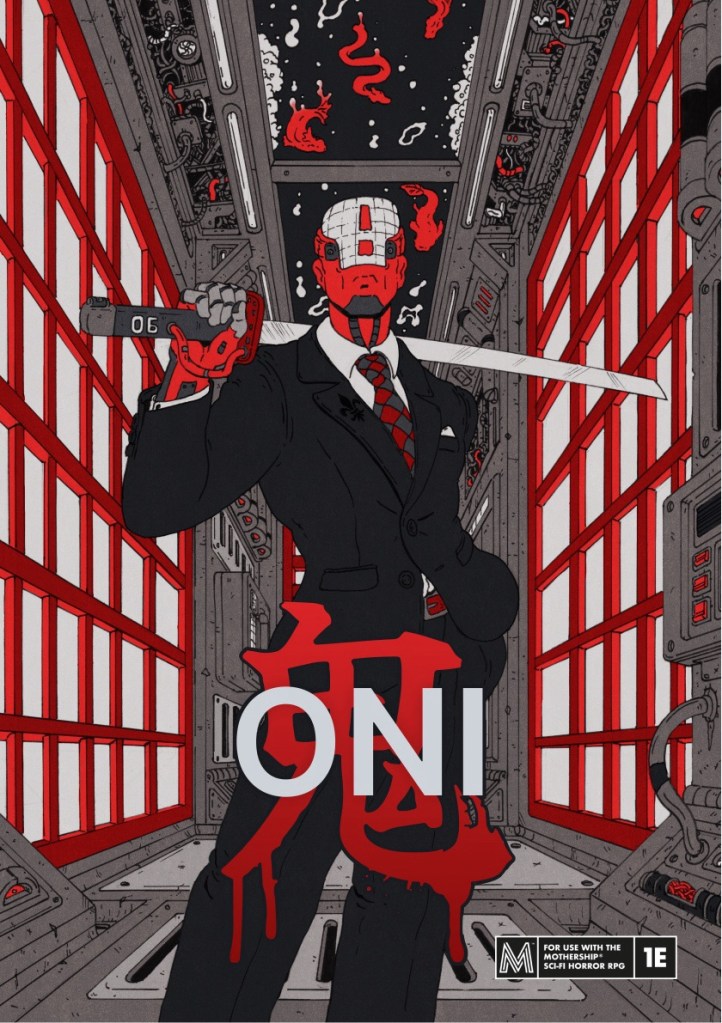
Oni is an 8 page module for Mothership by Jamie Heitler with art by Thomas Heitler. In it you sneak onto a mob boss’s ship, while avoiding a hallucinating AI. I think I was given a comp copy by the author, maybe?
Basically, this a 16 room heist, with 4 wild NPCs with different agendas, and 12 or so monsters patrolling the halls at night. These NPCs are great, and they interact in interesting ways with each other, the world at large, and with your time and location. The module operates on a 20 minute timer, which impacts the behaviour of the androids on the ship. During the day, they’re friendly and do maintenance, so long as you do nothing to attract attention. At night, lights turn off, and they turn into floating lightsaber wielding murderers visible only by that glow and their glowing screens, unless you find a pre-determined safe zone first. There is a lot of focus as well on appearing polite, which adds to the social puzzle — when is the AI watching and judging you? How should you behave? This builds a ton of tension in a small space, and limits the crews capacity to storm the place. The module would benefit from being generous with information to navigate safe and unsafe spaces.
The cover and character art for Oni slaps, and the colour choices pop although some folk struggle with white on black writing, and it will not home print well. Layout is a dense two column affair, which is fine, but does itself no favours. It’s dense enough that, lacking extra flagging or highlighting, I might flounder when running it, which could easily be fixed by taking better advantage of the graphic design choices that have already been made, adding art for navigation and breathing room, and being happy with a longer page count for the sake of legibility. Because, while this module is genuinely excellent — one of the better Mothership modules I’ve seen this year, with great characters, a load of tension, in a small package — the presentation undercuts it significantly. It wasn’t clear it was this good at a glance, and it wouldn’t be easy to run without studying and taking notes, which kind of sucks for an 8 page module.
If you want to run something at a glance, you might expect you can from such a small module, but if that’s what you want, I’d look elsewhere. If you’re happy to do a little homework in the name of a tense, violent, social affair, though, likely to last 1-2 sessions, Oni is a module I’d check out.
Bathtub Reviews are an excuse for me to read modules a little more closely. I’m doing them to critique a wide range of modules from the perspective of my own table and to learn for my own module design. They’re stream of consciousness and unedited critiques. I’m writing them on my phone in the bath.
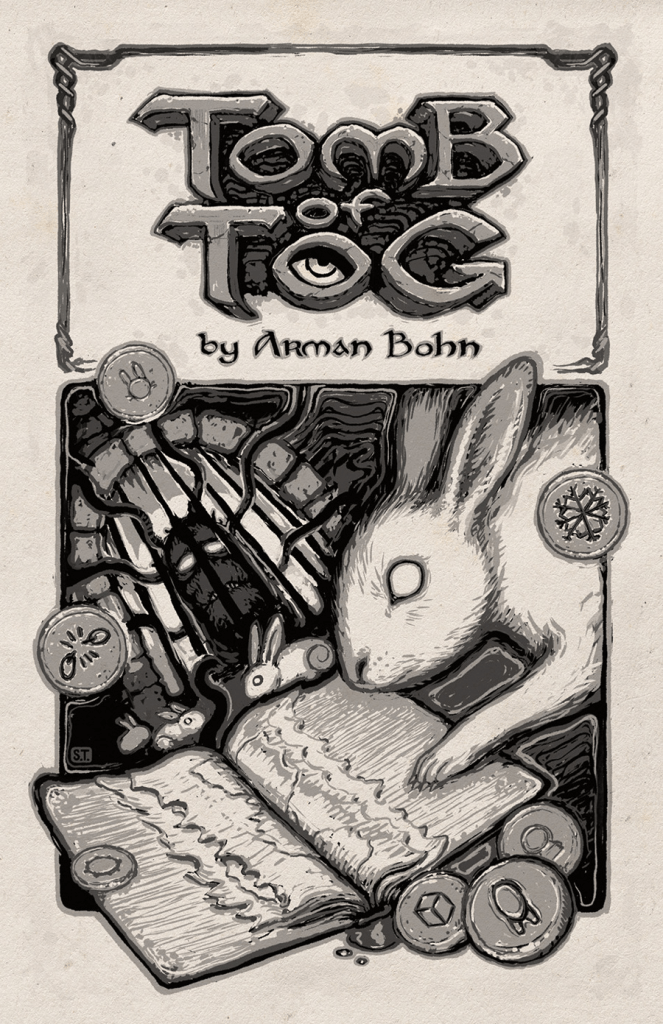
Tomb of Tog is a 24 page module by Arman Bohn, with additional illustrations by Nate Ashley, Shane Talbott and Avery Willmann. In it you explore the dungeon of an inept mage, who attempted to dominated his “mastery” of the 8 schools of magic in the design of his opus. I was provided a complementary copy by the author.
What we have here is a puzzle-focused dungeon, with 10 individual puzzles, 1 for each room, with unrelated approaches — unlike, the two recent puzzle dungeons A Familiar Tower and Outcast Unseelie which iterate on a familiar conceit throughout the same dungeon. The theme, instead, is what ties the puzzles and rooms together. My inclination is that using the 8 schools of magic as the basis for a dungeon is not going to put any designer off to a good start, but the twist that the titular Tog is incompetent (a fact that needs to be discovered) is a necessary twist to make this work, and provides additional clues regarding how to solve the puzzles that will be encountered. The other nice addition here is that while there are ways to solve these puzzles within the logic of the puzzle (for these “solves” you obtain a special token), you also recieve a “Tome of Tog” which provides a neat mechanic that alleviates the frustration of having to solve the puzzle if you’re stuck: If you can find the missing page in each room, you can “break” the room, and don’t have to solve the puzzle. All of this comes together to a set of interesting rooms, with a wide variety of fallbacks and potential solutions.
This solution variety is actually pretty important, because this room is pretty linear in its’ progression: Each room gives you access to the adjacent rooms, but there’s no back doors, so you could easily be stuck in a room and trapped unable to progress, and you cannot exit the dungeon without accessing the final room. And you cannot access the “end room” without either solving or breaking all the 8 puzzles. I think that this potential frustration could’ve easily been avoided, simply with a redesign of the space; there are allusions to pipes connecting rooms, for example, which might have been used to avoid rooms, or ways might have been used to skip, break, or backtrack the space in alternative ways. But, the puzzles are anything but repetitive, which is honestly an impressive feat when you’re writing 10 of them in total. This may not be an issue at all if you prepare your table for it before bringing them into the dungeon. The puzzles themselves: For me, personally, they’re a little hit-and-miss, but they’re largely either simple-but-complex enough to check the important “make the players feel good” box, or else they’re OSR style challenges that should be able to be figured out with a little creativity. And, you can always break them.
I do struggle, however, with the fact that aside from specific “boss monsters” in some of the rooms, there is one creature you may be fighting repeatedly — the Ravenous Cleansers. They’re not inherently aggressive towards the party, but they’re the “main character” of the dungeon apart from Tog, the inept mage, himself, and while I may be getting an exaggerated sense of how often they will occur in comparison to in play, I don’t think they’re exciting enough to play such a significant role. That said, I like that they’ve got a clear “order of operations”, which intimates that they won’t involve themselves with the players at all in the first few rooms.
Tog, as a personality, is very present in the dungeon, and if the referee leans into his little performance at the beginning of each area, I could see this buffoon being a beloved character. I like the developing story as you explore the dungeon of Tog, while being inept, also being unintentionally a scourge on all of those around him — this is interesting, but by room 10, Tog is revealed to be an utter villain. You’re given no way to correct his evils, and this being his titular tomb, he’s not alive to be slain. The primary hook, one of the local area being overrun by rabbits, seems a petty one in the context of the evils Tog is eventually revealed to have unleashed on many people. This leaves the dungeon narratively unsatisfying, given you’re conditioned to like the mage.
From a layout and art perspective, I find it visually challenging to read in a lot of ways — I’m a bit overwhelmed by the inconsistent formatting and about 5 different types of highlighting used for different purposes. As someone who reads these in the bath on her phone, this doesn’t work at all, but if you were reading on a screen or had printed this out these complex puzzle rooms being presented over spreads consistently, and all necessary information being held at a glance, and there are lots of maps and diagrams to help you comprehend what’s going on. The art is all pretty compelling and I’d use some of it to show players as well, even though it’s all spot art.
Tomb of Tog is a fun, silly little dungeon, that will likely last you 1 to 3 sessions, depending on the makeup of the table. There are some tables that will struggle with the limiting nature of the dungeon, and if your table is one who really wants sandbox play, or to talk their way out of things or crawl through the crawlspaces rather than take the doors, this isn’t for you. If your table is fine with a puzzle dungeon that there’s only one way out of, and they enjoy solving (or breaking) said puzzles, Tomb of Tog is something I’d encourage you to check out.
Bathtub Reviews are an excuse for me to read modules a little more closely. I’m doing them to critique a wide range of modules from the perspective of my own table and to learn for my own module design. They’re stream of consciousness and unedited critiques. I’m writing them on my phone in the bath.
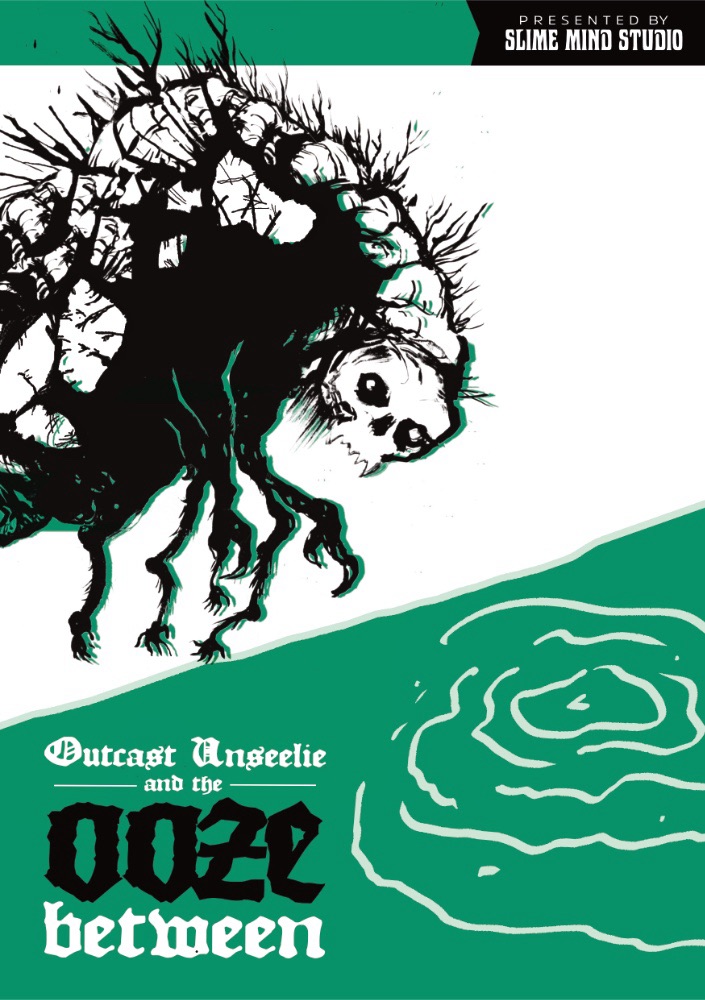
Outcast Unseelie and the Ooze Between is a 37 page module for Shadowdark by Jesse Winter and Cameron Maas. In it, you venture into a mine flooded with intoxicating slime. I backed it in a crowdfunding campaign.
I like the layout in this module. It’s spacious and clear. Well highlighted and navigable. It uses a simple emerald palette, with a separate high contrast highlight colour — red— for a specific topic (the perish lillies). These highlights allow clever shortcuts — like read aloud text that uses the highlighting to tell the referee information in secret. The grid varies between single, double and sidebar where necessary, and the sidebar used for keying is set out using colour and includes a great minimap. Most of the sidebars are utilised — often with reminders on puzzle mechanics if there are gaps — which I think is smart and minimises page turning and searching, and more important, memorisation. The art is totally unified using the emerald palette and a posterized halftone effect. It’s good stuff.
We open with a 4 point timeline, 4 hooks each of which direct the player characters to different locations in the dungeon (juicy worms!), then a half page describing the weird interactivities of the dungeon. It’s worth noting that half the hooks only refer to the upper level of the dungeon; you’ll need to rely on the players being excited if you choose either of those. I feel like 1 and 3 are the better choices because of this. We have 6 NPCs, main characters, which are each described in half a page, then a timeline telling what happens if the players do not interfere. This is all a good start — if I were to criticise anything, it’s that the 6 characters in this format were a little hard to differentiate simply because they’re all too much — a one sentence summary is supposed to help here, but for me, I’d have to study them.
The first location is the 22 room guardhouse. The random encounters here are fine; 2 of 6 extinguishes a torch, which is a challenging take on the standard Shadowdark advice. The map is initially fairly linear, but filled with loops and secret doors that make it a pleasing spatial puzzle. You’re also introduced to about half of the NPCs. The second is the Villa, which introduces the third aspect of the puzzle and the remaining characters. The villa is smaller, with a less interesting layout, so is a little disappointing as a climax, but I expect players to be backtracking to and fro between the 2 dungeons given the discoveries in the second impact the puzzles in the first; it’s probably better to think of them as a single dungeon than two because of this.
Those weird interactivities I mentioned above are really the juice here. Vertigrint and Perish Lillies are utilised over and over as a way of overcoming obstacles and defeating enemies in a really satisfying way. The dungeon tutorialises their interactions through simple rooms before expecting players to start utilising them, before introducing the seelie flea saliva as a way of interacting further with them. Directsun of Aberrant Reflections and A Familiar Tower consulted on this, and it shows — honestly I like this puzzle more than I like the one in A Familiar Tower. It’s excellent stuff, and I don’t think it’s too hard or prescriptive because of the additional NPCs and spatial loops that open up other avenues.
Honestly, this might be the best Shadowdark module I’ve reviewed. I like the puzzle elements, there are varied characters and interesting, the layout is clean and easy to understand. It uses the Shadowdark system well. I don’t honestly have many criticism to give. If you’re looking for something to run in Shadowdark and your players like feeling smart, Outcast Unseelie and the Ooze Between is a great next 3 or 4 sessions of fun and shenanigans.
I Read Games reviews are me reading games when I have nothing better to do, like read a module or write or play a game. I don’t seriously believe that I can judge a game without playing it, usually a lot, so I don’t take these very seriously. But I can talk about its choices and whether or not it gets me excited about bringing it to the table.
I’m supposed to be shopping for a present for a kid whose birthday party my kid has been invited to, but instead I am sitting on the grass watching the world cup and reading Full Send: A Game of Mountaineering. I backed this on its crowdfunding campaign, apparently for the print edition, and got some mountaineering themed tarot cards too? A pleasant surprise brought on by backing, I assume, drunk. Full Send is a roleplaying game about mountains and the people who climb them.
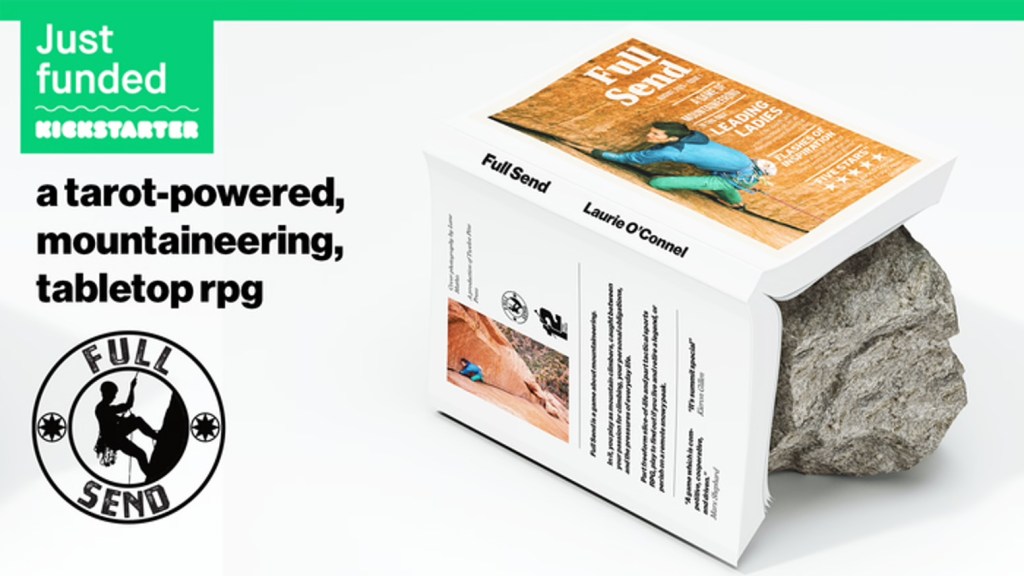
This is the only cover photo I could find.
Full Send is a 167 page role playing and card game by Laurie O’Connel who I’m familiar with for his lancer modules and his Zinequest a few years ago, Lichcraft. Full Send really feels a cut above in terms of ambition: A thick, full colour book powered by a custom set of tarot cards. The visual design by O’Connell and Kayla Dice screams a love of the sport of mountaineering — the cover is styled as the cover of a climbing magazine, and the art throughout is attributed to various mountaineering photographers — I’m not a particular fan, but I think the crack being climbed on the front cover is one popularised by Alex Honnold in Free Solo. It’s peppered with (again attributed) poetry translated by O’Connell. It’s incredibly apparent that this is a labour of love.
We start with rules on creating a climber, which impact mechanically your hand size, your luck, and your glory. You get drives, flaws, relationships, lifestyle and equipment, as well as special abilities that help your climbing. Your relationships have a strength in points, your lifestyle gives you the capacity to spend money to solve your problems, I really like the notepad-style example of a character sheet (although the included template is not the same), but I find some of the mechanical conceits a little uncomfortable — yes, gaining glory for climbs makes sense, but calling them Glory Points and using them as currency — why am I buying my electrolyte tabs in GP? It brings me out of the world of the game. In general for me, there’s a tension in the choices to portray glory and luck and relationships in terms of points, because it dehumanises the characters involved and can easily replace their imaginary existence with a number once invoked. On the other hand, there’s a goal to that quantification: All of these scores are used to create tension while climbing the mountain, and that tension and the difficult decision making regarding what to do when you climb, and how you recover when you’re back at home base, is really the core of the game. I think your mileage may vary on this approach, depending on the kind of player you are, and the kind of prompting you benefit most from.
The second chapter covers phases of play. During the climb, a face down spread of major arcana provides random obstacles, by consulting the prompts that fill the back of the book. Climbers then draw up to their hand size, and play these cards against the obstacles to overcome them, spending equipment and losing luck when you fail until you either turn around, making camp to recover, or reaching the summit, in a trick-taking variation card game. You gain cards for incorporating your drives or flaws in roleplay, and you can bank cards by taking the trick and being the best climber on that obstacle. If you summit with a full hand of cards, you get more Glory Points to get better equipment and better lifestyle, to make your next climb easier. I love this little strategy game, but at least in read, a lot of the “powering up” of cards you can do is a little confusing to track — each card played in the round after camp is worth double, for example, and cards banked by leading the climb are worth 20 x glory at the summit (and I assume can’t be used by everyone else for the remainder of the climb); there are a few rules like this, and on the surface, it feels hard to track. The complexity makes the climbing as well as the roleplaying engaging, but the details could clearer to me. The examples of play do a good job of clarifying, admittedly, but I personally prefer to rely on the rules explanation and not have to then flick to an example of play whenever I’m struggling. I really like the death and retirement that appears part way through this section: Basically, so long as you don’t lose the will to life mid climb, you can retire, and if your glory is high enough, you get interviewed by Full Send Magazine, where you answer questions asked by your fellow players. If you die after a successful career, you get an epilogue narrated by your closest friends detailing their favourite moments of your life. This is lovely stuff and the true incentive for glory and risking yourself for me.
The prompts are the meat of the book, and the reason it stays open at the table. They are pretty meaty: Effectively you’re given 48 The King is Dead style unique minigames (albeit very basic ones), plus 6 unique mountains with 6-7 unique minigames each. That’s good content, right there: A campaign of 5 climbers who all die in glory is totally within the scope of this book. I love that for Full Send, as one major recurring issue I have with many games of late is the lack of real module content packed into them: I get some rules and am expected to make up the rest. Not so here. This section is what makes me feel like I can actually play this game, despite not being a climber — not to mention the “fact book” aspect of this prompts section, filled with sidebars and additional information about climbing as a culture and its history. Great stuff to facilitate play, and to ease players to bringing this to the table.
I don’t like the information design philosophy behind Full Send, though. It’s very much designed as a manual — each heading is labeled 1.1, 1.2, etc. It feels sterile and impersonal in a way that feels contrary to the personal nature of the preface to the text (put a pin in that) and the physicality of the primary theme. It should make it easy to navigate from a layout perspective, but sections run on from each other and aren’t separated visually — for example lifestyle tiers and classes — making them difficult to find and to reference. Visual breaks — big, white-on-black pages containing long-form quotes — happen mid-section, breaking things up in ways that don’t make sense and rendering them useless either thematically or as a navigation tool. These visual breaks aren’t used at all in the print copy, I assume because the paper stock couldn’t take the ink density, and there they aren’t visually distinct at all, becoming actively detrimental to navigation and reading the text page-to-page. Colour and art is absent in the rules explanation, where it could be used to break up complexity, aid in navigation, and highlight important text, but is used excessively (and well) in most of the examples of play (although not the last one), to the point where they feel designed by different people. Visual themes like the elevation maps opening section 3 aren’t used well or consistently (at a glance, only in 3.1 and 3.6.11 ), which is a missed opportunity. Poetry quotes, which I love as an alternative to photography in a reality based game, honestly could be used more for navigation and breaking up complexity for easier understanding. Sidebars do appear in the latter half of the book to clarify meanings of mountaineering specific terms, but could’ve been utilised earlier in the book in analogous explanatory roles, even if they weren’t “fun facts” about mountaineering, to improve focus on core concepts. The back half of the book is almost entirely prompts (Full Sends equivalent of random events), and mountains (Full Sends equivalent of modules) and because of the run on layouts, they’re a little hard to navigate. I don’t hate a book that lives on the table and is used intensely the whole game, but that’s precisely the case where you need to put a whole ton of thought into the visual and information design to make running it feel intuitive. Full Send doesn’t succeed at that brief, at least for me.
Briefly and unimportantly, the tarot deck: I love the imagery in them, which mixes Rider-Waite iconography with public domain mountaineering photography in really expressive collage; I think typography could’ve been better aligned with the main book, and I really wish there had been a full deck here, as I find mixing tarot styles really jarring personally.
Full Send assumes a GM, but honestly I don’t know why. I think this is one of a few legacy issues with this games design (I mentioned GP earlier, another one) that aren’t cute but rather feel uninterrogated. I don’t see any need for a GM in this game at all. The main reason I think this glaring unneeded addition remains here is that the information design isn’t great: Someone is needed to navigate the book, and if you’ve got a history with a certain category of games, the person given the thankless jobs is called the GM. The section that addresses “What does the GM do?” is clearly a response to the fact that they don’t have much else to do. There’s a version of Full Send with no thankless jobs, though, so I wouldn’t run this with a GM or with a table who felt they needed it. If I found myself writing a chapter explaining why I included a GM that ends up acknowledging they have very little to do, I’d reconsider that aspect of my design, because that’s my game speaking to me, and it’s my job as a designer to listen.
Full Send opens with a good chunk — 14 pages — of personal and design reflections. Honestly, this feels a little self-indulgent and gives the impression of a game that’s targeted at game designers rather than players; that said, as a game designer, I enjoyed them. I want to focus on one aspect of the preface, so trigger warning for real life loss of life — skip to the next paragraph. In one of these reflections, O’Connell speaks about how he saw a climber die live, watching a stream, and how his feelings about this this almost prevented Full Send being completed. The reason it was completed, came down to the fact that it had already been promised to backers or the crowdfunding campaign that O’Connell felt a responsibility to fulfil for backers’ sakes. This personal reflection has a lot of value, particularly the consideration of the real life dangers and impacts of climbing, and the consideration of a game designer’s responsibilities when writing “biographical” (I use the term very loosely in the absence of a better one that I’m aware of) games that are birthed out of specific perspectives and subcultures. It places Full Send in conversation directly with the withdrawn from distribution Dogs in the Vineyard, in that both authors appear to feel a very real responsibility to the people portrayed in their games and what their games might be saying about them. It’s also in conversation with a lot of Jason Morningstar’s work, particularly Night Witches and Desperation, which chooses to pursue real life inspiration with a very intentional perspective on the events and characters in the game. I think that a strong perspective as a game designer is what makes a “biographical” roleplaying game work, and hence I feel there’s an unresolved tension between O’Connel’s preface and the game itself, which treats mountaineering with about the same degree of seriousness as D&D treats a dungeon. This tension wouldn’t be present without the preface — it’s totally fine to have a fluffy mountaineering game in my opinion — but the preface feels like it makes a promise of exploring this complexity that isn’t fulfilled. While I like Full Send as it stands, I think that the design would have benefited from reconsideration in the light of the events describes in the preface, and from a more complex or intentional portrayal of mountaineering in a mixed light that reflects the authors mixed feelings.
But let’s not judge Full Send for what it’s not: This is a clever, semi-cooperative trick taking game, with well incorporated roleplaying overlaid on it, a bucketload of excellent prompts, and a set of systems that provide decision-making a lot of tension in the way that a a game about a dangerous lifestyle like mountaineering really should. These strengths are undercut by poor choices around information and visual design which make it difficult to use the book at the table. The long, considered examples of play go a long way towards tempering these issues, for those who benefit from that approach. What Full Send is not is a complex exploration of the dangers of mountaineering as a practice of the grey areas of the subculture, or of the modern practice of livestreaming such dangerous practices. But if you’re looking for a game for those interested in mountaineering or who are mountaineering-curious, that is truly complete in itself, with content for many seasons, that doesn’t require a lot of prep between our before sessions, and could feasibly be run GMless, I’d check out Full Send.
Bathtub Reviews are an excuse for me to read modules a little more closely. I’m doing them to critique a wide range of modules from the perspective of my own table and to learn for my own module design. They’re stream of consciousness and unedited critiques. I’m writing them on my phone in the bath.
Blackout is a 15 page module for Mothership by Martin Orchard with art by Zach Hazard. In it you venture deep into an industrial colony to restore its power supply; but you’re not the first team to try, and what secrets did the previous one discover? I was given a complementary copy by the author.
We open with a timeline — effectively what the crew will know going in — and a “what’s going on” that’s pretty detailed. I usually wouldn’t like such a detailed plot for such a brief module, but here there’s a twist: Basically everything here is based in an environmental or NPC clue, meaning the mystery of what happened down here will be almost certainly able to be discovered by the players in broad strokes, and if they pay attention the specifics of the sort will be uncovered as well. It’s clever stuff. You’re incentivised to uncover these mysteries financially as well, because you’re rewarded for rescuing the previous team.
The map isn’t linear, and the players are provided their own map, but the changes to the map that have occurred as a result of the previous teams actions are likely to funnel the players in a certain direction. This direction happens to help lay breadcrumbs to the main narrative, but you can still take a non critical path due to simple looping (within reason — it’s a 10 location map). The mystery narrative is gated in multiple ways which will make all members of the crew feel useful and important without preventing them from progressing. Neat work. The keying uses exit lists, which I don’t think are put to good use here — when both referee and players have a map, I want those exits to help me describe them and differentiate them by sensation, so I don’t have to flip ahead. The ventilation shafts on the map are simple, clever, and the way rules affect the creature and the players differently is really neat and fun.
There are some missteps, though, notably the way information isn’t always predictably located — for example the agenda of “the Creature” is in “What’s really happening” rather than associated with its stat block or location. You can probably overlook these information design oversights, given how short the module is, particularly if you’re likely to read it before the session or you’re happy to mark these pieces of information up in the places you’d expect them to be as you go.
Layout wise, this is functional, with single columns, clear headings, and appropriate highlighting. The art is good, particularly the cover. As someone reading this in the bath on her phone, I wish the text size was bigger, especially given the fact that the line spacing is very generous so it probably could’ve been with the same page count — it is a little hard to read on a small screen. But there’s nothing meaningful here to complain about if you’re on a larger screen or in print.
Blackout is a stellar Mothership one-shot, which takes the typical “lone alien stalker” set up and turns it into a murder mystery. If you’re happy to put in a little leg work (or if you’re the kind to do homework before a session anyway), you’ll do just fine here. You might make a few mistakes if you prefer to do this off-the-cuff, so I wouldn’t recommend it for referees who show up 3 minutes before the session (like me). If you’re looking for a one-shot that has multiple tricks up its sleeve to hook new players on Mothership, or if you just want to throw a job into an ongoing Mothership campaign, Blackout is worth checking out.
I Read Games reviews are me reading games when I have nothing better to do, like read a module or write or play a game. I don’t seriously believe that I can judge a game without playing it, usually a lot, so I don’t take these very seriously. But I can talk about its choices and whether or not it gets me excited about bringing it to the table.
Ages ago I picked up Heroes of the Borderlands, the Dungeons and Dragons 2024 Starter Set, an homage, I had assumed from the title, to the classic starter module Keep on the Borderlands (which I reviewed along with two other homages here). It was new when I picked it up, getting closed to a year old now. I was at home tidying, and I found it tucked behind some board games on an upper shelf, and I thought, why don’t I open it, give it a read? So, I did.
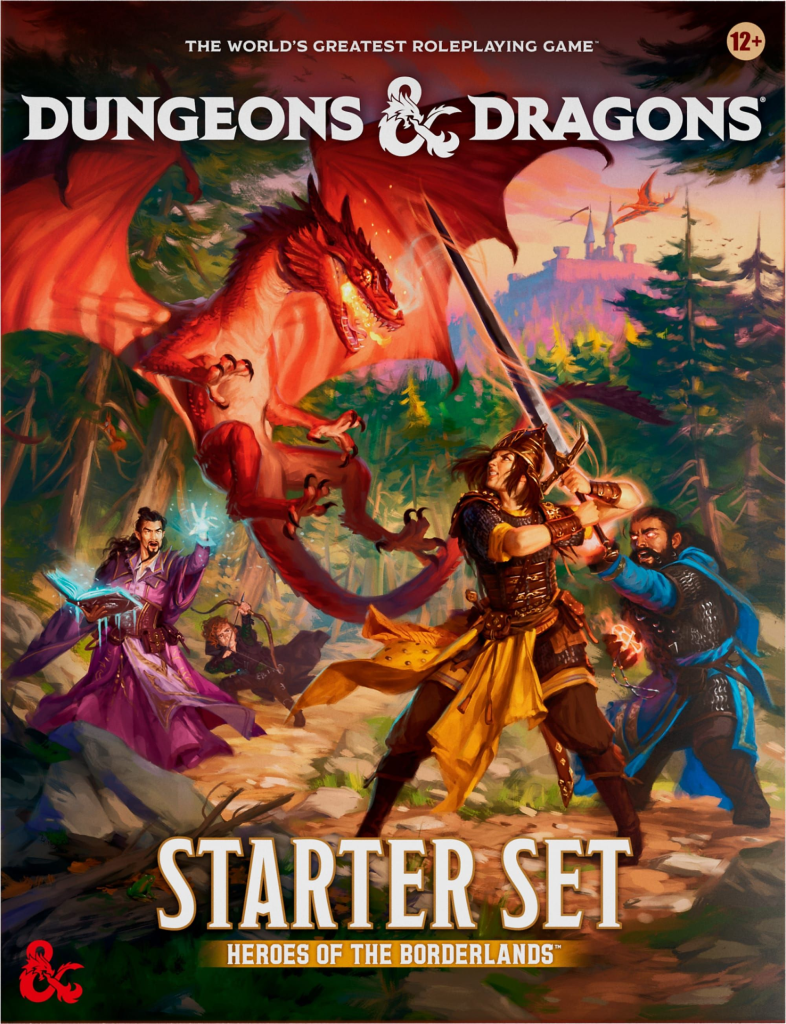
The cover to the Heroes of the Borderlands boxed set
Let’s unbox this: At a glance, this a chonkier, sturdier starter set than Lost Mine of Phandelver starter set for D&D 2014 was. When you open it, the top sheet is a “read me first” quick-start guide in the form of a bifold a4 booklet, then we have a 30 page “Reference Booklet”, 15 page “Wilderness”, 19 page “Keep on the Borderlands”, and a 27 page “Caves of Chaos” booklets; these are all a4, paperstock, sewn booklets so they will stand up well to use, better than previously used stapled booklets. Then we have 5 player handouts (the first feeling weirdly incomplete given the graphic design of it). Then we have 9 (!) double sided poster-sized maps, all being battle maps except the 3 full sized maps of the Wilderness, the Keep and the Caves. They’re in a little folder thingy to keep them safe. Then we have 8 card-stock character sheets that are designed as board-game style player boards; you place your cards on here — “armour” “background” and “species” are the main ones with slots, and there are 8 because there’s a separate side for 1st level, 2nd level, and 2 different versions of 3rd level for each class (so, 4 players can play at once, at the same level). Then we have 5 pages of cardboard tokens – gold pieces, tokens for monsters and standees for the players, moveable terrain, HP counters and power tokens. Get past that and we have a pad of combat tracking sheets (has to be good for close to 100 combats), a set of polyhedral dice, decks of standard cards covering backgrounds, species, equipment, magic items, spells and NPCs, and decks of tarot-sized cars covering monsters and an “on your turn” action summary. These components, when you examine them more closely, have excellent attention to detail. The NPC cards have rumours on each of them, as well as which monster card is their stat block if that’s needed. Magic spells have an illustration of their area of effect, if necessary, which makes the battle maps easier to use. The web spell has a full sized web template. The monster tokens, for those with more than one of the same art, are alphabeticised to identify differences. This is a killer sales pitch and a half for the combat-focused Wizards of the Coast edition, and one that feels like it looked at Baldur’s Gate 3 and rather than curl into a ball, stepped up to the plate (it that a mixed metaphor? I’m sorry, I don’t do baseball, you get it). Honestly, opening this box made me excited to play D&D 2024, and I haven’t considered that damned game in over half a decade.
On the other hand, it sets awful expectations: A quick google says 2 anthologies is all the other module content that’s been released since 2024, and without this kind of support — loads of maps and tokens and player boards and spell cards and stuff to match this box — you play through this and then you’re stuck with an entirely different looking game. Lost Mines of Phandelver may not have been as strong a pitch, but it was not at all a bait and switch. Heroes of the Borderlands, sorta kinda is. But, if the pitch for D&D 2024 was a boxed set every year, with these kind of components, I could get behind that business plan. I could run D&D 2024 if all I had to do was buy a boxed set every 12 months and it would look this good. Given I know of at least one other competitor that legitimately runs that model (albeit a bit more complicated), this is probably yet another example in the 2024 release of Wizards of the Coast half-baking their game design plans. You can go back and read my reviews of the Player’s Handbook (spoiler: it slapped) and Dungeon Masters Guide (spoiler: huge bummer) a few years ago, if you care. It looks like I was so bummed that I didn’t get around to reviewing the Monster Manual when it came out.
What about the contents? The quick-start guide is fine, I guess. It’s basically the first page of the player’s handbook, plus a little picture of how to set up your character sheet playboard thingy. Components list, etc. It’s fine. The reference booklet on the other hand is a wildly different take on “tiny PHB”, starting out with how to read the cards and player board, then getting into the rules themselves. I couldn’t be stuffed, to be honest, checking what was left out here — I think it’s entirely appropriate that rules are left out in a starter kit, and if you’re the kind of person who checks the starter kit for particular rules you probably aren’t the target audience now, are you? I’d go so far as to say that missing rules are the raison d’etre: You want the players to be wishing they had a PHB or DMG. Honestly, Why isn’t there a section that says “You want more on this? Buy our book!”. Anyway, it covers all the major rules (amusingly, Roleplaying gets 3 paragraphs on page 12 and that’s it — fruitful void indeed) with some notable exceptions given I’m familiar with the original Keep on the Borderlands, which is travel rules. From memory these were in the DMG, which might be why they’re skipped, but if you’re skipping travel rules altogether in a Keep on the Borderlands we might be off to a bad start. There’s a fabulous rules glossary at the end, which I think may have been a separate book in Lost Mines of Phandelver, but it’s fine that it’s here. I’m going to take a moment to forefront the credits here: It opens with an acknowledgement of Keep on the Borderlands and the contributors to that book; I appreciate that, I do. The credits for this boxed set itself, are at the back of the reference guide, and I fear, given I am someone who cares so much about module design, about what that means, because there is no acknowledgement of separate designers or authors across the rules, product or module design here.
First up is the Wilderness booklet. This booklet refers to itself as a tutorial, and in terms of tutorial structure, I like this: Effectively, the left hand column is the module and encounter itself, and the right hand column is advice and “how to run” information, defining how the module is written and how to interpret it. It introduces the basic structure that D&D 2024 uses in its modules, quite well, in a very simple and approachable way, and each subsequent encounter in the booklet increases the complexity slightly in a way that introduces you to the rules gradually. However, it’s not a railroad, it’s a sandbox: This means neither the players or the referee are going to be encountering these in the prescribed order. Furthermore the travel “rules” are “point at the map and say I go here”, which refers you to one of the four regions, or the Keep on the Borderlands. Your players may completely skip the wilderness, and I’m not sure why they’d choose any of them — if I had to choose between “Fens”, “Woods”, “Trail”, “Tamarack Stack”, “Keep on the Borderlands” and “Caves of Chaos” I’m sure as hell not picking the first 3, and I’m probably picking the latter 2. Even if you chose 1 of the first 4, I’m not sure it’s the intention that you play through all four encounters, given that completing 1 of the 4 encounters results in a “level up”, and completing a 2nd, 3rd or 4th does not. [Put a pin in this: it becomes relevant later] All of these choices render the entire approach to tutorialising redundant: The actual, on-rails introduction to Lost Mine of Phandelver was infinitely better, because you could ensure the players and referee would actually experience the tutorial in the right area, or at all. In terms of the design of the regions themselves, it’s absolutely confounding. Four different areas to “wander” about, but without having maps: These are your introduction to random encounters, even though some of these random encounters are locations (“Hermit’s Hut”, “Looted Wagon”). It’s a confusing introduction to the convention, especially considering the back two pages are a list of actual random encounters that fit standard conventions, which honestly are way better than the core set of 16. Only 2 out of the core 16 encounters is a social encounter, that might seed the players with rumours going forward; none of these rumours point the player characters towards anything of note — in fact, it’s impossible to do this, because locations aren’t concrete and can’t be explored towards. I’m not sure why this approach is taken, but it’s giving “never ran D&D before”, which is uncharitable of me I know given the credit list, but it’s genuinely inconceivable that this was the design approach they came to. Finally: These encounters have largely drained the wilderness encounters of Keep on the Borderlands, a pretty lightly seasoned module to begin with, of what little flavour it had — the hermit, for example, is simply grumpy and easy to persuade to be cooperative. I do not like the Wilderness booklet, on weight.
We then have Keep on the Borderlands. Here, you keep track of characters using their tokens, but they don’t have to travel between areas, and they’re not expected to remain together. The tutorialising continues here, for the first location only, but then backs off. Every location has a quest, and these quests vary considerably in nature, which I like, but they are also uneccessarily complex — the goat-wrangling quest, which literally features on the box cover, requires you to randomly generate where the goats are. Why? Why not have each goat in a fun situation already in certain locations? They are also awfully, for want of a better word nice: Unlike the original, where you’re expected to pilfer everything in sight, here the bank heist is replaced with trying to persuade the thieves not to pilfer the bank. When you get to the Fortress, the final location in the keep, it becomes clear why there are no hooks in this module [this is where you can remind yourself of my concerns earlier in the Wilderness I asked you to put a pin in]: The “keep official quests”, are the ones supposed to incentivise you to interact with these first two booklets: “visit 3 wilderness regions” and “complete 3 keep quests”. No need for anything to actually be interesting or appealing to the players: They simply have to do these to get a reward (you won’t know what until you do them!). If you visit the Castellan, he’ll give the players a quest that isn’t very clear: “investigate the rumours of a cult in the caves” “quash the evil” and something about a “source of power”. This is the only hook to go to the Caves of Chaos. Once again, this design is either making the massive assumption that people who’ve played video games would not consider engaging in an interesting world unless it was structured like a choose your own adventure game from the 90’s, or they haven’t played enough damned D&D to understand how to design a module. I’m not sure which is the more insulting design basis, but it results in a world nobody would want to explore, or be able to explore if they tried. The original Keep on the Borderland is better than this at hooks and rumours, and it was written almost 50 years ago.
Now, making the assumption we ever go to the Caves of Chaos, here we have are effectively 11 locations, and all of them are designed as combat encounters. 3 of these have been positioned as potentially social encounters: The kobolds, for example, have a scenario where the egg they were going to eat has hatched into a dragon, who they’re trying to appease and make a decision about whether they return it to its’ nest or raise it themselves. But, in the next sentence says “reduce the number of Kobold Warriors to make it easier and shorter”, implying you’re supposed to slaughter the lot of them, irregardless of their niceness. The same thing happens with the Nothic — technically it’s a quest-giver, but practically it advises “add additional Animated Flying Swords”. Every other encounter is combat only, with no potential for negotiation. Every single one of these caves exists as a poster-sized battle-map, and you’re intended to step through them in turns starting in a marked “start area”. In a way that the original Caves of Chaos did not, this feels like an absolute drudge to play through. It feels more like playing Heroquest than D&D. In the original, these were all factions you could engage with and play off each other; trickery was as much a tool as your sword. Not so here. That said, the Caves of Chaos is no longer a large dungeon, and I really like the new design as a mountain with multiple cave entrances as you ascend it. Each cave is independent; some but not all are interconnected in a way that might be considered reminiscent of the interesting looping of early dungeons like the Caves of Chaos. The intent is that you go on, do a combat, and then go back to the wilderness or the keep, and rest and restock, I suspect. And I get that: If you’re not familiar with the megadungeon as a concept (especially when the rules explicitly say you can’t long rest in the Caves of Chaos), the idea of barricading down and then continuing on is a little foreign. But I’d also kind of expect if you were going to use the Caves of Chaos as your starter module, isn’t the point to introduce players to the conceits of a large dungeon?
In terms of all 3 of the module booklets, there’s a few glaring oversights: Why would the referee start in any of the three areas (despite being told that she can)? Why would the player characters adventure in the wilderness at all? Why would they venture into the Caves of Chaos? There is a severe lack of hooks, even with the rumours included on the character cards, pointing them towards anything of note. The only reason to do anything is to fulfil questgiver’s requests, and hence earn a Gem (literally a token you can get) or a magical item. All of these lapses place the weight squarely on the referee to lead the players around this wilderness by the nose, to choose not using the random tables provided given their mundanity, and to try to come up with some reason to enjoy all of this. This iteration of Wizards of the Coast have, with this release, doubled down on refusing to acknowledge the referee as a player deserving of support and capable of enjoying themselves. A significant amount of the appeal of the chunky, beautiful components is reduced by what you might consider the videogamification of the module, for me. Coming back to the comparison to Baldur’s Gate 3: It’s like they missed what people loved about it. It really is a disappointment.
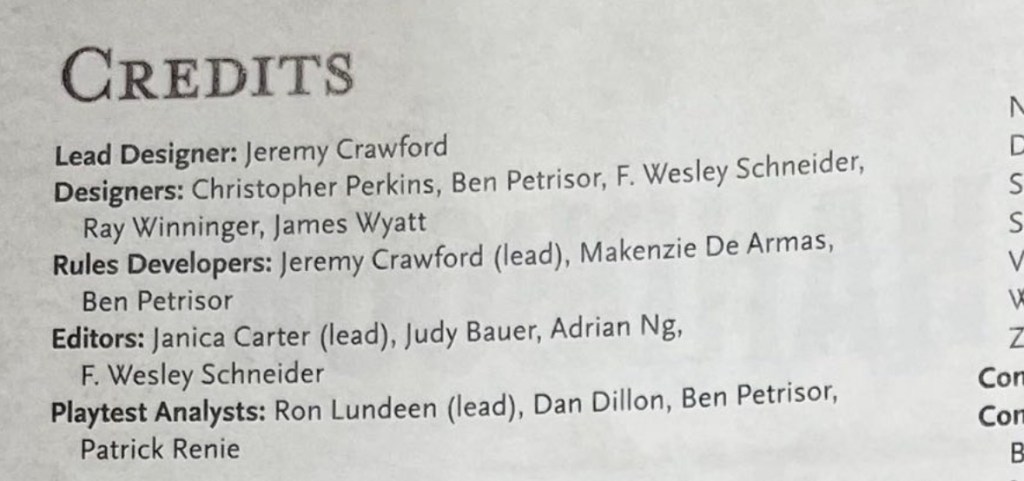
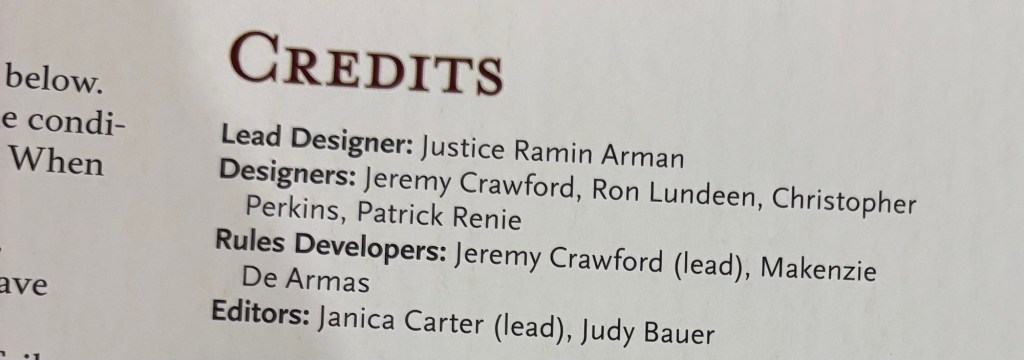
Looking at the credits for the PHB and Heroes of the Borderlands, 3 of the designers have changed, all of which were already on the PHB team. No one new has been introduced. Arman has been floating around for a while in both MCDM and Wizards of the Coast, working on the more recent much less traditional module design, while Renie and Lundeen the two other new names (who did playtesting on the PHB) cut their teeth on Pathfinder adventure paths. To me, these choices reflect a decision about what this starter set is supposed to be — rigid, combat focused — and also to me reveals a lack of insight into what made the original module Keep on the Borderlands great. Honestly, given their pedigree, I don’t think no thought was given the module design here: Simply that despite the superficial branding, Wizards of the Coast is uninterested in classic play, and wants a return to combat focused play of the 2000s. For me, this is a step down from D&D 2014, where the credits showed an interest in the OSR as an inspiration. I don’t think this actually reflects where the hobby is going, which is sad to me: The popularity of D&D is being buoyed by romance and character-centric APs and romance and character-centric videogames, and nostalgia for the 2000s does not to me feel like a direction that’s likely to end in success.
Credits for the 2024 PHB (Thanks Zak H for the photo)Credits for the Heroes of the Borderlands
There’s a lot to love here: The chunky, thoughtful components. Splitting the areas of the module into 3 making it easier to reference and hence to run. A sandbox that players can approach it in any order. Rules being directed at players and referees differently, to lean way from overwhelming the players, and separate out the player-facing and referee-facing rules clearly, which does help to onboard players at least, although it continues the theme of not seeming to care about the load the referee takes on that D&D 2024 has folded embraced. But it all falls apart, truly, for a number of reasons: The lack of a product design direction that supports a transition from this “version” of the game to the one in the books. The absolutely abysmal module design, that feels like it was designed by people completely unfamiliar with the historical or contemporary hobby. The lack of insight into what the fans brought to the game by video games like Baldurs Gate 3 actually loved that game, or at least the abysmal failure to facilitate that kind of play. I think it really comes down to the same problems I had with the main books back in 2024, sadly: When let my partner unbox Heroes of the Borderland, she was incredibly excited by all the player-facing paraphernalia. When I read the referee-facing content, it was absolutely awful and unsupportive. At this point, poor prospective product design, a lack of regard for the load placed on referees, and a lack of vision for how D&D 2024 is different from the videogame RPGs that are so popular right now, is not inadvertent, but rather a recurrent and conscious choice by Wizards of the Coast.
Honestly before considering this, check out one of the many alternatives as a first choice: If you want big box starter sets, cool components, and a prospective product design strategy, check out Pathfinder 2e. If you want the drama of Baldur’s Gate 3 and also uses card decks, check out Daggerheart. If you want freedom to be and do whatever you want, and unlimited choice of modules that are actually well designed, check out Cairn (this also comes in a fancy boxed set!). If you want wilderness exploration and quests that don’t feel like they’re presented by a robot, check out Mythic Bastionland (Quinn’s reviewed this and he’s more famous than me anyway). If you’re partial to sci-fi, Mothership has an excellent boxed set. If you’re looking to get a friend into specifically D&D 2024 (I can’t imagine anyone looking to play it the first time would be reading my review of it), a second hand copy of Lost Mine of Phandelver would be a better choice than this — the rules there are not that different to 2024’s rules. If what you’re after is none of those things — but rather a box full of chunky tokens that board-gamifies the first few levels of D&D — then you are a mystery to me, but you should consider checking out Heroes of the Borderlands.
If you’re good, you get XP for giving gold to benefit the poor or needy. For example, starting a soup kitchen, tithing to a church, donating to an orphanage.
If you’re neutral, you get XP for spending gold to benefit the betterment of your body or mind. For example, researching a spell, buying a horse, or training a new skill.
If you’re evil, you get XP for spending gold on your own comfort or pleasure. For example, eating an expensive meal, indulging in narcotics, or paying for a personal valet.
Note: I’m not here to argue about the meaning of alignment in elfgames. if you’re concerned about words like “good” and “evil”, change them. Make suggestions in the comments. The point is, if alignment exists, I want it to mean something, and introducing a rule like this gives them a meaning in a way I like. This isn’t a particularly novel take — XP variants for different classes are common — but it’s fun to make different parts of the design bear weight, instead of everything belonging to class.
Bathtub Reviews are an excuse for me to read modules a little more closely. I’m doing them to critique a wide range of modules from the perspective of my own table and to learn for my own module design. They’re stream of consciousness and unedited critiques. I’m writing them on my phone in the bath.
Vileplume Mountain is a 34 page module for Into the Oddish, written Warren F Smith and illustrated by Hodag. In this Pokopia-esque postapocalyptic Kanto, you venture into the complex beneath Vileplume mountain, to rescue kidnapped pokémon from a Mewtwo that exists only in legend. Both Warren and Hodag are friends of mine, but I ordered this for its preorder campaign.
This module is a a self-described parody of White Plume Mountain, the classic module by Lawrence Schick. I’m not as familiar with or feel as much affection towards this module as the author clearly is and does, and I suspect that tempers my experience of this module. Everything in this down to the layout is inspired by that original, and I’m sure there a plenty of very clever jokes and allusions that I missed. It features a bunch of commentary that speaks to the connections between the two, which I enjoy from both a design perspective and from the perspective of a referee, but about which your mileage may vary.
The module itself is 18 pages long, with the tail end of the book being stat blocks for new pokémon, and new moves (this systems equivalent of spells). It’s a 27 room, single level dungeon, with 3 separate wings, each between 5 and 9 rooms, exactly as the module upon which it is based. This gives the approach a lot of agency, although the north wing can only be easily accessed from the north. These rooms are, to a degree, a direct translation of the original rooms to ones with pokémon theming and slightly better game design, which sounds like more of a criticism than it is: They’re fun and they present this postapocalyptic world of only pokémon in a way that renders it concrete. What else is the “starter” module of a new game supposed to achieve? My main objection is the ending: Unlike most of the other game design “fixes”, the unsatisfying ending of White Plume Mountain remains. In that era, the expectation that referees supplement and expand written modules was baked in, but not adjusting the ending (and which is to be clear adapted with a huge degree of affection for the source material) was a little bit of a disappointment to me.
The layout is a fond homage to both its inspirations, which means it’s not especially easy to run or legible to read, but the simplicity of the dungeon cuts through that easily. Hodag’s artwork (as will surprise no one who follows his blog, which has featured multiple pokémon months) is full of love for the subject matter and in addition feels appropriate to the era and graphic design. It’s a nostalgic design, for those who have nostalgia for the subjects.
If you’re looking for a module to run a one-shot of Into the Oddish in, Vileplume Mountain is the module for you. If your group has been gasping for an OSR pokémon campaign, however, and you’re looking to kick off said campaign, this module ends in disaster for your team of pokémon. Irregardless, this is a charming little homage to White Plume Mountain, filled with advice on how to run it, and gorgeous art. If you’re a fan of Pokopia and the OSR, I’d probably check Vileplume Mountain out. Limited stocks last.
I use affiliate links where I can, to keep reviewing sustainable! Please click them if you’re considering buying something I’ve reviewed! Want to know more?
Have a module, adventure or supplement you’d like me to review? Read my review policy here, and then email me at idle dot cartulary at gmail dot com, or direct message me on Discord!




 Playful Void