• Elden Ring and Overworlds: Hostile worlds, line of sight and density.

    I finally picked up Elden Ring on special for an end of year sale, and it has me thinking alot about its design. This post evolved from one post, to three posts, and then I decided it all belonged in one mega-post. I’ll talk about lore in Elden Ring and how it impacts all the interactions you have, I’ll talk about the map itself and how it mimics a specific, interesting style of play, and I’ll talk about how I might apply this as a template to a theoretical hex-crawl.

    Part 1: Hostility and lore

    In Elden Ring (and in most FromSoft games), everyone wants to kill you.

    If you haven’t played it, here’s how it works: You walk around a huge world, and you are marked as an exile, “tarnished”. There are many factions in the world, most at war with each other, but all of which want to kill you, and other tarnished like you. There are a small number of friendly faces, all exiled members of these factions or tarnished themselves, and merchants, that won’t try to kill you.

    Thi] complex hostility is really compelling. Knowing everything, anywhere can and wants to kill you makes the world more opaque to you. In Elden Ring in particular, most of the information is in chats you have with one friendly, or in the titles of great enemies, or in notes you can buy. I’ve talked about bite-sized lore before, and Elden Ring is all bite-sized lore.

    There’s some compelling politics in the existence of the tarnished as well: Tarnished once lived in the world, and were banished to a hellish existence in punishment for serving the wrong god. Now they’ve been brought back to life, perhaps again to be punished, perhaps as a last-resort attempt by a god to reclaim her fallen world. The hostile world is a punishment for your sins, or perhaps you’re a punishment for theirs.

    I have a long-term project, a world that’s a jail, that keeps dropping off the list because I haven’t been able to get it to actually be compelling in its basic form. But casting the players as resurrected villains of legend, or the descendants of them, doomed to live in a land that they are not a part of, and are hated for simply being in, is compelling to me.

    Can we make parties of tarnished work in this context, if I wanted to build a world of exiles? Well, Elden Ring speaks to that as well, in a number of ways. Firstly, it implied that some groups are linked magically together, as defeating parties of enemies rewards you with regaining your vitality and magical power. You can summon allies you’ve met in the world to come to your aid in battle. Your foes are gaining this “party power” when you’re defeated as well, after all, if you return, they’re at full health again.

    This, then, makes me feel like a hostile world is possible, and is all the more interesting given a political climate that is strange and complex. You’re not a coloniser, but an exile returned, a criminal, hated for your crimes against the gods. The only people who tolerate you are the blasphemers and those who are hated themselves. You’re there to seek vengeance on those that once wronged you, or your ancestors, and to do so, you must pillage this land full of powerful demigods and their lieutenants for every ounce of power that they have claimed themselves.

    Part 2: Size, density and line of sight

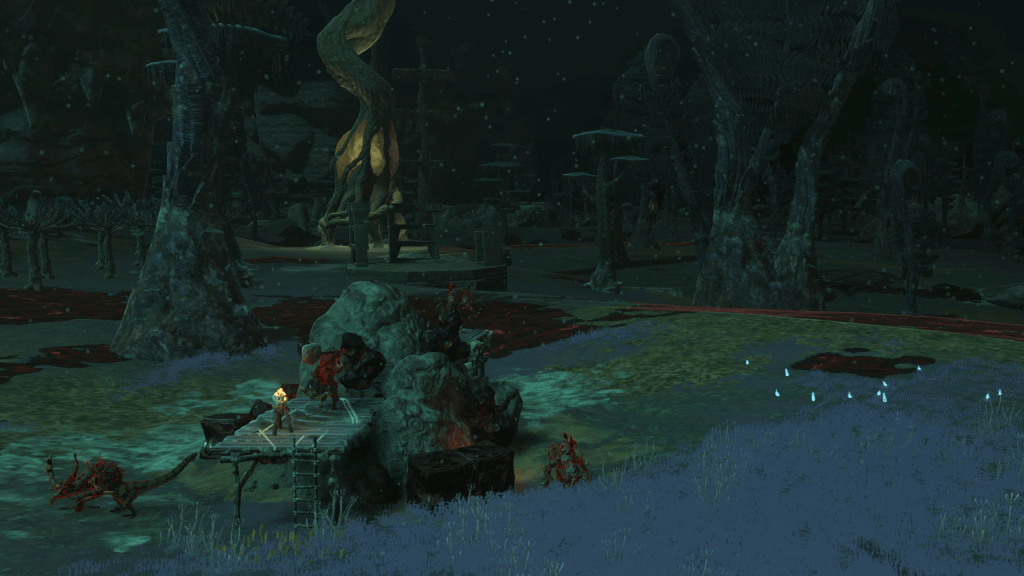
    This facilitates a unique take on who you are in the world, but how does Elden Ring facilitate an interesting overworld, though, when it’s so hostile? The entire Elden Ring map is 79 square kilometres according to a quick google, which entirely fits into 1 single 6 mile hex. This makes sense; you could walk (not run or ride) without stopping from one edge of the map to the other in a few hours, which is long in videogame time but not long in team life.

    I’m enamoured of Atop the Wailing Dunes right now (I promise a review is pending) and it uses 1 square mile subhexes, but doesn’t populate things as densely, as there are only about 3 points of interest in a 36 sub-hex region. Comparatively, Elden Ring and Tears of the Kingdom, the open-world games that I’ve recently played, are astoundingly dense. Hot Springs Island does something similar, with 3 points of interest in 2 mile hexes. Truly in Elden Ring you encounter something every thirty seconds across a potential four-hour walk. This is achieved through a bunch of mechanisms, into which I bring this GOATed post by Sacha. Read the whole thing, but I’m going to quote (here U stands for uniqueness, C stands for complexity, and H stands for hostility):

    ▲U/▲C/▼H – Towns: A dense location hub; a seat of power, assorted resource vendors, several faction HQs, and taverns.

    ▲U/▼C/▼H – Scenes: Natural features or dwellings; environmental storytelling, hidden resources and/or NPCs. The opposite of Lairs below. Examples: Groves, clearings, passes, shores, shacks, hamlets, villages…

    ▲U/▼C/▲H – Lairs: Hostile enemy camps or monster lairs – environmental storytelling, hidden resources and/or NPCs. The opposite of Scenes above. Examples: Enemy camps, monster lairs, occupied forts…

    ▲U/▲C/▲H – Dungeons: Collection of “dungeon rooms”; highly interactive risk vs reward gameplay. Split between combat, exploration and puzzles. Examples: Dungeons, ruins, mines, caves, tombs, castles…

    ▼U/▼C/▼H – Utilities: Useful recurring sites; an obvious repeatable role or service, such as transportation, shelter, crafting, information, healing, magical buffs. Examples: Taverns, shrines, stables, hiring halls, hot springs, farms, faction outposts…

    Now, breaking Elden Ring down into these categories (I’ll foreshadow here that I think there are additional categories we can incorporate into our overworlds,but I’ll stick with Sacha’s structure for now):

    Elden Ring (541 POIs)

    95 Dungeons (divine towers, dungeons, evergaols, legacy dungeons, minor erdtrees, wandering mausoleums – I think I’m right from the design intent here, because there are also 95 stakes or Marika, which indicate significant challenges)

    207 Lairs (Bosses, great bosses, or invasions)

    203 Scenes (landmarks, sealed areas, telescopes, statues, lore)

    41 Utilities (merchants and trainers)

    0 Towns (with some exceptions, such as Festivals, which are timed)

    The first thing you notice is that Elden Ring has far more points of interest than wither Breath of the Wild or Skyrim, but also that it’s map is far bigger (Skyrim is 37 square kilometers, and Breath of the Wild is 62 square kilometers). The second thing relates to my point on hostility earlier: There are no towns or town-like places at all; all complex interactions are precluded by your outsider status.

    Now, I don’t think this is actually a good indicator of how dense the map is, at least in Breath of the Wild and Elden Ring, because one major game activity in both of these is hunting and gathering, for crafting. Always, in eyesight, is something you want to collect or hunt for either body parts or for loot. These are as much a part of the sense of density as all the other points of interest, even though they’re exceedingly minor. They keep you engaged moment-to-moment. There is no list of all enemy encounters in Elden Ring that I’m aware of, but it’s hard to get out of line-of-sight of an enemy unless you’ve already killed everyone you can see from the spot you’re standing in.

    Part 3: Line of sight

    Breath of the Wild, and Tears of the Kingdom moreso, did a thing where everywhere you stood in the overworld you could see something interesting to investigate. Elden Ring leans even further into this, in two ways: Firstly, the Erd-trees litter the landscape, and you know something cool is there. Secondly, your sites of grace always point you in the direction of nearby plot. Thirdly, the map is a vague in-world document that gives you many vague icons that you have to intuit the meaning of, and even when you don’t have the full map you know where the roads are, so you know where to find the map even if you don’t have details on the environment. Enemies are everywhere, and most common enemies drop common consumables or crafting components when they’re killed; a lot of wild animals are essential to crafting so you need to hunt them. Plant life and other free collectible crafting components literally glow, drawing the eye to them in an otherwise gloomy environment. In these games, level design is really design of line-of-sight. I wouldn’t be surprised if this was literally tested: They had someone walk around the game worlds and make sure there were five things within eyeshot.

    But, Elden Ring uses the map to go a step farther, which is that it effectively implements the Landmark, Hidden, Secret formula. That is, there’s always stuff to see; if you use the map and in-world signifiers like enemy locations there’s always stuff to find, and then there are a bunch of environmental secrets that you won’t find without help, off-the-beaten track paths that lead to secret catacombs and dungeons. Every wizard tower is on the map, but most of the catacombs are only found if you follow the shorelines around individually, and it’s taken a bunch of play time for me to realise that I should always check beaches for caves.

    Secrets in particular, as alluded to just now, are predictable. All ruins have a basement with a treasure. All mines have elevators. All catacombs have a mechanically locked door that you have to find the lever to open. All towers have a puzzle to solve to open them. And you can subvert these! Boom! The treasure in the basement is a trap! The elevator is broken! The mechanism needs repairing! Non-unique locations allow subversion and allow players to learn things about the world that are useful, and people reuse floor plans and ideas between places.

    Part 4: Who cares?

    None of this applies to my tabletop RPG, does it? Nah, it does, babe. I’m not going to talk through it all, but I’m going to set some hex-crawl design rules for a theoretical #hex24 sequel to #dungeon23, based on everything above, and drawing from Atop the Wailing Dunes and Sacha’s post.

    Rules

    • 1 x 3 mile hex per week (all adjacent landmarks are visible from the current hex, as per Joel)
    • 1 paragraph description of the terrain
    • 3 points of interest (landmark, hidden and secret) of 1 paragraph each
      • These are 20% dungeons, 40% lairs, and 40% scenes, with 8/100 chance of being a utility instead (roll each time). And let’s say 1/100 chance of being a town, just to spice things up.
    • 1 boss (at one of these points of interest)
    • 3 unique rumours (if possible, make these visual, on a map)
    • 6 unique ambiences, hazards, discoveries or omens (something is always in sight)
    • 6 non-unique wildlife or plantlife (for crafting, wither one of these or one of the previous ones)
    • If you don’t want such a hostile world, make one of these previous 12 an NPC.
    • Once you’ve written them, go back and add this landmark to the adjacent hexes, so you know what line-of-sight is.

    Limitations

    • Dungeons match the proposal by Sascha [33% small (5-9 rooms), 54% medium (10-19 rooms), and 13% large (20+ rooms)]
    • A small dungeon takes one hex’s work to write, a medium dungeon takes two hex’s work to write, and a large dungeon takes three hex’s work to write. Don’t try to write hexes and dungeons at the same time.
    • If god-forbid you roll a town, the same rule applies as for dungeons, and each room counts as a location description.
    • Repeat non-unique things between neighbouring hexes.
    • Repeat your design in different location types, and only subvert them occasionally.

    Ok, concept expunged. Anyone want to make a #hostilehex24?

    Idle Cartulary


    Playful Void is a production of Idle Cartulary. If you liked this article, please consider liking, sharing, and subscribing to the Idle Digest Newsletter. If you want to support Idle Cartulary continuing to provide Bathtub Reviews, I Read Reviews, and Dungeon Regular, please consider a one-off donation or becoming a regular supporter of Idle Cartulary on Ko-fi.

  • New Year’s Resolution Mechanic!

    Warren challenged the DIY elf game blogosphere to create an all new resolution mechanic!

    My upcoming Bridewell uses tarot as randomisation, so I thought a tarot resolution mechanic would be cool!

    Give everyone a hand of three tarot cards. When a challenge that offers significant consequence of failure occurs, clarify what success and failure indicates, and the player chooses a card from their hand to play and place it in front of them, and consider the number.

    If they play a card that is trump to the task, they can draw an additional card from the deck and add it to the total of the card: Swords for strength or violence; Wands for wit or magic; Coins for charm or performance; Cups for expertise or agility.

    Add the numbers for all participating characters.

    The referee then draws a card for the task at random from the deck, once for each level of difficulty (normal, difficult, impossible). If it is trump to the task, it too gets an additional draw.

    If the player characters total is equal to or higher than the referee’s total, they succeed. If the player characters total is equal to the referees total, there is a complication.

    That’s my mechanic. It’s technically unique, I think, but certainly draws inspiration from Blades in the Dark and from Dragonlance: The Fifth Age, a game from the late 90’s that, of course, you’re all familiar with.

    Here’s another by Lars!

    Idle Cartulary


    Playful Void is a production of Idle Cartulary. If you liked this article, please consider liking, sharing, and subscribing to the Idle Digest Newsletter. If you want to support Idle Cartulary continuing to provide Bathtub Reviews, I Read Reviews, and Dungeon Regular, please consider a one-off donation or becoming a regular supporter of Idle Cartulary on Ko-fi.
  • Bathtub Review: Secret of the Black Crag

    Bathtub Reviews are an excuse for me to read modules a little more closely. I’m doing them to critique well-regarded modules from the perspective of my own table and to learn for my own module design. They’re stream of consciousness and unedited harsh critiques. I’m writing them on my phone in the bath.

    Secret of the Black Crag is a 97 page module for OSE by Chance Dudinack. It’s a pirate-themed island crawl with a multi-level dungeon at its center. I’m always here for pirate modules, and I am pretty excited to read this.

    Right off the bat: Chance does writing and internal art, and Sam Sorensen does developmental editing, line editing and layout. This combination of roles results in a resoundingly consistent and usable structure and design. The bold tritone sans serif choices remind me of Hot Springs Island, and clean touches like the tabulated index on the page edge make it very easy to navigate. Almost without exception, subjects hold a single page or a spread. This book is one of the best designed in terms of usability and structure I’ve read in a long time. I really appreciate that it doesn’t overuse font changes to draw attention to recurring items in the text, but still manages to be very useable. Spot art is quirky and a little janky, which is the vibe that I like, and used to support the textual structure. Maps are consistently clear and pleasing to look out; there’s a lot of mapping in this book, and Glynn Seal absolutely nails it.

    The book is split largely into three sections: The Port, the Islands that surround it, and the dungeon The Black Crag. The Introduction is brief and punchy: Three short paragraphs for the players, the rest of the page for the referee, and then a page of rumours to kick you off in Port Fortune. The neat, one item per column, page or spread layout has a negative here in terms of some people or places of interest are given a little too much space to breath.

    Starting with Port Fortune: With a module of this size, I’m not pre-reading it with any meaningful recall, and so the three paragraphs on, for example Ulysses Mcloud, are a little too much for me to skim accurately at the table. A close read of these characters and factions reveals a dearth of interconnection between them, despite the many words spent describing them. Their relationships with the party are often described, but they feel like NPCs in a late 90s videogame: Characterful, but revolving around you. Everyone has something to tell or give the PCs, but rarely more. A similar lack plagues the briefer descriptions, such as the d6 pirates: “Mancomb Spotswood. Cocky, fresh-faced young man known for his biting wit and habit of insulting his opponents. His crew is a rowdy bunch who love drinking, throwing jabs, and singing sea shanties.” There’s a description here, but it doesn’t help me incorporate the pirate into the story or run them more capably, so what is the purpose? Port Fortune finishes with a random character generator, a peeve of mine, as with the double spread that this takes, we could have had a dozen specific and connected characters, but instead the load is transferred to the referee and we are left with less connection.

    The Salamander Islands section opens with an encounter table I feel mixed on. We have about five good entries, that foreshadow or connect to the islands, but these are mainly big monsters. The aforementioned pirates are referred to, but if they have any goals or objectives aside from piracy they’re not mentioned. I’d add “if your hull is low in the water, you’re attacked” to halve the number of encounters with them, because all they are is combat and theft. It’s absolutely reasonable to have less exciting weather or whatnot on an encounter table, but why does weather occur here and on the weather table? I can roll doldrums and a thunderstorm at the same time, because of this oversight. It just needs to be more interesting, and not just a resource and time drain. What’s more, as an event occurs on average every three days, it’s likely that resources will regenerate between encounters. These are an irritant and a drag on travel, where they should be egging us on. Give those pirates lairs out in the isles so that we can start a rivalry. The doldrums a curse by the previously described sea witch on a member of the crew. It’s not hard to make this more interesting; but it’s not my job if I’m buying your module. The land encounters are worse in some ways, more interesting in others. The encounters read as if they were released in ‘74 (“1d6 zombies”) but they add interesting locations and activities which make these inherently more useful. The inconsistencies between these might be nonsensical (1d6 friendly sleeping zombies in a waterfall rushing off a cliff is a possible result) but may also be fun to reconcile as a referee.

    In the location descriptions, there are a lot of redeeming features, largely sly humour and imagination. A deaf girl causing problems for the sirens. The lair of a pirate gorilla (his portrait is fantastic). The dungeons are well keyed, interesting and have a sense of narrative to them, and are pleasing if simple spaces, but it’s undercut but transparent intentions (The gorilla pirate doesn’t want to fight! He just wants help with a secret door!) that make relationship building less interesting and undercuts the reaction roll. Initially I was feeling some dread that the lack of interconnection and relationship showing in Port Fortune would be here, but over the whole section it comes through, with quest-givers sending you across the isles. Reasons to help, though, are still thin. Why do I want to help the High Engineer save her father, when all she offers is cure wounds? And there’s nothing interesting on the island she sends you, and no treasure or character or clue to send you further.

    We’re halfway through the book, and the rest of the book is the Black Crag. Chance shines here. Brief and clear introductions to each level and it’s quirks. Factions with clear goals. Entries are usually one two paragraphs. Interactive environmental effects. There is humour and action. My major criticism is that it’s really not clear where the exits and routes down are; I even searched the pdf for “exit” and “down” with no luck, and I’ve examined the maps but here the beautiful map detail makes it feel like I’m playing Where’s Waldo. I can only assume the first two levels are to be accessed from the outside, and so help me I have no idea how to access the final two levels, I can only assume that somewhere leads to the main gate? Irregardless, this is something that again, could easily be fixed, and I’m disappointed it isn’t clearer.

    What the Black Crag is clear on (once you get there) is that this is the lynchpin of the adventure. Everyone here has goals and intentions, they send you out to the isles and interfere with each other within the Black Crag. Everything revolves around this, and gives you levers about which the rest of the characters revolve. The name of the adventure should’ve clued me into this, so perhaps more the fool me, but it could have been clearer I think, and starting with the town and islands their relative paucity of detail and lack of things that make me lean forward in my seat made me misjudge the module at first. A lot of what the first two sections lacks the third has in spades. It’s clear that the authors heart was in writing the Black Crag, and the islands around it are window dressing.

    I’ve complained a lot about the writing, but when Chance is on he is on. The sea dragon: “an intelligent serpentine dragon bedecked in silver and blue scales. Her flowing whiskers and magnificent red crest bestow a regal appearance. A giant pearl, just barely visible, flashes inside her mouth when she speaks. Vain and imperious.”, a seemingly uninhabited lair “stinks of reptilian musk”, “Open courtyard flooded with waistdeep water. Strange colors scintillate in the murk.”. There’s some great stuff here. I could recommend this book for inspiration just based on the descriptions, despite their size.

    Coming back and skimming the book again, one thing that stands out is a lack of orientation in the text for the PCs. Rumours are vague, and there are a number of fetch quests in town if you comb every character for information, but there’s little reason for venturing into the islands, and little guidance regarding which islands to aim for. I’m not even sure what the point of a map and seafaring rules are, if you’re just sailing aimlessly. It appears you’re supposed to be driven to collect treasure, but in the absence of “there’s treasure here!” sensible PCs would instead just resort to piracy, like the rest of the place.

    Gosh, what are my conclusions, with the about turn two thirds in? I think it’s clear to me that the first two thirds would have benefited from a more critical eye on the edit. Asking “what does this add?” would have brought most of my criticisms to light, I think. Even in a book so thick, it behooves the module to make sure that each part actually plays a part and doesn’t just fill space on a table or list. A few other small but not insignificant issues (the unclear spatial relationships in the Black Crag being foremost), plague a pretty exciting module.

    For me personally, though, my expectation of this being a pirate adventure was undermined by the centrality of the Black Crag. This is my fault and not that of the module (although the cover didn’t help), and looking more closely the Black Crag never hid the fact that the dungeon was at its centre, but I was really hoping for equal emphasis on the indoor and outdoor sections.

    If you’re looking for a seaside dungeon, Secret of the Black Crag contains a banger of one. I really like the dungeon itself (although if I were to run it I’d @ the author to find out where the entrances were), and I’d quite happily pull the threads outside the dungeon out and put them in another campaign. If you’re looking for a swashbuckling pirate themed adventure, I think it falls short on the weaknesses in Port Fortune and the Salamander Islands, although you could fix this with a little work if the setting sounds especially appealing.

    Idle Cartulary


    Playful Void is a production of Idle Cartulary. If you liked this article, please consider liking, sharing, and subscribing to the Idle Digest Newsletter. If you want to support Idle Cartulary continuing to provide Bathtub Reviews, I Read Reviews, and Dungeon Regular, please consider a one-off donation or becoming a regular supporter of Idle Cartulary on Ko-fi.

  • Prepping A Sandbox for Dragonlance

    Something that keeps coming up on the OSR and NSR discord servers is that a few years ago I ran an epic adaptation of the classic DL series of modules, as a sandbox, in fifth edition. People keep asking me, how the hell did I do it? And I keep saying “one day I’ll write it up”, and then I never do, mainly because I don’t have all the old documents. But I found my session binders the other day, when clearing out the garage, so I can at least take photos of things and talk you through my processes in setting it up, and running it week to week. There will be photos because I’ve lost original files; I’m sorry about the bad lighting.

    I read through the entire DL series of modules, stripping them for parts. The parts will go into the next two sections, but basically I was looking for a few major things, which were inspired by the Return of the Lazy Dungeon Master: Major locations throughout the modules that would need prep, usually ones that were pre-mapped; Major monsters that would need to be statted up; Major NPCs that would need to be detailed and incorporated or else amalgamated into less NPCs; PCs that varied across the modules (because that’s a strange quirk of the DL series), and secrets and intelligence that serve as hooks to draw conclusions about the overarching mysteries of the world, and to draw the PCs to new locations.

    Step 1. Player characters and internal conflicts

    I wrote about internal conflicts a while ago; the first thing I decided was that if I wanted the campaign to feel like the Dragonlance books, the relationships would need to be intact in broad strokes. To me, Dragonlance is really about those core characters. and their relationships! It’s teen melodrama! I took my list of player characters, sketched out and made pregen characters for each of them. I didn’t hand out character sheets though! I handed out little character cards that talked about their goals and motivations, and for the most part paired them up. I had a big session zero, and got everyone to pick the characters they were interested in playing, and then I modified them according to needs (for example, some characters didn’t have their pair, so we figured out how to make them work in isolation). Here’s a few of the ones I made (I don’t have the original files or I’d just give you them — but you can see the approach); I only have the ones that didn’t get played, because the players kept theirs!

    Step 2: Secrets across the world

    I gathered together basically every secret for the entire campaign into one page, gathering them into three categories — X, Y and Z. Keeping in mind the Three Clue Rule, I simplified them all down and divorced them from context, to be awarded generously.

    Step 3: The NPCs

    As I said earlier, I just listed every single character that might show up, so I had my cast ready.

    Step 3: Setting up the Gazeteer

    I mentioned that I had more than one session binder for this campaign back in the introduction: This is why. I printed out or photocopied everything I had on the world of Krynn, for easy access, in a separate gazeteer binder. I wanted this gazeteer here, because it’s important that if I’m running something in a set world — especially one that I absorbed as a pre-teen as much as I did the Dragonlance setting — it be blorby as it could be. This ended up not being so useful as I ended up going to the Dragonlance Nexus. I also printed out every character description from the 3e edition of the trilogy — a terrible product, but it summarises enough for me to be able to write anyone up quickly from its descriptions.

    Step 4: Improvisational tools

    I also developed a bunch of improvisational tools, specifically ones that would help me out for the whole campaign: Names by ability score for surprise NPCs, the three-moon calendar for strict time records to be kept, a bunch of inns that I stole from Drop the Die’s Inns, Taverns and Taprooms. I also collected a lot of maps — every one from the modules, plus a bunch of generic ones from Dyson and other places, so I could throw a map down if I ever needed to improv a location for a heist or something.

    Step 5: Play!

    So, week to week, I used the Lazy Dungeon Master prep approach, modified a little, to stay a step ahead of the players. Basically, I asked the players what their plans were for next week, and I prepped accordingly. The prep sheet I used basically made me think of and plan for possibilities: The stuff on the sheet wasn’t a script to follow, it was ideas for me to adapt. The most important thing was that I always had an explosive start: The PCs couldn’t retcon what they’d done last week, and this week always started with a bang.

    The prep was typical prep: major NPCs were described, locations & dungeons were mapped, factions were created. There’s no shortcut for this, but luckily there’s a wealth of information, so I’m only really creating when something is boring in the text: Making factions more interesting and one-note, mainly, and occasionally prepping for a weird situation to anticipate (dragon riding rules! a council! a battle underwater! a ship vs dragon battle!). The rest of the time I’m just matching existing maps and characters to ones in the system I’m in (custom stat blocks are for special occasions!), and adding points of interest that appeal to the current batch of players.

    What I didn’t do

    Don’t key a hex map. Ansalon is just too big to work as a hex crawl, and changing the map was just too much work. So, it effectively became a point crawl, between points of interest that the players were identifying, where I filled in those points of interest as they were approached. I didn’t build out the entire map of Ansalon day one, I just built out the things connected to the PCs current locations. If they had a distant goal to the east — as was the case for Silvanesti and for Sancrist — they just learnt what was next. Some sessions were entirely the travel between points of interest, however: I remember the wintery mountain travel to Pax Tharkas and the cross-desert trip to Silvanesti both being huge. To be honest and someone analysed this themselves and I can’t recall who, the hex map operated as a point crawl anyway (addition: I’m told this was Justin Alexander), as regions are carved out of the original hex maps already. I wasn’t using that hex map, but rather the one that came with Tales of the Lance, which I printed out for my Risk game (what Risk game? you ask).

    Addition: If you want to key a map, here!

    Don’t stick to the Script. In planning an open-ended sandbox version of the War of the Lance, I could keep major sequences up my sleeve and drop them in when appropriate, but a lot of the really memorable stuff came from sequence skipping or going completely off the rails. The Goldmoon/Laurana romance; the epic underwater battle at Watermere; A charge against Lord Soth at the High Clerist’s Tower. None of these happened in the books or in the modules!

    Don’t toss away the original modules. They helped me prep in a bunch of different ways! They were invaluable, even if the modules over wall are ahh…questionable? A bunch of the maps are stellar! The magic items are so much fun! There is gold in them their hills — if you didn’t get the impression I love mining classic modules for gold you clearly haven’t listened to Dungeon Regular.

    Don’t let space be a tyrant. Ansalon, as I said, is a huge space. At the beginning, distance was a fun barrier for a low-level group of heroes. By the end, they had a ship, a hot air balloon, and eventually their own dragons! Let the space be their oyster! Let them travel the world at speed! Just remember that the enemy have flying citadels and dragons of their own! Memorably, the PCs encountered one major character after another battle with a dragon downed them in uncharted territory, affording me the opportunity to use the random sky encounter “Attacked by a metallic dragon protecting its territory” into a plot accelerant and facilitate the discovery of the Dragonlances!

    Don’t back cool toys. The modules are so coy with cool toys, Don’t be. Let Flint have the Hammer of Kharas, let them use gnomish flying machines, let them wield Dragonlances and make Dragon Orbs powerful and dangerous. Have Fistandantilus bribe Raistlin with unique spells.

    The Risk Game

    There was one other thing I did, to keep the war ticking along in my head, and to keep things off script. Remember the calendar I mentioned a while ago? Each month that passed, I was playing a game of Risk in the background, solo. At the beginning, the Dragonarmies were at one end of the map, working together, and the soon-to-be-allies were not working together, but owned a significant portion of the map. They only began working together as the player characters brought them together! Finally, at the big Council that was help on Sancrist, they brought everyone together, and the tide turned, leaving only one special unit on the table that was beating the allies into submission: Dragons!

    And hence, while at the beginning the game of Risk has almost no impact on game play, by the end the PCs were getting scout reports directly as part of their roles as members of the Council of Sancrist, and hence it started driving play towards finding the metallic dragons and then finding out what happened to their eggs.

    Ok, going through my binders, that’s most of the preparation I did, both before and after, that I have still with me. I’m sure you have questions, if you’re interested in running a Dragonlance campaign.

    Please, comment below! I’ll add the answers to this!

    I hope this has been helpful!

    Idle Cartulary


    Playful Void is a production of Idle Cartulary. If you liked this article, please consider liking, sharing, and subscribing to the Idle Digest Newsletter. If you want to support Idle Cartulary continuing to provide Bathtub Reviews, I Read Reviews, and Dungeon Regular, please consider a one-off donation or becoming a regular supporter of Idle Cartulary on Ko-fi.

  • Bathtub (P)review: Nightwick Abbey

    Bathtub Reviews are an excuse for me to read modules a little more closely. I’m doing them to critique a wide range of modules from the perspective of my own table and to learn for my own module design. They’re stream of consciousness and unedited critiques. I’m writing them on my phone in the bath.

    I mentioned in my 2023 Nova Awards that one of the coolest things I’ve read this year hasn’t been released yet: It’s the first level of the upcoming release Nightwick Abbey by Miranda Elkins and Chris Huth. I don’t usually review unreleased titles, but I got enough interest in the awards post last week that I thought I’d talk about it. Consider this, then, my first Bathtub Preview.

    Nightwick Abbey art by Chris Huth

    Nightwick Abbey is an iconic megadungeon that has been run by Miranda for over ten years; you can see ongoing progress on the project at the Nightwick Abbey patreon, and you can join the games here. Miranda and Chris Huth have been developing it as a finished, releasable product for Old School Essentials as part of their patreon. It takes place in the ruins of an Abbey that had been built over the prison of a Great King of Hell. Think of the theme being medieval Doom. What I’m reading is the first of three finished levels of the megadungeon, consisting 89 rooms. Two other levels are finished and not available yet; if I recall from Miranda’s episode of Into the Megadungeon, no one has ever reached the third level of Nightwick Abbey, but people are still trying ten years later.

    The major unique gimmick of Nightwick Abbey are that it comprises a set of moving geomorphs. A geomorph is a 100 by 100 foot section of dungeon map. Whenever someone does something that would upset the Abbey — things like turning undead or praying — there’s a chance the sections will shift in relation to each other, changing the layout of the dungeon in macro, while retaining the micro structure of the geomorph itself, rendering some exits unusable but opening up others. This is genius for long-term replayability and as a practical use for geomorphs, which are a tech that is considered out of vogue, but which I hope will be revisited by the DIY elfgame scene when they see what Nightwick Abbey has in store for them.

    Layout wise, it’s not flashy but it’s very useable; lovely use of a consistent colour palette; consistent allocation of a spread to a geomorph; clear headings. I’m not a fan of dot point descriptions, but this innovates on it by using custom bullet points to differentiate content in a very clean way. The only criticism I have is that it’s not intuitive in a single book to have the factions and the bestiary at the back of the book; I either need stat blocks in the main text (there’s often room), or I need referencing to make encounters easy to run. The factions at the end made my experience of a first read bizarre: At first I was underwhelmed, then I got to the end and I realised all these people I’d met have goals and unique tactics. These might be fronted for a more intuitive read, or again could be incorporated into body text for ease of use.

    The Butcher is busy chopping up a rotten corpse and feeding it into his great grinder. The corpse squirms as though still alive.” Nightwick Abbey’s writing is horribly evocative. “Opening the door allows their piteous moans to echo through the dungeon.” The walls of the Abbey bleed when damaged, closed off exits are scabrous. Inhabitants are terrifying, twisted things that were attracted by the evil of the Abbey and battle now to control its power. The style is a modernisation of the classic style, akin that of Gavin Norman and Gus L, which in my opinion stifles the poetry of what’s there, but renders the project very useable as a result.

    Is Nightwick Abbey perfect? No, but it’s also not complete yet. This is a preview. Does it have the potential to be the best megadungeon of all time? It might have that honour in play already, to be frank. What’s really remarkable here is the ability to transmute a home megadungeon into something that’s fully playable by any referee; in combination with Miranda’s stocking rules (which are an essential puzzle piece which I think should be included in the final book), I could run this level indefinitely for a long time; with the additional two levels, it could be your game indefinitely. It reminds me of rogue-lite videogames like Dead Cells and Hades in the sense that it’s replayable not despite of its repeated areas but because of it; the deadliness of the encounters here is a blessing for the way it is played, rather than a curse.

    There’s one major caveat, though: This is a megadungeon, and a classic one. It’s deadly, it’s puzzling, it rewards long term play and mapping to understand its spaces and rules. The story it tells will be your own. But as an example of this style, it is, in my opinion, without peer. And if you’re not sure if it’s your jam, and you’re curious, you can play with Miranda this week, or support her patreon to stay up to date with the new stuff as she writes it.

    When a publisher gets a hold of this (honestly publishers should be begging to have this on their slate), and the layout and art is finalised, you’re in for something very very special.

    Idle Cartulary


    Playful Void is a production of Idle Cartulary. If you liked this article, please consider liking, sharing, and subscribing to the Idle Digest Newsletter. If you want to support Idle Cartulary continuing to provide Bathtub Reviews, I Read Reviews, and Dungeon Regular, please consider a one-off donation or becoming a regular supporter of Idle Cartulary on Ko-fi.

  • The Novies and Year in Review

    2023 was a wild ride, y’all! This post is a self-indulgent one, so strap in. I’m going to do the Year in Review first, so if you don’t want to hear me talking about myself, click here to skip to the inaugural Nova Awards!

    Nova’s Year in Review

    It was a great year! Twitter’s death seems to have transitioned a lot of the sauce to Discord, which, while a dangerous platform for similar reasons G+ was, has been a fun place to be. I got to play a lot more this year, including playtesting a bunch of my own stuff (Hiss and Bridewell got a lot of hours of play this year), playing in Trophy Gold sessions run by Alex, and joining a few PBP’s run by Amanda P. Thanks generous referees!

    Despite it being the toughest year of my life health and finance-wise (sorry all the kickstarters I didn’t back), it was the year where I overcommitted in terms of projects!

    Hell on Rev-X, an intense depthcrawl in a space hulk for Mothership, I collaborated with HODAG on and released. I’m so proud of how this merged my aesthetics and style with a more traditional module structure.

    Hiss, I released agnostically and re-released for Cairn. It’s a village with all the social complexity of a city, with a dungeon and secrets inspired by Against the Cult of the Reptile God. I’m working on a physical releases via Lulu, but will need some bonus material and art for that, and I don’t know which artist I’ll be forking out for, but I’m collaborating with Marcia B I hope for that second edition, which hopefully will be a hot fully-arted pocketbook in the style of rubbish Steven King paperbacks.

    I’m working on the Tragedy of Grimsby-Almaz, a murder-mystery module for Mothership as well as a bustling space station you can base your campaign around. This is a hugely ambitious project in terms of scale, and reminds me more of a science-fiction Fever Dreaming Marlinko than of a Pound of Flesh. This is a place you’ll want to spend time in and get to know. I want this so much to be fully illustrated, but that will entirely depend on how much cash I can earn by the time it’s finished, edited, and playtested. I am so excited about this one folks.

    I’m also working on Rats in the Cellar, a dungeon crawl adventure that’s also very ambitious, but in a different way. It’s inspired by the classic “there are rats in the inn’s cellar” low level encounter, but once you get down there, you uncover multidimensional horrors, intergalactic refugees, and a multilevel interloper-devouring dungeon. Every cellar in the town is connected to the dungeon, which means it’s ambitious from a mapping perspective: You can flee a pursuing nightmare from outside on the streets, through their cellar into an area of the dungeon you’ve never been, and then back out again. This is entirely written, but that ambitious dungeon design is proving challenging. It’s not worth releasing, though, unless I get that level design just right.

    I’ve published 43 Bathtub Reviews, my regular module review series. I’ve actually written ten more, that are scheduled out for next year to ease my load: Look forward, there are some absolute bangers coming up! These are so much fun, and are such a learning opportunity for me, I just dread the day when I run out of money to do them regularly. I really don’t have any regrets about any of the reviews I’ve run, because it’s pretty easy to find redeemable elements in most modules. I don’t think I come across as profoundly negative in these reviews, even the ones I wouldn’t choose to play. A plug: If you want to spread the word about your completed module, send me a copy of your stuff! I won’t promise a positive review, but I promise I will review it, and I’m happy to schedule around your releases if you’d like and you give me time and a finished product!

    I’ve published 8 I Read A Game Reviews. These are less regular, because, to be honest, I buy and read far fewer games than I do modules. Also, two reviews — of the Trophy Trilogy and Black Sword Hack — are in the current issue of Wyrd Science Magazine! I tend to be more critical of games than I am of modules, but if I’m excited about a game, or interested in its conceits, I’ll read it. These are a lot of work, though, so they tend to be at the bottom of my priority list, even though they get a lot of views. I have more regrets about these reviews, though, than I do for my Bathtub Reviews: Particularly the three Gauntlet Publishing games I’ve reviewed, have left me with a bitter taste. My resolution for the new year; No more Gauntlet reviews, even if they seem interesting on the surface. Clearly they’re not for me; and if I continue I’m either a fool or a bully, and perhaps both. I’m not going to refrain from negative criticism, but I don’t need to seek out things I’m seeing a pattern of flaws in.

    I’ve aired thirteen episodes of Dungeon Regular, my podcast where I read and try to squeeze practical learnings out of every module ever published in Dungeon Magazine. This is a lot of fun, although podcasts are a lot of work (Yochai, how do you and Brad push an hour-long out every week? And still sound better than my six minutes? This is absolutely unfathomable to me!). If I had any idea how, I’d love to do a girls-around-the-watercooler-of-TTRPGs podcast, but between timezone problems and the insurmountable challenge of production, that feels like an impossible goal. Warren, I’m there, though, if you ever want to actually do Hot Blog Time Machine, which is the best idea for a new DIY elfgame blog since…well, ever.

    I published two issues of Dungeons, Regularly, my zine full of fantasy maps that are commercially licensed so you can use them in your games or products! These are just really cool zines, and they come with a bunch of tables to help you fill them as well as high res pngs of the maps if you pay the full price. These are just so pretty, ya’ll.

    And of course, Bridewell lurches towards publication and a potential kickstarter. This is an absolute monster, ya’ll. Dense as a triple chocolate mudcake, oozing with horror, with adventure hooks wherever you step and whoever you speak to. Feedback from playtesting, both from referees and from players, has been incredibly positive for something that takes the idiosyncracy of Hiss or Hell on Rev-X, dials it up to eleven, and expands it to an entire region full of dungeons and castles.

    Gosh! That’s so much now I list it! As many of you know, I’ve been achieving a lot of this because I’ve been unlucky enough to have been quite unwell, but lucky enough to be same to take time off work for treatment and recovery, but that will be ending soon as I return to regular work, so next year I’ll expect to be reducing my output a little to compensate for that. I’ll start with a week off over the holidays, where I won’t post a Bathtub Review or publish a Dungeon Regular episode. I’ll be back in January. Hopefully I won’t reduce my creative output by too much, though, as I really enjoy it! I just need to look after myself as well.

    The Nova Awards

    I’ve read and played a lot this year, so here are the (inaugural) Novies for 2023, based on opaque criteria of what I thought was cool.

    Best Game Design Take

    I was going to give an especially bad take a Wildest Shit award this year but decided the better of it, so instead, I’m going to give the most self-indulgent award to myself, because it was the only good game design take this year: How we play doesn’t reflect on our moral failings or strengths (if there are such things), and neither do our opinions on game design. This post was about a specific bad take, but y’know? It keeps coming up. Now maybe can we stop being judgmental assholes about game design next year?

    Cleverest Random Table

    Technically I think Pirate Borg came out last year, but I didn’t back it, so I saw no trace of it until this year. It has this absolute star of a multi-use table in it:

    Like, just read the final paragraph for all the ways to use this table. Absolutely bananas work, author of Pirate Borg (Limithron? Are you a person, or a group of people?).

    Most Funnest New Game

    Fivey: Tabletalk Fantasy is Marcia B’s system for playing Fifth Edition adventures, which attempts to preserve the sense of silly fun and customisation in 5e while reviving the complexity. I am the target damned audience for this game, it is fire. Neat high fantasy, elegant rules, it’s a powerful blend of DIY elfgame and trad ethos, which carries things in the opposite direction that Shadowdark and Five Torches Deep carry mechanics to great effect. It appears to be on haitus while Marcia works on her retroclone FMC Basic, that just means it’s pretty stable. I’ve played a few sessions in it, would recommend.

    Most Immediately Influential Blog Post

    Flux Space by Nick LS Whalen is something I apply to so many areas in play and in design because so often you want to design a huge and sprawling space, but not in the same kind of way a dungeon sprawls. It’s perfect for labyrinths, ventilation mazes, dimension-warping spaces. I incorporated concepts from this into my depth-crawl for Mothership, Hell on Rev-X, and I’ll be using aspects for ventilation spaces in an upcoming release. Very cool and exciting stuff! Nick just kickstarted Sanctimonious Slimes and Expired Epicures, to whet your appetite for Dungeon Moon that he wrote system for!

    Most Anticipated Thing

    I got to read the first level of Nightwick Abbey recently (thanks Miranda!), and that shit treads the line between innovative design and classic play in a way that is just wildly exciting to me. A moving megadungeon, that’s fully keyed and full of horror and danger. The combination between player knowledge and unexpected dungeon movement responses brings roguelite vibes to a mega dungeon resulting in a really creative and playful environment, that is always surprising. Anyway it isn’t out and I’m not sure when it will be, but you can support the project and play in the longstanding game here. It’s absolute fire, y’all. I might write something longer form on this soon.

    Most Playable Module That Played Best

    I didn’t want to give this award to Barkeep on the Borderlands, Ennie award-winner for Best Supplement and on which a bunch of my friends wrote, but you know I love a good social module and this one is just full of joy. It’s a perfect module for the holidays, to be honest, just coat it with snow and decorations. It’s full of cute touches and callbacks to Keep on the Borderlands, like the colour scheme and millions of small notes throughout the bars and pubs, which are cute winks to anyone who is familiar with it. It’s just a wholesome module, and a pleasure to run and play. If by vague chance you haven’t already gotten this, do so now!

    Most Promising New Author

    The Rumbling Forest and Mangyaw by Benj are absolute fire and two of the freshest and most unselfconscious takes I’ve seen on DIY endgames this year. Reading these is like it would have been to read a draft of Spy in the House of Eth before Zedeck Siew was a household name. I’m not sure how to keep abreast of what Benj is doing, but you should at least follow the itch.io page to keep an eye on what happens next. I don’t have much more to add, maybe read my review of Rumbling Forest here. And tip!

    Most Interestingest Podcast

    Into the Megadungeon has just been absolute fire this year; every episode packed with inspiration. I think my two favourite interviews were with James and Miranda, but the quality here has just been out of this world. Basically every time one comes out, I start writing a new megadungeon like the mercurial dungeon princess I am. The best podcast in DIY elfgames right now, hands down. Hats off to Ben Laurence for producing it.

    Most Best Word of the Year

    I still contend that Marcia B coined the phrase DIY Elfgame as a replacement for the proliferation of initials that describe this corner of the hobby; I’m not here for an argument about the history of the term elfgame; nobody is claiming it isn’t co-opting an ancient term. But I love this term, because it’s descriptive of the interactive, self-referential and conversational aspects of this hobby rather than defining our hobby by relationship with the past, or in reaction to the problematic or disgraced aspects of that past (distant, or recent). Honestly, were it not for copyright law, I’d say DIY D&D, because let’s be honest that’s what most of us are doing, and it avoids long discussions with grognards who assume I’m a dilettante about the origins of the term “elfgame”.

    Most Irritatingly Retreaded Discourse

    Maybe it’s because I write so many reviews, but roleplaying game criticism discourse reared its ugly head at least every month this year I fear, and perhaps more. Even Matthew Colville apparently weighed in at some point recently. It largely revolves around two things: Firstly, that there “Isn’t Enough Good Criticism”, which obviously turns about what you consider good criticism; and secondly that “You can’t write reviews without playing the game”, which with a moment’s consideration regarding how difficult and time consuming playing a game or module to completion is, is a patently absurd bar to raise. Obviously, as someone who writes reviews that are critical, I think that they’re important and that you should be able to write them without bringing a module or game to the table. I would be kind of shocked, to be honest, if anyone who follows Playful Void disagrees with me, given it’s the overwhelming percentage of my output. And regardless: What would we rather in the hobby, a single percent of the reviews that we see now, or an acknowledgement that session reports are damned fantastic and that we as a hobby should focus on how to facilitate interesting and compelling session reports and interesting presentations of campaign data like this one (interesting that Nightwick Abbey unintentionally gets a second call out in this Awards ceremony). That said, one good thing about this discourse is that it produced the word Hand-guy (runner up for Word of the Year), to describe people like Ben Milton who are hugely successful largely due to their long videos of leisurely flipping through the pages of books; thanks to Substitute Adventurer‘s partner for this turn of phrase.

    Most Cutest Blog

    This year, the two cutest blogs were Traverse Fantasy and Idiomrottning, because neither Marcia or Sandra treat their blog as a sacrosanct elfgame space, and talk about politics, cookie recipes, book reviews, programming or whatever video game is engaging them right now. Marcia’s Cinnamon Cocoa Cookies are fire, and Sandra’s front page is like a work of art and entirely impossible for me to navigate; it feels ephemeral, like a post only exists for the moment it’s in my RSS feed. Also, they’re both great game theoreticians and you can never have enough women’s voices in DIY elfgames. If you don’t follow these two, you should: Just two smart, cool women talking smartly about what they think is cool, and with no pretensions to task-mastery and more excitement and enjoyment manifesting.

    That’s the Nova Awards! Please, let me know if you have any best blogs, best games, best modules or best blog posts, please let me know! I’d love to hear your takes! Publish your own awards! Tear awards away from the Tyranny of industry! People love to hear that you love their stuff! Have a happy holiday!

    Idle Cartulary


    Playful Void is a production of Idle Cartulary. If you liked this article, please consider liking, sharing, and subscribing to the Idle Digest Newsletter. If you want to support Idle Cartulary continuing to provide Bathtub Reviews, I Read Reviews, and Dungeon Regular, please consider a one-off donation or becoming a regular supporter of Idle Cartulary on Ko-fi.

  • 50 Bathtub Reviews!

    I just wrote my 50th Bathtub Review! It won’t be published until February (it’s a special one! a classic!), but given it’s also a year of Bathtub Reviews, I thought I’d call out my five most popular reviews, especially as it’s Christmas day for those who celebrate and hence I at least am spending time on my phone, writing and avoiding talking to awkward relatives. Here are the most popular reviews of the year!

    At number 1, Reach of the Roach God! I had some very complex feelings about this flawed but amazing work, especially in the light of what came next.

    At number 2, Another Bug Hunt! This one is a little out of date, as Tuesday Night Games updated the final product in response to my criticisms, changing some of the character descriptions and updating the maps!

    At number 3, Barkeep on the Borderlands! This is one of my and many other peoples module of the year! It won Ennies!

    At number 4, Into the Cess and Citadel! This city supplement is full of amazing writing and flawed execution!

    At number 5, Slumbering Ursine Dunes! An absolute classic compromised by its archaic layout! But rumour has it a revised version is in the works!

    Have a happy holiday, and I hope these keep you occupied for a few minutes, if you’re not having a great time!

    Idle Cartulary


    Playful Void is a production of Idle Cartulary. If you liked this article, please consider liking, sharing, and subscribing to the Idle Digest Newsletter. If you want to support Idle Cartulary continuing to provide Bathtub Reviews, I Read Reviews, and Dungeon Regular, please consider a one-off donation or becoming a regular supporter of Idle Cartulary on Ko-fi.

  • Bathtub Review: Trouble at the Rock of Tariq

    Bathtub Reviews are an excuse for me to read modules a little more closely. I’m doing them to critique modules from the perspective of my own table and to learn for my own module design. They’re stream of consciousness and unedited critiques. I’m writing them on my phone in the bath.

    Trouble at the Rock of Tariq is a module for Orbital Blues by Basheer Ghouse with art by Joshua Clark. It features PCs trapped on an unfamiliar pirate moon, unintentionally involved in a succession crisis that they are likely to decide the direction of. I’m a big fan of Orbital Blue’s vibes, and I’ve big expectations for this, which I’m reading digitally and received as part of the Kickstarter.

    Trouble’s writing style is a little too verbose for my liking, writing prose in sentences and paragraphs as if it were aspiring to be a WOTC module. It would benefit from more structure to help me grok the intrigue more easily. The voice is in generic rpg-gazetteer voice, with occasional evocative flourishes like “a towering building of red stone domes and brightly colored steel walls slicing out of the mists.” showing that Ghouse is capable of writing well. My main concern about the writing approach is that both gameable content and evocative writing is buried in the prose, with no consideration for the capacity to find the information as needed. The combination between the amount of prose and its lack of immediate usefulness feels self-indulgent rather than generous. The most usable piece of writing in the module is the table on the 4th last page finally explaining all the buyers and what they’re offering, but this still doesn’t summarise all the information needed to make a decision, present elsewhere in the module. Most of the first paragraphs in each chapter could be two or three dot points, for example. Dot points are part of the already existing layout repertoire so I often wonder why they’re not used more. Just overall, not useful writing decisions for me.

    Structurally Trouble is in four chapters and an epilogue, that are entirely written to be on rails. The on rails nature of the story doesn’t bother me (not my jam, but whatever floats your boat), but it does bother me that the location keys and additional character information are both scattered and poorly demonstrated, and won’t support the PCs making inevitable off-rails choices. The outcome of the structure results in difficulty engaging with the characters choices, and the plot itself doesn’t provide strong reasons for the PCs to follow the rails, so I’d expect them to wander.

    Layout is flashy, clear, and screams Orbital Blues. The art very much blends in with the layout (in a positive way), doesn’t feel like cheap spot art, and doesn’t detract from the product like much art does. The production values are strong with this one. But it’s not as usable as it first seems. To a significant degree, this book would benefit from boxed text as a structural decision. A lot of the content might as well be read aloud, but it’s not differentiated. Having it boxed would help the author realise how much reading there actually is, and make it easier to run. If the intent isn’t to read aloud, it needs to be more accessible, because currently, i’m pausing to read two to three paragraphs between preset scenes. The lack of references, particularly if the location is optional, is problematic in such a spread out text. There are a few solutions to this not implemented; page references would work well (there is one, once, which is jarring), but so would plot summaries for subplots as well as the main plot.

    I have major concerns about the story itself, in which the PCs don’t possess much agency at all, largely shunted from event to event until they have encountered all the major offers for the cargo on their ship, as if these pirates are likely to wait and politely allow them to confer quietly. Information is withheld from the PCs for the greater part of the adventure, and because of that it feels less a mystery and more their being strung along on a goose chase. The information is rarely delivered using the action sequences, but rather in exposition by specific characters. There would be a lot more interest if, for example, the encounters leading up to the main decision point (“Who do we sell the cargo to?”) gradually dropped clues as to the nature of the cargo and the secret intentions of the buyers. Basically, the module doesn’t understand that the most interesting thing to the players is full information resulting in an intentional decision, rather than fumbling around, and the various buyers actions aren’t complex enough for their opaqueness to translate into interesting about-turns. They’re all above-board honest pirates.

    The Rock of Tariq has the potential to be a very interesting place, but it comes off as a thoroughly underdeveloped Prospero’s Dream. The agendas and approaches of the various major NPCs and factions are spread out across multiple sections, making them hard to run unless you’re following everything in exact order. Locations are similarly spread out across multiple sections, as are the NPCs inhabiting them. Compressing the information already provided and developing the location and it’s factions more clearly would be a more effective way of achieving the promised intrigue.

    As it is, Trouble is so misguided I had trouble reading it and I have trouble being generous towards it. It often feels like the author wanted to write a short story rather than a module. Orbital Blues as a system seems tacked on. There are a bunch of ways this type of intrigue module could be structured to be less boredom-inducing than it is, but from the text I don’t see any way of running it where I wouldn’t be bored out of my mind, and I’m afraid my players would be bored as I read it to them. To make it work for me, I’d be basically rewriting it. I’ve done this before for modules that brought a lot of interesting and exciting potential, but there’s nothing here unique enough for me to bother with that kind of prep. If you love Orbital Blues, I think you’d be better off spending your prep time adapting another business themed module than running this; I’ve already mentioned A Pound of Flesh, and there’s a lot of of sci-fi intrigue in Hull Breach as well, much better handled. That said, it certainly nails the “sad space western” vibe of its mother system Orbital Blues, which is quite the achievement.

    Idle Cartulary


    Playful Void is a production of Idle Cartulary. If you liked this article, please consider liking, sharing, and subscribing to the Idle Digest Newsletter. If you want to support Idle Cartulary continuing to provide Bathtub Reviews, I Read Reviews, and Dungeon Regular, please consider a one-off donation or becoming a regular supporter of Idle Cartulary on Ko-fi.

  • I Read The Silt Verses

    I Read Games reviews are me reading games when I have nothing better to do, like read a module or write or play a game. I don’t seriously believe that I can judge a game without playing it, usually a lot, so I don’t take these very seriously. But I can talk about its choices and whether or not it gets me excited about bringing it to the table.

    I was going to go keep working on The Tragedy of Grimsby-Almaz today, but it’s too hot in the study to focus on creating beautiful things, so instead I read the Silt Verses. I honestly, after the complex and compelling disappointments that were Trophy Gold and Brindlewood Bay, had said to myself I wouldn’t read any more Gauntlet Publishing games. I was seeing a lot of praise for Silt Verses, though — it got an extended segment in the Dice Exploder End of Year Bonanza, for example — and I love folk horror, so I decided to give it a read.

    The Silt Verses is a brief 86 pages, and calls itself both Powered by the Apocalypse and Carved from Brindlewood, leading me to anticipate mystery solving being a key part of the gameplay. Unbeknownst to me, the Silt Verses is a licensed product, adapted from a horror podcast by the same name. In it, the player characters are agents of a shadowy organisation who are sent to deal with dangerous divine manifestations. I find that description quite compelling, as it feels at least on initial impressions to imply a very catholic world where said angels and divine beings are not compatible with human life. The initial world building and pitch has me leaning in, that’s for sure.

    The actual setting guide, however, which opens the book, doesn’t quite fulfil the promise. It, I think, implies a rural British setting before the turn of the millennium, an X-files crossed with Stranger Things with gods and saints instead of aliens and interdimensional monsters. But it also implies that all faiths supply these deities, making the word choice of saint and angel a little strange. I can see the reasoning behind that choice — limiting a game to just Catholic iconography might set you short on ideas— but it muddles things somewhat. The Custodians, this shadowy agency, become a kind of modern day version of the Night’s Watch from Game of Thrones — mainly criminals who are drafted into a dangerous and unforgiving job to pay off their debts to society. I came out of this quite disappointed; it is specific in parts that I didn’t need specificity in, but not specific enough to support me in playing them, for example, saying that there is a complicated web of conspiracy, but not telling me how to support that, or repeating the drama of the Custodians twice in a few pages. Hopefully this is an overview, and will be revisited later, but being 20% of the way into the book, I’d rather have something concrete to work with at this stage.

    The Silt Verses assumes and abbreviates a lot of what it draws from Apocalypse World, which for me as someone familiar with that text and its descendants, is a virtue. Die rolls and stats are simple, although it uses the messy Advantage and Disadvantage system from Brindlewood Bay which I’ll take a stand against. It introduces a key mechanic here, which feels a bit messy in practice, called Writing a Verse. Basically, a player can always change the course of history and describe the outcome in response to whatever the Keeper just narrated as the new reality, increasing the level of success by an additional tier. There are no conditions on this. Initially this felt like a misguided rule; but then I realised that what it really does is place us in a dreamlike reality, where the Keeper is encouraged to always describe the worst possible outcome, and the players are always encouraged to counter it with a better outcome, as they flick between dimensions or realities. This is actually kind of cool, although I’d have to see it in play to really grasp whether it feels as cool as it seems (it might end up being annoying and clunky). But yeesh wouldn’t this mechanic fit better if reality-warping and dimension-hopping was actually built into the world?

    The moves themselves are…functional, I guess? They’re weirdly named (the “Take a Risk” moves are called Veiled or Revelation depending on the source of the risk); they borrow “Answer A Question” from Brindlewood Bay, but it sits strangely here as it doesn’t feel like the goal of play as it does there, but rather ancillary. It’s clumsier too; you add the clues and subtrack a Complexity score which is associated with…perhaps there will be more on Complexity later in the book. It does say (I shudder in dread at the thought) “The Keeper chapters contain a more in-depth treatment of the moves”. [Nova from the future, reporting back: They do not spend more time on Complexity later in the book.]

    This game is full of tiny missteps like that one, that point to a lack of or ill-considered editing. You choose your Custodian’s Style but they don’t have to be dressed in a manner that matches their style…what? Why choose that word, then? There’s redundancy, like the repetition of the abilities across different areas, that seem like they were overlooked rather than intentionally included. The first sign that there may be a limit to “Writing a verse” lies in the “Anatomy of a Character Sheet” section, which doesn’t contain a copy of the character sheet (but it refers to the “Writing a Verse” section that is to come, rather than the “Writing a Verse” section I’ve already read). It turns out that you can only “Write a Verse” a number of times, and each time you are to narrate an important flashback, and once you’ve ticked off all seven flashbacks, you retire your character. This makes the “Writing a Verse” group of rules seem like, to be honest, nonsense. It would look like this: The Keeper narrates the outcome to a scene; a Custodian says “No! I Write a Verse”, and narrates the alternate, slightly more successful outcome to the scene. And then, they narrate another scene, this one a flashback to one of seven choices. And then, if it’s their seventh flashback, they also have to narrate or decide why suddenly they have to retire immediately in that scene. \In none of the groups I’ve played with, would the entire table enjoy any player interrupting a climactic action with not one, not two, but three monologues. Disappointingly, none of these extra rules feel like they bring much to the table.

    The Silt Verses “aims to tell a cinematic story” and to that end it uses a phased play structure that’s initially reminiscent of Blades in the Dark. We have an Investigation Phase and a Journey Phase, but…is there a third phase, for the showdown? Or is that part of the Investigation phase? This is another, I think, example of poorly named designed; the Journey phase appears to be an excuse to spend time chilling out with your Custodians and getting to know them, where the Investigation phase is where all the cinematic action happens. But that’s not clear, and like…these don’t feel like phases, just things that happen, and couching them in the phase terminology makes it feel like your session looks like Investigate, Journey, End Session.

    That is the end of the first section, and I feel like it should cover most of the rules, as we enter the Keeper section now, but honestly I’m dumbfounded and don’t understand the phases of play, or what a session will look or feel like. You’d think with half a dozen Powered by the Apocalypse games under their belt, Gauntlet Publishing would have ironed out the kinks that had already been ironed out a decade and a half ago by the Bakers, but it seems not. I venture into the Keeper: Basics section tentatively. Here we have most of the information that really should have been included earlier: A list of steps for running investigations, for example. What an assignment consists. This is stuff that really should have occurred earlier, because read the “Custodian” section and I have no clue what’s going on. It feels like they know it too, because it comes before the traditional “Keeper principles” and “Keeper reactions” (rather than moves) sections, which are, to be entirely honest, pretty disappointingly generic. Although, I have to say, the “Keeper reactions” are far meaner than the usual, which plays into my suspicions about how the “Write a Verse” move is supposed to fuel play. Conditions follow this, the first time they’ve been expanded upon despite being repeatedly referred to, in the advanced section no loss. Then, we have a more in-depth treatment of moves. I was dreading this: It’s is an inclination that dates all the way back to Apocalypse World, but in Apocalypse World it served a purpose, because then nobody knew what a move was. Now, we get it, and here, as with most Apocalypse World descended games, keep the habit of elucidating their moves. It feels to me like a cover for bad design: A long, rambling chapter labelled “Advanced” but containing information that should have been in a better designed move, doesn’t make a game more playable. All in all the Keeper section is a mess of things that should be considered for all players and things that explain at length how to work around the flawed design in the section for all players. What a mess.

    The next two sections, on the other hand, are absolute fire. There’s effectively a starter kit, showing you and talking you through how to run your first one-shot, how to keep track and run the conspiracy (this is the first time it’s mentioned, it’s not mentioned anywhere in the actual rules). It’s pretty cool, although I do wonder if in practice it might be a little too structured for actual play due to the freewheeling nature of the Write a Verse move. Then, there’s a session one procedure, which walks you through everything. This should have been the core of the entire book, what the actual hell is going on here? Who wrote this? Why is this at the end of the book and not the core structure of the book? This is yet another book from Gauntlet Publishing in dire need of developmental editing. It feels like they received feedback in playtesting and rather than redevelop what they’d already written, they simply these two sections to the end to address the concerns that “I have no idea what’s going on on how to play the game”. And that’s it. That’s the end of the book. At least it wasn’t 166 pages long.

    I should mention safety, because this is a horror game. There’s a decent content warning midway through the first chapter; there’s a section on safety tools as part of the step-by-step running your first session section. It sets the tone for good communication, I have to say, but it doesn’t really speak to the specifics of handling the themes of religious horror, which to me could be quite sensitive to a significant part of the population. I’m not entirely convinced that more safety tools than this are strictly the job of the game designer (nobody involved in this, that I’m aware of, is a therapist and even if they were should they be issuing advice in a game?), but what’s here sets an expectation for clear communication that’s positive in my opinion, if a little cursory. The tools here are precisely the tools I’ve heard Jason Cordova speak about utilising on his podcast, Fear of a Black Dragon, so they’re probably well tested, at least, even if they’re not specific.

    Layout is a bit of a mess, in my opinion. Columns often flick from a 50 / 50% split to a 40 / 60 % split in a single spread, which doesn’t feel intentional (although it may be, if the column texts aren’t similar in length, but it’s a clumsy solution). Fonts initially appear to change with section — the player section in serif, the keeper section sans — but certain highlighted sections are monotyped as well, and sometimes coloured and monotyped. And then the final section is at first all monotyped, but then switches almost completely to italic serif again. Because of these rapidly changing choices, locating anything in this short book is difficult to be honest. The art is mostly quite good and fits the mood and theme, although colour choices aren’t immediately apparently meaningful either. At first I thought the spot colour in the illustrations were section-related, but that doesn’t appear to be the case, and not all illustrations are spot-coloured, and some are fully coloured. This book feels like it was put together on Microsoft Word by a middle aged man in the 90’s who wanted to show off their new inkjet printer. It certainly doesn’t make the contents easier to process or understand; for me, it makes it harder, which is honestly a feat given how confused the text makes me.

    Well, colour me disappointed. I was hoping for a compelling and well-designed horror game, but instead I got a mess with a single compelling mechanic. It’s a pattern, I’ll claim, after similar criticisms of Trophy and Brindlewood Bay as well. There are glimmers of hope in the Silt Verses that are not at all fulfilled by its text. A version of this book exists somewhere out there in the ether, which is rearranged in a manner that’s actually conducive to play, which contains some more concrete world building and some suggestions for gods based on the audio drama, that concretizes the setting in a manner that makes it playable or perhaps even intriguing to build a world around. The Silt Verses is not that book.

    Sadly, I can’t say there are a hundred roleplaying games that try to do exactly what the Silt Verses does, but you can get a compelling, psychologically complex horror out of Apocalypse Keys or Grand Guignol or Sleepaway and honestly you’re better off hacking those with some heavy-handed religious themes and a coating of Men in Black than trying to piece this together into something that works for yourself. I won’t be trying to bring this to the table, unlike Trophy Gold which I’ve played a lot of, and unlike Brindlewood Bay which remained compelling enough to try.

    Idle Cartulary

  • Bathtub Review: Slumbering Ursine Dunes

    Bathtub Reviews are an excuse for me to read modules a little more closely. I’m doing them to critique well-regarded modules from the perspective of my own table and to learn for my own module design. They’re stream of consciousness and unedited harsh critiques. I’m writing them on my phone in the bath.

    In conversation with a few other bloggers, it was raised that there’s not a whole lot looking at classics of the renaissance that occurred in the second decade of the century (yes, we’re in the third now). It’s a challenge, to a degree, because I object to the actions of a number of excellent authors of the period, so I don’t want to draw attention to them. One author that I do not object to, is Chris Kutalik, author of the Hill Cantons blog and a number of other excellent modules set in the same region, not the least Fever Dreaming Marlinko, a city module I have praised multiple times here on Bathtub Reviews, but never actually reviewed. Today, I’ll be looking at Slumbering Ursine Dunes.

    Slumbering Ursine Dunes is a 68-page mini-sandbox written for Labyrinth Lords. It has some, but not a lot of, excellent spot art by David Lewis Johnson, decidedly functional maps (standing out as beautiful maps are commonplace today, even if they aren’t always functional), and basic, small-margined, single-column text that can be a bit much at times. Module layout has come a long way in ten years.

    Kutalik’s writing is beautiful and evocative but in Slumbering Ursine Dunes, there is too much of it. An early example is the description of the dunes themselves, an entire paragraph I assumed was more sentences than it is (only four) because of a preponderance of commas. But within it “soaring about the scattered broadleaf groves like massive scarlet battlements”, an absolutely evocative phrase. To a degree, it’s the narrative voice that makes the text both sing and feel long-winded. It’s the voice of a local tour guide giving the inside tips on a tour of the dunes; it’s a pleasure to read, and a bit challenging to parse in action. That said, there tend to be between one and three paragraphs per topic (be that faction, encounter, or location), which varies appropriately with the complexity of the topic; this is not on the unmanageable end of the spectrum, but rather just a few inches off the ideal. More of a problem is that lack of layout choices around more complex sections, which hew towards traditional dense text with in-line stat blocks and no breaks or assistance to differentiate traps, treasure, etc. The locations later in the book are challenging to parse because of these choices.

    Factions are neat, with their relationships to the party and to other factions receiving their own headings to facilitate political maneuvering. Some type of relationship chart might help, but there are only four factions, so it’s manageable. The “What do the NPCs talk like?” section is excellent, although I’d have preferred it not be separated out from the main section with the factions.

    The dunes themselves are a pointcrawl. I like pointcrawls, but specifically for wandering through dunes, a pointcrawl seems an odd choice. The entries themselves here are drier, again mimicking a more traditional style than the earlier narrative voice Kutalik utilised. I criticised that voice there, but the change is jarring and these entries are no where near as vibrant or evocative as the introductions or factions in the early sections. While the writing takes a sharp turn, the content is still good, for example a “silvery ball that induces an orgasmic sensation” and a gloomy and lonely vodnik who will give you a soul to drink if you’re injured. They’re just a bit sparser out here in the dunes, which is equal parts toll collectors or murderous ghuls that provide little opportunity for interesting interactions aside from judicious avoidance or battle. The Ghuls at least make for a comedic fight, as they both attack and preach at you.

    One fo the two adventuring locations needs a summary at the beginning to ascertain what is going on there, and it’s not entirely clear on a read through of the location itself, resulting in the feeling that it’s randomly generated to some degree. How did Major Xhom and his magic ape get past the Ghuls? Why don’t they care? Why can’t fly the cool barge? The other is great, a wizard’s tower where the wizard cannot dispatch his brother who is in the dungeon without your help. The characters here have needs and wants and the player characters have things to do aside from delve pointlessly.

    The Chaos Index is an excellent ruleset that recurs if I recall correctly in other Hill Cantons books. The Dunes are a mythical wilderness, and follow a fever-dream logic that varies according to how much chaos is occuring due to the interactions of the factions and the interference of the player characters. The direct impact the stirring of the pot by the player characters has on the state of cosmic affairs is absolutely *chefs kiss*: Crashing spaceships, interdimensional rifts, wild magic storms, solar eclipses. It’s a neat system that adds a lot and has the potential to completely dominate and derail the game, if that’s your cup of tea (it is, indeed, mine).

    The appendixes fill out the book. The Bestiary is essential here: Hill Cantons is full of weird and wonderful creatures, but as much as I criticised in-line stat blocks earlier, that was more from the perspective of layout; the full size blocks here feel like a space-waster, and although I thought Labyrinth Lord was a B/X fork, are reminiscent of AD&D. The descriptions of the Cave Dwarves and Solider Bears in particular, key unique elements of the setting, are excellent. I would lean right into these as a major part of the setting (something I didn’t get from Fever Dreaming Marlinko), and it’s encouraged, with character options that encourage the players to dip their feet into the world, by playing a war-bear or a cave dwarf. Flavourful men at arms for hire in Marlinko feature as well, with nicely brief description: “Greases hair with pig fat, pretends to be a gladiator”, which are exactly the size of description I prefer. I wish there was more of this throughout the module.

    Overall, Slumbering Ursine Dunes is a success, if you’re willing to overlook the basic layout and the concessions to traditional setting and style. Exceptional writing when it’s on it’s game, leaning towards generic when it’s not. Fantastic world-building and interesting characters and ideas. Compared to Fever Dreaming Marlinko, it feels like it loses something in service of being a place in which to adventure, rather than simply being a place. In these reviews I’m looking for modules that allow me to run them without modification, but the modifications required are probably minimal to make the space-ship barge dungeon work and to make the characters you’re encountering out in the pointcrawl pop a little more. The set ups for faction play are excellent, and if you’re playing in Hill Cantons as a whole, this connects directly with Marlinko, which would bring across its strengths. If I were to pick this up, I’d be doing this, because together I think the setting shines brighter. I’m excited to see if the other Hill Cantons modules bring the same cumulative effect.

    Idle Cartulary

Want to support Playful Void or Bathtub Reviews? Donate to or join my Ko-fi!


I use affiliate links where I can, to keep reviewing sustainable! Please click them if you’re considering buying something I’ve reviewed! Want to know more?


Have a module, adventure or supplement you’d like me to review? Read my review policy here, and then email me at idle dot cartulary at gmail dot com, or direct message me on Discord!


Recent Posts


Threshold of Evil Dungeon Regular

Dungeon Regular is a show about modules, adventures and dungeons. I’m Nova, also known as Idle Cartulary and I’m reading through Dungeon magazine, one module at a time, picking a few favourite things in that adventure module, and talking about them. On this episode I talk about Threshold of Evil, in Issue #10, March 1988! You can find my famous Bathtub Reviews at my blog, https://playfulvoid.game.blog/, you can buy my supplements for elfgames and Mothership at https://idlecartulary.itch.io/, check out my game Advanced Fantasy Dungeons at https://idlecartulary.itch.io/advanced-fantasy-dungeons and you can support Dungeon Regular on Ko-fi at https://ko-fi.com/idlecartulary.
  1. Threshold of Evil
  2. Secrets of the Towers
  3. Monsterquest
  4. They Also Serve
  5. The Artisan’s Tomb

Categories


Archives

January 2026
M T W T F S S
 1234
567891011
12131415161718
19202122232425
262728293031  

Recent Posts