Bathtub Reviews are an excuse for me to read modules a little more closely. I’m doing them to critique modules from the perspective of my own table and to learn for my own module design. They’re stream of consciousness and unedited critiques. I’m writing them on my phone in the bath.
Trouble at the Rock of Tariq is a module for Orbital Blues by Basheer Ghouse with art by Joshua Clark. It features PCs trapped on an unfamiliar pirate moon, unintentionally involved in a succession crisis that they are likely to decide the direction of. I’m a big fan of Orbital Blue’s vibes, and I’ve big expectations for this, which I’m reading digitally and received as part of the Kickstarter.
Trouble’s writing style is a little too verbose for my liking, writing prose in sentences and paragraphs as if it were aspiring to be a WOTC module. It would benefit from more structure to help me grok the intrigue more easily. The voice is in generic rpg-gazetteer voice, with occasional evocative flourishes like “a towering building of red stone domes and brightly colored steel walls slicing out of the mists.” showing that Ghouse is capable of writing well. My main concern about the writing approach is that both gameable content and evocative writing is buried in the prose, with no consideration for the capacity to find the information as needed. The combination between the amount of prose and its lack of immediate usefulness feels self-indulgent rather than generous. The most usable piece of writing in the module is the table on the 4th last page finally explaining all the buyers and what they’re offering, but this still doesn’t summarise all the information needed to make a decision, present elsewhere in the module. Most of the first paragraphs in each chapter could be two or three dot points, for example. Dot points are part of the already existing layout repertoire so I often wonder why they’re not used more. Just overall, not useful writing decisions for me.
Structurally Trouble is in four chapters and an epilogue, that are entirely written to be on rails. The on rails nature of the story doesn’t bother me (not my jam, but whatever floats your boat), but it does bother me that the location keys and additional character information are both scattered and poorly demonstrated, and won’t support the PCs making inevitable off-rails choices. The outcome of the structure results in difficulty engaging with the characters choices, and the plot itself doesn’t provide strong reasons for the PCs to follow the rails, so I’d expect them to wander.
Layout is flashy, clear, and screams Orbital Blues. The art very much blends in with the layout (in a positive way), doesn’t feel like cheap spot art, and doesn’t detract from the product like much art does. The production values are strong with this one. But it’s not as usable as it first seems. To a significant degree, this book would benefit from boxed text as a structural decision. A lot of the content might as well be read aloud, but it’s not differentiated. Having it boxed would help the author realise how much reading there actually is, and make it easier to run. If the intent isn’t to read aloud, it needs to be more accessible, because currently, i’m pausing to read two to three paragraphs between preset scenes. The lack of references, particularly if the location is optional, is problematic in such a spread out text. There are a few solutions to this not implemented; page references would work well (there is one, once, which is jarring), but so would plot summaries for subplots as well as the main plot.
I have major concerns about the story itself, in which the PCs don’t possess much agency at all, largely shunted from event to event until they have encountered all the major offers for the cargo on their ship, as if these pirates are likely to wait and politely allow them to confer quietly. Information is withheld from the PCs for the greater part of the adventure, and because of that it feels less a mystery and more their being strung along on a goose chase. The information is rarely delivered using the action sequences, but rather in exposition by specific characters. There would be a lot more interest if, for example, the encounters leading up to the main decision point (“Who do we sell the cargo to?”) gradually dropped clues as to the nature of the cargo and the secret intentions of the buyers. Basically, the module doesn’t understand that the most interesting thing to the players is full information resulting in an intentional decision, rather than fumbling around, and the various buyers actions aren’t complex enough for their opaqueness to translate into interesting about-turns. They’re all above-board honest pirates.
The Rock of Tariq has the potential to be a very interesting place, but it comes off as a thoroughly underdeveloped Prospero’s Dream. The agendas and approaches of the various major NPCs and factions are spread out across multiple sections, making them hard to run unless you’re following everything in exact order. Locations are similarly spread out across multiple sections, as are the NPCs inhabiting them. Compressing the information already provided and developing the location and it’s factions more clearly would be a more effective way of achieving the promised intrigue.
As it is, Trouble is so misguided I had trouble reading it and I have trouble being generous towards it. It often feels like the author wanted to write a short story rather than a module. Orbital Blues as a system seems tacked on. There are a bunch of ways this type of intrigue module could be structured to be less boredom-inducing than it is, but from the text I don’t see any way of running it where I wouldn’t be bored out of my mind, and I’m afraid my players would be bored as I read it to them. To make it work for me, I’d be basically rewriting it. I’ve done this before for modules that brought a lot of interesting and exciting potential, but there’s nothing here unique enough for me to bother with that kind of prep. If you love Orbital Blues, I think you’d be better off spending your prep time adapting another business themed module than running this; I’ve already mentioned A Pound of Flesh, and there’s a lot of of sci-fi intrigue in Hull Breach as well, much better handled. That said, it certainly nails the “sad space western” vibe of its mother system Orbital Blues, which is quite the achievement.
I Read Games reviews are me reading games when I have nothing better to do, like read a module or write or play a game. I don’t seriously believe that I can judge a game without playing it, usually a lot, so I don’t take these very seriously. But I can talk about its choices and whether or not it gets me excited about bringing it to the table.
I was going to go keep working on The Tragedy of Grimsby-Almaz today, but it’s too hot in the study to focus on creating beautiful things, so instead I read the Silt Verses. I honestly, after the complex and compelling disappointments that were Trophy Gold and Brindlewood Bay, had said to myself I wouldn’t read any more Gauntlet Publishing games. I was seeing a lot of praise for Silt Verses, though — it got an extended segment in the Dice Exploder End of Year Bonanza, for example — and I love folk horror, so I decided to give it a read.
The Silt Verses is a brief 86 pages, and calls itself both Powered by the Apocalypse and Carved from Brindlewood, leading me to anticipate mystery solving being a key part of the gameplay. Unbeknownst to me, the Silt Verses is a licensed product, adapted from a horror podcast by the same name. In it, the player characters are agents of a shadowy organisation who are sent to deal with dangerous divine manifestations. I find that description quite compelling, as it feels at least on initial impressions to imply a very catholic world where said angels and divine beings are not compatible with human life. The initial world building and pitch has me leaning in, that’s for sure.
The actual setting guide, however, which opens the book, doesn’t quite fulfil the promise. It, I think, implies a rural British setting before the turn of the millennium, an X-files crossed with Stranger Things with gods and saints instead of aliens and interdimensional monsters. But it also implies that all faiths supply these deities, making the word choice of saint and angel a little strange. I can see the reasoning behind that choice — limiting a game to just Catholic iconography might set you short on ideas— but it muddles things somewhat. The Custodians, this shadowy agency, become a kind of modern day version of the Night’s Watch from Game of Thrones — mainly criminals who are drafted into a dangerous and unforgiving job to pay off their debts to society. I came out of this quite disappointed; it is specific in parts that I didn’t need specificity in, but not specific enough to support me in playing them, for example, saying that there is a complicated web of conspiracy, but not telling me how to support that, or repeating the drama of the Custodians twice in a few pages. Hopefully this is an overview, and will be revisited later, but being 20% of the way into the book, I’d rather have something concrete to work with at this stage.
The Silt Verses assumes and abbreviates a lot of what it draws from Apocalypse World, which for me as someone familiar with that text and its descendants, is a virtue. Die rolls and stats are simple, although it uses the messy Advantage and Disadvantage system from Brindlewood Bay which I’ll take a stand against. It introduces a key mechanic here, which feels a bit messy in practice, called Writing a Verse. Basically, a player can always change the course of history and describe the outcome in response to whatever the Keeper just narrated as the new reality, increasing the level of success by an additional tier. There are no conditions on this. Initially this felt like a misguided rule; but then I realised that what it really does is place us in a dreamlike reality, where the Keeper is encouraged to always describe the worst possible outcome, and the players are always encouraged to counter it with a better outcome, as they flick between dimensions or realities. This is actually kind of cool, although I’d have to see it in play to really grasp whether it feels as cool as it seems (it might end up being annoying and clunky). But yeesh wouldn’t this mechanic fit better if reality-warping and dimension-hopping was actually built into the world?
The moves themselves are…functional, I guess? They’re weirdly named (the “Take a Risk” moves are called Veiled or Revelation depending on the source of the risk); they borrow “Answer A Question” from Brindlewood Bay, but it sits strangely here as it doesn’t feel like the goal of play as it does there, but rather ancillary. It’s clumsier too; you add the clues and subtrack a Complexity score which is associated with…perhaps there will be more on Complexity later in the book. It does say (I shudder in dread at the thought) “The Keeper chapters contain a more in-depth treatment of the moves”. [Nova from the future, reporting back: They do not spend more time on Complexity later in the book.]
This game is full of tiny missteps like that one, that point to a lack of or ill-considered editing. You choose your Custodian’s Style but they don’t have to be dressed in a manner that matches their style…what? Why choose that word, then? There’s redundancy, like the repetition of the abilities across different areas, that seem like they were overlooked rather than intentionally included. The first sign that there may be a limit to “Writing a verse” lies in the “Anatomy of a Character Sheet” section, which doesn’t contain a copy of the character sheet (but it refers to the “Writing a Verse” section that is to come, rather than the “Writing a Verse” section I’ve already read). It turns out that you can only “Write a Verse” a number of times, and each time you are to narrate an important flashback, and once you’ve ticked off all seven flashbacks, you retire your character. This makes the “Writing a Verse” group of rules seem like, to be honest, nonsense. It would look like this: The Keeper narrates the outcome to a scene; a Custodian says “No! I Write a Verse”, and narrates the alternate, slightly more successful outcome to the scene. And then, they narrate another scene, this one a flashback to one of seven choices. And then, if it’s their seventh flashback, they also have to narrate or decide why suddenly they have to retire immediately in that scene. \In none of the groups I’ve played with, would the entire table enjoy any player interrupting a climactic action with not one, not two, but three monologues. Disappointingly, none of these extra rules feel like they bring much to the table.
The Silt Verses “aims to tell a cinematic story” and to that end it uses a phased play structure that’s initially reminiscent of Blades in the Dark. We have an Investigation Phase and a Journey Phase, but…is there a third phase, for the showdown? Or is that part of the Investigation phase? This is another, I think, example of poorly named designed; the Journey phase appears to be an excuse to spend time chilling out with your Custodians and getting to know them, where the Investigation phase is where all the cinematic action happens. But that’s not clear, and like…these don’t feel like phases, just things that happen, and couching them in the phase terminology makes it feel like your session looks like Investigate, Journey, End Session.
That is the end of the first section, and I feel like it should cover most of the rules, as we enter the Keeper section now, but honestly I’m dumbfounded and don’t understand the phases of play, or what a session will look or feel like. You’d think with half a dozen Powered by the Apocalypse games under their belt, Gauntlet Publishing would have ironed out the kinks that had already been ironed out a decade and a half ago by the Bakers, but it seems not. I venture into the Keeper: Basics section tentatively. Here we have most of the information that really should have been included earlier: A list of steps for running investigations, for example. What an assignment consists. This is stuff that really should have occurred earlier, because read the “Custodian” section and I have no clue what’s going on. It feels like they know it too, because it comes before the traditional “Keeper principles” and “Keeper reactions” (rather than moves) sections, which are, to be entirely honest, pretty disappointingly generic. Although, I have to say, the “Keeper reactions” are far meaner than the usual, which plays into my suspicions about how the “Write a Verse” move is supposed to fuel play. Conditions follow this, the first time they’ve been expanded upon despite being repeatedly referred to, in the advanced section no loss. Then, we have a more in-depth treatment of moves. I was dreading this: It’s is an inclination that dates all the way back to Apocalypse World, but in Apocalypse World it served a purpose, because then nobody knew what a move was. Now, we get it, and here, as with most Apocalypse World descended games, keep the habit of elucidating their moves. It feels to me like a cover for bad design: A long, rambling chapter labelled “Advanced” but containing information that should have been in a better designed move, doesn’t make a game more playable. All in all the Keeper section is a mess of things that should be considered for all players and things that explain at length how to work around the flawed design in the section for all players. What a mess.
The next two sections, on the other hand, are absolute fire. There’s effectively a starter kit, showing you and talking you through how to run your first one-shot, how to keep track and run the conspiracy (this is the first time it’s mentioned, it’s not mentioned anywhere in the actual rules). It’s pretty cool, although I do wonder if in practice it might be a little too structured for actual play due to the freewheeling nature of the Write a Verse move. Then, there’s a session one procedure, which walks you through everything. This should have been the core of the entire book, what the actual hell is going on here? Who wrote this? Why is this at the end of the book and not the core structure of the book? This is yet another book from Gauntlet Publishing in dire need of developmental editing. It feels like they received feedback in playtesting and rather than redevelop what they’d already written, they simply these two sections to the end to address the concerns that “I have no idea what’s going on on how to play the game”. And that’s it. That’s the end of the book. At least it wasn’t 166 pages long.
I should mention safety, because this is a horror game. There’s a decent content warning midway through the first chapter; there’s a section on safety tools as part of the step-by-step running your first session section. It sets the tone for good communication, I have to say, but it doesn’t really speak to the specifics of handling the themes of religious horror, which to me could be quite sensitive to a significant part of the population. I’m not entirely convinced that more safety tools than this are strictly the job of the game designer (nobody involved in this, that I’m aware of, is a therapist and even if they were should they be issuing advice in a game?), but what’s here sets an expectation for clear communication that’s positive in my opinion, if a little cursory. The tools here are precisely the tools I’ve heard Jason Cordova speak about utilising on his podcast, Fear of a Black Dragon, so they’re probably well tested, at least, even if they’re not specific.
Layout is a bit of a mess, in my opinion. Columns often flick from a 50 / 50% split to a 40 / 60 % split in a single spread, which doesn’t feel intentional (although it may be, if the column texts aren’t similar in length, but it’s a clumsy solution). Fonts initially appear to change with section — the player section in serif, the keeper section sans — but certain highlighted sections are monotyped as well, and sometimes coloured and monotyped. And then the final section is at first all monotyped, but then switches almost completely to italic serif again. Because of these rapidly changing choices, locating anything in this short book is difficult to be honest. The art is mostly quite good and fits the mood and theme, although colour choices aren’t immediately apparently meaningful either. At first I thought the spot colour in the illustrations were section-related, but that doesn’t appear to be the case, and not all illustrations are spot-coloured, and some are fully coloured. This book feels like it was put together on Microsoft Word by a middle aged man in the 90’s who wanted to show off their new inkjet printer. It certainly doesn’t make the contents easier to process or understand; for me, it makes it harder, which is honestly a feat given how confused the text makes me.
Well, colour me disappointed. I was hoping for a compelling and well-designed horror game, but instead I got a mess with a single compelling mechanic. It’s a pattern, I’ll claim, after similar criticisms of Trophy and Brindlewood Bay as well. There are glimmers of hope in the Silt Verses that are not at all fulfilled by its text. A version of this book exists somewhere out there in the ether, which is rearranged in a manner that’s actually conducive to play, which contains some more concrete world building and some suggestions for gods based on the audio drama, that concretizes the setting in a manner that makes it playable or perhaps even intriguing to build a world around. The Silt Verses is not that book.
Sadly, I can’t say there are a hundred roleplaying games that try to do exactly what the Silt Verses does, but you can get a compelling, psychologically complex horror out of Apocalypse Keys or Grand Guignol or Sleepaway and honestly you’re better off hacking those with some heavy-handed religious themes and a coating of Men in Black than trying to piece this together into something that works for yourself. I won’t be trying to bring this to the table, unlike Trophy Gold which I’ve played a lot of, and unlike Brindlewood Bay which remained compelling enough to try.
Bathtub Reviews are an excuse for me to read modules a little more closely. I’m doing them to critique well-regarded modules from the perspective of my own table and to learn for my own module design. They’re stream of consciousness and unedited harsh critiques. I’m writing them on my phone in the bath.
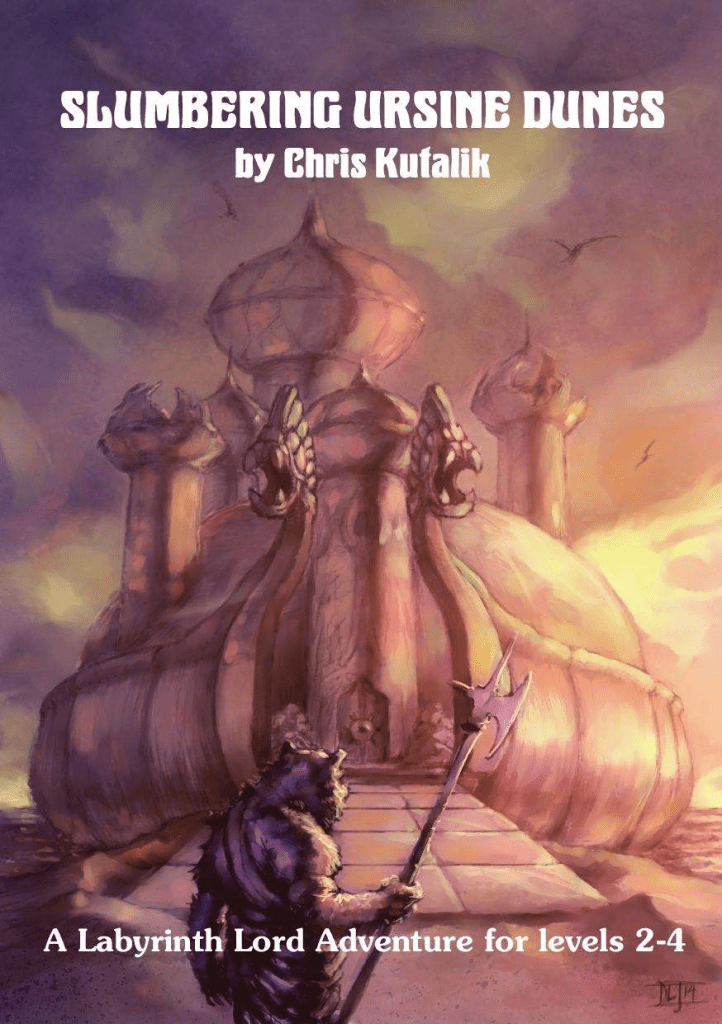
In conversation with a few other bloggers, it was raised that there’s not a whole lot looking at classics of the renaissance that occurred in the second decade of the century (yes, we’re in the third now). It’s a challenge, to a degree, because I object to the actions of a number of excellent authors of the period, so I don’t want to draw attention to them. One author that I do not object to, is Chris Kutalik, author of the Hill Cantons blog and a number of other excellent modules set in the same region, not the least Fever Dreaming Marlinko, a city module I have praised multiple times here on Bathtub Reviews, but never actually reviewed. Today, I’ll be looking at Slumbering Ursine Dunes.
Slumbering Ursine Dunes is a 68-page mini-sandbox written for Labyrinth Lords. It has some, but not a lot of, excellent spot art by David Lewis Johnson, decidedly functional maps (standing out as beautiful maps are commonplace today, even if they aren’t always functional), and basic, small-margined, single-column text that can be a bit much at times. Module layout has come a long way in ten years.
Kutalik’s writing is beautiful and evocative but in Slumbering Ursine Dunes, there is too much of it. An early example is the description of the dunes themselves, an entire paragraph I assumed was more sentences than it is (only four) because of a preponderance of commas. But within it “soaring about the scattered broadleaf groves like massive scarlet battlements”, an absolutely evocative phrase. To a degree, it’s the narrative voice that makes the text both sing and feel long-winded. It’s the voice of a local tour guide giving the inside tips on a tour of the dunes; it’s a pleasure to read, and a bit challenging to parse in action. That said, there tend to be between one and three paragraphs per topic (be that faction, encounter, or location), which varies appropriately with the complexity of the topic; this is not on the unmanageable end of the spectrum, but rather just a few inches off the ideal. More of a problem is that lack of layout choices around more complex sections, which hew towards traditional dense text with in-line stat blocks and no breaks or assistance to differentiate traps, treasure, etc. The locations later in the book are challenging to parse because of these choices.
Factions are neat, with their relationships to the party and to other factions receiving their own headings to facilitate political maneuvering. Some type of relationship chart might help, but there are only four factions, so it’s manageable. The “What do the NPCs talk like?” section is excellent, although I’d have preferred it not be separated out from the main section with the factions.
The dunes themselves are a pointcrawl. I like pointcrawls, but specifically for wandering through dunes, a pointcrawl seems an odd choice. The entries themselves here are drier, again mimicking a more traditional style than the earlier narrative voice Kutalik utilised. I criticised that voice there, but the change is jarring and these entries are no where near as vibrant or evocative as the introductions or factions in the early sections. While the writing takes a sharp turn, the content is still good, for example a “silvery ball that induces an orgasmic sensation” and a gloomy and lonely vodnik who will give you a soul to drink if you’re injured. They’re just a bit sparser out here in the dunes, which is equal parts toll collectors or murderous ghuls that provide little opportunity for interesting interactions aside from judicious avoidance or battle. The Ghuls at least make for a comedic fight, as they both attack and preach at you.
One fo the two adventuring locations needs a summary at the beginning to ascertain what is going on there, and it’s not entirely clear on a read through of the location itself, resulting in the feeling that it’s randomly generated to some degree. How did Major Xhom and his magic ape get past the Ghuls? Why don’t they care? Why can’t fly the cool barge? The other is great, a wizard’s tower where the wizard cannot dispatch his brother who is in the dungeon without your help. The characters here have needs and wants and the player characters have things to do aside from delve pointlessly.
The Chaos Index is an excellent ruleset that recurs if I recall correctly in other Hill Cantons books. The Dunes are a mythical wilderness, and follow a fever-dream logic that varies according to how much chaos is occuring due to the interactions of the factions and the interference of the player characters. The direct impact the stirring of the pot by the player characters has on the state of cosmic affairs is absolutely *chefs kiss*: Crashing spaceships, interdimensional rifts, wild magic storms, solar eclipses. It’s a neat system that adds a lot and has the potential to completely dominate and derail the game, if that’s your cup of tea (it is, indeed, mine).
The appendixes fill out the book. The Bestiary is essential here: Hill Cantons is full of weird and wonderful creatures, but as much as I criticised in-line stat blocks earlier, that was more from the perspective of layout; the full size blocks here feel like a space-waster, and although I thought Labyrinth Lord was a B/X fork, are reminiscent of AD&D. The descriptions of the Cave Dwarves and Solider Bears in particular, key unique elements of the setting, are excellent. I would lean right into these as a major part of the setting (something I didn’t get from Fever Dreaming Marlinko), and it’s encouraged, with character options that encourage the players to dip their feet into the world, by playing a war-bear or a cave dwarf. Flavourful men at arms for hire in Marlinko feature as well, with nicely brief description: “Greases hair with pig fat, pretends to be a gladiator”, which are exactly the size of description I prefer. I wish there was more of this throughout the module.
Overall, Slumbering Ursine Dunes is a success, if you’re willing to overlook the basic layout and the concessions to traditional setting and style. Exceptional writing when it’s on it’s game, leaning towards generic when it’s not. Fantastic world-building and interesting characters and ideas. Compared to Fever Dreaming Marlinko, it feels like it loses something in service of being a place in which to adventure, rather than simply being a place. In these reviews I’m looking for modules that allow me to run them without modification, but the modifications required are probably minimal to make the space-ship barge dungeon work and to make the characters you’re encountering out in the pointcrawl pop a little more. The set ups for faction play are excellent, and if you’re playing in Hill Cantons as a whole, this connects directly with Marlinko, which would bring across its strengths. If I were to pick this up, I’d be doing this, because together I think the setting shines brighter. I’m excited to see if the other Hill Cantons modules bring the same cumulative effect.
I Read Games reviews are me reading games when I have nothing better to do, like read a module or write or play a game. I don’t seriously believe that I can judge a game without playing it, usually a lot, so I don’t take these very seriously. But I can talk about its choices and whether or not it gets me excited about bringing it to the table.
Edit, 24th January 2024: This post was nominated for a Bloggie award! Thank you for all your support everyone!
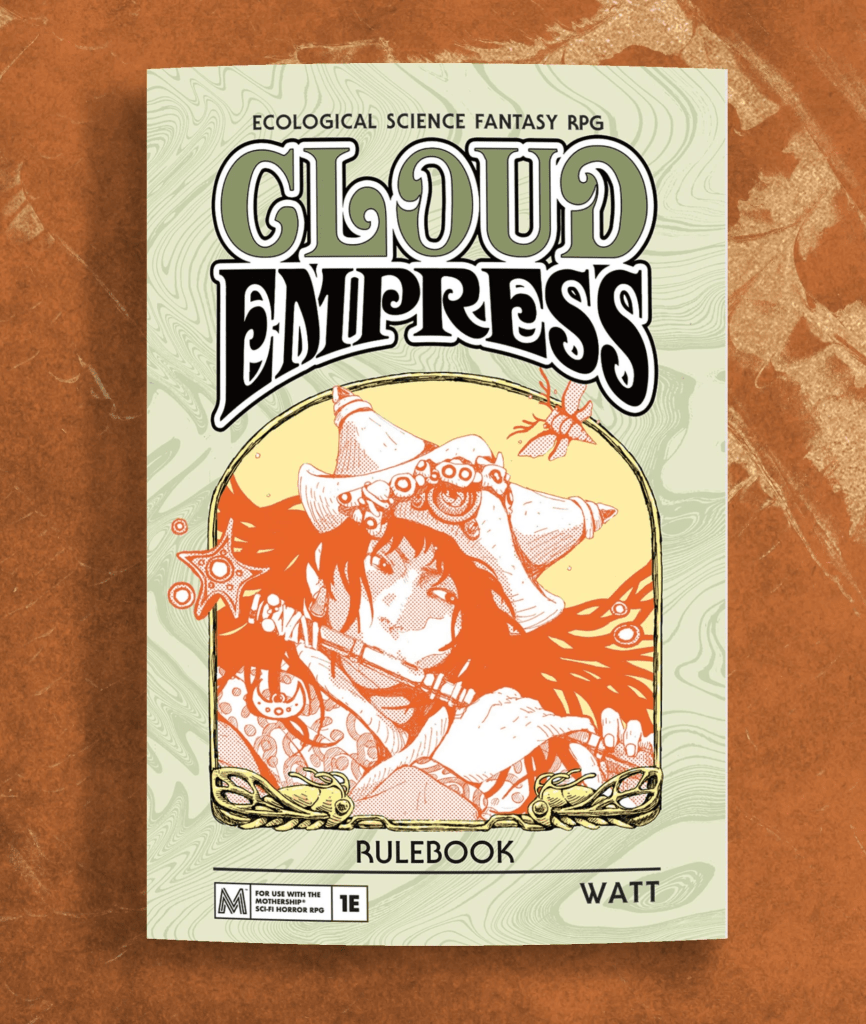
I was going to go to the beach today, but there’s a cyclone or something and the weather is miserable, so instead I read Cloud Empress. It was on my list mainly because I was talking to Sam about my review of Beecher’s Bibles, and was asked the question “Do Mothership fans like the system enough to follow it to other settings or is that community ultimately more about the settings/vibes than the specifics of the rules?” and I thought that was interesting, and Cloud Empress is about the opposite approach to a Panic Engine game to Beecher’s Bibles, to be entirely honest.
You see, Cloud Empress isn’t just a rulebook based on the Panic Engine, it’s also got a companion setting book, and it has seven additional short zines that detail specific locations beyond what’s in the setting book. If what Mothership fans like about Mothership is that there’s a lot of content available for it, Cloud Empress is off to a resounding start. It makes this a difficult review, though. I said I was going to the beach, but honestly It’ll probably take me a few days to read all of this and write about them, so I’m going to take my time, and review the entirety of Cloud Empress, because honestly why make nine zines when you could have just released a book? That’s Watt’s first mistake, to be entirely honest. This should’ve been a chonky hardcover book.
Oh, I should start more formally. Cloud Empress is an ecological science-fantasy setting, reminiscent (to me) of Nausicca and Mononoke, mostly written by Watt (with a star-studded cast of guest writers and additional developers), fully illustrated in absolutely excellent form. The core two books are 60 A5 pages long each, and all seven modules total about the same, so it’s an ambitious project, and as I said above, honestly it should’ve been a chonky hardcover, and I’d hold off until Watt releases it as a deluxe edition because these different documents I find a little difficult to wrap my head around. Like, at least release it as three books?
Enough about that particular complaint, anyway. To the first of the nine books: The Rulebook. Watt is a lovely writer, who adopts the voice of a grandmother telling her people’s story to the younglings. It’s wordy, though, and I immediately bounce off the density of the text, and the floridness of the word choice. It’s well-written, but it’s definitely not for me. In the rulebook, this prose text doesn’t play a huge part in the delivery, and to perhaps the text’s detriment, my eyes tend to skip over it. I need this delivered in bite-sized pieces, scattered through the rules and in its tables, rather than where it’s delivered in page-long (or to be fair, half-page long with art) chunks. It’s also organised a little unintuitively: You don’t find out what chalk is until after you have to decide if you need to take the “Chalk Collecting” skill. But I definitely don’t begrudge the time spent on this unique world and its unique terminology. The vibes here are immaculate, right down to the borders on the character sheet.
The character creation rules seem equally inspired by Into the Odd’s backgrounds as they are by the original mothership rules, with less focus on skills (no skill tree, just a skill list) and more on gear and sparks for roleplay. The skill list itself has a few entries that speak to the uniqueness of the world (“chalk collecting”, “thopter piloting”), but some that while they do do that, may be of limited use from first impressions (“Farmwork”, “Needlework”). In most players, with the background of deadliness we’re inheriting from Mothership, I wonder if anyone would choose the latter over “Spell casting” or “Firearms”, despite what it says about the world.
The basic rules feature little deviation from what you’d expect from an adaptation of the Panic Engine (although, and I’m not sure if this is a feature of timing or something else, it’s not called a Panic Engine system but rather a Mothership hack). There are a few additions that do shed light on the intentions of the world: Rest, for example suggests tasty meals or heartfelt conversation. There are weird magical mushroom spores. There are spells that are very weird in a perfect way related to the fact that they’re closely related in theme to the magical bug corpses that litter the landscape. Magical items (“crests“) are the stolen and broken remains of ancient civilizations architecture. The biggest deviation (again, seemingly seeking inspiration from Into The Odd) is that “most attacks auto-hit”. You only roll an attack if it’s difficult, as do your foes, so there’s a lot of implication that you’re supposed to be clever with combat so that you deal a bunch of damage very quickly for free and they have to roll their dice. Again, there’s good flavour here, though: All weapons are dual use, because this world is not a one of violence. I love the equipment lists which are full of flavour but with very few elucidations. Great fuel for imagination, as are the “What Do You Find” tables. Before I move onto the next book, I’m left feeling like the rules would have been best simplified to a few pages, and the flavour been transferred to the next book, as this feels like it would be a messy reference at the table; but the rules are simple and who doesn’t know how to play Mothership? I could do it from memory. We shall see.
My first impression of the setting book is the inside cover, a big whopping impressive hex map that is rendered as a 16 bit video game map and that…honestly it’s incredibly jarring. The amount of money spent on the art in these books, and they couldn’t have splurged for an illustrated map? Really disappointing, and completely out of left field design wise, in a series of books that is otherwise has an incredibly coherent design direction. The map itself works, and is full of relevant information on the different areas, travel and trade. The rules for the hexcrawl are in this book, rather than in the other. I suspect that from a readability perspective, I’d expect to have these two zines at the table, and so I’d want the rules for travel in the rule book on my left, and the setting details on my right in a separate book. They were released simultaneously (relatively) for me, so I don’t see benefit in separating these out. The rules are fine, and the map is useful. That’s nice. I’ll reset my expectations going into the book proper.
We have a few different regions, each with a Hunt & Gather table, encounters (some with expanded descriptions), unique NPCs, brief 1 paragraph hex descriptions, and then a few specific fully keyed locations (again in that jarring 16 bit map style, which I’m suspecting now was a conscious choice but in my opinion it’s a bad one). So much of this book’s writing is absolute fire, even the merchant generators (which give you a nice single word description of each merchant, plus what they have), and the mood table (which is an interesting take on the reaction table). There’s even a rumour table, although it’s not the most magnetic take on the rumour table; it ranges from clear hooks “Sleepy Renault will give a crest to anyone who brings him the Farmerling pirates on the Broken Back river” to very vague ones that don’t provide much guidance, “There must be a Flesh-thresher repair depot“. I genuinely love most of this.
The layout is very clear in terms of finding what you want, when you want it, and the art (apart from the maps that I shan’t perseverate on) is fantastic and consistent. See the art on the cover? The books are packed full of art that level of quality. To the gills. The only criticism is that the bold layout choices make the columns of text writing into a challenging read for me, at least in digital format. The font feels a medium or bold set, even for the body text, and my eyes glaze by the end of a paragraph. Luckily, though, most of Watt’s writing doesn’t range more than a paragraph for a single item. The ones that do are usually the major characters in specific locations, and should they be shorter? They’d be easier to run, but their descriptions are so compelling: “The giant is waking, and crumbling to dust. Oola must learn all she can. She only agonises over her lost memories and the evaporating resources.”. I don’t think we’d be better off without these descriptions, but maybe we could use a lighter weight to make it easier to read in this level of consistent density.
The final seven short zines are specific keyed locations on this hex map. Each of these are very cool, but interestingly aren’t included on the hex map descriptions where all the others are. This makes sense as they’re not included in the main setting book, but it makes them a clumsier addition. They, like the main book, do not share a common structure, and while they’re all good, Alfred Valley and Joel Hine’s really stand out as being compelling and places with a reason to explore rather than simply a vibe. That said, I’ll call out Kienna Shaw’s piece because it’s genuinely a great vibe, even if I don’t see a reason why I as a person would actually attend the ball.
Ok, that was a lot of reading, and it took me a few days. I was definitely right on the money with my first impression that this should all have been a single book. There are just not many rules, and they’re hard to navigate amongst the setting information. It’s very well written, although longer-form than my taste leans, and the guest writers contributions are decent to excellent. But the lack of incorporation of the guest writers works into the setting book is an oversight that weakens that setting book overall, which is otherwise excellent. The entirety of Cloud Empress’s releases so far give me a confused sense of what they’re trying to be: It seems like they want a somewhat pastoral, travelling company type gameplay (with skills like farming and needlework) but haven’t provided the tools to do that. They did a better job than Beecher’s Bibles did (even if Beecher’s Bibles didn’t telegraph that gameplay as well as Cloud Empress did), but not enough for what they communicate. What they’ve written instead, in the hex-crawl and keyed dungeon locations, is a more traditional wilderness fantasy exploration game with a unique setting. And there are world elements that support that well! Crests, Spores, the dangerous combat system — all of this supports some interesting, heavily-themed traditional dungeoncrawling play. The stronger supplementary material supports that kind of play as well, with the other supplementary material somewhat listless; I just wish that the other modules actually were better supported by the rules. What’s the point of giving me new rules, if they don’t support the type of gameplay you’re aiming for?
All in all, I suspect what I’m experiencing is a sense of betrayed expectations: The references, the descriptor of “ecological sci-fi” and the promise to “find a way to thrive, live and love in the psychic wreckage of earth, scavenging” is hinted at by the modifications to the Panic Engine and then gives way to a traditional mode of play, unsupported by the supplementary material and the setting book. Yes, I can still play that game — I could run Cloud Empress in Fifth Edition if I wanted to as well — but I feel like if you make a promise, there should be support for the kind of play you want, in the modules, in the setting book, or in the rules. Somewhere. I wish I was seeing it, but I’m not.
That fairly major complaint set aside, this is well-written, an intensely compelling far-future post-apocalyptic setting, weird and unique and familiar enough to me that I could easily make it my own, with popular enough referents that I could easily sell it to friends to get them to join my table. The Panic Engine is fine here, and although it doesn’t support the play that it promises, it still makes for compelling, high-risk gameplay. What Cloud Empress actually is, it is pretty damned good at. It just isn’t everything it says it is.
(For what it’s worth, today, when I finished reading Cloud Empress, I was going to go to an air-conditioned shopping centre and shop for Christmas presents, but my wife ran late with the car, so I did this instead.)
Bathtub Reviews are an excuse for me to read modules a little more closely. I’m doing them to critique modules from the perspective of my own table and to learn for my own module design. They’re stream of consciousness and unedited critiques. I’m writing them on my phone in the bath.
Seven Stars of the Unseen is a 24 page module for Cairn by Dan Fawcett. It’s another submission to the A Town, A Forest, A Dungeon Jam that I’m using to highlight excellent hobbyists and up and coming authors. It’s an isekai adventure (for those not into manga think the Lion, the Witch and the Wardrobe), featuring a search for. mysterious missing woman who was cursed by a dark god.
Layout wise, it’s not hard to follow, but not especially pretty or easy on the eyes. It opens poorly, with messy font choices and spacing, but for the majority of the Art is appropriate public domain, and I really like the look of the maps even though they’re really just point crawls layered over nice public domain art.
I like this module a lot. It is bursting with ideas. It’s lovely to set a Cairn adventure in the real world, or in a folkloric historical France. But it feels as if some of these ideas don’t come together fluently.
The first section, New York City, 2014 is an example. It’s asking me to ask my group to free roleplay what they would have done in New York in 2014, until (I assume, this isn’t in the module but it’s referred to) a chauffeur brings you all to a mysterious book shop (why you?) and a mysterious man whose orders you have to follow (it’s his curse) sends you to 18th century France on a quest. And…I’m not sure why? I don’t feel like this section adds much to the story told (it does add some interesting touches in the form of the solutions the author provides to the inherent problems with an isekai dungeon crawl), and simply having a quest giver grant the quest in 18th century France would be simpler and less clumsy a start to the adventure. The author is clearly attached to the framing device, but even then: “You are a group of friends, and you found your way to a mysterious book store where a mysterious man gave you a mysterious quest and sent you to 18th century France” is what I’d do if I were running this.
One you get to the forestcrawl in France though, boy is this characterful! Random encounters include squirrel merchants and squirrel-hating gnomes. The locations are a bit overwritten for my tastes, although part of that feeling may be attributable to the two column layout being quite dense. For the most part, though, the locations have two factors plus Luc’s encounter, so there’s a reason they’re busy, and it makes for some interesting locations, if not written as evocatively as I’d like, the descriptions feeling a little too boxed text for my tastes.
There are two significant twists on the typical forestcrawl. The memory curse makes for an absolutely fascinating twist on the small number of encounters and locations, as the NPCs that have been interacted with will never remember the previous encounter. I adore this as an influence on encounters, and so could see it being manipulated in a really fun way by the players. Also, the villain stalks, bargains and teases the PCs throughout their time in the forest. Specific prompts and deals are given in different locations, and are optional. This means you could choose to slay the main villain early, or could be on the wrong side by the time the final confrontation in the dungeon comes. Very cool touches.
The dungeon, however, feels a little arbitrary for my tastes. There is no clear indication that swimming in a portal pool will take you to Luc, for example. There is an ogre just hanging out in the dungeon for shelter. There’s a rock fall that needs to be cleared, but I’m not sure the PCs would have any reasons to other than “we haven’t found Luc yet” and even then, there’s no clear signal it’s Luc’s lair. Compared to the varied, complex forest encounters, this is a disappointing climax.
Overall I’m very mixed on Seven Stars of the Unseen. It is an absolutely fascinating idea, that isn’t executed as successfully as I wanted it to be, but despite that, it incorporates a bunch of great ideas and techniques that I’d love to see developed further and incorporated into more modules to add interest and excitement. If you’re interested in a fairytale forestcrawl, it’s well worth running that section over most other forestcrawls I’ve read, I’d just transplant Luc to a different place, and change the opening somewhat. Dan Fawcett is certainly someone to keep an eye out for, if this innovative if flawed module is something to go on, and there are a few principles in the forestcrawl that I’ll eagerly incorporate into my own work. It’s free, so if anything here raises your brow, I’d check it out.
I Read Games reviews are me reading games when I have nothing better to do, like read a module or write or play a game. I don’t seriously believe that I can judge a game without playing it, usually a lot, so I don’t take these very seriously. But I can talk about its choices and whether or not it gets me excited about bringing it to the table.
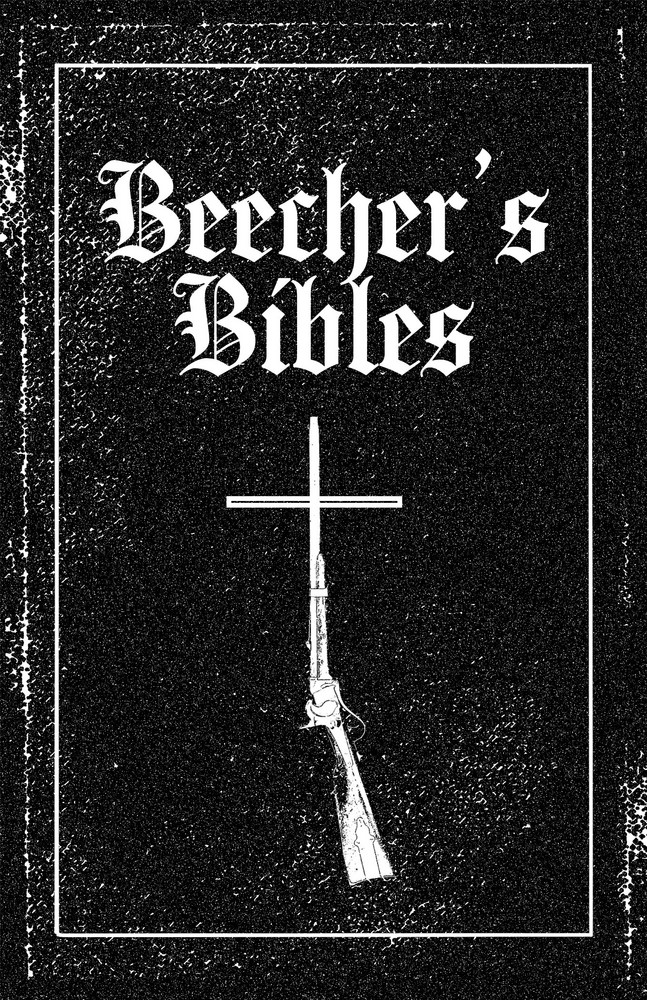
I was going to do yard work today, but it’s 38 degrees outside so I’m going to read Beecher’s Bibles (words by Noora Rose), because of events happening of late and I’d like to drop a little positivity into the shark-infested waters that can be the roleplaying game scene. A year or two ago, I was playing Boot Hill (first edition), and thinking how much Mothership’s Panic Engine (I don’t think it had a name back then) would suit Boot Hill so well, and I began writing something along those lines, then stopped (because the list of unfinished projects of mine are far longer than the list of finished projects), and a few years later this Kickstarter popped up and I was like “Woah! Cool! This is exactly what I wanted!” Today, let’s see if it was.
This is a 30-odd page double column layout presented neatly as something written in the 1800’s, complete with cute hand-drawn manicules. I don’t have the physical version, but it looks like it’s intended to be printed as an A5 zine, and it’s not especially readable. A glaring problem is that on non-titled pages, the headers are consistently Beecher’s Bibles and Noora Rose, which, while thematic and reminiscent of contemporary layout, actually makes it hard to recognise when the page is a Critical Effects table or whatever when you’re flicking through the book. The equipment tables are both nigh illegible and look exactly like a Sears catalogue from the same time period looked like. Overall, the layout is stylish as heck and its vibes are impeccable (complete with what I assume are period black and white photos), but there are trade-offs to that which make it a wee bit more difficult to use than I’d like.
The rules themselves are the Panic Engine rules, with minor changes: Stat names are more flavourful (I adore Justice replacing Combat here), a new skill list (which is, to be honest, due to the layout choices, far less intuitive or nuanced than the original), and an elegant combat difficulty systemand hit location that reflects the way you’d likely play a Western game without all the absurd complexity of Boot Hill 1st (or any, really) edition. There are lots of aspects of the expanded rules that I really like and that say a lot about the intended pace and setting of the game. The list of real diseases strongly suggests these are going to happen to you, drugs are likely to be a part of the game. Sometimes this is undermined by a reliance on traditional structures — the hunting rule suggests a very slow, day-based approach to travel, but the travel and foraging rules base things upon watches. Movement is handled in miles per hour, rather than using either the watch-based or day-based timelines. I’d need to put together a table to figure out what all these things actually mean. One thing that I don’t love is that it’s not as lethal as I’d like – you can take twice your Fortitude in wounds, and that is a lot of bullet strikes. I want every time you draw your gun to be tense; that goes back to my desire to retroclone Boot Hill 1st edition to the Panic Engine.
All of this really lends itself to a Red Dead Redemption feeling game — with the exception that the pleasure of Red Dead Redemption II is in the small moments, the pleasure of fishing, the vistas and the feel of the horse underneath you. I recently read Atop the Wailing Dunes, and it does a really good job of giving its neolithic fantasy world which I have no guidelines for and making it a world I could describe as a walk through one mile hexes, one mile at a time. Beecher’s Bibles doesn’t try to do this, but the way the rules point suggest a type of gameplay that would benefit from this approach. To be fair, Pariah, the system that Atop the Wailing Dunes is written for, also fails to support that type of play. But, as you’ll see when I Bathtub Review that in a few months, that’s a significant criticism of Pariah in my opinion, and a fair criticism as well of Beecher’s Bibles, as I don’t think I could run the game that this game points to without a bit more support.
This goes to a few of the rules, as well. I referred to those disease rules that I really like, but the game talks about what it means to have the disease, but now how to catch them or how you’re likely to be infected with them. If I’m going to beat around the bush learning a set of rules, I want a little more support in how to use them, especially (and maybe it’s my non-American-ness here) given how I can’t rely as strongly on the tropes of the Western as I can the tropes of generic elfgames. Unlike Gary Gygax, I wasn’t brought up on John Wayne and western pulps, I know the tropes from a few videogames and spaghetti westerns.
The book’s climax is a module to run a scenario during the Wakarusa War, what appears to be a real world event. I have no familiarity with 1800s state history, so I can’t judge as to how true-to-life this book is, but it certainly seems well-researched. This set up, harking back to the previous section, doesn’t feel like the kind of adventure the rules are written to support: It’s a battle, a stand-off, and the rules are violent and deadly, and are concerned with wandering through the wilderness and catching diseases at brothels or dockyards. I wonder to what degree it’s meant to stand as an example of what you should do with the game, rather than provide an actual scenario: The encounter table is neat, and hits some of the notes I wish the game hit as a whole; the chase rules appear here and not earlier, but are the first example of how skills would be used. I’d love for the key NPCs to have a clearer direction rather than just a description of their recent history and notoriety.
How do I feel about Beecher’s Bibles as a whole? I think it’s very good, but the parts of it that spark my imagination, don’t appear to be the same ones that sparked the author’s imagination, and so those aspects are underdeveloped in my opinion. I play rules-lite games, but for that very reason, if I play a new game, I want it to support the type of play I want, or I’ll just write or hack a new game myself. This one doesn’t give me the Kansas generator I want, so that wilderness travel won’t have the juice of seeing a herd of Bison in Red Dead Redemption 2 and detouring from my goal to go hunting and claim a perfect pelt, or of seeing a storm rolling in or an abandoned hut. This doesn’t support the interesting play directions it implies, like its diseases and travel giving nice, slow timelines, and suggesting the exact ramifications of high-speed travel like rail would have on this world. I don’t like how durable your characters are.
Does that make it a bad game? I don’t think so. It’s fine if your picture of a western roleplaying game is different from what mine is. I’m a little disappointed, though, because it showed a lot of promise to be exactly what I wanted. This is a game which feels like it could have been though, it’s just not fully baked. I’m aware that I can make all the content myself, but I could have written the game myself, writing rules isn’t that hard, particularly using someone else’s engine. What has been added here is good, even when it’s not to my taste, and I could tweak those thing easily to be to my liking. But there is so much that isn’t added, that I’d want to make running my 1800’s Kansas campaign an ease and a pleasure, that isn’t here.
So, in conclusion, Beecher’s Bibles: A good western game, that feels incomplete. It’s $6.99, a price at which I wouldn’t expect perfection. It’s better than pretty much every other Western game out there, because they are better kept simple, in my opinion. I’d recommend picking it up, if it’s your jam, but I warn you that unless you’re from Kansas, it’ll take a bit of effort to pick up and run.
I have two processes for dungeons: In one, I draw a map, then figure out what’s in it. In the other, I figure out what’s in it, and draw the dungeon to match those ideas.
The second is really hard, because I usually only have one or two ideas for a full dungeon level. So, I use this, based on the Old School Essentials random room stocking table, to help cue myself:
Empty
Empty
Empty
Monster
Monster
Trap
Empty
Monster
Empty
Trap
Empty
Monster
What is this and who cares? Basically, I’ll never have a dungeon level or area with less than six rooms, and I usually limit areas to a maximum of twelve. By filling this out from top to bottom, I basically get a nice variation of room types. I don’t include “Special” rooms because I like to put them in according to theme, and they’ll be one of the empty rooms.
So, I’ll label the rooms, and then decide what goes in them. I’ll arrange them later when I’m mapping, so this numbering isn’t necessarily in order of encounter at all. Use tarot cards or Magic: The Gathering Cards or a spark table or your world anchors to prompt your theme. I’ve decided this is a wee cursed chapel.
Empty: Vestibule
Empty: Chapel
Empty: Cave-in
Monster: Apse (Undead Priest)
Monster: Catacomb (Rock-Eater)
Trap: Catacomb (Roof collapse)
Empty: Scriptorium
Monster: Baptismal Font (Ghost-possessed water)
There is roughly 1/3 of a treasure in each room (again, this is extrapolated from the OSE random room stocking), which means an 8 room dungeon area has 2 1/3 treasures in it, and I’ll just decide where that’ll be thematically. For the extra third of a treasure, either I’ll stick something trinkety in or I’ll add it to the next dungeon area if that makes sense. The amount of treasure I put in something varies, but usually I’ll aim for about 200gp per dungeon room (but that’s spread out), which means a party of five levels up every 50 rooms or so. So for this one, I do this:
Empty: Vestibule
Empty: Chapel (Golden idol worth 200gp and antique, magically preserved tapestry depicting the Hind-Headed God of Septvictus worth 350gp)
Empty: Cave-in (buried under the cave-in is the body of an adventurer, bearing 150gp and wearing faintly glowing plate armour)
Monster: Apse (2d4 Undead Priests)
Monster: Catacomb (Rock-Eater, if carved open has 100gp in gold nuggets in its belly)
Trap: Catacomb (Roof collapse)
Empty: Scriptorium (if the library is searched, there are a dozen heavy tomes in excellent condition, each worth 100gp to a collector of religious texts)
Monster: Baptismal Font (Ghost-possessed water)
Now, I draw the dungeon area (I reiterate that this is usually a section or level of the larger dungeon, not the entirety of it — that’s why there are stairs in an unnumbered, empty catacomb):
Look I just whipped this up don’t examine it
If I’m doing this for my table I won’t do much more, I’ll just add key words to help descriptions pop, and say what other creature it acts like that already has stats (fungal, moist, crumbling and stats as bear). If I’m writing for publication, I’ll actually key it with pretty words and renumber it in a logical order, as this process will make me number things illogically and I intensely dislike that (you can see that above — the numbering doesn’t serve the internal logic of the dungeon without tweaking).
Anyway, that’s how I write a dungeon without rolling any dice.
When I’m running a draft dungeon, I love giving the player characters a fairly sure escape option if they encounter something that they’re not prepared for. This is how I do it.
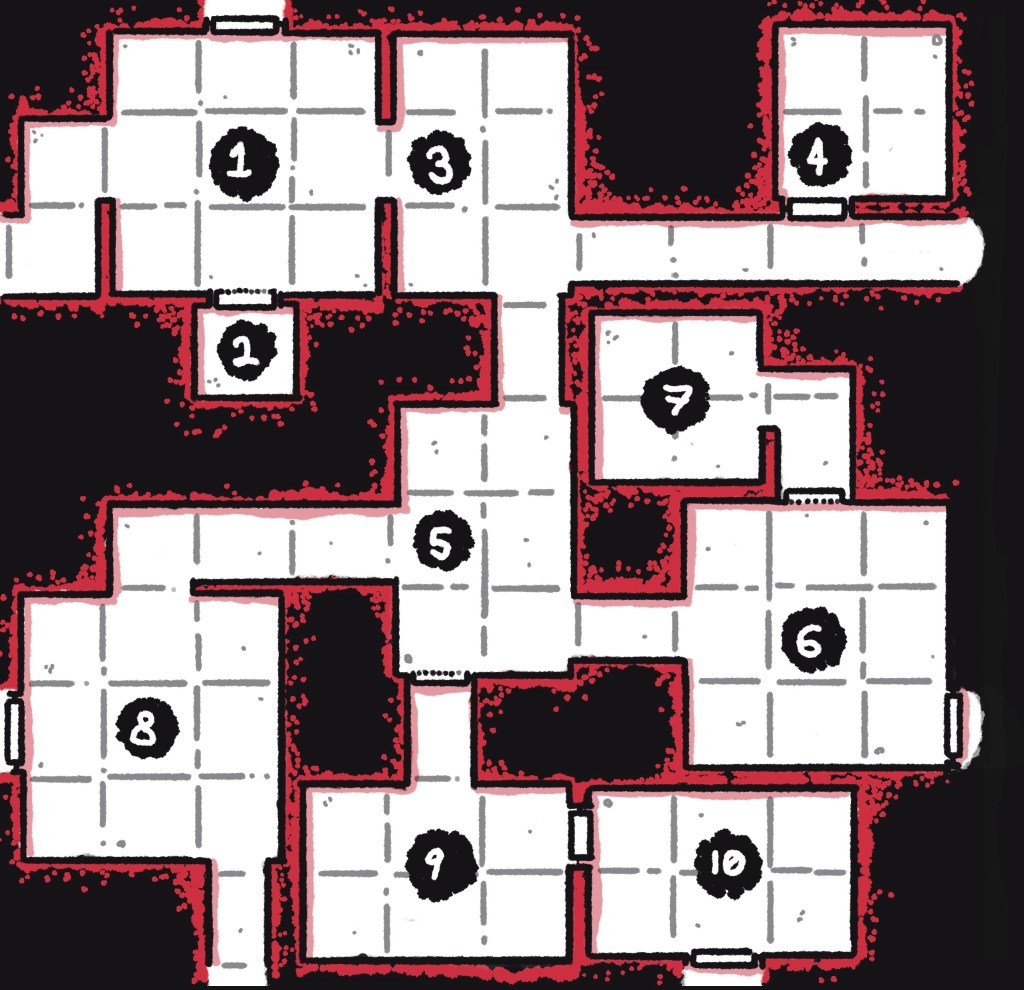
Here’s a dungeon I prepared earlier
The players characters entered through the eastern door in room 6, and find the secret door to room 7. Oh no! An ogre! They’re not prepared for it. They choose to flee: They get a chance of losing the ogre, at risk of getting lost in the dungeon. They need to flee through 4 rooms to escape as the ogre has 4HD.
I count 4 rooms. There’s only one exit from 7, so they are in room 6 (first room). There are two exits from 6, and I roll west to room 5 (second room). There are three exits from room 5, and I roll north to room 3 (third room). There are two exits from room 3 and I roll west to room 1 (fourth and final room). They’ve escaped the ogre. My description is a frenzied and impressionistic overview of the rooms they’ve been through, and then I describe their destination room in detail as Id explain any room.
That’s if there are no hiccups! What if there are traps or monsters in the room? If there is a trap they would trigger, they receive damage and stumble onwards as part of the fleeing description. If there is a monster, the monster is surprised, and I allow a choice: Do the players dash past them or do they interact with the monster. In the first case I roll a reaction roll to see how the monsters respond) — they only chase if they roll hostile. In the second case, I’ll give them an exchange to interact with the monsters before the Ogre arrives for a more complex encounter.
If there’s a hidden or secret door that I roll, I’ll usually allow it (depending on the kind of secret — I’m more likely to allow a trap door covered with a rug than a statue that requires a puzzle to be solved unless they’ve already solved it) and give a bonus room, as the ogre is more likely to have trouble chasing, and I’ll describe it as hiding in the secret room while the ogre searches for them.
I enjoy this, particularly in larger dungeons, as you can accidentally end up on another level of the dungeon and with no clue where you are. More difficult opponents are harder to flee from (or perhaps impossible in a small dungeon, resulting in a surface world confrontation or chase).
Gus L suggested that you could choose dungeon landmarks rather than exits to travel between, which is a neat idea in a larger dungeon particularly if you were designing it around a major xenomorph-like creature. You could also add additional rules around using tricks to distract the ogre or to flee faster, if you wanted to, or to incorporate territories in your dungeon to flavour your flights. These I think would be great again, if the dungeon was intentionally the kind of dungeon where it’s balanced towards more difficult challenges.
One proviso: In my opinion, this works quite well in most systems, but some systems with softer levelling take a little more customisation; I play Cairn a lot, and I use a factor of HP there (half HP to be precise) just because creatures tend to be tougher there. Your mileage may vary, but I want it to be not too tough to escape in terms if number of rooms, because there are additional risks in terms of traps, other monsters and getting lost to consider as well.
Bathtub Reviews are an excuse for me to read modules a little more closely. I’m doing them to critique modules from the perspective of my own table and to learn for my own module design. They’re stream of consciousness and unedited critiques. I’m writing them on my phone in the bath.
Knowing Revenge of the Grasping Gods is a 20 page system agnostic module written by Kyle Tam with graphic design by Lone Archivist, who also did Another Bug Hunt. It’s about stealing fire from the gods.
This zine is clean, structured and creepy in the way protestants find catholic texts creepy. I’m not sure what Lone Archivists’ references were, but it feels like a clean version of an illuminated apocrypha. Big, bold paragraphs on single column large point, clear explosive headings and if it’s not a single typeface throughout, it’s painstakingly picked to appear that way to the layperson.
The big, bold paragraphs are a fascinating choice for a module. Usually, we have a huge heading and a single (rarely double) spread covering a point of interest. Each point of interest feels like it stands on its own through the unusual layout choices, and feels like it’s screaming at the reader. It reminds me a little of a Maria Mison layout, like it was inspired in part byI Eat Mantras For Breakfast. It doesn’t feel clean, it feels like a clean recitation of something messy.
There’smore verbiage in these descriptions than I’d prefer, but it feels forgivable here. Why? I’m not sure. It’s florid but not absurd or self-indulgent. It could honestly afford to lean into its largeness more, be a bit more David Foster Wallace. But as is, I’m running this module telling my players to have a coffee while I read and absorb each point of interest, and then am running it off vibes.
I couldn’t run it traditionally, I don’t think. Instructions are buried in the prose along with descriptions. It’s beautiful but inconvenient. It ends with a choice between godhood and humanity, having impressed the guardian at the gates of Olympus. It feels like a drift from module to lyric game, and I mean this with no aspersions. I could play this in free kreigspiel as a one shot I think with great success. It would be impeccable vibes. But could I drop it into an ongoing campaign? Only one with a very specific vibe.
I think the most damning and complementary thing about this module is that, while I’d enjoy playing it with the right group, what it does do is set my brain on fire for variations on the concept: I want a heist on god mountain, structured to reflect Oceans 11’s antiheroics rather than Promethean heroics. This is excellent, but it wallows in its subject matter rather than subverts or frolicks in it. And sometimes you just want to lay back and soak.
This is the kind of story and atmosphere I often see bundled with a plentitude if half-baked mechanics when really what you need is a table of players which are sold on the mythical heroes stealing fire from the gods vibe and good at improvising heroes based on a random treasure table. I like this a lot, on its own terms, but it’s far enough afield it’s hard for me to recommend aside from: If you found this review intriguing, it’s probably worth at least a read through.
I just released the second issue of my (potentially) regular zine full of dungeon maps.
Dungeons, Regularly #2 contains thirteen maps (mainly dungeons) for you to key yourself and use for personal or commercial use.
If you pay a little extra, you get two pages of things to put in those dungeons, if you need inspiration, as well as the jpgs of the maps if you want to use them commercially or as a VTT. I statted them for Cairn because right now I’m in a Cairn state of mind, but I might move to 0D&D next as a feel inspired by FMC Basic.
This is a lot of fun to make, so I hope people find or make use of them. If you do, let me know! And if you back me monthly on my Ko-fi, you can have them for free!
I use affiliate links where I can, to keep reviewing sustainable! Please click them if you’re considering buying something I’ve reviewed! Want to know more?
Have a module, adventure or supplement you’d like me to review? Read my review policy here, and then email me at idle dot cartulary at gmail dot com, or direct message me on Discord!






 Playful Void