Bathtub Reviews are an excuse for me to read modules a little more closely. I’m doing them to critique well-regarded modules from the perspective of my own table and to learn for my own module design. They’re stream of consciousness and unedited harsh critiques. I’m writing them on my phone in the bath.
Reivdene-Upon-The-Moss (hereafter Reivdene) is a 91-page module by Chris Bisette. It came about as an episodically released Christmas module, and has minimal art and layout. The text identifies that it’s a first draft, but to my knowledge it hasn’t been updated at this time. It is statted for B/X, Mork Borg, Troika! and Fifth Edition, although what version of Troika! this would make sense in is beyond me, to be honest. It’s a horror investigation module in a creepy town.
A hex from Reivdene, used as cover art for the storefront.
Briefly, a summary: We have sections on history, hooks, weird omens, weather, and details about the ritual which places the module on a timer. Six locations within the parish, a three hex hexcrawl, Four places in the village, a few NPCs, and details about the final dungeon and the Looming Evil.
This module, due to its lack of art and layout, relies heavily on punchy and evocative writing, and it brings it in spades. The opening monologue gives the voice of this town’s occupants as well as a summary of the creepy goings on, and I’d read it aloud (“A weird place, Reivdene. Insular. You can spot a moss-eater in a second when they come to town.”). The rest of the writing in the module reflects the opening in a number of ways: It’s evocative, it reflects the small British town on the moors (at least as I imagine it from television), and it’s just a little too wordy. The opening monologue is a half page. The “brief” history is two pages. The content here is good, but it needs a good edit.
There are some sections which I feel just aren’t necessary, as well. Being trapped in Reivdene is essential for the plot and the pressure, but it’s just not important enough to justify a page of rules about the weather, which essentially indicates it’s cold and snowy and you’ll get snowed in. The three hex hexcrawl isn’t big enough to justify the use of hexes; technically there are seven hexes but only three locations, and they’re connected by paths, but there’s no detail about the other four so why are they there? And, as I alluded earlier, I can see it’s statted for the most popular forms of D&D, but nobody’s playing this in Troika, it suggests you ignore a bunch of B/X rules in the text, and honestly sending a bunch of optimised 5e PCs would make short work of this cult, so it kind of betrays the spirit of the piece to do so, although I recognise the smart marketing decision.
I would love for this to have been a briefer, better edited module, because it’s absolutely stellar. Writing is uniformly excellent, it just needs a decent chop. It’s a fairly contained and small story, with a lot of neat lines drawn and interesting relationships built in, lots of levers for the PCs to pull, and I imagine it would be a really memorable series of sessions. It’s hard to communicate in a review how much fun these are: There’s a secret sibling-god being held prisoner by a random NPC, who also may make an ally against the big bad, but is likely just as bad. Old shrines hidden beneath giant rocks. Secret dungeons. Spaceships. All interconnected and drawing the PCs together for something bound to be explosive.
But it’s written to be a similar size to a much bigger scale module, and the contrast here makes me reluctant to run it. This is 91 A4 pages, to be clear. Witchburner covered a similar location in two thirds the pages with more rules necessary for its investigation elements. Fever Dreaming Marlinko is 71 pages with art and layout and it’s an entire city and provides a basis for years of play.
Honestly, this is a strong enough module that if it were released in book format, edited down to 60 pages, actual layout and more effective art to make it more useable and streamlined unnecessary sections (with consideration given for their intended purposes), this would be a no brainer purchase for me, as a big fan of horror-leaning elfgames. I certainly think choosing a system or remaining entirely agnostic would be a smart choice as well.
Bathtub Reviews are an excuse for me to read modules a little more closely. I’m doing them to critique well-regarded modules from the perspective of my own table and to learn for my own module design. They’re stream of consciousness and unedited harsh critiques. I’m writing them on my phone in the bath.
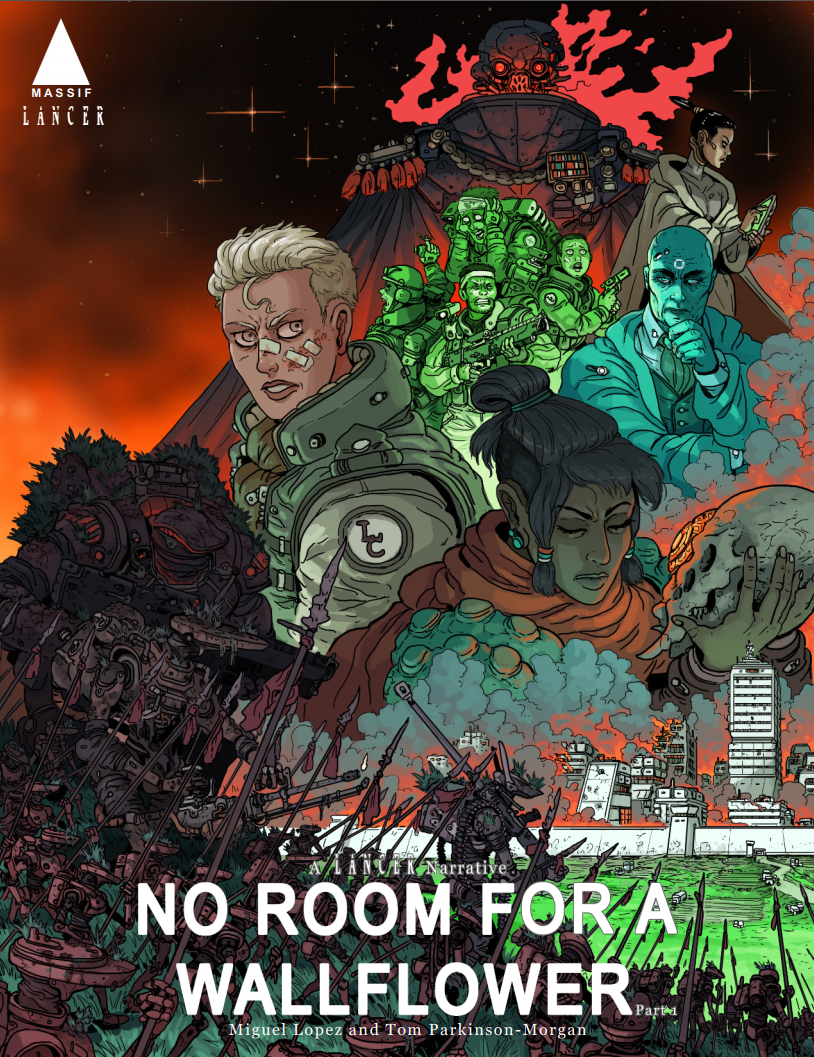
No Room for a Wallflower is a narrative module for Lancer RPG by Miguel Lopez and Tom Parkinson-Morgan. It’s a solid effort, and appears to be an attempt to produce something akin to what Horde of the Dragon Queen was for D&D 5e when it was released. That means, we have more artists, more production value and more words, and an attempt to solidify a house style for Lancer outside of the core book. I feel like I have to defend given what style of games that I focus on here that I’ve actually run a fair bit of Lancer, and while this module was a gift, I think it’s interesting to look at a module that’s trying to be a fifth edition module, but that (looking at the credits) actually has some solid indie cred behind it. It’s a big book, so this will be a long one.
The introductory chapter is exactly the kind of introduction that grinds my goat, not suffering from any specific deficit but rather from but not knowing what its target audience is, and hence what to leave out. The result is a bloated rules introduction that feels aimed at a beginner who is likely grappling with complex Lancer lore and rules already. From the start, I’d be remiss not to mention the art, which indeed is universally excellent, and fits Lancer style, but I won’t make mention of it again, as none of it is functional and it doesn’t really factor into how useful or good the module is.
The introduction is a gazetteer covering the backstory (for the GM only), gazeteering the planet, the factions, and then a one-page on what the player characters might know. This chapter could have been presented in half the words, probably less, and more effectively, but this is very much Lancer house style, and if you’re conditioned with that expectation I wonder if you’d be disappointed with a lower word count? Irregardless I remember the hours it took me to digest core Lancer lore and can’t imagine this additional lore would make the book welcoming to me coming straight out of that. A lot of this secret lore is never going to be told, and in fact is explicitly hard to find out by player characters, and you’ll find that further in, most of the characters players might interact with have the lore they know listed with them. Secret lore secrets doesn’t drive interesting play in my opinion, but rather should be generously doled out, and if this section is to be useful, it’s best as a list of “things people know” that is referred back to in order to be communicated to the player characters, or just relegated to the existing sections of information that specific characters know. Everything here would, if brevity was not on the cards, have benefited from more structure to render its size and density less opaque. Present it as a dossier rather than a gazetteer (I’ll come back to this suggestion). Lots of subheadings, headshots of major players, tables and things to tie back into later. Make it more practical. Make it both GM guidance and player handout.
I should briefly detour into an explanation of how this book modifies typical Lancer structure to make it a “narrative” module. Normally, Lancer missions consist a number of combats, after which the player characters increase their license level. Wallflower introduces “beats”, formal forking narrative intermissions between the combats, illustrating the progress of the state of the planet Hercynia over a year of war. The bulk of the book is the actual content of these missions and the beats that are interjected into them. There are five missions and a couple dozen beats, and the strengths and weaknesses are repeated throughout. My first impression of Wallflower is that it’s well laid-out, taking after Lancer’s core book with bold colours, clear tables, and simple iconic sans serif fonts. Every page looks good on impression. But on closer and further reading, fonts multiply rapidly, highlights like boxes are used inconsistently (used for briefings, combat descriptions, stat blocks and specific parts of stat blocks), and the writing exacerbates the problem, at times with almost entire pages italicised or bolded, becoming incredibly difficult on the eye. There is a clash of layout, typography and writing choices in this book that results in something very challenging to read once you get past first impressions.
The first page of Mission 1 appears to be three quarters read-aloud text, which in my opinion is egregious. I’ve never had a table willing to sit through reading an A4 page of text themselves let alone my reading it out loud to them. The writing is decent, evocative for the kind of James Cameron military sci-fi vibe they’re appealing to here, but there’s just more of it than is practical. The same brevity complaint comes for characters. They’re well-realized characters, however the conversational half-to-full-page style doesn’t lend itself to my easily slip into those characterisations. Give them a strong structure if you want this much information to be provided per character, else make them stereotypes and give them one or two quirks and let the GM bring their own flair to the roleplay. A half decent map would describe the colony better than the text does, and because the map is neither co-located with the locations nor half decent, locations fall into the trap of describing geography (“well downriver, on the east side of the river”) and then describing the banal (“the day to day functions of Evergreen’s Stable Reactor Plant are largely automated”), while burying the useful and interesting (“Currently, the bridge…[can’t] support mechs”). The “Scenes of Daily Life” table is excellent, but a missed opportunity, lying on the same page as GM advice is right next to it “You may wish to include a scene or two in which combat can be heard in the distance” which should have been right there in the scenes of the daily life table! I could go on. It feels unedited, but it’s definitely not rationalised.
This is impenetrable prose, that would be best rationalised and removed to more appropriate locations. Incorporate your advice straight into the table. Incorporate your gazetteer straight into the handouts or character sheets. A dossier on arrival in the colony of Evergreen; let it be passed around the players to read when they’re tuning out of the next thing the text wants you to read aloud to them. Record a newscaster over stock static and tell the GM to play it in the background (maybe if you have to read your writing yourself you’ll realise you’re using too many words). Use dot points (forgive me for suggesting them). A wiki. Give me something to work with so I don’t have to transcribe your gazetteer into something more useful. Lancer as a game always points to combat as the core activity of the game, so expending too much of the GM’s time on this stuff doesn’t behoove it’s incorporation in play, or their interest in your module.
The mission and combat structure itself is pretty cool. You’re provided stakes, get to choose how to approach it from limited options, do that combat, and the beats you progress to change algorithmically as you progress through the story. Your choices and successes fill clocks that contribute to events occurring further into the story at different stages. This semi-rails experience isn’t for everyone, however with planned and structured combat missions like those required for Lancer, it’s an excellent way to scaffold supported storytelling into the mission structure.
Overall structure here is also a little challenging. I’m not always an advocate of a summary of the ‘story’, because these are supposed to be roleplaying games, and the ‘story’ should be dictated by the actions of the players. But in this case, some kind of summary of the potential outcomes of the algorithm would help the GM a lot, because this is a big document, with lots of text, poor signaling, and I don’t think it’s fair to expect someone to read six to twelve months ahead in order to understand what’s going on and provide the player characters with true and relevant information. An alternative would be better signaling regarding the themes, goals, or potential outcomes of each beat.
The story itself ends on a significant downbeat, and a direction which is impossible to divert from. This is the structure Wallflower commits to, but it is a little disappointing how little impact player choice has on the overall story. A lot of the time, it feels more like a videogame where you can choose evil or good, but choosing evil will always deprive you of opportunities for fun. I think for this algorithmic structure to work, it would help to provide the GM with the algorithm, and for both sides of all forks to provide meaningfully different information or outcomes. If you don’t want to do that, you probably should be making a purely linear narrative, which is perfectly ok for a Lancer campaign in my opinion.
Overall, would I run this for my table? I probably wouldn’t. It doesn’t provide me with battle maps for the many combats which is an absurd thing to leave out as what for me is one of the most time-consuming parts of preparation, neither does it provide me with any tactical advice for running the combats. In aggregate, using this module would probably cause me to run a less interesting game with more preparation time and less flexibility than if I ran it based on the (admittedly absent) story summary. The elephant in the room, I should add, is that this is an Act 1 that released the same year as Lancer released, but Act 2 is yet to be released, if it ever will be (a casual google indicates the authors now work full time in game development for one of Massif Press’s opponents); purchasing this also comes with no promise of the story being finished, and if you feel you need this book to tell this story, you’re probably going to feel ill-prepared to finish it on your own fumes.
Let me meander for a moment. For me, a good Lancer module should come with battle maps, tactical advice, and much briefer and more rationalised story linking them together. If I was to provide no battle maps or tactical advice, we’re in the space where a freeform Lancer sandbox is a perfectly reasonable expectation from a 200 page product. And if you do, it’s not, and this algorithmic approach is the best possible, but it’s pointless if choices don’t have meaning. Both are useless approaches compared to preparing your own campaign unless the content takes less time to digest and provide to your players than simply regurgitating ad hoc the hundreds of pages of lore you’ve already memorised from reading the core book, and winging it, allows for the flexibility and surprise we love about roleplaying in the first place. This module doesn’t tick any of these boxes, sadly. This a module that’s modelling itself after Horde of the Dragon Queen, when it should be modelling itself after Pathfinder 2e adventure paths or old D&D 4e adventures, or, even better, paving its own way.
I was supposed to go to a miserable family party today, but my wife is sick, so instead I’m going to read BREAK!!, one of the most long-anticipated games in recent memory. I’m not going to call it a review, because I don’t have time to play BREAK!! right now (maybe I could run a playtest in BREAK!!?) It’s more of me answering the question of whether BREAK!! is something that will ever come off my shelf and hit the table.
For those who don’t know, BREAK!! is a diy-elfgame inspired by manga, anime and roleplaying video games in the vein of Zelda and Final Fantasy. It was a huge kickstarter hit, and the beta was just released to backers. I’m going to call it Break from here on in because the punctuation is jarring.
From the first pages, Break is beautiful, in a maximalist layout kind of way. Most pages have full colour art, sections are colour coded, random dice rolls are on every page for the GM, complex headers communicate where you are in the book and which way to move. Font choices are simple but effective. Break is aiming for the same league as Pathfinder 2 and 5e, and it shows.
The choice of structure and the introductory sections reflect this aim, as well: The introduction (aside from a sidebar for the RPG initiated) is aimed at newcomers to the hobby; it opens with 200 pages of character options, competing on Princess Play and OC grounds with the well-funded leagues of Paizo and Wizards of the Coast.
As a forever GM I burn out on character options, but boy these are unique in terms of availability in roleplaying games, mechanically well supported, adequately complex, and manage to compete on the same terms as the big two while maintaining continuity with a completely different tradition.
I don’t think I’ve discussed my problems with all the poorly realised criticism aimed at 5e by indie designers, but the tl;dr is that the criticisms all come from GMs because 5e is really bad at supporting GMs i’m their role. But it’s really really good for players who love the scaffolding that the nigh infinite player options provide in creating the character of their dreams, supported not just by their imagination but by the rules of the game, and in the growth of that character. BREAK!! Does a decent job of replicating the early stages of that scaffolding (although it would take significant work to catch up with their release schedule).
I won’t go into detail, but we have callings (not classes) from our world with mobile phones, two contrasting princesses, and people who just aren’t special at all, all who appear balanced and mechanically unique. They get species, traits, histories and quirks. I enjoyed making a character (apart from gear, buying gear in games of this scale always sucks), and it didn’t take very long at all. Oh, and the gear here is cool, most having unique powers attached to them instead of just a damage dice. And they’re flavourful. The negative: The gear section is ridiculously long.
Honestly I think Break nails the player-facing side of the game, at least in terms of standing proud against the competition. Does it nail the GM facing side? Here, 5e is a low bar to clear, but Pathfinder 2, while requiring a 101 college course to master, once you have it it’s easy to run.
The dice are d20 roll under; I prefer the simplicity but I think it’ll be alienating for the players it’s poaching. It’s got numerical bonuses and advantage and disadvantages (a rose by any other name, “Edges” and “Snags”). It’s overexplained, in the grand tradition of its competitors, but as much as it grinds my goat it knows its audience.
Look, I don’t love the journeying rules in Break, but they are so much better than the core travel rules in anything in the same field, I could kiss the authors. Anyone who reads this blog knows I spend a lot of time struggling with travel, but Break chooses well-trodden paths that suit the style of of the audiences they’re aiming for, while actually proceduralising them nicely for easy of use. Good GM support. Oh, just love there are special rules for giant monsters. Creature maps and strike points. It looks like it’s be a great time. Monster Hunter campaign coming right up.
Journeying is one of a bunch of what they call “Focused Rules”, which are basically procedures for specific types of interactions. Or, a more apt analogy for the inspirational material: They’re minigames. Negotiations, combat of course, perils (traps and collapsing roofs), downtime and crafting are included here. Some of them are great, some of them I think are a bit too much. I don’t know how likely it is that everyone at the table has a copy of this tome, but without it say goodbye to crafting or downtime being a part of your game. Regardless, these procedures are great ways to support your GM and players in a broad range of play reminiscent particularly of roleplaying videogames.
Ok I hate lore, even well written lore, but I have to say Break nails it, where you can flip to the continent for a list of ways to describe and embody it, then to the region for more detail. It’s not quite “use it at the table” good, but it approaches it.
Eugh, the Being A Game Master section. There are a bunch of these “how to RPG sections” I’ve skipped over, and gosh I find them repetitive and mind-numbing. They’re definitely written with the 12+ age category in mind. And keeping that in mind, they’re also trying to subtly retrain you out of bad habits you might have learnt from other games that don’t provide so much support. That said, if I were to run Break, as someone only intimately familiar with two or three of its referents, the spark tables are pretty excellent. It’s another example I think of knowing your audience, and it’s just not me.
There’s a bestiary. It’s pretty, with cool creatures in it. They each get a spread. It seems a bit much. There aren’t dedicated rules that I could see for mooks vs bosses and final bosses (actual game terms), it feels excessive to have a two page spread each for a dozen mooks. I’m certain there must be rules about this somewhere but I couldn’t find them, even by perusing the index and by searching the pdf. [Addition: GreyWizard, one of the authors, piped up in the comments, locating where mooks and bosses were delineated. and there’s no concrete advice in terms of encounter design and enemy difficulty. This feels like the diy elfgame coming out in the creators, but i don’t like it as a design choice here.] Here, the GM scaffolding falls short, which is a concern for a combat heavy game (there are a bunch of summaries and chest sheets in the appendix, which would help a little, but not enough).
This is one of my peeves with this type of game: It takes a lot of familiarity with the rules for me to properly understand them. I strongly doubt there are major flaws in a game with a ten year development cycle, but it doesn’t mean that flaws aren’t going to creep into my game because of the depth of complexity. I’m only getting the pdf, and I think that was a waste of money, because I could never run this without the book in hand and I’d spend months getting up to scratch with the rules.
But that’s what it’s trying to be, so I can’t fault it. BREAK!! Is what you get when you try to write a competitor to 5th edition, with a completely different Appendix N, and a solid knowledge of the elfgame blogosphere at your back. It is packed to the gills with love, attention to detail and character. There are a few missteps I think, but for the audience that it will appeal to you this outpaces 5th Edition at its own race. Like, if I could sell my old 5e group on it, and I played it for a while, I reckon I’d grok it and enjoy it a lot. I think I’d have more trouble selling it to them than Pathfinder 2, though, which would take a similar amount of effort for me to learn and run. And when push comes to shove, the pitch is key for me wanting to fork out $160 including postage for a full colour tome.
Rowan wrote a very clear reasoning why negative reviews are out of bounds for the new series Dungeon Deep Cuts, and it made me think I should articulate why I’ve decided to do the opposite with Bathtub Reviews. This is a challenging little thing to write, actually, because it’s personal.
The constant refrain echoing about the elfgame community over the past few years is “where is the criticism?”. I know where it went. Regularly, a new game or module gets a negative or mixed review, and there is outrage that the critic is accused of toxic negativity, accused of not caring about the indies, accused of not supporting new creators. It’s not the game, they say. It’s the critic. I don’t want to be the mean girl of module reviews. I don’t love conflict. I want people to like me. It would be easy to decide not to write anything negative and so preserve the appearance of kindness and positivity, and avoid creating any conflict in our insular elfgame community.
I know game design is hard, and vulnerable. I write myself. I tend to write experimental things that people don’t like. I’m sinking money I can’t spare into my upcoming book, Bridewell, which is likely to bounce right off the major critics in the hobby. It’s painful to receive criticism, because as artists we’re putting our hearts on display for people to spit on.
My stated audience is my table, my design journey. It is not my place to provide unsolicited feedback to game designers. Aiming to identifying what makes a module worth playing for me, and hence what makes a module worth emulating when I write, is limits my responsibility some. I don’t know what you like or would enjoy. But I can comment on what I’d like and enjoy. It’s important to say “y’know what, this is incredibly useable but the vibes are off for me” or “the module is poorly put together but the vibes are immaculate”, because I’m more likely to play the latter than the former, but the latter will receive more criticism no doubt.
I wrestle with the criticism in my reviews. It takes self-awareness to understand why you don’t like a text, or why you have trouble engaging with it. They are art, not mechanics. I don’t believe it’s contributing what I want to contribute at all to publish something that declares This Is Bad And I Don’t Know Why. It’s valid for me to dislike something without grounds, but that is a cruel and negative approach to reviewing that I don’t allow myself the luxury of performing. It’s important I wrestle with my feelings about my why I feel critically.
I try to mitigate potential damage. I’m flexible around publishing dates if the a review is close to launch or to awards. I’m concerned about negatively effecting sales because I’m conscious about presenting honest, nuanced reviews. In a world that doesn’t make it easy to get by, and certainly one that makes it near impossible to make a living in elfgames, a negative review might be a meal not on someone’s table. “But game design is hard, the authors and artists have put their blood, sweat and tears into the game”, and yes, that is true. But a review of my game is not for me, as much as I wish it was. It’s for players, who deserve to know whether the game is worth their time and attention. It’s for other designers, to know what they should be learning from. If you want glowing praise, seek an endorsement. Endorsements are brief. If I were reviewing on Tik Tok, my reviews would be more glowing. But my reviews are typically long; over a thousand words. My spending that amount of time interrogating a text means I think it’s strong; but also, it’s difficult for a long review not to become a discussion of strengths and weaknesses. It’s very difficult to write a long review that is all praise. Pointing out a game isn’t perfect is not saying it shouldn’t have been made.
I believe there’s a place for criticism that isn’t a beige unboxing video, uninformed criticism based on vibes, or unabashed cheerleading. I’m writing criticism to try to be an antidote to that. I’m not writing advertising copy, although I’m very happy to bring more money into the hobby. My reviews, in attempting to be honest and nuanced, feel more critical than pretty much anything out there. I feel it invalidates my opinion if I were to publish only positive reviews, or if I favoured friends or colleagues, or if I were to not review something that I had read with the intent of reviewing it, because my experience were negative. If I only were to publish negative reviews, it would also invalidate my opinion. I need to review in an honest, nuanced way for the work to have meaning.
This hasn’t exactly been a structured essay, so I’m not sure how to finish. Its a complex issue in a small hobby, and I’ve put considerable thought into publishing nuanced, balanced reviews for modules that I don’t feel positive towards overall. I certainly feel a responsibility to the creators as well as to whoever reads these reviews, and that responsibility is foremost in my mind whenever I’m writing criticism, whether the module is one of the best I’ve ever read, or not one of those. And hopefully, that is enough.
Bathtub Reviews are an excuse for me to read modules a little more closely. I’m doing them to critique well-regarded modules from the perspective of my own table and to learn for my own module design. They’re stream of consciousness and unedited harsh critiques. I’m writing them on my phone in the bath.
Barkeep on the Borderlands is a fully illustrated 59 page module by W.F. Smith known as Prismatic Wasteland, with a broad range of guest writers. I backed Barkeep on Kickstarter and am reading a digital version, and I’m both in one of the communities thanked in the book, but also friends with a few of the writers. It’s system neutral, but unashamedly styles itself as a “pubcrawl”, a style of play with its own rules distinct from hexcrawls, dungeon crawls and point crawls. It is set in the distant, cosmopolitan future of classic module B2: Keep on the Borderlands. The antidote to the monarch’s poison has been lost amongst the Raves of Chaos festival, and a great reward awaits those who find it. Meanwhile six factions vie for power in the Keep as the prime ministerial election is decided.
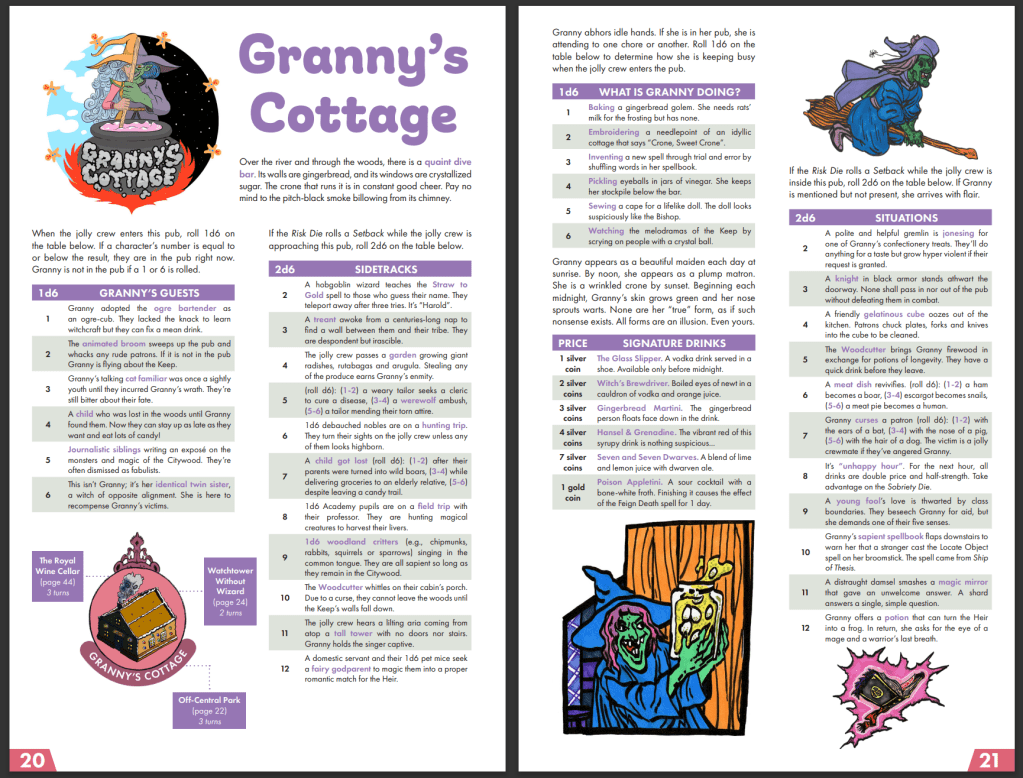
W.F. Smith’s writing style is lighthearted and holds together a module that could easily veer into ridiculousness in the derogative, but doesn’t. Most of the writing is in bite-sized tabulated format, is evocative enough to springboard off the other writing in the module, and also relies on the GM to fill in gaps which is exactly the way I like it. The humour sneaks up on you in each entry, as well, but it should be clear that I expect Barkeep played as intended (as a pubcrawl) to result in a ridiculous and gonzo campaign, as most elfgames trend towards comedy even in the absence of a comedy setting. I appreciate especially how the tables are used to tell stories for the GM, often being an art form: “(1-2) a weary tailor seeks a cleric to cure a disease, (3-4) a werewolf ambush, (5-6) a tailor mending their torn attire.” This kind of writing is elegant and occurs throughout the product. It feels like W.F. Smith edited all the other authors for consistency, because it’s a shockingly consistent module for one with so many writers.
Structurally, we have 20 pages of set up and rules, and the remainder is pubs. The first section feels a little too much as you read it looking forward to the money of the module, but honestly if I look at the individual sections I can’t fault them too much individually. The adventure is a complex one: It involves time passing and things changing, election politics, and theft investigations, and so these sections are necessary to keep the ball rolling as anything other than a book of pubs. Unfortunately, if you want to run this as a GM, the 20 pages of set up is necessary work, in the same way that the first section of Witchburner was a bit much for me, but worth it for the outcome.
An example layout, of the spread available on Drive Thru RPG preview.
The layout is flashy and straightforward, with clear headings and use of colour for clear delineations. I wouldn’t recommend reading this on your phone, like I tried to do. It’s designed to thoroughly take advantage of the print format. Different pubs have unique colour signatures and title fonts, and fit to a spread. I’m usually an objector to having such highly variable headings, but they work here due to a very consistent format with exemplifying art, summarising paragraph and top left placement. Art is almost always palette-matched to the colour scheme of the associated pub, and uniformly matches the aesthetics of the piece. Every pub has its own stylised mini-map as well. I should probably back track a little and say that while the majority of the text is exceptionally laid out, the introductory sections don’t benefit from the consistency of the pub structure and are a little messier and more ad hoc.
Writing more about Barkeep is challenging, because it’s a complex and intentionally varied experience, so I might pick out a few favourite moments of mine in it, by way of illustration. I love the way the politics are not subtle, but not communicated to the players through exposition: “Lizardfolk nuns hand out red pins. “Remember the Iron Fens Uprising. Mourn, yet organize!” Dwarf revelers try to get them arrested by Chaos paladins.” I enjoy how the signature drinks of each pub are simply excuses for the writers to be a little flashy and make puns: “Newest Corpse Revival. Won’t actually animate you with grotesque unlife but feels like it could. Gin, bits of orange.” I love how each situation (of which there are at least eleven for each pub) feels like a potential set up for an entire night of gamming: “A thrown spear narrowly misses the Barkeep. The bar is closed until somebody faces their wrath”, as do the sidetracks that are intended to be tangents: “A couple’s date is interrupted when one transforms into a wolf. Their date cries for help but won’t allow the wolf to be hurt.” Most of all I enjoy the subtlety of the connections: “The owner wanted to sell this rooftop karaoke bar and retire to a tropical island but discovered an endangered bird roosting in the rafters. Now any sale is prohibited by royal decree.” and then, in a table: “The phoenix in the rafters mistakes an ashtray for its murdered hatchling. The bartender commands everyone to sing a lullaby to soothe the phoenix’s fiery anger.” These are common, and excellent examples of how to world build without lore and endless exposition. To be clear about these examples, normally I take thorough notes as I read the module to find good exemplars of the writing. For Barkeep, I just flicked to a random page and had to choose from multiple excellent set ups on that page, all of which were worth quoting. This book is dense with gameable concepts and explosive situations in a setting that gives strong reasons for the Jolly Crew to participate in both debauchery and investigation, as well as strong reasons for the situations to be explosive.
Barkeep is a unique experiment in a specific type of module, and I think it succeeds for the most part. It’s intended as a social adventure, which is exactly my jam (if I wanted a combat-packed session, I’d play something with tactical combat rules), but it doesn’t try to be an exploration-based game in the slightest. I imagine playing this roughly in real time, with the Jolly Crew (as the party of PCs is called) cramming as much debauchery and investigation into each night of partying as they can. The effort in running and setting up I think would reward the right group of players, but it’s an irreverent pitch that wouldn’t be for everyone. If I recall correctly, my recommendation for Witchburner is that it’s close to perfect a social intrigue game, but the dark and hopeless premise may not be fit for your group. If that darkness and hopelessness was what prevented you running Witchburner, Barkeep on the Borderlands is your light-hearted and irreverent solution. I personally prefer the darkness and twistiness of Witchburner, but Barkeep is probably a better social module, and it’s definitely going to be funnier.
I was saying to Marcia and Emmy that I’m feeling a little tired regarding the complexity of Knave 2e’s abundance of hazard dice, and mentioned that I am preferring a token system right now. I use poker chips.
Buy Supply Chips in town, at the cost of 1 gp per Supply Chip. They take as much space as a ration or 6 torches, and replace those things and assorted paraphernalia. Parties may pool Supply Chips but carry them individually.
To travel forward a hex or a dungeon area, expend a supply. To find a secret location or door where you are, expend an additional supply.
Supply exists in the world, so you find it and leave caches of it, but its use is abstracted in a way that incorporates time. Whenever you spend a supply, there is a 1-in-6 chance of a random encounter.
Importantly, Supply is not directly related to finding loot. Importantly, you can spend additional supply to find a secret win can lead to or contain treasure, but not to uncover the treasure directly. The players are not inventing treasure, they are discovering hidden places.
Gravek and her party are travelling through the Gruelsome Forrest. It is dense, and it takes two supply to advance through a hex unless they have a guide or are familiar with it. They climb a tree, and see signs of a valley or sinkhole to the west. Do they expend additional supply to investigate? They do, and discover a hidden location: The Funguzoid Sinkhole of Fr-ang Fr-zul.
Soulumo and their party are on the second depth of the Fane of the Brain-Snake. They are in an otherwise unremarkable blood-shrine, but are suspicious of the carvings in the walls. Do they expand an additional supply to investigate? They do, and they discover that inside a gargoyles mouth is a map leading to “The Golden Scroll of Saint Barabbas the Lion-Maned”.
In either of these cases, the party should find what a secret when they search. I keep a list of secrets and maps ready for most regions I play in, unconnected to places or people. I keep unique loot tables for regions as well. There might already be a secret location or a secret door, or a secret treasure in the location, in which case they find that. But the most important thing is that they find interesting actionable information first, and stuff second. If you’re having trouble with what they find in a room or location without anything hidden, I might suggest adding a world anchor to something from this table:
Note (courier, a memo, to self)
Book (secret history, heretical scripture, personal journal)
Map (hastily scrawled, architectural, surrealist)
Key with a unique shape (unlabelled, labelled mysteriously, tracked)
Small treasure of mysterious origins, requiring a specific antiquist to identify, who wants more and larger
A portal, leading to…? (a viewpoint only of, one-way to danger and reward, two-way and impossible to close)
Anyway, that’s how I’m gamifying travel at the moment, being annoyed with rations and torches and timekeeping and terrain and all that malarchy. It’s clearly inspired by Hunt Tokens, but they’re not really enough for me.
There is a lot of room for improvement, I’m sure. Riff on this, I know Emmy and Marcia will have revolutionised my approach by the time this goes up.
Bathtub Reviews are an excuse for me to read modules a little more closely. I’m doing them to critique well-regarded modules from the perspective of my own table and to learn for my own module design. They’re stream of consciousness and unedited harsh critiques. I’m writing them on my phone in the bath.
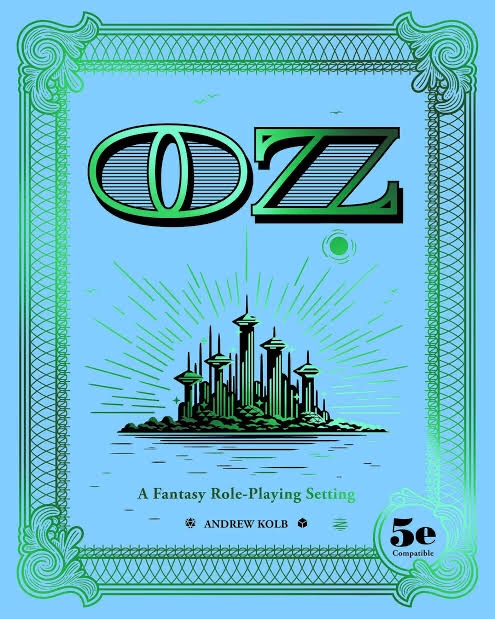
Oz is a 200 page city-and-more supplement for fifth edition written and illustrated (and with cartography) by Andrew Kolb. It’s a spiritual successor to the similarly produced Neverland, this time featuring the world of L Frank Baum’s Oz series rather than that of JM Barrie’s Peter Pan. I have the print book, so screen shots are taken from previews on Amazon, Drive Thru or Kolb’s personal website.
On first impressions this is an intimidating text. Three column layout, tiny point size this is a very dense text from the get go. This is a monster of a book, an A4 paged, metallic embossed hardcover with a cloth book mark, full colour interiors, and affordable with the margins only available to publishers like Simon & Schuster. It’s not a premium product: There are plenty of these on the shelves, and it feels like a gaming product with style, belonging next to your copy of Tomb of Annihilation if you’re a quirky fifth edition player. It’s undoubtedly a more polished product than most elf-game products on the shelves, especially for something so idiosyncratic by a single author, and a sight better than anything else aiming for the fifth edition market.
The structure is similar to Neverland, although simpler: Rules and introductions, then bestiary and NPCs, then locations and finally a chapter of resources. I’m not sure what the right approach to orienting someone to such a huge non-linear text, but while it’s overwhelming, the first “what’s going on” spread does a decent job. When I say overwhelming, I mean “21 major characters and 12 major factions in 2 pages”, if you want to benchmark what I consider a bit much, and how could it not be a bit much in so little space? A nice addition is explicitly calling out themes so that the thematic resonance isn’t missed at the table; I know I have mixed opinions on whether the author should be discussing the themes of their work so explicitly, but honestly this particular work doesn’t communicate those themes particularly well through the text, and as someone whose experience of Oz is limited to the Scottie Young comic series, it’s appreciated.
Oz opens with what I’m beginning to suspect is the universal sin of module writers in the 20’s: Choose which four of the twenty one characters I just summarised to you will be the main four. I reiterate this a lot, but there is a place for non-specificity and this is an unreasonable ask when you don’t know the structure or politics of the piece. Just tell me about who’s in charge in your creation please! This whole spread is an exercise in offloading scene-setting to the reader in the name of replayability, which I feel completely misses the essence of what replayability means in elfgames like fifth edition.
We transition to rules, where a lot of energy is oddly put into defining terms, particularly point crawl and ‘local crawl’ (a generic dungeon crawl term). It’s odd because they are self explanatory to those of us who understand the terms, it doesn’t help anyone who doesn’t. They are also repetitive: there are different types of points to travel between — a subway map with multiple intersecting but separate lines — but the rules for each individual line are usually identical and always similar, and so spending multiple paragraphs on it seems redundant (derogatory) to me. There is also an advanced rules section which is largely pointless and dry, although the mapmaking section is pretty cool, featuring a method I saw first in this JP Coovert video method for streets, and a building designer that is excellent. The method needs support — tables — but those tables are in the back of the book, and no reference is given to them here — I had to look for them, a failure in my opinion. Referencing in general is present but not always when you want it to be. Overall, a bit like the rules in Neverland, these are overwritten for what they achieve, but there is gold in them there hills.
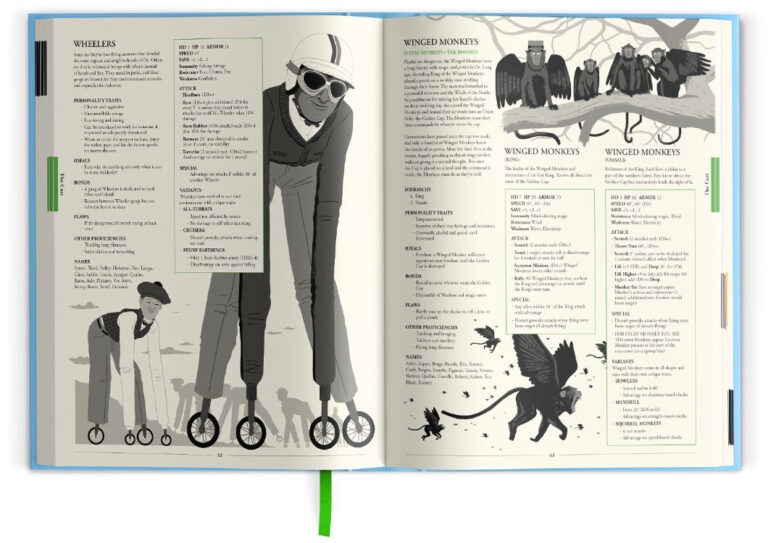
The creatures in this bestiary are very Oz-flavourful in a much more interesting way than Neverland’s were Peter Pan flavoured, and interact with the editions mechanics in imaginative ways. A serpent who spells out words to be resistant to, clockworks that become more strong the more you fight them, paper people with spells written under their clothes. Fun, unique stuff. My concern that major NPCs are scattered throughout this section, a choice inherited from Neverland that I don’t enjoy. Interesting, the trait/flaw/bond structure inherited from fifth edition character creation has had added to it a unique descriptor (for example “Wicked & Wonderful Leader: Animal, commanding, powerful, unpredictable”) which honestly in cases where it’s present is all I’d actually need to run the character (in combination with the chapter 1 information). This is the good stuff, and I’d love for Kolb to trust me more with this kind of writing rather than (we’ll get to it) the stuff he wants me to make up myself. I’m overall honestly a big fan of this bestiary, but it is worth acknowledging there are entries for as bland things as “animal, small” here too, so it’s not all roses.
Bestiary spread. About as good as it gets for fifth edition. Disappointing though that Kolb didn’t provide a version of the spread that was entirely animals.
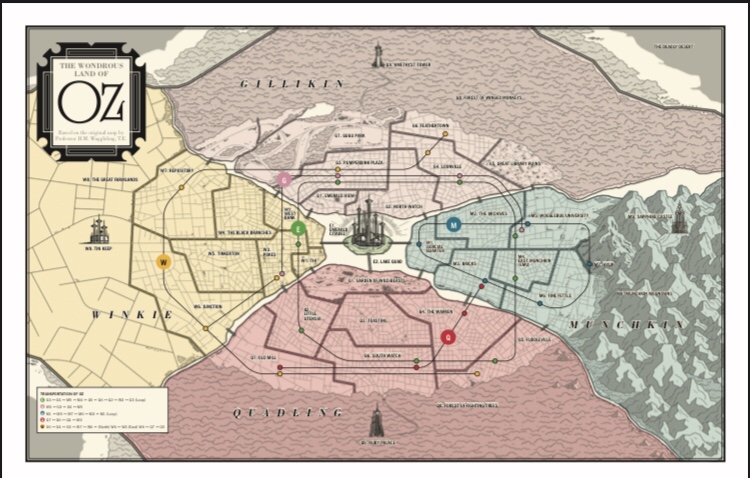
In the location section, the quick area reference is essential because of the complexity of the city (it wasn’t in Neverland, as the hexcrawl was relatively straightforward). But again after Neverland there are two maps! I just don’t understand this choice; they appear to be identical, one more abstracted than the other. The abstract one is much easier to read but doesn’t have information on terrain type. Front and endpapers also contain two different versions of the non-abstracted map than are in the book; one, the messier version, with better keying. But the cleaner map would tolerate the busier key better because it’s cleaner. That’s four separate versions of the same map with similar information in the one book. This design decision strikes me as absolutely bizarre. One could argue everyone will have a different favourite version but it’s a map, and this reeks of lack of faith in your design.
One of the many versions of the map; the one I referred to as messy and useful.
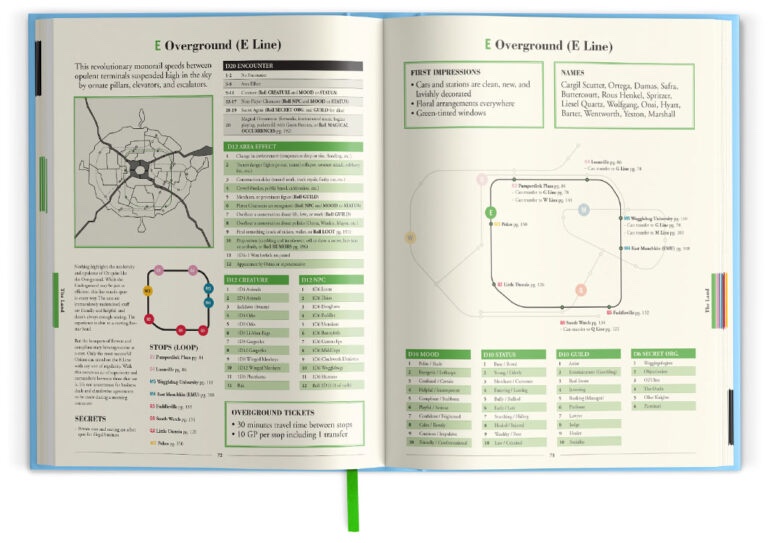
In the gazetteer, it is not at all intuitive what order locations are in in. At first I thought there was a train line followed by its stops, before I realised that it was by letter which wasn’t alphabetical but rather by first initial or the region name. For such a wordy book, this is something I probably shouldn’t have had to figure out. Unlikely Neverland, a variety of layouts are used to facilitate the different information for the different types of points here, which is a smart choice. Within each layout, the overall forms are pleasing, but the inconsistent placement of the same sections across different spreads makes information finding more difficult than it needs to be (for example the “first impressions” section moving about, a section I’d consider important to keep consistent). On train line entries, nice maps modelled after the London underground provide excellent usability. Unique NPC names for most locations make NPC generation a breeze, but again names are on one page, and the tables are on the other. The “stops” map appears on almost every page in the same location, but it’s probably the most recognisable section due to its unique colour use, and really doesn’t need the consistency; neither does “mood” which gets the same placement every spread and also has the same content. There enough of these perplexing decisions that I suspect some of the layout decisions are purely logistical (“how can i fit this on a page?”), or perhaps legacy (“I’m familiar with their placement in Neverland”) but disregarding those practicalities, they could be more intuitive.
A train line spread; note the nicely subtle detail of intersecting train lines in the right hand diagram, and the simpler but clearer communication in the left hand diagram of connected locations. This is good communication!
The contents and description of these is dry but flavourful, and delivered gradually in a pleasing way. Each location gets a single sentence summary, it’s location in the city, a longer description and a few secrets, delivered in increasing length. There are always a first impressions, usually some unique names, always train connections. Remaining spreads are used for navigation, events, specific characters, and more specific secrets. This is honestly a smoother and better iteration on Neverland’s system, but still generating on a visit to an area will take at most 4 rolls and potentially a few searches for pages (no bestiary page references in sight). This is an excellent version of this approach, but my favourite parts are universally the sections with specific characters and events in them, which are dry but well written: “Para Bruin. Captured by a group of bandits long ago and trained to box. Now free and happy to work for honey. Serious and suspicious of others” or “Fresh Dusting Bakery & Cafe. Tunnel leads to a safe space for those with dangerous or uncontrollable magic.”
Another significant improvement over Neverland is that locations that need maps, unique details and keying, appear in this section as well. This messes with the layout consistency in a third way, but makes it much easier to use them because they’re sitting right there next to their stop or district. I know this is the opposite opinion to what I feel about NPCs in the bestiary, but for good reason: NPCs need to be understood to run whole swathes of the book, so deserve to be separated from animals and grunts; locations on the other hand are usually best gathered geographically.
The final section is for resources, and it’s a pleasant hodgepodge. We have nicely non-mechanical “relics”, and floor maps for common recurring locations like banks and parades. We have random tables for adventures that for me are displeasingly nonspecific (“discover the identity of a prominent researcher”) when they could have tied directly into the locations and bestiary. An A-Z of random tables, some good, most disappointingly generic. An example is a d12 ceremonies, which, rather than give us twelve interesting Ozian ceremonies as it assures us “Oz is all about ceremony”, it gives us general categories of ceremonies. Contrast this with the small talk table which is much more hooky despite being generic (“They keep quiet, but have a relative in power”) and the actually strong plot hooks and rumours tables (“An envelope containing a dose of the Powder of Life meant for Ozma is delivered to a PC.”; “Patchwork girl has been accused of stealing on four separate occasions”). I’m of two minds here: A lot of this stuff will be more useful to more people because it’s generic, but I genuinely believe that it robs Oz itself of its greatest strength, which is the weirdness of the land it draws from.
The resources section ends with a much appreciated m “external and complementary resources” section, a much briefer “sketches and design notes” section which I found more obnoxious in Neverland, and a few pre-made characters that are absolute bangers; an angry turtle and a clockwork boxer. None of this “stock characters with a relevant hook” malarchy, these are pure gold, pulling absurdity into fifth edition by way of James West’s Black Pudding.
Overall, this is a book that tries to be usable at the table and largely succeeds. Kolb’s writing style is dry at best, and when he isn’t leaning into the specificity of his setting, it falls very flat, but in the places where he does lean into the specificity of the setting, it soars. The layout and organisation of this book are leagues ahead of Neverland and most of the competition, although it is not without its mistakes (or perhaps compromises), and while I remain surprised Neverland hasn’t had a more significant impact on module design, I’d be very surprised if this more polished version doesn’t have an impact in a few years time.
I brought Neverland to the table a few years ago, and I think that Oz is more flavourful, better organised, and easier to use than Neverland was. Not something I’d often say of a city supplement compared to a hexcrawl. I think I’d grow weary of Kolb’s constant need to let me know that I’m making the world my own, though. I want to hear his take on Oz more, and less vague prompts for my own take. When he’s showing me his version, Oz shines.
I’d be remiss not to compare this to other city supplements, like Fever Dreaming Marlinko and Magical Industrial Revolution. For me, these two products in particular are flavourful in their bones, and do not fall prey to the assumption that I need help to make it my own. On the other hand, each of the three have their own unique flavours, and neither replicate each other in that regard, nor are they particularly compatible with each other if you want to develop a fantasy city of your own. If you’re looking for a city to run, my recommendation would probably lie with Fever Dreaming Marlinko; but if you’re looking to make your own city, or you adore the atmosphere of a darker, more political Oz, this book has a lot to offer. I really like this approach of taking public domain properties and turning them into settings, there’s something fun about it, but I’d like to see other voices try their hand at these large-scale beloved-public-domain-to-sandbox conversions.
I Read Games reviews are me reading games when I have nothing better to do, like read a module or write or play a game. I don’t seriously believe that I can judge a game without playing it, usually a lot, so I don’t take these very seriously. But I can talk about its choices and whether or not it gets me excited about bringing it to the table.
I was going to read an old favourite AD&D module of mine instead, but evidently my copy is missing and there aren’t any available for free on the internet today, so Shadowdark it is. I’m not going to call it a review, because I don’t want to play Shadowdark. It’s more of me answering the question of whether Shadowdark is something that will ever come off my shelf and hit the table.
Oh, right, for those who don’t know, Shadowdark is a 5e-like retroclone that appears aimed at grabbing some of the 5e crowd and teaching them dungeoncrawling. It’s basically Five Torches Deep but with better branding.
Terrible terrible blackletter choice for the front cover. It’s barely legible. I hope this changes on release, but they use a cleaner version on the inside for headings, so I suspect they won’t. Great not-beholder on the cover, though, if the internal art is 50% as good as the cover art, it’ll be pretty. I’ll skip the endpapers with only the comment that I had misgivings even in the weapons list, which duplicates information and skips essential tools because it’d make their rules too hard. It’ll take 30 seconds flat for someone to ask for a glaive because it sounds cool, and probably best you have an answer for how they work rather than design your rules to avoid polearms altogether.
I’m not sure what size the pages are, but my children have fully illustrated picture books with more words per page. It’s clearly written for beginners, but honestly who’s coming to the Shadowdark rulebook without experience of either other diy elfgames or fifth edition already? Are you not aware of the difference between who buys the books between those two cultures?
The characters stuff is elegant in the way some diy elfgames are. There are some very nice rules flourishes, you can be a goblin, you level up randomly, there are lawful and chaotic gods. A nice touch is that every class level has a title like in the old days. Except, no 5e player is going to enjoy this, GM’s have got to stop writing games. Not only that, this game is written in such a way that all of the potential extra classes have their names taken already by the titles, which are by alignment! You can’t have a paladin, an invoker, a scourge, a barbarian or a battlerager, because they’re already in the rules! GM’s writing games that miss the point about 5e are grinding my goat lately. Retroclone with 1000 classes: Challenge.
I’m reading this with an imaginary 5e players handbook in one hand, and books like Whitehack, Errant and OSE in the other. And it makes me realise that the 5e Player’s Handbook is a damned fine rulebook full of rules I don’t care for, as is the OSE rulebook. Where Whitehack and Errant are perfectly adequate rulebooks full of rules I really like. Shadowdark is neither of those things. It lacks personality, it feels written for fourth graders, the (I’m assured) lovely author needs to talk to Jay about writing games with a narrative voice, because it’s as bland as invisible cheese slices for a game whose art and title scream grim and scary.
That’s not to discount what we have here, which is a relatively rules lite 5e clone that pulls from the best of the blogosphere, with touchings of Dungeon Crawl Classics. It tries to brin gits own innovations, but second guesses itself: The game passes in real time it says, but every moment in the game doesn’t need to be accounted for. It’s a dungeon crawler it says, but provides no structure for such an activity, as if it has missed all the obsession around procedure in the past few years. It seems to want to say: Play a retroclone! They’re exactly what you’re playing right now, but with less interesting characters but also fewer rules!
Cool! Wierd! It has a in-world gambling minigame! Ok. Strange thing to end the player-character centric part of your book on, but you do you I guess. I guess I’ll put a collectible card game in my next monster-hunting campaign to keep the players occupied? The GM-centric remainder is all the stuff that needs to be in here because it isn’t an existing book. Magic items, bestiary, all of that, plus the little dungeon-masters guide for the beginner to retroclones GM. It’s serviceable and dull, much like most of the rest of the book.
My impression of Shadowdark is that it’s a serviceable, clearly written, clearly laid out retroclone with a lot of rules in common with D&D 5e. But, it has no personality, it doesn’t bring shadow nor dark into the text, and it doesn’t leverage the huge advantages that springboarding off 5e brings. This game needs to be oozing horror; it needs banging layout that chills your spine; it needs to bring more personality than 5e brings to the Players Handbook and it doesn’t succeed in doing that. Most of the buzz I saw leading into the Kickstarter was that this was a 5e killer, coming in the wake of the OGL disaster to sweep up the disenfranchised.
This is not the one, I’m afraid. If you’re willing to learn a new game with the vibe that a game named Shadowdark should have, learn Errant, a game that does ooze horror while remaining D&D, and doesn’t skimp on tactics either. If you want to play 5e, but with dungeon crawling, listen to blogs on tape for a while, learn about proceduralism, and just add some rules to your game (honestly just take them from Errant). Your players will thank you for it; they like playing Moon-worshipping tabaxi princesses in space, let them. If what’s actually going on here is that you’ve gotten old and you don’t have the time or energy to devote to preparing the behemoth of prep that is 5e, then admit it and get your single friend to take over the job, because everyone likes their game already.
There’s been a lot of talk about how 5e is bad lately (it isn’t) from public GMs and designers who want their players to switch to new or their games (they won’t), because GM and design centric perspectives misdiagnose that 5e is good, actually.
This video’s first point illustrates the misdiagnosis well. Actually, players of 5e want a list of character options the size of Pride and Prejudice. It scaffolds unique characters with mechanical support and prescribed choices in character growth. GMs don’t like it because the GM is poorly supported, and designers are usually forever GMs.
I actually diagnosed this confusion a few years ago with my embarrassing Infinite Hack, which I don’t expect I’ll revise. The key thing is that any (fantasy) hack of 5e needs to be fully compatible with all the character and spell options to be acceptable to players of 5e.
With this in mind, here are the hacks I would try to achieve those goals and make the combat less slow and easier to prep for. There are a bunch of procedures I’d add, but honestly you can take them straight from any fantasy procedural from the last few years. Errant, for example.
Hit points. Use your number of HD, add the size of your hit dice. Monster HP is same.
Death saves. Roll the type of hit dice for rounds until you die, when reduced to 0 HP. Monsters don’t get death saves.
Proficiency. It’s fine, but if your passive proficiency at something is equal to or higher than the DC, auto-succeed. Also, if you learn something cool and specific, get the specialisation bonus, and write it on your sheet next to arcana or whatever.
Damage. All attacks deal 1 damage. Critical hits deal their damage dice. Beware multi-attacks! Monsters are same.
Rests. Heal 1HD damage and conditions on a short rest, all damage on a long rest.
Inventory. Players don’t care. Use a pack mule and then just give each character ten slots for cool things like a video game. Yeesh, go full Breath of the Wild and allow them to trade XP for extra slots if they want.
Spells. Do away with slots and memorisation. Make a spell check (like a spell attack) whenever you cast a spell. If you fail, lose the spell for the day, but you can still cast the spell. Yup, it makes spell attacks messier, but it makes everything else cleaner.
Ugh I could probably do math to figure out how equivalent this is to RAW combat mathematics, but honestly I’m feeling sick and couldn’t be stuffed. My point is, if you want 5e players to play with you recognise what they love and incorporate that into your game. And that means 15 classes, 100 subclasses, and 1000 spells.
Bathtub Reviews are an excuse for me to read modules a little more closely. I’m doing them to critique well-regarded modules from the perspective of my own table and to learn for my own module design. They’re stream of consciousness and unedited harsh critiques. I’m writing them on my phone in the bath.
A Pound of Flesh is a 52 page module for Mothership, by Donn Stroud, Sean McCoy and Luke Gearing. It is a setting primer for a space station that is effectively a city, Prospero’s Dream.
I enjoy the space stations name, a reference to the Tempest, where Prospero’s dream (in my understanding) refers to the illusions that he weaves around himself; here the illusion is the illusion that it’s possible to survive or get ahead in this criminal, hyper-capitalistic city; I also love that it gives the impression of a place where you can achieve your dreams for those (likely the inhabitants) that do not know the reference.
In typical Mothership fashion front papers are maps (the station in two and three dimensions); cybernetic mutations and loot tables in the end papers. I’d have preferred the random encounter table referred to on the map be part of the endpapers over the mutations table, but they’re great mutations like “Arms grow until your hands touch the floor and drag.”
First page is law and boarding, effectively setting the scene for the people landing here with a bucketload of debt and laws made to be broken. The next three are how to run the module, including hooks, the three main plots and their events and phases (which is a lot, and limiting it to three plots is a smart idea for usability), phase alterations (ways to personalise locations), and finally infections (one of the plots is related to a disease). We then have a list of criminals looking for suckers to take jobs for them. The jobs are how you’d determine what phase of the plot you are in. When it comes to onboarding a GM to a complex scenario, this does a great job, but I don’t love how wordy it is, nor do I love the layout decisions that separate the plots from their phases; I’m not sure what the best way to provide this information would be, but it really needs to be on one spread instead of five pages.
The we have locations. Usually in a two page spread, except for a few exceptions for various valid reasons (including cybernetics rules in the chop shop, for example). Individual entries aren’t too much, although more than I’d like. Inconsistently but often excellently written: “A jungle of gnarled veins and cables […] the Avatar of Caliban sits on a twisted, oily throne”.
The last section is six pages of generators for managing the entire station: Deadly encounter rules, the encounters, NPCs and establishments. There is a lot of well-written stuff here, but I’m not sure I’d generate a lot of the NPCs and establishments, and it would probably be a neater, easier experience if these were tied together. These are excellent one-line NPCs and encounters: “Aug screaming “Help! It’s not me, it’s Caliban!” Can’t stop attacking.”, although the establishments are not so engaging.
The last section of the book is a space station generator, which, while cool, just doesn’t belong here. At all. I have no more to add. They could have used the extra space, which I’ll discuss later.
Mothership layout is famous for being busy and functional. To be honest, there’s plenty of white space in A Pound of Flesh, and it’s clear and easy to read at a page level, but it lacks consistency. In an attempt to bring across the personality of the individual locations, for example, the layout, font choices, heading positioning is inconsistent, making information locating more difficult at the table (for me) which is contrary to the intent. The same criticism goes for font choices on some of the maps, although some maps are stellar.
Overall, I think A Pound Of Flesh lives up to its reputation as an exceptional city–type module, but I think it could have been more user friendly with some reorganisation and utilising the wasted six pages to facilitate this. The city generators should have been easy access at the back, random encounters should be back cover or backpapers. The section on running the plots and timelines needed more space to breath in terms of layout, or to be compressed and simplified (the matter might have been contrary to the goals and certainly would make Prospero’s Dream feel less alive).
That said, I’m surprised I haven’t seen more modules in the past four years mimic or improve on A Pound of Flesh’s structure. It’s pretty exceptional, and I can’t imagine a better way of developing a plot-driven city setting than some variation on this. It’s a very solid Mothership module with some exceptional room to play. It kindles the imagination too: I can see this as a primary base for a campaign, particularly if you centre it around a particular criminal enterprise and have a rotating roster of characters that go out and do other Mothership adventures. Exciting stuff.
I use affiliate links where I can, to keep reviewing sustainable! Please click them if you’re considering buying something I’ve reviewed! Want to know more?
Have a module, adventure or supplement you’d like me to review? Read my review policy here, and then email me at idle dot cartulary at gmail dot com, or direct message me on Discord!











 Playful Void