I was thinking about encumbrance in the context of this fantastic post and was thinking that, while I love this level of quantum inventory, because streamlining inventory helps most games a lot, it detracts from the fun of “Ooh! I have this cool thing!” which I want more of.
Tears of the Kingdom
I, like everyone else, am playing Tears of the Kingdom, and a perennial conversation is how to recreate the sense of cosy exploration there. The aspect of coziness that I focused on being easily adaptable is finding random and cool stuff en route to your destination. This, we can do.
Whenever you pass through a hex, you pick herbs or capture a small creature along the way. Roll 1d6 for the region you are passing through. Each region has two themes for herbs and creatures in them.
Themes
Lightning
Fire
Frost
Water
Light
Poison
Cloud
Confusion
Thorned
Weight
Sticky
Explosive
Combine these two with these effects to make your list for each region:
Resist or shield
Decrease or deprive
Increase or grow
Inflict or project
Fuse or bond
No regional effect, heal
Tweak this for any pre-existing regions you have of course, or use it to give a theme to a region you’re designing.
I rolled 6 (Poison) and 12 (Explosive) for my region, which gives me the impression of a volcanic swamp, bubbling mud and potent gasses. I rolled 3,3,4,4,5,6 for my effects. Oh, and I randomised herb and creature, but whatever.
Forage in Swayraks’ Swamp
Brimstone Shroom. Add to fire or explosive to increase its effect twofold.
Fanged blightmoth. When brewed, renders the imbiber venomous of tooth and claw.
Bombardier Puffball. Explodes in fireball when struck.
Grey flagweed. Poisonous when ingested.
Corrosive Pufferfish. When startled, explodes in a poison gas cloud. Can be attached to arrows.
Steambee Honey. Heals surface wounds as an ointment.
I added the condition here from Tears of the Kingdom that creatures need to be brewed into potions for effect. Let’s try for a second. You can guess this time.
Whetwood
Cloudflower. Burn to create a broad smokescreen.
Glue truffle. Eat to immediately spit out a cloud of adhesive gas.
Slippery whitegrub. Squeeze as toothpaste for a small amount of incredibly slippery paste.
Giant flatworm. Brew, and the i’m i ver grows suckers on all limbs, able to grip slippery or sheer surfaces.
Salvemoss. Heals internal wounds as a tea.
Graveweed. Suspends the body at the moment of death, to be healed at a later date.
Add it to your current procedure, a cosy travel layer.
Addition: Already there have been a number of suggestions and hacks to this. Sacha suggested adding a rarity layer on twitter, Long Goblin suggested a substance layer in the comments (see below), Marcia suggested loading it with wandering monsters to replicate the fact that you can’t forage under attack and to reduce rolls. Ktrey has written herb, tree, bird and fish generators, if you’re having naming troubles! I’ll continue to consider these perspectives and maybe update it as I go, but I’m so glad this idea is vibing with everyone so much!
Marcia just posted this, positing fuck procedures, just let the GM decide as hoc for more meaningful bespoke travel.
This is cool, but right now I’m into player choice, so I propose:
When the party travels, spend the day. travelling.
The GM proposes a danger you will encounter, an opportunity you will miss, and a consequence that will occur if you travel that day.
Expend a supply each to avoid the encounter, to catch the opportunity, or to prevent the consequence.
This feels very cheeky to me in a diy elfgame, but like, it’s also simpler, the tension is greater, and it makes resource management not boring. You’re loading up on supply (like, quantum, so you can be creative in its use) to control your adventure. This is how it’d play out:
“We head north, to the old barrow we camped in last time.”
“Ok, so that slug-dragon you fled last time is out for blood near there. You risk encountering it again. The Grand Seven Swords are still out there searching for the Fane of Twice-Diamond, and they’ll find it today. Back in town, the Contest of Champions is being held and you won’t be able to compete if you head out. What do you do?”
“Ok, I think we can take the slug-dragon if we load up on salt and explosives. Let’s spend a supply on horses so we make it to the Fane first, and let the Contest go — letting Garbinon win will go to his head and he’ll let his guard down next time we face him out in the wilds.”
Cool, I think. I was gonna include a list of stuff to make adjudicating this easier, but honestly, use whatever is going on already in your campaign or your World Pillars is probably the best approach.
Yesterday I posted my Reach of the Roach God review, and it was a review I struggled with, for a number of reasons. This then, isn’t a review, but simply an expression of my feelings about the book and writing the review.
I was torn on whether it was ethical to criticise strongly so early in Reach’s release cycle. I refrained from formally reviewing Throne of Avarice for this reason when it was released. I want to provide honest criticism but also, I don’t want to deprive creators of potential sales in such a challenging financial climate. I reached out to Zedeck with this on mind before I published, but it was still foremost on my mind for the last 24 hours. This primed me for a stronger emotional response than I’d usually have to writing a review, because I wasn’t sure releasing it was doing the right thing.
I was also really excited regarding a number of Reach’s innovations because of how they reflected my own work, but I didn’t want to turn a Bathtub Review into advertising for my own work. Particularly, Reach’s stat blocks are very similar to my own in Ludicrous Compendium (I know for a fact that this was not plagiarism but convergent design), and Zedeck used a page referencing system similar to what I have implemented in the upcoming Bridewell (something Zedeck built on from Lorn Song, I understand, but that I honestly didn’t remember had been in that when I intended it).
It’s personally exciting to me to see parallels between my and Zedeck’s work because Iv regard it with a lot of admiration and respect, and A Thousand Thousand Islands on particular was the first text I read that made me feel like work like that which I’m interested in producing a) can be done and b) can be recognised as valuable.
In a similar way, I responded quite emotionally at the disappointment that the translation from zine to tome didn’t go as smoothly as I’d have liked, because I can see those same difficulties manifesting as I playtest and attempt to information design and lay out Bridewell. I fear that perhaps this particular type of system agnostic module will not survive a transition from zine to long-form, and that’s not an outcome that is acceptable to me.
All of this, and the parallel work I’m doing on Bridewell, as well as ongoing discourse on the apparently dismal state of criticism in elfgames (a comment that, as you might imagine, I take personally and argue against vehemently, although I maintain that if you want change, be the change), has just filled me with challenging feelings this week.
Anyway, that was a rather pointless and incoherent rant, but there you have it, it’s my blog and I can be incoherent if I want to.
Bathtub Reviews are an excuse for me to read modules a little more closely. I’m doing them to critique well-regarded modules from the perspective of my own table and to learn for my own module design. They’re stream of consciousness and unedited harsh critiques. I’m writing them on my phone in the bath.
Editorial. Today, both creators of a Thousand Thousand Islands (Zedeck Siew and Munkao) made announcements regarding an end to their professional relationship. This is sad news, and it appears that anyone purchasing A Thousand Thousand Islands in the future will only be renumerating one of the creators financially for their work. In a complex situation such as this, I’d encourage you to read these statements before you consider buying Reach of the Roach God or any other parts of A Thousand Thousand Islands. – Idle Cartulary, 11th July 2023
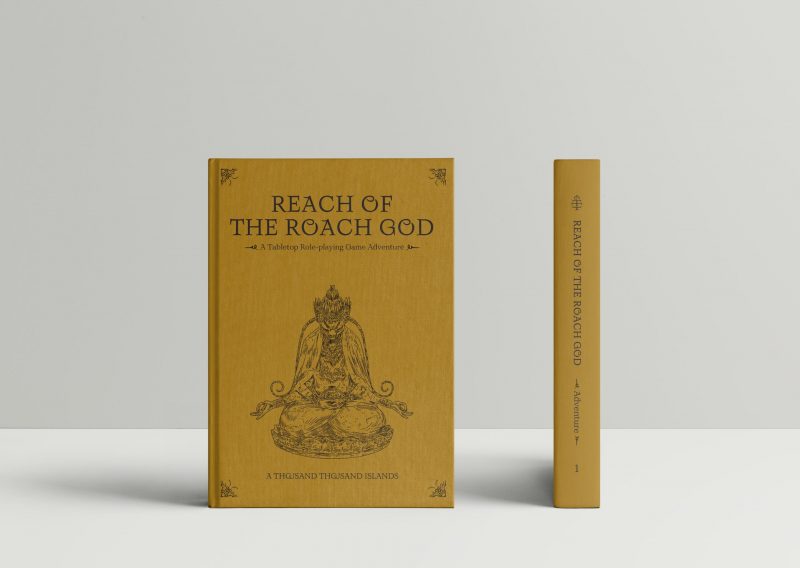
Reach of the Roach God is the first long-form of A Thousand Thousand Islands, previously a series of zines (Mr-Kr-Gr, Kraching, Upper Heleng, Andjang, Stray Virassa, Korvu and Hundred Red Scales, plus appendixes). Written by Zedeck Siew and illustrated by Munk Kao, with layout for the first time outsourced to hrftype. It is a setting with a strongly implied narrative, one of independent villages, encroaching cities, and a developing doom creeping up from below, driven by spite. This is a long book spanning multiple concepts and approaches, and so my usual chronological approach won’t really hack it for this bathtub review.
Zedeck’s writing here is slyly funny and unsettling when necessary, but mostly hypnotising and tactile. It fills the page more here than in previous iterations, largely because of hrftype’s layout choices which I’ll go into later on, and it pulls you forward into the text like an undertow. Reach is bookended by short story openings, and while a pet peeve of mine is when authors sneak their uninteresting fiction into my modules, Zedeck’s writing feels like an ancient fable your grandmother memorised and recited to you, and fills you with empathy and loathing for the foes featured in each section.
Mun Kao’s illustrations are as subtle and erudite as anything he has drawn before. The soft linework complements Zedeck’s writing in a higher density than in any previous iteration. This higher density is a mixed blessing, however, causing the groupings to be less contained and intuitive; characters are scattered from their inciting incidents and locations, reducing the usability of the text. This problem was clearly recognised, as superscript page references are incorporated to help facilitate interactivity between increasingly broad swathes of text, however it feels a little like the pressure of Maximum Illustration in a “professional RPG product” in this case is at odds with usability. To a degree, the amount of art often mutes the effect of the forthcoming art; the proximity of the map on the left page on page 88 lessening the effectiveness of the introductory viewpoint on page 89 for example.
Many of Mun Kao’s maps are beautiful but not awfully clear and perhaps not more useful than a chart would be. This is placed in stark relief when you encounter his more abstract maps of the City of Peace, which are really useable and remain artistically en pointe.
I can’t say the same about the layout consistently complementing the writing as well as the illustrations, although I have a complex response to the book as an artifact. There are so many touches to the final book that literally gave me goosebumps or caused me to sigh at the luxury. The embossed cover, bound book mark. the thicker yellow stock of the chapter titles, are just beautiful touches that feel like the style of the series of zines applied to a stronger budget in the best possible way. The custom font designed by hrftype is creepy, beautiful and legible, however feels overused in the book where perhaps it would have been best left to headings and titles. There are dozens of small icons, custom separators and flourishes throughout the book that speak to attention to detail and love of the product being made. Page references are very complex to apply and are utilised very well in the first third of the book. I haven’t measured the book, but it looks to be US Trade or Royal format, so it’s quite the imposing hardcover; the large choice of typography therefore isn’t entirely inappropriate, but in combination with the density of Mun Kao’s art here, it loses the sparse yet considerate sense of form that previous iterations of A Thousand Thousand Islands had. I prefer the previous approach, although I suspect that this book would double in size if it were taken.
The book is broken up into four sections, where the fourth is not included in the book in probably my favourite invitation to play in recent memory: “QUOTE IT HERE”. The impression here is one of symmetry, three locations, each with three stories, in each of three parts. This gave me a strong sense that I understood what was coming, which sadly wasn’t true. The three parts in Reach of the Roach God are, in my opinion out of order. I attribute this a little to the nature of Kickstarter-funded projects, and a little to the fact that any author wants to front-load with their strongest writing, but I reached the end of chapter four feeling like it was content I wouldn’t use, which coloured my approach to chapter five and six. The eighth chapter however, a Kickstarter stretch goal, is key to your recognition of the entire second part’s place in the story. I read the first 100 pages and was leaping out of my seat with excitement; the second 100 pages and felt disappointed; the final third and I realised that there was a secret key to it all that I had never understood, and that I’d have to put more preparation than I’d expected from my experience with the previous iterations of A Thousand Thousand Islands.
Ok, those are my overall impressions, and I think I’m coming across as very critical of the book at this point, so I’m going to get a bit more specific for a while and call out some aspects that are just absolute genius to balance it out.
In Reach, Zedeck implements a five-sentence stat block that is highly reflective of what I think should be the standard for stat blocks in all system-agnostic modules. I (and most people I know) rarely run a module in its intended system, and this approach means that I don’t have to put as much work into translating stat blocks or learning systems I’m not interested in. I’ve been on this bandwagon for a while (I wrote a series of bestiaries based on this approach a number of years ago), but this is the first time the approach has appeared in a mainstream product that I’m aware of, although Luke Gearing’s Volume 2: Monsters& approaches the concept. I hope it spreads further.
Zedeck’s writing tows a narrow line between facilitating humour (in my opinion, the natural end-point of elf-game play) and maintaining a south-east asian fairy-tale tone. An excellent example of this is a cushion which, once your feet touch it, you cannot leave for an hour, intended to encourage meditation. I immediately pictured an absurd pillow fight against the roaming roach-boulder guardians, dodging and ducking thrown meditation cushions, until the losers are stuck sitting together for an hour thinking about what they’ve done.
Random tables litter this book. For every single occasion of travel, there is something that happens, randomly generated, but often not an encounter: “It’s claustrophobically still. Your heartbeat pounds in your ears”. This is stellar use of random tables to make every instance of travel feel meaningful without the drudgery which is complex travel rules. On the other hand, some of these tables probably could have been lists. One generator might produce a caretaker from a funereal city that “repairs burial jars with colourful, powerfully adhesive gums, has a glowing ghost arm that cannot carry weight, and was given away as a child.” and adds a few prompts to develop them further. But the two pages spent on generating this caretake may have been best simply creating six caretakers from this list, saving one and a half pages. I don’t think there is any replayability lost from minor characters being repeated in these cases.
There are a series of spirits in part 3 that are just evocative and I want to play them all. They’re born from particular desires, and Mun Kao’s art of them is weird in a particular way that feels unique and true. They are just so cool.
Part 6, the section focusing on Odoyoq, the Roach-God and the cult attached to it, provides an incredible amount of support for the rest of the book, while also requiring a huge amount of interpretation. Flip to a page and you’ll always find scripture to quote, which is absolute gold. But also, it incorporates a huge amount of Roach politics that were unexpected to me and in retrospect would change the way I ran the campaign, but also, provides me with a huge amount of material to sustain the campaign that comes after Odoyoq inevitably wins.
After Creatures of Near Kingdoms, I don’t think anyone’s surprised that this includes a spectacularly illustrated, inventive and evocative bestiary in chapter 7. My misgiving with the bestiary here, is that none of these entries are referred to before the bestiary occurs; there might be stalagmite-animals in the bestiary to complement my stalagmite-people in the gazette, but that’s not something I, running this at the table, would necessarily be able to facilitate incorporating without a lot of preparation. However, the bestiary is referred back to in the following section.
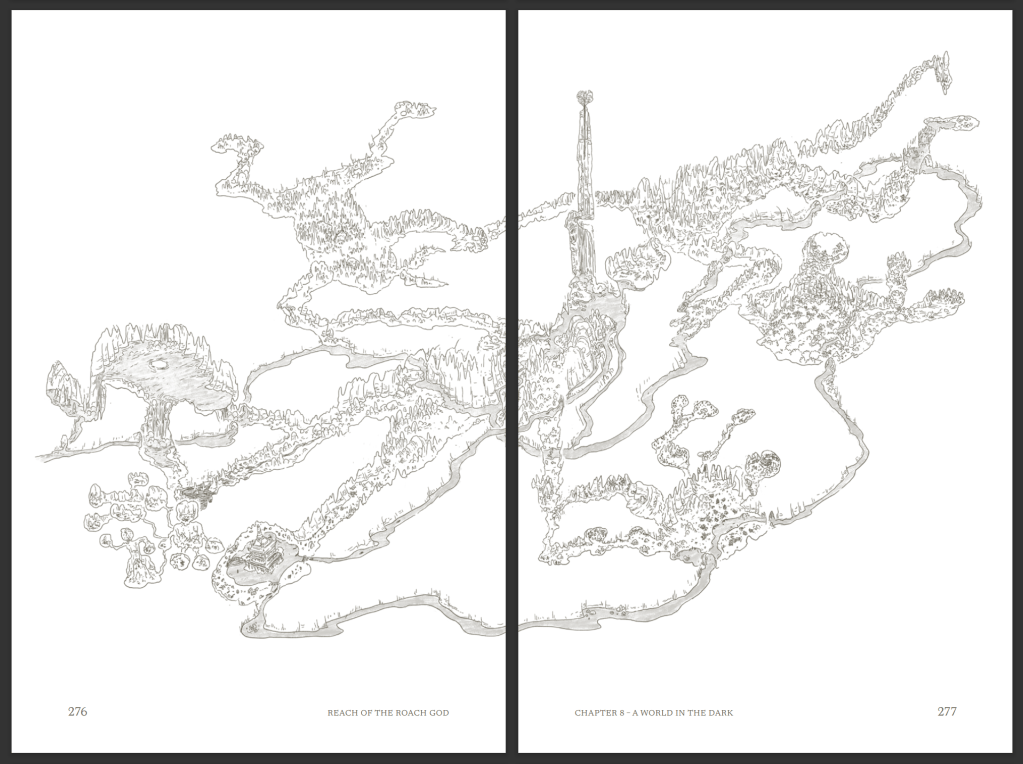
I alluded earlier to the stretch goal in chapter 8, a map-generation system using a series of action figures. This is something I was completely disinterested in from the description, but what we actually have is a way to customise your map and how all six sections link together, as well as fleshing out the connections between the places. This is where the story locations, gazetteer locations and peoples and bestiary are tied in together, dynamically. It is very, very cool, particularly as a proof of concept, but Mun Kao literally illustrates a map of the world as part of the explanation in a gorgeous two-page spread. And I can’t help but feel like I’d have preferred to have that map of the world up front, as chapter 1. Chapter 8 pulls a lot of disparate elements together in a way to make the book something I can actually run as opposed to just something I can enjoy reading, and it gets very short shrift as an implied appendix here at the end of the book.
Perhaps I view the zines in A Thousand Thousand Islands through rose-coloured glasses, but to a degree I feel like Reach of the Roach God fails to reach the heights those zines did. Why? I think it’s worth speaking of the effect of format in expectation setting. In my library, the only roleplaying games with a book as beautiful as Reach are Thousand Year Old Vampire and Trophy Gold, both excellent but flawed books that are not in the same league. Other books? My first edition of The Gods Themselves; an illuminated Apocrypha; a folio edition of Under Milkwood; a complete Lovecraft. These are definitive editions of these texts. The implied expectation from the format chosen for Reach of the Roach God is that Reach is the definitive A Thousand Thousand Islands; I think that the typography choices, the point sizing, the titling choices, and the density of illustration (among other things support this expectation. Instead, I think what we are given is six new zines and two appendixes, in a novel format. And, why am I disappointed in six new zines in the most consistent series of modules in recent times?
Reframed as such, Zedeck’s writing is absolutely without peer, as are Mun Kao’s illustrations. Reach of the Roach God is innovative in a number of ways that I would love to see implemented more widely. Despite my criticisms, this one of the best long-form books released in a long time – perhaps ever. The experience of reading the hardcover was the most tactile pleasure I’ve gotten from reading anything roleplaying-related in a long time (the only other that comes to mind was the Art & Arcana artbook). An absolute recommendation.
Bathtub Reviews are an excuse for me to read modules a little more closely. I’m doing them to critique well-regarded modules from the perspective of my own table and to learn for my own module design. They’re stream of consciousness and unedited harsh critiques. I’m writing them on my phone in the bath.
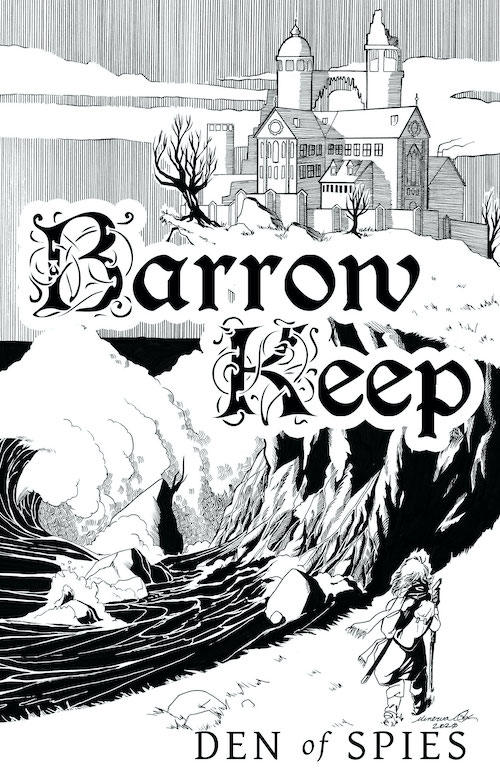
Barrow Keep: Den of Spies is a 70 page fully illustrated setting module written by Richard Ruane with stellar art by Minerva Fox. It’s written for generically OSR settings. It’s broken into two larger sections, the first being an introduction to the setting for GM and players alike, the second being secrets and further expansion on the setting for the GM only.
The introduction immediately falls into a pitfall that renders it not for players of characters in the setting: Random tables. It just pitched wrong. The random tables, also, are something I rail against: I don’t need a generator for the three most important political characters in the setting, I’d rather you give me all three on one page and let me stew in the possibilities. The first three pages cover three characters who aren’t named and have 2–3 sentences of characterisation. This makes me twitch.
Locations within Barrow Keep are well-structured and evocatively written. I would have loved the layout to be more consistent: A location to a spread or page, perhaps. And they’re a little wordy for my liking for locations stretched across multiple pages. But there are no wasted words, and my main criticism is in the usability at the table. Faces in Barrow Keep absolutely nails it, with a bunch of useful and short 2–3 sentence descriptions. They aren’t beautiful, but they’re unique and characterful. Great.
Next up is rules for equipment and ritual magic, which, I understand that this is intended to bring the vibe in line with romantic fantasy, but I just don’t think belongs. It particularly jars because it isn’t modifying an existing system, but rather generic DIY adventure games. Luke Gearing’s Wolves upon the Coast (something too big to read in the bath) does this, but it assumes the use of a specific hack for that campaign. I just don’t find any of it to be flavourful enough to justify the space or my bothering with it.
Then we’re onto the second section: Secrets of Barrow Keep. Here, the module absolutely falls apart structurally, which may be because outside contributors take some of the load. There is no map of the keep, which feels intentional, but I had the impression that most of the keep had already been covered. This section adds sections to the keep, including “how to navigate” which simply does not do as titled. Then, it digresses to a heist adventure suggestion, a rumour list, a few new characters, some delegations, and it continues. Just a hodgepodge that is desperately in need of structure and recommendation.
The individual sections here, though are as strong as the earlier ones: Well structured (although some of the structures aren’t consistent with earlier ones), evocatively written if not beautifully or wittily. It’s all very useful, but not usable at the table, mainly in preparation. The secrets section also luxuriates in an overuse of tables, which, once again, seems a misunderstanding of the purpose of a table. Give me great relationships and interesting situations, and then vary things within them. Well-written is better that randomised; randomised tables fit a specific use-case of things that need and want variation.
I should stop here, and note that looking through the inspirations list and reading this, we’re talking about running a campaign that is likely to be high intrigue, minimal combat and dungeon-crawling. That’s not how I would characterise romantic fantasy, but honestly, genre labels are always kind of vague.
Overall, I’m a little disappointed in Barrow Keep. It’s a module that brings a great first impression, the art is beautiful and sucked me in, and that has a lot of good to excellent writing that works well with the stated aims of running a romantic fantasy adventure game, but whose structural failures and lack of clarity on how to incorporate your player characters into the setting leaves it falling flat for me. I don’t mean to be scathing, but it reminds me of an excellent WOTC adventure: Lots of great content, requiring lots of work to turn into an actual campaign. Even if I’m buying a setting, I’m not looking to spend tens of hours preparing to run it.
Barrow Keep comes strongly recommended if you’re looking to run a romantic fantasy adventure game, and are willing to put in a fair amount of effort to fill in gaps (or if you have a campaign where you could drop this in and incorporate its politics with yours). Lots of excellent content, all useful, but you need to make it useable yourself. Not a module for my table, but maybe one for yours.
Tom commented on my post Only two or three things that they felt that this approach (or at least my examples) were over-compressed, and it got me thinking. Like, obviously I disagree, but I think there’s a little more nuance to it.
Firstly, yes, you can write one paragraph per thing. But, in my opinion, why write a paragraph when you could write a sentence? Why write a sentence when you could write a clause? Additional words, in my opinion, should be justified. I write for myself, and to be honest, I want to be able to quickly read and adapt, and I can’t do that with a four paragraph description. That’s why my writing feels over-compressed.
Is there a place for four paragraph descriptions? Yes. I think great examples are puzzles and traps; they benefit from additional words for clarity and to allow the GM to adapt to alternative approaches. In my recent review of Aberrant Reflections I commented on this approach being appropriate, and the traditions of traps and puzzles in elfgames mean that allowances should be made for this.
But that’s not what I usually see in four paragraph encounters, or four paragraph characters, or four paragraph descriptions. I usually see paragraphs that could be communicated in a sentence or even with a few words. I use the word “overwritten” a lot when writing bathtub reviews for this reason.
Why do I think they’re overwritten? Probably because I don’t need every detail of a room, character or encounter described if I’m running a game. I want just enough that I can run it, no more. Much of the detail can be implied, I can imagine the rest. This does vary depending on what we’re describing though.
So for dungeons, maps are extra necessary detail. Puzzles and traps might deserve a paragraph to themselves. But for everything (these things included), for me, less is more.
Bathtub Reviews are an excuse for me to read modules a little more closely, but I’m doing this as a critique from the perspective of me, playing, and designing modules myself. They’re stream of consciousness and unedited harsh critiques on usually excellent modules. I’m writing them on my phone in the bath.
Aberrant Reflections is a fully illustrated 38 page dungeon module by Direct Sun. It bills itself as a “puzzle dungeon”, and it more than lives up to its name, more closely resembling a dungeon from the Legend of Zelda than any other module I’ve read.
It’s a smart move to pick a gimmick for the whole dungeon, and open with explaining the gimmick to the GM and suggesting how to adjudicate edge cases. An example of an edge case is given from playtesting, which I really liked. I imagine it would be challenging to use a gimmick strong enough to sustain a complete, if small, dungeon.
Aside from that, it opens with a timeline (not strictly necessary, but it’s standard on modules these days), a page of special items and how they can be used, and eight creatures and NPCs. Four of the items are involved in solving puzzles, although you may not discover them all. There’s a jarring moment here where text is purple with no explanation, and it’s purpose gets explained a few pages later.
The symbols and colour coding occur as part of the key and maps, which covers most of the book. Most rooms are one to a page, include art of the room or a map cutout if it’s important to understanding the room, and has text for both the “real” room and the one in the alternate “abberant” universe. I usually don’t like wordy entries, but I forgive it in this case because they’re doubling up on rooms every entry and using art to assist with understanding.
The writing is functional, but has a lot of nice worldbuilding touches such as “Selling the painting will draw the ire of its previous owner— Captain Rosewell of the Martel adventuring company.” I don’t mind the workmanlike writing here, because it’s important to understand the pieces of the puzzle, although I’d love to see the gap being bridged more effectively between great prose and practical puzzle communication.
Layout is consistent and clear. There’s a lot of solid line art here with purple highlights by Del Teigeler Jacob Fleming, Luke Broderick and Kiril Tchangov, all of whom have harmonious styles. Typefacing is readable. None of this is flashy, but it all feels very classic dungeon sensibility while also modernising the messes that were classic dungeons in reality.
The puzzles themselves are very central to the dungeon, and I’d recommend being sure that your friends are keen to solve puzzles. I like them a lot. I don’t think they’re too difficult, they lend themselves to creative solutions, and in the hands of a good GM, they’ll be a great time. There’s also the evil lurking on the other side, placing time pressure on many of the puzzles completion in a satisfying way.
Finally, I like the use of the inside cover pages for wandering monsters and the map of the dungeon. Great for usability and also they’re great quality. The map is annotated, and if you knew the module well you could probably run the adventure from it, and if you don’t it still makes it very easy to find relevant other locations and items. The wandering monsters table includes stat blocks, and includes checklists for encountering the same characters multiple times for different events.
Overall, this is a very solid dungeon, and I’d recommend it for the right group. My criticisms are mainly things holding it back from being great, and I suspect were conscious decisions made for functional and pragmatic reasons that make sense in the context of the module and don’t detract from its usability. It’s easier to criticise my favourite type of middle that reaches for the stars and fail, than this more modest dungeon that nails most of what it attempts.
There are about 40 monsters in Bridewell. I’m going to playtest in Trophy Gold, maybe Into the Odd, two systems that are easy to stat for, so here is a dual bestiary. This is why I wrote the other week. I’ll write about ten at a time, I suppose. Content Warning: Horror, implied abuse, murder.
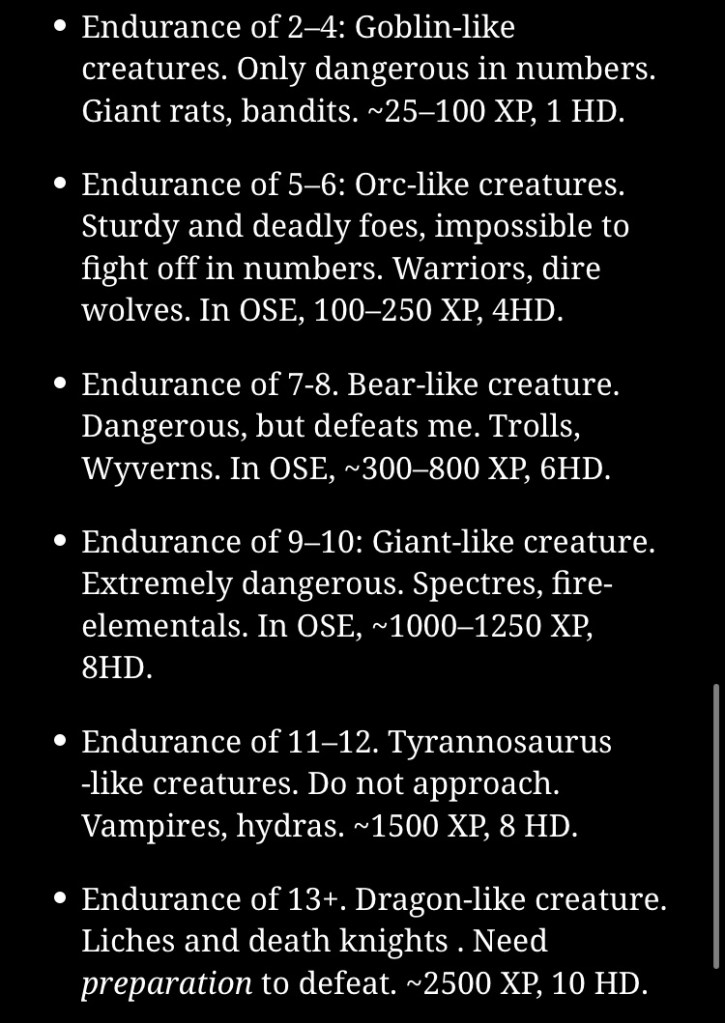
Khumush-spawn. Magist-experiments, serpentine, winged, undying, rotting. TG. Endurance: 6. Weaknesses: Sunlight, kindness. Habits: Starved, curious, friendly or guarding. Defences. Freeze-constrict, lightning-bite. ITO. HP 4. Armour 0. STR . 10 DEX 13. WIL 5. Attacks: Lightning-bite 1d6. Can constrict as a serpent, 1d4/turn blizzard.
My Bridewell playtest campaign continued today with Marcia and Alex joining. It was a longer session as I’m out of hospital. We’re playing in my own hack of Trophy Gold. There will be Bridewell spoilers, but if you’re a part of the playtest, you can definitely read this.
Erstwhile the disaster girlfriend joined Ursaline the bear-priestess. They picked up choosing to pursue to thread of finding a holy relic (“part of a god”) in order to save the relic stolen from the Vineyard of Our Lady of Perpetual Light by the Penny Dreadfuls of The Abbey of Saint Angelus.
Erstwhile disguised herself as a scholar to persuade Sigfiend and Orto to allow them entry to the library. With Orto escorting them, they browsed the library, eventually discovering a forbidden book that required both charm and slight of hand to access too (and Orto’s suspicions now lay on Erstwhile, having been revealed she cannot read or speak a language she indicated she could). The forbidden book maid reference to a cult of Knights Belour and their associate Magists being involved in dark magics involving chained or hostage gods.
Ursaline interrogated Veaceslav, secret druid for information, leveraging the multiple favours he owes them. He indicated these Knights Belour were in the very south of the valley of Bridewell centuries ago, but knew very little else. He indicated it would be a great evil to use the bodies of any of the gods of the valley – Padru, Groaming or Khumush – in such a ritual.
Ursaline and Erstwhile, taking the road and choosing (out of character) to bypass many sites for the sake of the session, travelled for a number of days to arrive in Ravensbourne, a small town which strangely feels as if it is not of the same dismal cut as the rest of the valley. Here, flowers bloom, birds sing, and grass is green, although the people of Ravensbourne act as though all is more as it seems than you’d expect. Visiting the fairly empty tavern, they persuade the innkeeper Erik the vibes in his inn are off, ply a local – Alexi – whose grandsons fled for Dimmness-town leaving him with nobody to look after the rookery – for information, and gain the interest of two robed strangers who let slip they have a map leading to the ruins of a Casa Belour that they intend to visit soon. They ignore a suggestion to talk to the Burgomaster of the town. Planning to beat the strangers to Casa Belour, they depart post-haste.
Casa Belour is a fortified manse in a field of artificial black thorns, hidden behind a cleft in the mountains. The only place in this region that does not seem merry and bright, it clearly is the site of an ancient battle, and is crumbling and vine-choked. Within, they spied and avoided praying corpse-knights, flying death-serpents, and plotting undead tacticians, before engaging in a long conversation with the gay commander of the Knights Belour, stuck in his office planning a battle for centuries. With the knowledge of his true love clouding his awakening, they stole his papers and his amulet, which they used to open a secret door in the statue of the Warden of the Forsaken, an unknown god, in the great hall. Screams could be heard from a nearby room as they climbed down into the basement, and here they faced two long-dead, bored and surprised magists in a vestibule, and could hear nearby the groaning of something vast in a twisted and dark laboratory.
I feel like there was less happening this session despite its length, mainly because a lot of the dungeon crawl at the end was starting and stopping, and avoiding encounters, much of which was breezed over in the summary. I’m not a fan of “door to the left or two the right” in dungeons, so I basically gave them a free peek through every door, so they had full information for the most part about the room ahead so they could choose whether to engage. This potentially backfired, as the two felt they were not well positioned to fight the dreadful horrors that lay within this castle. The map I used for this dungeon was experimental in the sense that I didn’t complete it, which I think was not successful in the way that these players wanted to tackle the dungeon. I think that map will need revisions. That said, I think certain success in this first Bridewell dungeon crawl so far.
Marcia at last twigged to the fact that the Bridewell mists are a variety of Nick’s Flux Space when the map they gained allowed them direct access to the Casa Belour. I think this tied together why I’ve set up the mists the way they are, and I wonder if the rules to this simplified flux should be explicit or if I should let that gleam happen in future player’s eyes too.
Some great pleasures are coming from the success in the module’s capacity to face out of sequence play. Not once so far has the approach of the players been the anticipated route by the module, but each time that has yielded fun and unique results. In this session, the sequence-breaking meant they had key information for a character (the death-knight commander) that otherwise would have been a significant foe, to render him instead lovesick and open to plying with charm. This is a single sentence in his description which I honestly put there for the sake of the GM, but ended up playing a key role in the outcome of this particular session.
I’m really enjoying running Bridewell, but I’m starting to see that the structure and writing here is sound (although I’d love to test out a few more locations), and the real question is whether or not the writing and structure holds up to other GMs playing and reading it. Now there’s tension between whether I cease my playtest earlier (even though there’s a lot of fun to be had), or whether I cease after a few more sessions and then let the beta phase of playtesting (“Do other GMs like this too?”) begin.
Bathtub Reviews are an excuse for me to read modules a little more closely, but I’m doing this as a critique from the perspective of me, playing, and designing modules myself. They’re stream of consciousness and unedited harsh critiques on usually excellent modules. I’m writing them on my phone in the bath.
The Big Squirm is an 80 page, fully illustrated mystery for Troika! by Luke Gearing. I backed it on Kickstarter. It is a complicated module to wrap my head around, being an investigation with randomly generated clues. First up: Impeccable art by Andrew Walter and very suave type facing. Honestly the cover doesn’t do the interior justice. Just lovely to look at, with very few missteps in layout.
One of my favourite illustrations, by Andrew Walter, from the Big Squirm
It opens uniquely: A description of the state of the city and the stat blocks of two feature creatures, before the contents page. I like this as an opening, to be honest, and am of two minds because if I wasn’t reading a .pdf, I might have just skipped the stuff before the contents page? Like, there isn’t usually anything useful there.
Information here is disseminated to rival investigators after four days, which serves to even the playing field and put some fuel on the fire, as the enemy can easily catch up and interfere with your plans. The d66 information generator is cool, and would make sure scenes aren’t replicated across play throughs. I’m always a bit suspicious that a table that should be rolled in advance should be a table at all, though.
There are six competing investigators, and the author really leans into the strengths of Troika to make them memorable, terse, easy to run characters. This is gold.
The “Interested Parties” are the factions, and these are fun and weird as Troika! factions should be, excellent ease of use and interest. They’re just funny, too: “At the height of the speculation, the Left Yellow Gang began crafting harmless imitation worms. These sold well…”, then: “Goals: Shift a bunch of papier-mâché.” Some layout decisions I wouldn’t have made, put similar information in different page positions across spreads for three of the spreads (just switch the art positions for consistency!).
The locations section is anchored around a spectacular and functional map. The location summaries suffer from something that is a peeve of mine — the largest location at twenty pages comes up first, the smaller ones (between one and seven pages) come after. I find that approach a little overwhelming and it makes the latter areas underwhelming. The best of these are pithy and witty, (“The concierge is a dog with very, very long legs, wearing its hat at a rakish angle. She doesn’t appear on any salary records, but no-one has yet been able to remove the hat”, and the worst are unnecessarily verbose. The latter would benefit from either an edit or shudder dot points. There is a single page with four locations on it, and each of those nails it. The longest location feels like it may be the main adventure location, a major heist, which is not the vibe I expected until I arrived at that location in the book, and could use stronger telegraphing. I did miss the minor telegraph on my first read through: A footnote in the information table suggests the presence of a complex location.
I’m very torn on this module all together. On one hand, the vibes are impeccable, and it’s lovely to utilise a system like Troika! for an investigative module like this. The best investigation module in my opinion is Witchburner, but it’s a much tougher module to engage with than this.
On the other hand, while The Big Squirm offers more replay value, I think (not having run both) it would be the more challenging module to run. This is mainly due to the information economy and the random information generation systems. The latter can be ironed out easily, though. I think it’s hard to gauge whether the information economy would have value except table to table, and whether it would achieve its intended effect for your table specifically.
I came up against information design concerns reading Witchburner, but it was easy enough to reframe the module to find a good approach. The Big Squirm feels more traditional in its location-based structure, and hence it’s much harder to simplify your approach or reframe information to similar effect.
Why am I struggling? I think, after a week’s pause, another bath, and a re-read, it’s because the Big Squirm is two things: An investigation and a sandbox. I don’t think it manages to square the circle. If I approach it as an investigation, I want a summary of the mystery as a GM. I want a final confrontation with the Weaver. But, this module also wants freedom at all points in between, which causes problems with my capacity to prepare. And what’s more challenging, Troika! as a system encourages more chaos! I honestly have no idea which direction this adventure would take, and that’s after two read throughs.
There’s so many great things about the Big Squirm, and it really showcases well a fantastic writer working in a comedic mode. It’s interesting and lighthearted. It’s an investigation. It’s really a unique module with a lot to offer. It’s hard not to recommend it, despite my concerns about managing all the complex information in the module, which would probably require a lot of preparation for a GM like me. So, the Big Squirm: Recommended.
I use affiliate links where I can, to keep reviewing sustainable! Please click them if you’re considering buying something I’ve reviewed! Want to know more?
Have a module, adventure or supplement you’d like me to review? Read my review policy here, and then email me at idle dot cartulary at gmail dot com, or direct message me on Discord!






 Playful Void