In 2025 I’m reviewing zungeon zines. They’re stream of consciousness and unedited critiques, just like Bathtub Reviews, but they’ll be a little briefer. The goal here is a little different: I want to spotlight what a craft-based, just-do-it approach to module writing can do.
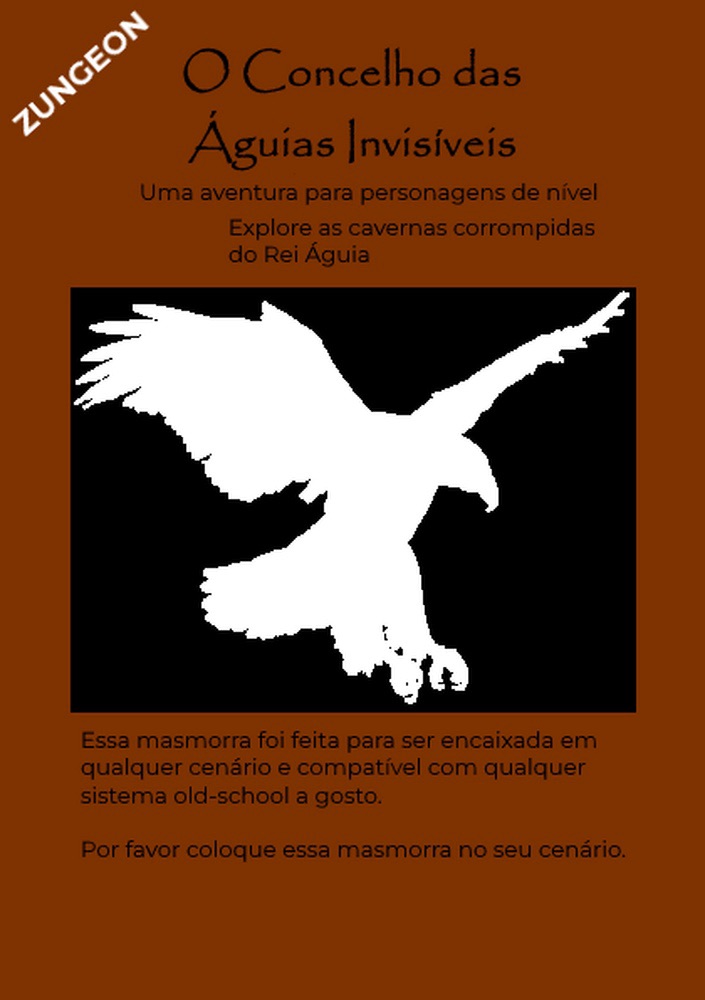
Council of Invisible Eagles is a 3 page dungeon for Old School Essentials by Matheus Gran. Gran has been an active member of the Advanced Fantasy Dungeons community for some time, and completed a SLIMDNGN translation to Portuguese, but as usual, it won’t affect my review. In it, you explore the corrupted lair of the Eagle Monarch. It’s also available in Portuguese.
This is a simple 6 room dungeon, but Gran adds some flourishes that make it really sing. The Eagle Monarch has a tangible, but recognisably bestial goal, that make it easy to imagine how it can be implemented into your campaign (it wants kill all rodents as a way to ascend to godhood). There’s a nice d3 table of random encounters, which is the right number for a small dungeon. The smell makes it impossible to rest in one empty room — lovely touch. The map is lovely and visual by O Elefante. Lots of funny touches too — why aren’t these particular eagles invisible? The monarch just likes looking at them. The Harpies have their own horde, hidden from the Eagle King. The invisibility is caused by spores the King harvests — which can be co-opted by the players.
All of these show that Gran knows what makes a module tick. How to make something small and simple, interesting to dungeon play. It’s interactive. It’s fun. I’d prefer a little more personality provided to each of the factions — what do the eagles want, how does the Eagle King want, why are the Harpies both on his side and acting independently? But overall, this will give you a solid night of fun play, and it’s designed to drop straight into your campaign. Neat stuff.
A prominent game designer recently said in a Dice Exploder thread, that breaking down design paradigms before you design games is self-limiting and unproductive. This was interpreted by many as “you don’t need to read or play a lot of games before you start designing games”, which is both true and not true. I thought I’d talk about how it is and isn’t true.
If you want to design games, you have to do the work of designing games. Lots of bad, dichotomous discourse comes from this advice, but it’s like any art: You just have to make it to get better and find your voice. But also, like all art: You’re going to be bad at it, initially. This is part of the process. You have to do the work of bad design to get to the work of good design. Don’t let anything stop you from your practice. And at the same time, you have to do the work of learning about game design. Do these things while you continue to design games.
The first thing you have to do to learn about game design is read a range of games. You need to get to know what has been designed before. There are at least 50 years of game design before now: Loads of clever people doing clever things. You will be better if you know about them, and have thought about them. You’ll be inspired by their beauty and by their flaws. Read designers: Designers with a long catalogue have been in conversation with themselves, and you get to listen in. It’s illuminating and it will help you grow. Read a range of games!
The second thing is to play. You can read more games than you can play (or at least most of us can), so your reading also acts as browsing the catalogue. Which games will you actually bring to table? I suggest the ones that make least amount of sense to you. Try to play as well as run, but games are often as much about how the book acts at the table as how they read. If you can, play the same game at different tables, because it’ll help you internalise the fact that every game you read comes to the table completely differently with a different group. If you can’t, actual plays can substitute, or complement. Seeing people play and run games gives you insight into the extent of a designers power over the play.
The third thing you need to do is to start learning the extra stuff you need to (sadly) do to make a game. Art, layout, information design and editing in particular, are important parts of your game design. They are game design. You can collaborate with people or do it yourself, but collaboration is a skill in and of itself that you have to learn, and thinking in terms of art, information design and layout is something your games will benefit from incorporating into your thought processes, even if other people are working with you. None of it is optional as part of your game design development. Your game design will be better once you embrace that game design is multimodal, not just rules and words.
The important point here, is that yes, if you’re a new game designer, just make games. Don’t wait until you’ve read every game: You never will. Don’t wait until you’ve played every game: You never will. Don’t wait until you’ve can make or afford art, layout, marketing, editing, printing, or any of that stuff. Just make your game. But also: Read games widely, play games broadly, and practice, research, grow.
I Read Games reviews are me reading games when I have nothing better to do, like read a module or write or play a game. I don’t seriously believe that I can judge a game without playing it, usually a lot, so I don’t take these very seriously. But I can talk about its choices and whether or not it gets me excited about bringing it to the table.
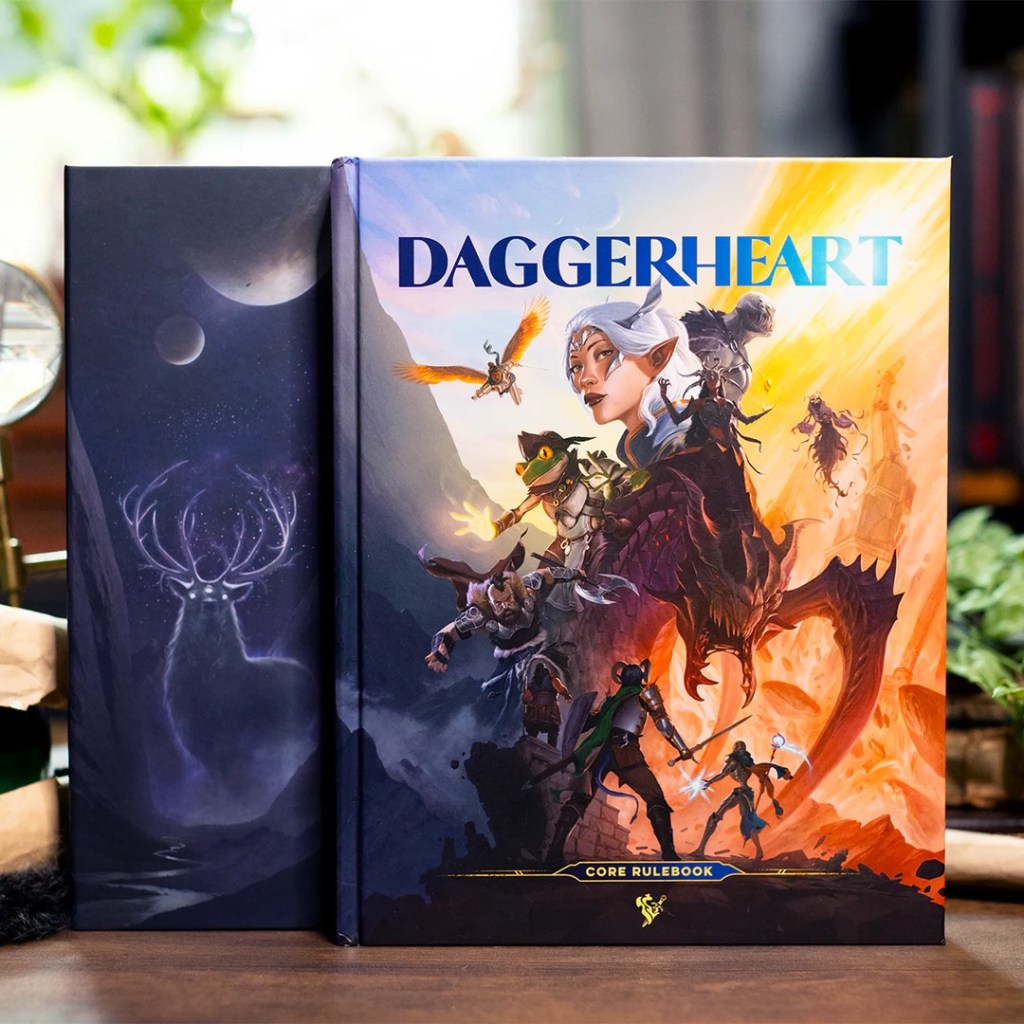
I’m exhausted from a big house clean up, so while I take the kids to the park, I’m reading Daggerheart. If you haven’t heard of Daggerheart, a 400 letter format D&D killer from the Critical Role team, you’ve probably been hiding under a rock (fair given the pending apocalypse). Even if you are, you mightn’t be aware of the team they’ve brought together: many tens of contributors, lead by Spencer Stark, but joined by Meguey Baker, John Harper, Banana Chan, Sebastian Yuë, Pam Punzalan and many, many more, in varied roles. I don’t know how much work all of these people (or the dozens whose names I don’t recognise) contributed, but the bar is high. Daggerheart styles itself as collaborative, heroic, narrative game that focuses on combat. What I hear when they say that is: This is a game designed to play Critical Role. Let’s see if I’m right.
This is a game focused on conflict resolution, so it has a primary roll, just like D&D: Here you roll a d12 for hope and a d12 for fear, add a bonus and compare it to the difficulty level. If hope is higher, the referee is cued to make the situation better, and if fear is higher, worse. This seems an elegant way of adding in a little story-game narrative suggestion without eliminating that list of skills and abilities that this style of game typically has. Damage dice are polyhedral, like 5e, and the referee rolls a d20 instead of 2d12. Interestingly, you’ll also need a stack of tokens to track things on your character sheet including bonuses, and a deck of cards (you can print them, if you want). Maps and minis are also optional in the same way that they are in 5th edition: Not really.
Once this is covered, the book moves on the principles of play. I’ve said before, I love it when a game sets out explicit principles: and Daggerheart has the unique advantage that I suspect a lot of its players are keen enough to actually read the rulebook, but disappointingly these are loosely paraphrased from classic story games. I prefer some bespoke principles to these, but as this game is aimed at an audience naive to the games ludography, I suspect this is intentional. There is a little space here devoted to the “world” of Daggerheart — likely so that mentions of Daggerheart’s equivalents to the multiverse don’t fall on deaf ears. This is not the first and I suspect will not be the last place where Daggerheart is trying, if not explicitly, to feel like 5th edition, either to court that audience or to reflect how Mercer runs Critical Role. Another place where it does this is in character creation: There are 9 classes each with 2 subclasses, and although names don’t always match, these feel incredibly 5th edition. There are 6 stats with modifiers in the familiar range, and ancestries cover the classics such as orc, elf, firbolg and “drakona” (I’ll give you 1 guess what that is). A fun addition is communities: The place you’re born, not just the ancestry, impacts your characters. A nice addition, but you can see the tension the authors are facing in trying to step away from the problems of ancestry without distancing themes from D&D too much. Daggerheart does officially bid farewell to languages: Everyone can speak and sign to everyone (this is the right moment to say that Daggerheart puts a huge amount of effort into inclusivity: multiple sections cover playing disabled characters and supporting them — Daggerheart is a queer, disabled, and inclusive world). Finally, you have hope, fear, evasion, stress and hit points. I like that hope doubles as the equivalent here of inspiration and of experience points. The rest are what they sound like, covering familiar ground such as AC, damage, and exhaustion. You still start with the classic D&D items like 50 feet of rope, but mundane equipment is deprioritised here (although copious space is devoted to mementoes and magic items later). Finally, skills and proficiencies are replaced by experiences, which can be gained or lost. This is a neat overarching umbrella and allows for much more interesting action that the old 5th edition list, but I wonder if the infinite potential here might be a disadvantage to the audience, who are used to the limited slate of 5th edition applied broadly. The issue is that when you’re treading a line between system mastery (with the cards I’m about to cover), these flexible experiences feel abusable by the crowd they’re flirting there. It’s a tension I don’t think they succeed at navigating, but that may turn out to be an invalid concern. Finally, you choose your domain cards — these are your abilities and spells. You pick 1 per level from your classes 2 domains, 2 at first level. Very 4th edition. I think, in person, people will enjoy these cards. Now, explaining this was a lot, but I suspect it’s straightforward practically once you understand the system, and provides enough different interactions to reward a little system mastery while keeping it loose and giving more story levers n the form of communities, connections and experiences than a typical 5th edition character would. The character sheet, which is far more forgiving than 5th editions, bears out that theory, although note that you’ll have a small hand of cards as well as your sheet.
Going through the classes and ancestries, there are no surprises. For me, they capture a lot of the archetypes you want from 5th edition, with very little innovation except in that the use of the cards mean the class descriptions mostly max out at 2 pages (some exceptions — druids have shapeshifting rules that stretch a while longer for example), and the ancestries at a half page. No Daggerheart classes are as complex as their 5th edition counterparts, but they’re all similarly complex, gaining a similar number of abilities or spells at each level, and no matter what your level you’ll only have 5 “equipped” at a time. It suits me, but players who love to figure out how to milk interactions may struggle. One 10/10 decision, though is that you can either play a Myconid, or someone who is half myconid. I can’t wait for the myconid/drakonar fan fic.
At this point we get into rules proper, and there aren’t too many surprises. It feels like 5th edition with some extra narrative sparkle. I like that they define a character taking the spotlight as a move, and domain cards can therefore hinge you whether you take the spotlight — that’s neat. Tag Team rolls are a neat way to mechanise the team working together in a way 5th edition always wanted you to but never incentivised: You could have your hulking orc fastball special your gnome at the dragon with this, which is cool. The addition of tokens to cards allow for some fun potential combinations for certain classes too. It’s a nice, flexible mechanic and I’m sure it’ll go cool places. Interestingly, Daggerheart measures in inches not squares, or in range bands: This again reflects combat in Critical Role, where it’s either theatre or the mind, or it’s in an elaborate, never squared, map.
Just like the Player’s Handbook, huge swathes of Daggerheart are dedicated to lists: Equipment, ancestries, etc, but nevertheless character creation and player facing rules end at page 139, and it veers to referee facing stuff: That’s three quarters of the book for the referee. That’s an unprecedented amount of support, rivalled only by Pathfinder 2e — but here we’re doing narrative as well as mechanical support. It opens with referee principles and best practice, which are solid but (again) generic, but then integrates the Baker’s concept of moves into a 5th edition framework very elegantly without forefronting it too heavily. The referee is suggested that moves are triggered by player actions: Fear, consequences, or other opportunities. They tie what kinds of moves are recommended with those suggestions. They even suggest improv prompts for different versions of hope/fear and success/failure. There are examples of play, to make the framework practical. This is good referee support. There are 2 pages of example moves, that are effectively a Daggerheart version of the ones from Apocalypse World. Good stuff. It then covers how to use the “fear” you accumulate for max drama (from all those fear dice the players are rolling) and also covers how to set difficulties with tons of examples. It goes through how to use countdowns (using a die to count down from a number) to run a bunch of different scenarios in a way that mimics clocks but that feels more tactile. This is all good stuff. It then adopts what I feel is the Robin Laws concept of Beats as narrative prep (perhaps lifted from Slugblaster, which gets a credit), which while linear for my style, works very well for heroic narrative play. It’s got examples and ways to make battles interesting and to avoid a grind-style battle — in terms of combat balance, it’s really straightforwardly laid out: This is the formula, pick from the tiers. It’ll take play to see if the tiers and the algorithm are correct, but on the face of it it’ll be easy to make a heroic combat encounter, and adversaries are grouped so you know you need this many minions with your boss or whatever. And it tells you how to build your own! And with it are the rules on environmental hazards — focused on raging rivers rather than traps. It has advice on one-shots and campaigns, how to incorporate character backstories, and juggling multiple personal player character arcs. This is all excellent stuff, if you want to run a campaign like Matt Mercer.
After the bestiary (it’s a bestiary, natch, it’s fine), we go to campaign frames: This is Daggerhearts system for world-building to the point you can sit down with your friends to play. It takes you through the process, then gives you 5 examples with varying scales and complexities and their own rules. I can’t understate how cool some of these are, and how much they’d open many eyes to some wild possibilities that just didn’t exist in 5th edition, particularly the Motherboard and Collossus frames. Just great stuff. I’m just surprised, to be honest, Exandria isn’t here — I know Wizards of the Coast had published a sourcebook, but I can’t imagine Darrington Press has lost the rights somehow?
Briefly on the layout and art: This is meant to look like D&D and it does. It does it better than D&D 2024 does, to be honest. The art is incredibly evocative, if you’re into the digital painted style, but it doesn’t have a strong identity. The text is complex and unwieldy, and refers to yet to be stated rules too much. That said, it does that with page references, it is generous with space, sections are clearly signalled, it uses colour incredibly well, and the pdf is digitally indexed very well. For the mess that it is and the complexity that books of this scale need to be, it handles it admirably.
Honestly, I’m really impressed. This is better referee advice than we see in Pathfinder 2nd Edition or D&D 2024. I could run this, despite being a mother of 2 young kids with no time. My friends who want a heroic fantasy and aren’t interested in the OSR: This could fit into my schedule. It’s neat and elegant. The tradeoff is that player characters are simpler: This will a betrayal to players who like the complexity of 5th edition or Pathfinder. But you know what? I could never run those systems in my current lifestyle, and I could run this next week without a hitch. Is it groundbreaking? No, but it isn’t intended to be. This takes the best parts of the current indie community, aims them at perfecting but adhering to the conventions of modern D&D, and it mostly succeeds.
My big concern, of course, was that this would be an expensive book: It places a huge amount of the game into the cards, and without them, you couldn’t run a character. It expects the players to buy the book and the cards: But to be honest, it’s more affordable than I’d expect for the set (although not in stock). The overhead is high but not much more than 5th edition (where you have to buy 3 books), and spread around the players. And the clever mapping of the classes across the deck of cards (the “domain circle” means that 1 deck will serve 4 players if they choose their classes spaced out. It’s becoming affordable, almost (it’s a matter of perspective: Cairn and Mausritter are both available for free).
Is Daggerheart for you, though? If you don’t enjoy the current 5th edition or Pathfinder zeitgeist, or don’t have pressure to run a game that suits it, no it isn’t. This ain’t gonna convert any OSR heads or story-gamers to Critical-Role-curious. But, if you want to run or have friends who want you to run a Critical Role style campaign full of half-planned narrative beats and intertwined character arcs, with the veneer of the classic game? Honestly, this is better than 5th edition for that. Likely better than anything on the market — D&D2024 and Pathfinder 2e are leaning in the other direction, I don’t get the impression the terribly named unreleased Draw Steel is aiming at the same target, and unless 13th Age 2nd edition is a complete rehaul, I like this better. Daggerheart hits a bunch of the actual play friendly notes as well in terms of familiarity and ease of play (I’m not going to go into that at length, but I covered them here), and based on those I genuinely could see this taking over as the preferred system to run actual plays in. Was I right that Daggerheart is a game designed to play Critical Role in? Yeah, yeah I was. Your mileage may vary on whether that’s what you want, but for a huge audience, that’s a killer pitch.
Bathtub Reviews are an excuse for me to read modules a little more closely. I’m doing them to critique a wide range of modules from the perspective of my own table and to learn for my own module design. They’re stream of consciousness and unedited critiques. I’m writing them on my phone in the bath.
The Cairn Adventure Anthology (Volume 1) consists 3 modules, each about 20 pages in length, the first by Amanda P, the second by Brad Kerr and the third by Zedeck Siew, all for Cairn 2nd Edition. I got this as part of the recent Cairn crowdfunding campaign. Disclaimer: Both Amanda and Zedeck are friends of mine, who I play with regularly, and you’ve read reviews by myself of their work before, so if you think I’m biased…that’s fine. I think it’s more we’re friends because we’re on the same wavelength, so I’d approach this knowing that.
Dread Hospitality
In Dread Hospitality by Amanda P., you venture into a 14 room mansion full of gruesome horrors. It appears very intentionally simplified: Tightly framed with 1 hook, a series of rumours that are all true, and clear goals for entry and escape. The player characters aren’t here to solve the problems in the manor, they’re here to get in, attain their target, and get out. The main complication is that events take place on a timer, associated with some significant barriers to achieving the players goals and making major changes to the environment. This is a pretty elegant system (although I’d scrap the randomisation) and adds a lot of depth to a small and simple location. I would prefer if all of these were in a clear list, though: Large changes require tracking on the map, which while being more realistic and organic, are more complicated as well.
The main barrier to running this module is the 11 “factions”. Only 2 of these are actually factions, and the rest characters: This is a hell of a social dungeon. These characters are all pretty compelling, individually, but as a whole it’s a lot to swallow. I’d struggle to know at the drop of a hat exactly what Jensen Wilthorn’s goals in an encounter would be, so some visual highlighting or subtitles would go a long way towards having these characters at my fingertips.
The key uses the same (or at least close) to the format used in Beyond the Pale, something I favour a variation of in my own modules, and Amanda P’s writing is as flavourful and concrete as always; their characters inhabit the world so vividly: “She uses a kitchen knife’s reflection to peek around corners”. The key itself is a deep one: Lots of interactivity, lots of opportunity to waste time and bring on the consequences of wasting time.
There are a few key movements here that lack clarity, though. How do you change the music being played? It clarifies that the organists’ boiler needs refilling once it is empty, but can you just switch out the sheet music otherwise? And is the automaton suit as likely to explode in its makers’ hands as yours? I can wing this, of course, but they’re misteps I think for this fairly complex clockwork style of module.
Overall, though, this is a fun session or two of play, and while there are heavy themes here, they’re deep enough in subtext that you don’t need to surface them if that’s not your group’s jam. Dead Hospitality would make an excellent Halloween one-shot.
Bloodmarm Barrow
In Bloodmarm Barrow by Brad Kerr, you venture into a burial mound to do away with some bandits, only to discover it’s the lair of a fearful creature from beyond the veil. It’s an 18-room dungeon, with a deadly timer.
Bloodmarm Barrow is an altogether different beast from Dreadful Hospitality, a tour into a twisted realm that only gets stranger the deeper you get. The twist of course is that the goal is right there a few rooms into the dungeon; you’re just more likely to get it and move forward and accidentally deeper than back again. A clever and swift party will get in and get out, with little concern as there are no random encounters and no signal that the main foe on the first floor will leave her room.
All the pressure is dependent on the timer that brings that bandits back to the barrow. The return of the bandits is not foreshadowed by much, is random but will probably occur within 6 turns, and will likely result in the players being thrown in the prison pit. The goal of this is get past the inciting incident of the bandits — not really what this story is about — and place the player characters into contact with the Bloodmarm, while discouraging them from taking the easy way out. But in doing so, it steals agency from the players, something I wince at a little in this case. I think if I were to run this, I’d explain that there’s a chance of you being stonewalled into certain decisions, and make sure the table was ok with that.
The other bone I have to pick here is the “extra barrow” that’s tagged on with minimal explanation. I just feel like such things need to be — as is tradition — sealed off passages the referee can choose to fill, or left out all together. What it should be given its simplicity, is a second exit, and actually on the map. I’m not sure why it’s not, to be honest. It wouldn’t have been hard. But also, it’s unnecessary and muddies already muddy water.
The reason I feel the water is so muddy, is that the three factions here — Bandits, Bloodmarm, and Barrow-wights (effectively, they’re not called that) have no connection to speak of. So, you simply stumble from one’s territory to another’s until you retreat, or you encounter all or most of the scenes that have been written.
Now, adventure tourism is certainly a style of adventure that some people enjoy — it’s just not for me. And you do have spatial choice here, at least — aside from being forced down, you get options regarding where to explore next. But I think this would be better framed explicitly as a funnel, because that’s kind of what it feels like, and I strongly suspect that none of the peasant family the player characters are supposed to escort to safety would reasonably make it through that funnel.
While the theming and horror here is striking, I probably wouldn’t bring this to my table. It’s just not my kind of module; it’s not why I run. But I know plenty of people are just there for the ride, and an adventure tour like this is very appealing for them. It’s a beer-and-pretzels module, if there ever was one, and that’s not a bad thing. One thing I wouldn’t do is run it for players who are strongly attached to their characters, because it’s the kind of horror show that’s unlikely to be survived en mass.That said, with the degree of horror here, it would make for yet another pretty fun Halloween one-shot.
A Tide Returns
A Tide Returns by Zedeck Siew breaks form and is, rather than a dungeon, a 12-hex wilderness. The King, and more importantly his magical scepter, is missing. Recover it or the kingdom is doomed.
A Tide Returns is at once a far simpler set up — go forth into the wilderness and see what happens — with simpler complications — your rival will compete with you and steal your glory if he can. The meat of the hex-crawl is unlikely to be retrieving the scepter, but likely choosing to side with the indigenous or the colonisers. There is a grand total cast of only four characters that drive that more complex plot, and each of these have multiple clear goals (“to be together”, “to escalate the war”). It’s immensely elegant and brief, and features Siews’ elegant style from the get go.
Honestly, in terms of imagination, beauty and elegance, I think this might be Siews’ best work. Certainly, unchained by the complexities and expectations that plagued Reach of the Roach God, and with many years of experience atop Lorn Song of the Bachelor and Spy in the House of Eth, this tackles Siew’s recurring themes elegantly, his prose sings to the point I had to reduce the amount of time in this review praising it, and despite the unconventional structure and presentation it feels eminently useable. If you’re a fan of his previous work, this is worth picking up.
That said, the complexity does snowball over time, and I feel like by the time I get to the wilderness itself, I wish there were a better presentation of the recurring information that I have to track while running the module. This may not have been at its best in this anthology, but presented by itself, given more space to breathe, and with more supplementary materials than it does. As is, I’m printing a lot off, or copying it into summaries, or making a screen — something — to keep all the balls in the air. But the wide grin I got just reading the bestiary and random encounter table — maybe that would all be worth it.
And after all, that’s the bulk of what you need to know — the hexes themselves, most of them, are very brief. The largest are a page, and most are a third of a page. Once you realise that really this is an exploration of a few people’s desires and their actions in response to them, in the context of a long and slow war scarring members of all sides, you realise that the emphasis is squarely where it needs to be, it just is hard to lay it out clearly.
A Tide Returns is much larger in scale than the other two modules here, in only a few more pages, and provides a lot more interaction and long-term play. As a mangrove setting, I’d dare say you could weave in the two modules I mentioned into that world, or jury-rig it after you’ve ended this story.
A Tide Returns is a module that requires study to run, and requires placing yourself in the shoes of characters both villainous and comprehensible — if you’re willing to do that work, though, you’ve got potential for a complex and long-running setting here.
Conclusions
There’s not a lot of art in this anthology — Bloodmarm Barrow gets 4 illustrations, The Tide Returning gets 3 illustrations, and Dead Hospitality gets none — but they’re good while they’re there, and despite the consistent artist — Ripley Matthews — they’re matched well for the subject matters. The maps, though, for all three of these, are absolutely stellar. I noticed Ripley Matthew’s maps recently in Raid in the Obsidian Keep, but her work is even better here. Excellent maps, well used. Layout is a simple, consistent 2-column affair until A Tide Returning, with fonts and other flourishes changing between modules for effective flashing and navigation throughout the book, but sometimes not in the best interests for the specific mostly — I don’t think the monotype choices for Bloodmarm make sense thematically or read well. Dead Hospital fares the best here, although A Tide Returning clearly pulls inspiration from the stellar layouts of Siew’s previous work, to its’ benefit.
One interesting side-effect of reading these the modules for Cairn back to back, is that you see how some of the typical assumptions for module writing fall apart when writing especially for a system that leans into diagetic advancement as a core principle. The gold incentives in Dread Hospitality ring a little cold — the “a player is the heir” alternative is far more engaging, but the goal within the dungeon is not to connect loot. Bloodmarm on the other hand offers property, a more Cairn-ish reward for participation, and also provides a clear non-loot reason to venture deeper. A Tide Returns is (typically of Siews’ work) disinterested in details of this nature, and to its benefit. It’s good to see modules whose reasons to delve go deeper than gold or treasure, even in the presence of social contract.
One thing that’s clear though, is that while the quality within this anthology varies, these three authors are very good choices for Cairn’s ouvre, and these modules play to its strengths. One big disappointment with the anthology is that it is thematically broad enough that they aren’t compatible — I’d love to have been able to drop the first and second into the world of the third easily, but alas. That said, it broadens the appeal to a degree, which I understand. The Cairn Adventure Anthology is the equivalent of a tasting menu at a restaurant: Not everything you’d have ordered yourself, but you’ll find something new and exciting that’ll stay with you, and everything is a great example of the best the restaurant has on offer.
TTRPG design consists of a bunch of different things, and the relationships and interactions between them lead to something hopefully greater than the sum of its parts.
What are the things we’re concerned with when we design a TTRPG? Well, a lot of people would say “mechanics”. You might define mechanics as the rules and processes of the game and how they interact. The mechanics define how the game works. But a TTRPG isn’t just the relationships between these rules and processes, in my opinion. It’s also the relationships between writing, world building, art and covers, layout, modules, the book’s dimensions, the community, and arguably more. These things are often equal to or greater in importance to mechanics in their impact in the game.
A lot of TTRPG designers like to place these things under the umbrella of mechanics. The instinct is valid: It acknowledges that many things impact gameplay. It’s more useful in my opinion to acknowledge that all of these things are in dialogue with your mechanics, with their own unique ways of relating to your players, and to reserve the term mechanics for specifically the rules and processes of the game and how they interact. A car is more than the motor, and to call the seats, the exterior and everything else all “the motor” is both a misnomer and does a disservice to how everything else contributes to the driving experience, even though doing so might acknowledge that they’re all important to the car as a whole.
The city of Duskvol in Blades in the Dark is surrounded by a the lightning barrier that traps most inhabitants of the city within its walls. This takes the mechanics of the game, and places them in a city you can’t escape from. This is essential to the experience of Blades in the Dark. This phenomena is world-building, and it works in concert with actual mechanics that are in place to make life in Duskvol feel doomed and inescapable. It’s not a mechanic, but it’s still important.
The size and finish of Yazaeba’s Bed and Breakfast is really important to the gameplay: It’s a tome, a coffee table book, with a fancy cover and sleeve, and you’re supposed to put stickers in it. Now, using stickers is a mechanic: The choice to put those stickers into a very expensive, incredibly thick tome full of full illustrated premium glossy paper is not. But it impacts gameplay, and it tells you about the place this game is supposed to have in your collection and potentially in the life of the people playing it.
In TTRPGs, it is rare for one person to be responsible for all of these things. Would Advanced Fantasy Dungeons have been the same game without Hodag’s art? Hell no. It wasn’t a mechanic I designed. I didn’t dictate specifics to Hodag at all. I gave Hodag ideas and collaborated. Would Mörk Borg be the same without Johan Nohr’s layout? Of course not. It’s a huge contributor to the gameplay. It changes how you interpret the text, compared to the plain text version. But it doesn’t define how the game works. Calling these things mechanics suggests to me, that Pille Nilsson or I were somehow responsible for this. Auteur TTRPG designers. But we weren’t: This is why we collaborate. Of course, having a vision beyond the mechanics is something a TTRPG designer might have: I imagine that many TTRPG designers think something like “I have this in mind, I will seek a collaborator that can achieve this”, but that doesn’t mean the results of that collaboration are a mechanic craeted by the TTRPG designer.
I think that embracing the multitudes that consist TTRPGs: writing, world building, art and covers, layout, modules, the book’s dimensions, the community, mechanics, and more, makes us better at creating, interpreting and playing. I want to embrace the complexity of the art we make art, and the unique ways in which embracing all of these things that consist our TTRPGs can relate to our players and readers. So, maybe we can start by not calling everything a mechanic, and instead work on being comfortable with being creators that work across multitudes of mediums.
Bathtub Reviews are an excuse for me to read modules a little more closely. I’m doing them to critique a wide range of modules from the perspective of my own table and to learn for my own module design. They’re stream of consciousness and unedited critiques. I’m writing them on my phone in the bath.
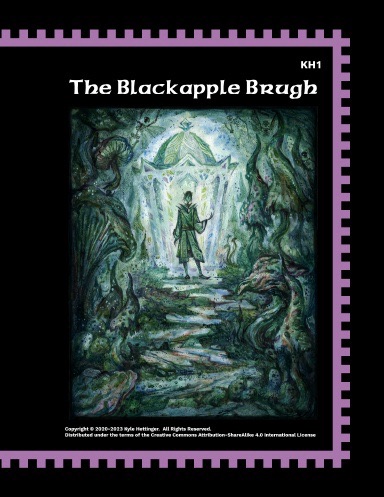
Blackapple Brugh is a 47 page module for Basic Fantasy by Kyle Hettinger. For a free module, it’s got a hell of a lot of names on the acknowledgments page; whatever coop works on Basic Fantasy has a hell of a lot of passion. In Blackapple Brugh, the player characters venture into a forest and then underground to rescue children stolen by malevolent fae.
The voice used here reminds me of the bland but clear voice used in the least interesting Dungeon modules. There’s no poetry here, just the dry accountancy of Gygax without his characteristic purpled prose. It’s overwritten for the most part, and because of that, a little difficult to parse.
The layout is a dense, illegible, ugly mess. It’s hard to find what you’re looking for here, unless you know exactly what part of the key you’re looking at. It’s verbose, and the lack of typographical emphasis makes the body text difficult to process for me. It extensively uses boxed text for read alouds, which is useful, as the read aloud substitutes for description in this module. The art is eclectic and inconsistent; recognising this likely had a budget of passionate volunteers, I’d rather it not be there than be either ugly or atonal. There are nice usability touches though: Hit points are checkmarked in stat blocks, for example, and it’s heavily referenced to both pages and keys.
There are some technical mistakes; the rumour table isn’t labelled correctly and places the wrong rumours at the far ends of the probability curve, making it difficult to gain important information. The jobs board doesn’t direct you to the right locations to fulfill those jobs. A bunch of little things make it less useable, sadly.
But the content here is all juice and interconnection. It’s not concept dense but relationship dense. Half the random encounters are directly connected to locations or NPCs. All of the locations have two or more connections. The outskirts of the village are absolutely packed to the gills with fairytale magic, with singing strange and wonderful happening regularly on the key. Everyone has a secret about someone else. My sense about Blackapple and its surrounds is that it would be an absolute pleasure to play in, and full of enjoyable characters to inhabit.
The Brugh — the dungeon — is by necessity complexly keyed and difficult to process, largely as a consequence of there being two descriptions of each room. This conceit brings a pleasantly confusing twist to the dungeon, which is eclectic enough to feel very fairytale, but sadly this double key isn’t taken advantage of for any interesting puzzles, but rather only for an ambush or two. There are so many characters to talk to here, and it’s a compelling social space, very much designed as a dreamlike space rather than as a space to explore in using your spatial reasoning. Not your typical dungeon at all.
My feelings are so complex with regards to Blackapple Brugh, I must say. In so many ways, it’s an absolute mess. Ugly, unreadable, difficult to navigate. But the practicalities of its content are unique and compelling, if you wade through the overwritten accountant’s prose. I’m just not sure I would — I’m not so enamoured of fairy palaces and fae-cursed villages that I’d want to wade through the negatives here for the sake of the positives. But the positives are so very strong and unique, it’s a very close call, and you may not fall on the same side if the line as me, particularly if you and your table are fans of worlds like that of Jonathon Strange and Mr Norrell, which this is very evocative of. The closest module in theme that comes to mind is Winters Daughter; but this is better, I think, thematically. Irregardless it’s free: If the idea of a creepy elf-world appeals to you and your friends, you should check it out. But be sure to persist before making a judgement, as your initial impressions of Blackapple Brugh are likely to be offputting.
Bathtub Reviews are an excuse for me to read modules a little more closely. I’m doing them to critique a wide range of modules from the perspective of my own table and to learn for my own module design. They’re stream of consciousness and unedited critiques. I’m writing them on my phone in the bath.
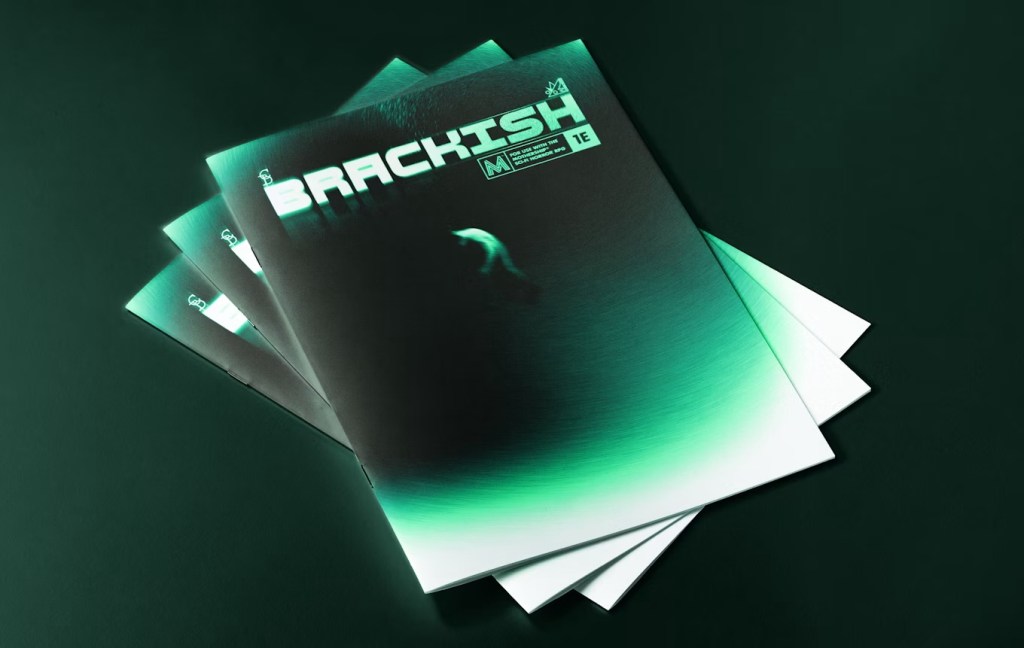
Brackish is a 19 page module for Mothership by Norgad, a creator I’m keeping a very close eye on, and C. Bell. In it, you investigate a space station that has sent a distress signal, with the goal of photographing each NPC and identifying their status, location and cause of death, all the while being pursued by a zombie-like creature. I received a complementary print copy of Brackish.
The thing that stands out most about Brackish are the goals: This is clearly inspired by video games like Return of the Obra-Dinn and Case of the Golden Idol, which in turn are inspired by classic mystery novels and board games. This means the players are incentivised to continue exploring until they’ve identified all 11 staff on the manifest. It also renders the environment and the NPCs a puzzle to be solved, making this a really compelling twist on the typical horror scenarios that occur in Mothership.
In addition to the zombie foe who persuades the players, the station is flooding due to a damaged airlock, and this flooding varies either on a timer or with the supplied soundtrack, in real time. This means that travel changes, and routes vary, and you can be trapped or prevented from accessing certain rooms depending on the time. I love these dynamic environmental challenges, and the real time soundtrack is a lovely touch.
The enemy creature, Flotsam, is interesting: Mystical, levitating, passing through mirrors and reflective surfaces, but nevertheless with unique varying tactics as it is injured. It’s uncommon for a Mothership module to feature a creature grounded in magic, but whilst Flotsam has fairytale vibes, it also responds in an dynamic way to the players offences. More foes in Mothership should be written like this. My main issue with Flotsam is that its goal is to protect a mystical object that the station has recovered: There’s no reason it would attack the player characters, let alone the entirely of the ship, even if it can be assumed that the creature is protecting only those that open the chest. I feel like, of the times specified for it to strike, finding the Stone Key is the only one that makes sense as motivation, and opening or finding the chest isn’t mentioned. I’d just change this, to be honest: The players might find Flotsam and it’s in hibernation, they photograph it and carry on their goal, until they trigger it by finding one of those aforementioned items.
If I changed this, though, the module might lose integrity. While this module departs Norgad’s typical tenseness — a smart move, as you expect the players to be investigating closely every room — this information is aimed at providing evidence for the stated goals of the players, not to tell them what happened or why Flotsam is there. There’s no way to find out that the key and the chest are the cause of all of this, without triggering it — partially because the station itself wasn’t entirely aware either. I don’t think this is necessarily a bad thing — but if I reposition the mystery to point at Flotsam, it’s not geared to prove that part of the story. It’s supposed to be a mystery why Flotsam appeared — it just might help if we knew a little more about the artefact and Flotsam, in terms of running the module, even if it never were revealed to the players.
The layout is solid, the art minimal but functional. The main issue in terms of visual design is that the rooms aren’t numbered in the key, just on the maps and minimaps. I think the thought is that this is redundant because the minimap cleverly rearranges the map such that the map keyed in that column is at the top of that column: This isn’t immediately apparent, though, it took some reviewing to realise this. Clever, but not well communicated. In terms of the map itself, it’s just begging for ventilation shafts, I have to say, given the nature of Flotsam and the flooding. I might add that in.
Brackish is a module, though, that benefits from preparation — while the evidence leading to each crew member is summarised at the back (this is excellent as far as I’m concerned), you might want to highlight that evidence in the module text, as it’s not highlighted natively, for example. You probably want to pitch this as an investigation or puzzle, to your table, as well. If the players aren’t digging through paperwork, looking in filing cabinets, and examining bodies, you’ll have to talk a lot as a referee, which would end up being quite dull. If they engage in being crime scene investigators eagerly, though, they’ll be in for a rewarding time. Importantly, the evidence provided doesn’t have to be adhered to at all: So long as they survive and have a convincing story that accounts for every crew member, they’re ok: Your superiors don’t know the real story. I like that, and it’s another reason perhaps not to centre Flotsam like I’m inclined to.
Overall, Brackish is the first module in a while to take on investigation as a goal , and it does it in an interesting way different to others like Witchburner and The Big Squirm, while keeping true to the horror roots of Mothership. With the right, fully engaged table, one that enjoys puzzles and is keen to emulate crime scene investigation for a few sessions, you’ll have an absolute ball.
Bathtub Reviews are an excuse for me to read modules a little more closely. I’m doing them to critique a wide range of modules from the perspective of my own table and to learn for my own module design. They’re stream of consciousness and unedited critiques. I’m writing them on my phone in the bath.
Steelhollow, written by Stuart Watkinson, with art is by Kiril Tchangov, is the third module in the Abbot Trilogy, a system neutral series of modules. Steelhollow stands alone, and in its own words, “uses a roleplaying staple for its framework; a town, a wilderness, and a dungeon”. In Steelhollow, you’re tasked to find a shard of a god’s eye — and this shard is allegedly in the fortress Steelhollow, in the midst of the Harenja desert. I backed this on Kickstarter.
Mapsedge, the town, consists an inn, a trading post, and one house that you’re likely to get a private invitation to. Mapsedge is largely a tourist destination, either for its hallucinogenic wine, or as the last stop on the way to Steelhollow, a regular adventuring location. There are 10 regulars, which as per Watkinson’s typical approach, are very well realised, although not all of them really play an interesting role in proceedings or direct you anywhere, or do other than making things feel like they’re populated. The rumours aren’t particularly incisive — particularly if a rumour is false, it needs to have a meaningful impact on an event or location later, in my opinion (see Juicy Worms). Undermining these rumours and the Inn as a location is the character of Duncan, who will give the characters a bunch of useful information about Steelhollow, with no drawbacks. Pleasingly, there’s also a team of rival adventurers, who also work for the Abbot, and are competing for the same prize. These three are again, well described, but I’d have preferred in the context of the broader module for there to be a list of deceits that Brashen might tell, or more of note that Brent’s would do. As rivals, this is a major faction, and you want them to have their own personal agendas and ways to achieve them, for some interesting intrigue. There being only 3 of them would be clever if the intent was that they’re all compelling and you don’t want them to die, but if they’re not, one use for rival adventurers is revealing traps and other hazards, which this party is too small to use for.
The desert, as with Bitterpeak, is characterised by its’ random encounters rather than any map. This makes it, for me, a kind of non-entity. In this case, it’s suggested that the desert is filled with shifting dunes and that Duncan’s starmap is the only way to navigate it — but of course plenty of other adventurers including your rivals find their way there without it; it even without the starmap (if they don’t meet Duncan, or are persuaded not to trust him) they’ll experience the same travel. There are ways to describe a sea of shifting dunes without undermining the characters agency, even if you don’t want to detail a map, but I maintain that if you’re running a wilderness, the wilderness needs to exist, else skip it altogether. The two other locations largely exist as wider world building; if you were spending more time on this desert than the brief part of a session it feels it expects, they’d be compelling elements of a larger tableaux; here, I don’t quite see the point, as the outcome is fixed.
I quite like the set-piece encounter at the door to Steelhollow, but “mindful of how the party have treated both zealots and the rival party in the past” rings hollow when the zealots are only available to be met prior to this 30% of the time, and you only have the opportunity to meet the rivals back in town where they’re not likely to have played a huge part, as yet. If you’re wanting to load meaning into social encounters, you really need to spend the time laying the groundwork for these encounters first.
There is no dungeon to speak of in Steelhollow, however. There are two rooms here, held by the zealots you may have already angered, and who will respond with violence if you retrieve the eye of the god. There is no god, either — the zealots are the entirety of the battle. Unlike Bitterpeak, there is no real dilemma here — no reason to not take the shard or to question your quest, nor any difficult decision to weigh. Like Bitterpeak, it’s a little anticlimactic.
In an effort to render this more climactic, you are encouraged to pause, and have a moment with your player characters prior to entering the room that holds the “god”. You are asked as a referee to pose questions such as “How have you grown and changed since meeting the Abbot? or “How have your relationships with the others in your group changed?” It feels ham-handed and forced to me, and as a whole is a little reflective of the Abbot Trilogy’s main failing as a whole: Each of these modules should have been three times as big, expanded and built in such a way that their relationships and themes were naturally expressed by the play that occurred in them. Because each of them is given no room to breathe, none of them feel like their climaxes are earnt; neither do the feelings or growth of the characters. These three are the seed of something remarkable, but the story that grows out of them feels stunted and incomplete.
You’re going to have to bring a lot to the Abbot Trilogy and to Steelhollow in order for it to sing the way the author wants it to sing, but I think if you bought all three of these with the aim to expand them, and a willingness to build a world, and perhaps to add in Largshire as well, you’d have something really fascinating and remarkable. I could see a future project where these are explored more thoroughly, and published together with Largshire as a more complete setting, filled with small adventures — a larger version of Abbotsmoore, to whit. And that would be stellar. Watkinson’s writing continues to be exceptional, and his ideas are worth pillaging even if you’re not planning to play it directly.
That said, for me Steelhollow isn’t a success, either as a town, wilderness or dungeon, and I wouldn’t bring it to my table, largely because I wouldn’t want to put that effort into expanding it. I’m a little disappointed: I felt largely the same about Largshire, and I was hoping that these three would be precisely what I was looking for as a way forward, because the core of this remains very, very good, and the elements are all very strong. If you’re interested in strongly written modules, or something filled with ideas and turns of phrase to pilfer, or if you’re already running a desert wilderness — this would fit right in on Sea of Sand for example — this is excellent. And if you’re willing to take the time expanding it, or if that’s your usual practice, it’s a great foundation for interesting world and relationships. But as someone who largely brings modules to the table because she doesn’t want to do that legwork, Steelhollow doesn’t work for me, and neither does the Abbot Trilogy as a whole.
Bathtub Reviews are an excuse for me to read modules a little more closely. I’m doing them to critique a wide range of modules from the perspective of my own table and to learn for my own module design. They’re stream of consciousness and unedited critiques. I’m writing them on my phone in the bath.
The Howling Tomb is an 8 page module for OSE by Medora Games. In it, you delve into the tomb of a fallen knight. I backed this one on Kickstarter for Zinequest.
The Howling Tomb doesn’t beat around the bush: No preamble to speak of, no surrounds, and even the backstory is kept mythic rather than specific. There is no timeline or such, just 4 rumours and some encounters on the steppe surrounding the tomb. The rumours don’t have much content to them — a rumour needs to be more than just facts about your location to be worth wasting your time with, as I’ve discussed in Juicy Worms previously. The encounters on the way, given the otherwise lack of information on the world around the tomb, are completely unnecessary and don’t provide anything that the AD&D DMG doesn’t provide in terms of “steppe encounters”. If there were some deeper encounters here that connected to the tomb, it may have been worthwhile. This shallow content also lies at the back of the book — a bunch of steppe mini-tables are here, again, none of them containing much of anything. I don’t see much point in any of this: Either you should build these steppe nomads out properly, or you should just leave the surrounds entirely to the referee and focus on your dungeon. At the back there is also an explanation of the Wayward Knight — but the truth is this longer, page-length version has no more detail – it’s just more florid. Excellent detail is evocative; this is gygaxian.
That said, the Howling Tomb’s key is filled with excellent detail. Layout is very good; each page has a minimap and pictures of NPCs. Read-aloud text is minimal but useful. Dot points use highlighting for important phrases. Puzzles are really well spelt out in minimal words. Because the text uses the keying, I think the minimap would benefit from having the keying numbers as well, though. Honestly, the Howling Tomb as a tiny dungeon location slaps, although I think the excellent layout is wasted on such a small dungeon — you just don’t need all this utility for just a few pages. Good practice for a more complex text though.
Overall, I’d recommend the Howling Tomb for the kind of encounters that zungeons often occupy — it’s something for you to encounter along the way, to throw into your hex map as a point of interest. I don’t think the author recognised its place in the ecosystem, though, and hence the tone and energy spent on the steppe. I’d love to see this verve and layout brought to a bigger project, because if you’re adding factions, juicier hooks, and increased interactivity into this dungeon style, you’re going to have something really memorable. As is, the Howling Tomb is a fun little dungeon to add into your fantasy campaign, with a little tweaking.
In 2025 I’m reviewing zungeon zines. They’re stream of consciousness and unedited critiques, just like Bathtub Reviews, but they’ll be a little briefer. The goal here is a little different: I want to spotlight what a craft-based, just-do-it approach to module writing can do.
Remembrance of a Holy War is an 8 page system-agnostic zungeon by Theodore L Rivera. In it, you delve into the catacombs of a family with a storied history.
It starts with a single page history of the family, as well as a brief politic of the local city. Then it breezes over the truth of the matter — I don’t mind letting the referee figure things out at all, but making a title called “The Truth” then saying “figure it out” feels a little disingenuous to me. I really enjoy that the random encounter table is packed equally with NPCs and nameless fights, although in a 12 room dungeon, 14 encounters is going to water down your chances of encountering any single one, meaning you’ll miss out on the cool ones if you’re on a bell curve like you are here. The key itself is terse, the rooms are interesting, and the vibe is decidedly creepy.
What doesn’t sit right with this zungeon is that the context reaches halfway there and never finishes. You get some political context, but why are you in the catacombs? Why are the undead Patricia and Leticia there? Or are they immortal? Why are both of the men vying for the throne here? It says the seeds are here to figure out the truth, but I don’t think that’s the case. It feels unfinished to me. It’s pretty easy to expand to fill these gaps, even if you wanted to leave some room for improvisation — it’s just in dire need of some hooks, and of some one or two sentence descriptions of these characters. All of the history and politics is kind of wasted, when you have no real clue who the characters are or what they want. Make these clear, not the politics of the local town. I’m more likely to place this in an existing campaign, so making the dungeon concrete and the exterior more generic (although it can still be there!) would work far better. It’s just going for subtle and shoots too far, landing in obtuse
That said, if you’re willing to put in the time or enjoy improvising characterisations, there’s a fun spooky zungeon here. Remembrance of a Holy War will give you a neat session or 2 of play, and introduce some politics to your region.
I use affiliate links where I can, to keep reviewing sustainable! Please click them if you’re considering buying something I’ve reviewed! Want to know more?
Have a module, adventure or supplement you’d like me to review? Read my review policy here, and then email me at idle dot cartulary at gmail dot com, or direct message me on Discord!






 Playful Void