
I Read Games reviews are me reading games when I have nothing better to do, like read a module or write or play a game. I don’t seriously believe that I can judge a game without playing it, usually a lot, so I don’t take these very seriously. But I can talk about its choices and whether or not it gets me excited about bringing it to the table.
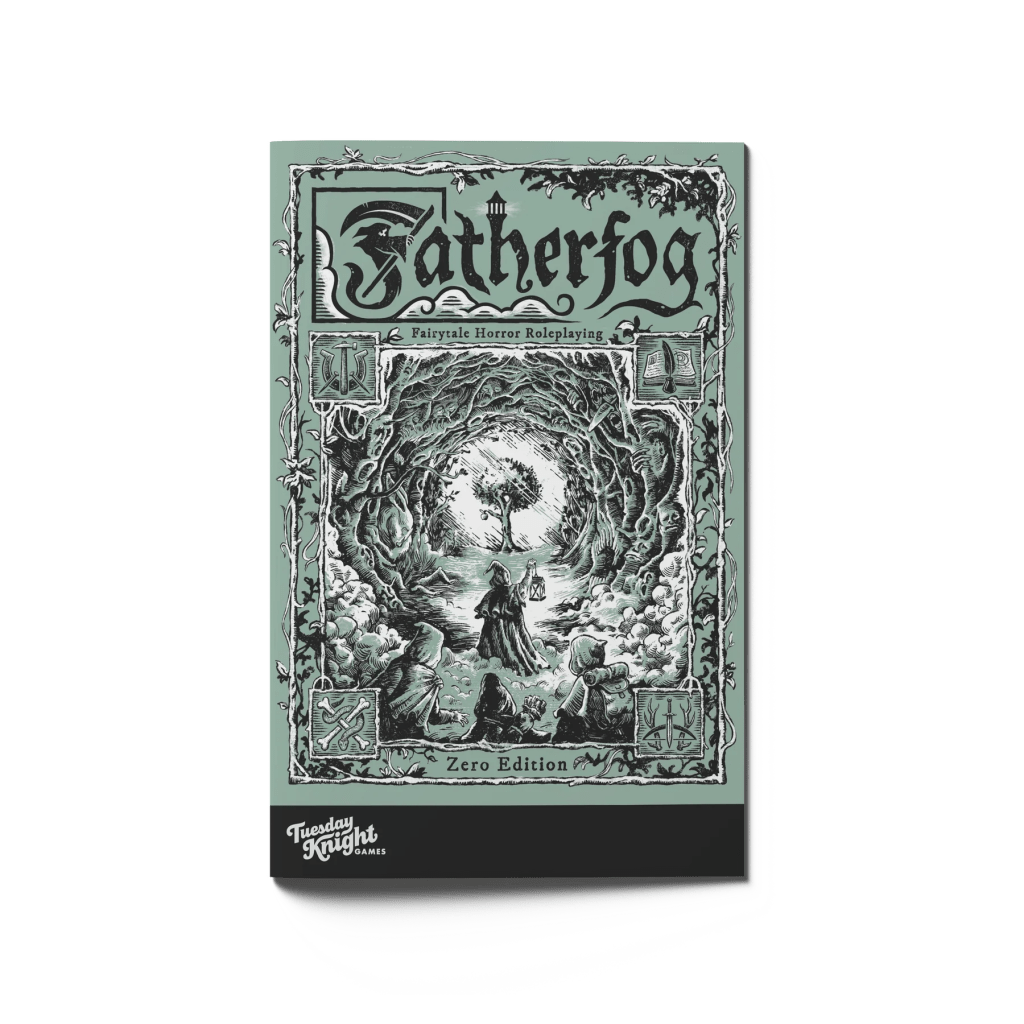
I’m feeling a little overwhelmed after going shopping for work outfits, so rather than go home, I’m going to sit in my favourite cafe, eat a hash brown sandwich, and read Fatherfog. Fatherfog is a 64 page roleplaying game by Alan Gerding, and it’s the first new roleplaying game from Tuesday Knight Games since Mothership in 2018. Like Mothership, it’s styled as 0E. In it, you’re trying to survive in a world where the fairytales you know and love exist in their original, horrifying forms, while you try to recover the dying resource “hope” for your village, the only place of safety you’ve ever known. I was sent a copy of Fatherfog by Tuesday Knight Games.
Fatherfog is, at a glance, an adaptation of the panic system (Mothership’s SRD), but while it keeps the d100 checks and saves and the skill trees, it makes meaningful changes: Skill points are now a resource used across multiple systems, you can give up entire skill trees for unnatural abilities, resting is an important and potentially engaging subsystem, you can freeze in combat, “bits” add more meaning to dice rolls (I’ll explain that a little more in a moment), and there are now significant travel and death rules. Lots of these rules feel specific to the world of Fatherfog in a really pleasing way that is very different from the more broadly applicable rules choices that Mothership has made with very good reason. There are a lot of things that have changed less, that I feel work well nevertheless: I was doubtful to see skill trees effectively applied to fairytale horror, but it feels good; the lateral translation of fear and panic to hope and despair is thematically sound and gives mechanical weight to a lot of choices across play; the clarity over the fact that enemies don’t roll to attack, but rather player characters roll to save. Some of these new rules are really elegant, in particular, the system called “bits”. The “ones” die of a d100 is called a “bit”; if you roll a mind save and succeed, you still lose a “bit of hope”; providing successful medical care heals a “bit of health”, if a failed save might cause damage, it causes a “bit of damage”. They’re a little underutilised — these bits could also refer out to subtables for unique checks or attacks against specific monsters, but this either hasn’t been conceptualised yet or is going to appear in a future module. I also like the very specific combat rules of the referee passing you if you don’t have an idea, until you have a second chance, but that if you still don’t know how to act, you “freeze” and do nothing this round. Instead of tracking all of your equipment, you must describe everything you’re carrying and how; an “equipment check”, failure of which causes a penalty; this rule is a little vague and referee-specific, and I think it needs a little workshopping, but I like where it’s at. It’s worth mentioning that although it’s not mentioned, the character sheet design here really limits your equipment carrying capacity, although that would bear mentioning in the text if it’s an intended part of the design. Overall, I really like the adaptations given to the Panic system here, and I think it’s significantly more thematic and interesting in terms of rules design than the only other Panic system game I’m familiar with, Cloud Empress.
The thing I always have the most trouble reviewing in fantasy roleplaying games is the content, because it tends to blur together. Our stats here are strength, intellect and will; our saves are body, mind and spirit. There are four classes: Workers, Philosophers, Hunters and Strangers. These each have a unique trait that usually occurs when you roll a critical success and sometimes on a critical failure. You choose a “subclass” by choosing a set of equipment (a “rucksack”), and further develop your character by choosing (or rolling) a colour for your cloak, the broach the holds it in place, a personal trinket, and how you gained what coin you have. Equipment here is unremarkable, although your player (not the character) receives a legacy artifact that is passed from character to character, which is encouraged to be kept secret, which is a lovely touch (and a mystery associated with the world that you’re encouraged to hash out amongst yourselves). You earn skill points for a variety of things, most interestingly for keeping watch; you can spend these on new skills, or can scrap your capacity to gain new skills in a certain tree to take an unnatural ability — a highly specific power that doesn’t provide a bonus, and is designed in collaboration with the referee. Only a few foes are listed in this core book, although little guidance is given to create more, although it must be said that I really like the foe structure — with every foe given not just a motive but a trick associated with how to defeat it that the player characters will have to discover. It’s worth noting, to me, that there’s an implication in the introduction (which I mentioned in my introduction as well), that you’re going to be dealing with hope as a resource at a level beyond simply the character sheet, but rather at the level of your home village. I do think that this game would benefit from some kind of additional system or referral back to this; the structure and implied narrative is begging for more focus on the village and what it might mean to save it, and it’s a disappointment this is missing, although I wonder if it once existed and was lost to page count. My overall impression of Father Fog as a statement, is that it’s the equivalent of a “Player’s Guide”, with no known “Referee’s Guide” planned. This is a similar approach to the original Mothership, but it should be noted it leaves a lot to the referee’s imagination and planning and this stage in the release schedule.
I’m a little mixed on the writing and content of Fatherfog. On one hand, the worldbuilding is compelling and raises some big questions that your campaign is likely to revolve around, particularly around the fog and the Fogtower keepers, and it plants seeds that are very easy for most referees to work from in terms of inspiration for adventures — after all, everyone knows a few fairytales, don’t they? If you’re a skilled referee, just buy Grimm’s Fairy Tales and have at it. Setting elements are alluded to throughout the book which are very intriguing in the best possible way — I imagine player characters finding foglines and following them to who knows where. I imagine what the consequence might be if you break the law of the foghouses. Why do legacy artifacts mysteriously appear in the possession when one dies? Where do the strangers come from? These are all compelling questions. On the other hand, it’s a little workmanlike, where I’d love it to feel a little more, well, folk-tale-like and florid; the phrase “Trained in combat and/or survival” shouldn’t be in a fairy tale themed book; I love the clarity, but it sacrifices atmosphere and relegates it to clever ideas; I think with the right team, one wouldn’t need to be sacrificed for the other. That said, it’s still evocative at times, particularly in the character-building coin and trinkets tables (“Your attempt to sell flowers, while appreciated by some, has left you with little.”, “Wonderfully crafted shoes appeared in your home overnight; their sale earned you a hefty sum.”, or “Thing sealed in a murky jar“, and often funny (in the death table — “Your right hand can’t help but feel your left hand is mocking it.”). One thing that is featured heavily is the character of Death — there’s a whole section devoted to Death, and how characters might interact with Death when you die, and Death is featured in the logo, which makes me suspect it’s supposed to be a core mystery as well. This is an interesting direction, although it’s not explored thoroughly. One thing that there is not in Fatherfog is any beginner’s module — and for good reason, it’s maxing out the potential size of a zine at 64 pages. This means, if you pick this up immediately, you’re going to be designing your own adventures — that said, I think that once again, Tuesday Knight Games has chosen a core theme here that is likely to invite a lot of creativity from the community, given the huge number of potential fairytales and interpretations of them that could be adapted into modules for Fatherfog.
Fatherfog is the first thing I’ve seen that brings the full weight of the Tuesday Knight Games visual and game design team to an aesthetic that isn’t the hyper-dense Mothership visual signature, and they manage to make it work, feel fairy-tale, while keeping the clever design that made Mothership so easy to pick up in the first place. Smart typeface choices, a cohesive colour palette, and It reproduces the intuitive “play straight from” character sheet without sacrificing that identity, and I especially like the implications of colouring and drawing on that character sheet. Layout conventions are appropriately broken to describe things like the character sheet and classes. Art is used to break up dense areas like d100 tables, while those tables all scream colour in the same way Mothership’s patches do. Iconography is used for game phases and for skill levels in a pretty intuitive way (although I think whether or not they’re a stroke of genius or simply flash probably won’t become evident until we start seeing modules and expansions to Fatherfog and see how they’re incorporated there). A suite of excellent artists including Conner Fawcett and Ryan Lynch, all create a distinct visual identity for Fatherfog. Colour is used to differentiate sections so that those playing party members don’t stumble into the referees section. The back cover is a summary of how to play that covers all the major mechanics, elegantly and clearly. The biggest miss in terms of layout and design is the lack of page references; 64 pages is enough to get lost in for me. That said, the table of contents is clear and thorough. The physical product itself is exactly what I’ve come to expect from Tuesday Knight Games: This may be a zine, but the cardstock is thick, well textured, and will stand up to a bunch of use.
We have no shortage of high-lethality horror fantasy games in the hobby — there are at least two heavy-hitters in Trophy Gold and Cairn 2e that feature a fairy tale aesthetic. Trophy Gold released with a cornucopia of incursions (although a quick search on itch.io gives me the impression ongoing development of more incursions by the community may be dead in the water); Cairn’s own print store lists around 60 modules. The cumulative weight of the communities of these competitors is hard to compete against, but Tuesday Knight Games has in Mothership a very strong track record of support. What Fatherfog offers is a strong aesthetic, some clever mechanical twists, a familiar overall system with some welcome clarifications, and a unique and more specific setting than either Trophy Gold or Cairn have to offer (sorry, Vald). I obviously can’t recommend Fatherfog as an exosystem right now, but I think it’s really promising as a system to develop for, and I suspect people will be excited to develop for it given it has a far more specific angle than anything else out there right now, and that angle allows creators to demonstrate how unique their own upbringings are in a way that’s pretty unique. That’s an exciting future, if it eventuates.
I like Fatherfog, a lot. As someone without a lot of time to design my own adventures on a weekly basis, its’ specific theming is a detriment to me bringing it to the table. It won’t be, however, for people who get excited at the idea of rifling through a book of fairy tales as their weekly prep, and if the community gets as excited for Fatherfog as I feel after reading it, it won’t be long before I won’t have to design my own adventures. It’s a take on the Panic system with a bunch of unique and clever mechanical innovations that I’m excited to see expanded upon and implemented, while remaining familiar enough to be easy to put into play without a fuss. It’s also full of a bunch of really interesting seeds and evocative concepts that are really compelling in terms of world-building. If you love fairy tales, and have yearned for an on-ramp into running them in an OSR style, if you’ve bounced off Cairn and Trophy Dark as fantasy horror games but are familiar with Mothership, or, if you’re excited by the baked in mysteries that Fatherfog is offering, Fatherfog is probably for you.
Idle Cartulary
Playful Void is a production of Idle Cartulary. If you liked this article, please consider liking, sharing, and subscribing to the Idle Digest Newsletter. If you want to support Idle Cartulary continuing to provide Bathtub Reviews, I Read Reviews, and other work, please consider a one-off donation or becoming a regular supporter of Idle Cartulary on Ko-fi.


Leave a comment