
I Read Games reviews are me reading games when I have nothing better to do, like read a module or write or play a game. I don’t seriously believe that I can judge a game without playing it, usually a lot, so I don’t take these very seriously. But I can talk about its choices and whether or not it gets me excited about bringing it to the table.
Ages ago I picked up Heroes of the Borderlands, the Dungeons and Dragons 2024 Starter Set, an homage, I had assumed from the title, to the classic starter module Keep on the Borderlands (which I reviewed along with two other homages here). It was new when I picked it up, getting closed to a year old now. I was at home tidying, and I found it tucked behind some board games on an upper shelf, and I thought, why don’t I open it, give it a read? So, I did.
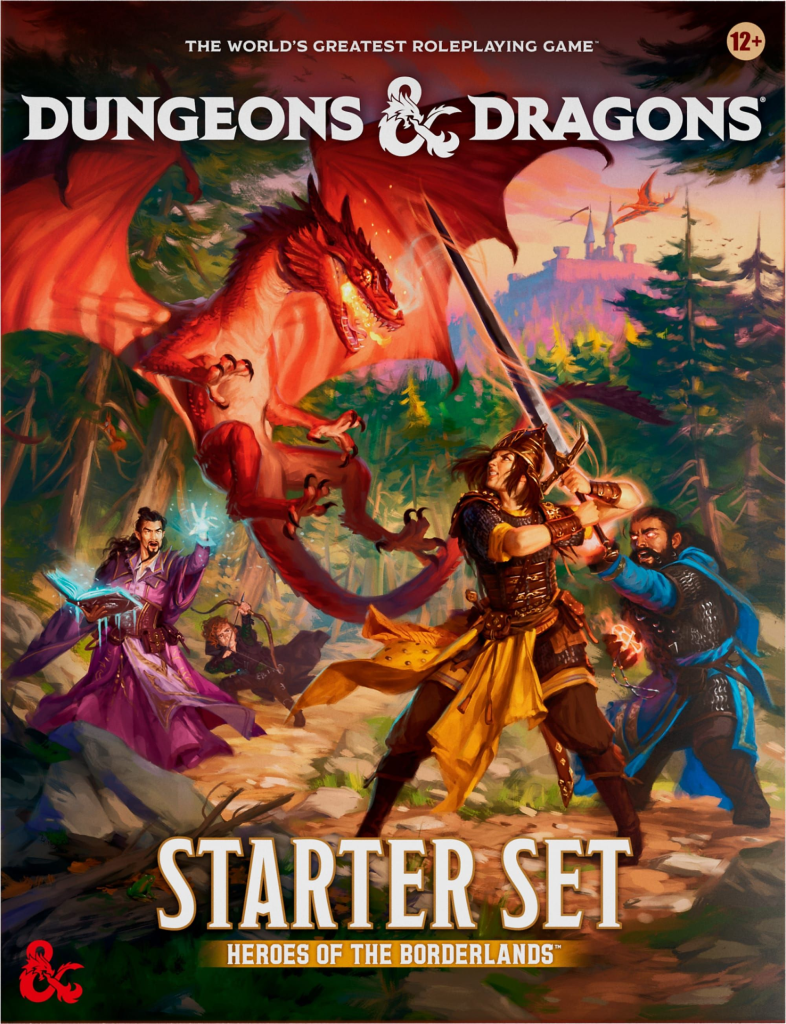
Let’s unbox this: At a glance, this a chonkier, sturdier starter set than Lost Mine of Phandelver starter set for D&D 2014 was. When you open it, the top sheet is a “read me first” quick-start guide in the form of a bifold a4 booklet, then we have a 30 page “Reference Booklet”, 15 page “Wilderness”, 19 page “Keep on the Borderlands”, and a 27 page “Caves of Chaos” booklets; these are all a4, paperstock, sewn booklets so they will stand up well to use, better than previously used stapled booklets. Then we have 5 player handouts (the first feeling weirdly incomplete given the graphic design of it). Then we have 9 (!) double sided poster-sized maps, all being battle maps except the 3 full sized maps of the Wilderness, the Keep and the Caves. They’re in a little folder thingy to keep them safe. Then we have 8 card-stock character sheets that are designed as board-game style player boards; you place your cards on here — “armour” “background” and “species” are the main ones with slots, and there are 8 because there’s a separate side for 1st level, 2nd level, and 2 different versions of 3rd level for each class (so, 4 players can play at once, at the same level). Then we have 5 pages of cardboard tokens – gold pieces, tokens for monsters and standees for the players, moveable terrain, HP counters and power tokens. Get past that and we have a pad of combat tracking sheets (has to be good for close to 100 combats), a set of polyhedral dice, decks of standard cards covering backgrounds, species, equipment, magic items, spells and NPCs, and decks of tarot-sized cars covering monsters and an “on your turn” action summary. These components, when you examine them more closely, have excellent attention to detail. The NPC cards have rumours on each of them, as well as which monster card is their stat block if that’s needed. Magic spells have an illustration of their area of effect, if necessary, which makes the battle maps easier to use. The web spell has a full sized web template. The monster tokens, for those with more than one of the same art, are alphabeticised to identify differences. This is a killer sales pitch and a half for the combat-focused Wizards of the Coast edition, and one that feels like it looked at Baldur’s Gate 3 and rather than curl into a ball, stepped up to the plate (it that a mixed metaphor? I’m sorry, I don’t do baseball, you get it). Honestly, opening this box made me excited to play D&D 2024, and I haven’t considered that damned game in over half a decade.
On the other hand, it sets awful expectations: A quick google says 2 anthologies is all the other module content that’s been released since 2024, and without this kind of support — loads of maps and tokens and player boards and spell cards and stuff to match this box — you play through this and then you’re stuck with an entirely different looking game. Lost Mines of Phandelver may not have been as strong a pitch, but it was not at all a bait and switch. Heroes of the Borderlands, sorta kinda is. But, if the pitch for D&D 2024 was a boxed set every year, with these kind of components, I could get behind that business plan. I could run D&D 2024 if all I had to do was buy a boxed set every 12 months and it would look this good. Given I know of at least one other competitor that legitimately runs that model (albeit a bit more complicated), this is probably yet another example in the 2024 release of Wizards of the Coast half-baking their game design plans. You can go back and read my reviews of the Player’s Handbook (spoiler: it slapped) and Dungeon Masters Guide (spoiler: huge bummer) a few years ago, if you care. It looks like I was so bummed that I didn’t get around to reviewing the Monster Manual when it came out.
What about the contents? The quick-start guide is fine, I guess. It’s basically the first page of the player’s handbook, plus a little picture of how to set up your character sheet playboard thingy. Components list, etc. It’s fine. The reference booklet on the other hand is a wildly different take on “tiny PHB”, starting out with how to read the cards and player board, then getting into the rules themselves. I couldn’t be stuffed, to be honest, checking what was left out here — I think it’s entirely appropriate that rules are left out in a starter kit, and if you’re the kind of person who checks the starter kit for particular rules you probably aren’t the target audience now, are you? I’d go so far as to say that missing rules are the raison d’etre: You want the players to be wishing they had a PHB or DMG. Honestly, Why isn’t there a section that says “You want more on this? Buy our book!”. Anyway, it covers all the major rules (amusingly, Roleplaying gets 3 paragraphs on page 12 and that’s it — fruitful void indeed) with some notable exceptions given I’m familiar with the original Keep on the Borderlands, which is travel rules. From memory these were in the DMG, which might be why they’re skipped, but if you’re skipping travel rules altogether in a Keep on the Borderlands we might be off to a bad start. There’s a fabulous rules glossary at the end, which I think may have been a separate book in Lost Mines of Phandelver, but it’s fine that it’s here. I’m going to take a moment to forefront the credits here: It opens with an acknowledgement of Keep on the Borderlands and the contributors to that book; I appreciate that, I do. The credits for this boxed set itself, are at the back of the reference guide, and I fear, given I am someone who cares so much about module design, about what that means, because there is no acknowledgement of separate designers or authors across the rules, product or module design here.
First up is the Wilderness booklet. This booklet refers to itself as a tutorial, and in terms of tutorial structure, I like this: Effectively, the left hand column is the module and encounter itself, and the right hand column is advice and “how to run” information, defining how the module is written and how to interpret it. It introduces the basic structure that D&D 2024 uses in its modules, quite well, in a very simple and approachable way, and each subsequent encounter in the booklet increases the complexity slightly in a way that introduces you to the rules gradually. However, it’s not a railroad, it’s a sandbox: This means neither the players or the referee are going to be encountering these in the prescribed order. Furthermore the travel “rules” are “point at the map and say I go here”, which refers you to one of the four regions, or the Keep on the Borderlands. Your players may completely skip the wilderness, and I’m not sure why they’d choose any of them — if I had to choose between “Fens”, “Woods”, “Trail”, “Tamarack Stack”, “Keep on the Borderlands” and “Caves of Chaos” I’m sure as hell not picking the first 3, and I’m probably picking the latter 2. Even if you chose 1 of the first 4, I’m not sure it’s the intention that you play through all four encounters, given that completing 1 of the 4 encounters results in a “level up”, and completing a 2nd, 3rd or 4th does not. [Put a pin in this: it becomes relevant later] All of these choices render the entire approach to tutorialising redundant: The actual, on-rails introduction to Lost Mine of Phandelver was infinitely better, because you could ensure the players and referee would actually experience the tutorial in the right area, or at all. In terms of the design of the regions themselves, it’s absolutely confounding. Four different areas to “wander” about, but without having maps: These are your introduction to random encounters, even though some of these random encounters are locations (“Hermit’s Hut”, “Looted Wagon”). It’s a confusing introduction to the convention, especially considering the back two pages are a list of actual random encounters that fit standard conventions, which honestly are way better than the core set of 16. Only 2 out of the core 16 encounters is a social encounter, that might seed the players with rumours going forward; none of these rumours point the player characters towards anything of note — in fact, it’s impossible to do this, because locations aren’t concrete and can’t be explored towards. I’m not sure why this approach is taken, but it’s giving “never ran D&D before”, which is uncharitable of me I know given the credit list, but it’s genuinely inconceivable that this was the design approach they came to. Finally: These encounters have largely drained the wilderness encounters of Keep on the Borderlands, a pretty lightly seasoned module to begin with, of what little flavour it had — the hermit, for example, is simply grumpy and easy to persuade to be cooperative. I do not like the Wilderness booklet, on weight.
We then have Keep on the Borderlands. Here, you keep track of characters using their tokens, but they don’t have to travel between areas, and they’re not expected to remain together. The tutorialising continues here, for the first location only, but then backs off. Every location has a quest, and these quests vary considerably in nature, which I like, but they are also uneccessarily complex — the goat-wrangling quest, which literally features on the box cover, requires you to randomly generate where the goats are. Why? Why not have each goat in a fun situation already in certain locations? They are also awfully, for want of a better word nice: Unlike the original, where you’re expected to pilfer everything in sight, here the bank heist is replaced with trying to persuade the thieves not to pilfer the bank. When you get to the Fortress, the final location in the keep, it becomes clear why there are no hooks in this module [this is where you can remind yourself of my concerns earlier in the Wilderness I asked you to put a pin in]: The “keep official quests”, are the ones supposed to incentivise you to interact with these first two booklets: “visit 3 wilderness regions” and “complete 3 keep quests”. No need for anything to actually be interesting or appealing to the players: They simply have to do these to get a reward (you won’t know what until you do them!). If you visit the Castellan, he’ll give the players a quest that isn’t very clear: “investigate the rumours of a cult in the caves” “quash the evil” and something about a “source of power”. This is the only hook to go to the Caves of Chaos. Once again, this design is either making the massive assumption that people who’ve played video games would not consider engaging in an interesting world unless it was structured like a choose your own adventure game from the 90’s, or they haven’t played enough damned D&D to understand how to design a module. I’m not sure which is the more insulting design basis, but it results in a world nobody would want to explore, or be able to explore if they tried. The original Keep on the Borderland is better than this at hooks and rumours, and it was written almost 50 years ago.
Now, making the assumption we ever go to the Caves of Chaos, here we have are effectively 11 locations, and all of them are designed as combat encounters. 3 of these have been positioned as potentially social encounters: The kobolds, for example, have a scenario where the egg they were going to eat has hatched into a dragon, who they’re trying to appease and make a decision about whether they return it to its’ nest or raise it themselves. But, in the next sentence says “reduce the number of Kobold Warriors to make it easier and shorter”, implying you’re supposed to slaughter the lot of them, irregardless of their niceness. The same thing happens with the Nothic — technically it’s a quest-giver, but practically it advises “add additional Animated Flying Swords”. Every other encounter is combat only, with no potential for negotiation. Every single one of these caves exists as a poster-sized battle-map, and you’re intended to step through them in turns starting in a marked “start area”. In a way that the original Caves of Chaos did not, this feels like an absolute drudge to play through. It feels more like playing Heroquest than D&D. In the original, these were all factions you could engage with and play off each other; trickery was as much a tool as your sword. Not so here. That said, the Caves of Chaos is no longer a large dungeon, and I really like the new design as a mountain with multiple cave entrances as you ascend it. Each cave is independent; some but not all are interconnected in a way that might be considered reminiscent of the interesting looping of early dungeons like the Caves of Chaos. The intent is that you go on, do a combat, and then go back to the wilderness or the keep, and rest and restock, I suspect. And I get that: If you’re not familiar with the megadungeon as a concept (especially when the rules explicitly say you can’t long rest in the Caves of Chaos), the idea of barricading down and then continuing on is a little foreign. But I’d also kind of expect if you were going to use the Caves of Chaos as your starter module, isn’t the point to introduce players to the conceits of a large dungeon?
In terms of all 3 of the module booklets, there’s a few glaring oversights: Why would the referee start in any of the three areas (despite being told that she can)? Why would the player characters adventure in the wilderness at all? Why would they venture into the Caves of Chaos? There is a severe lack of hooks, even with the rumours included on the character cards, pointing them towards anything of note. The only reason to do anything is to fulfil questgiver’s requests, and hence earn a Gem (literally a token you can get) or a magical item. All of these lapses place the weight squarely on the referee to lead the players around this wilderness by the nose, to choose not using the random tables provided given their mundanity, and to try to come up with some reason to enjoy all of this. This iteration of Wizards of the Coast have, with this release, doubled down on refusing to acknowledge the referee as a player deserving of support and capable of enjoying themselves. A significant amount of the appeal of the chunky, beautiful components is reduced by what you might consider the videogamification of the module, for me. Coming back to the comparison to Baldur’s Gate 3: It’s like they missed what people loved about it. It really is a disappointment.
Looking at the credits for the PHB and Heroes of the Borderlands, 3 of the designers have changed, all of which were already on the PHB team. No one new has been introduced. Arman has been floating around for a while in both MCDM and Wizards of the Coast, working on the more recent much less traditional module design, while Renie and Lundeen the two other new names (who did playtesting on the PHB) cut their teeth on Pathfinder adventure paths. To me, these choices reflect a decision about what this starter set is supposed to be — rigid, combat focused — and also to me reveals a lack of insight into what made the original module Keep on the Borderlands great. Honestly, given their pedigree, I don’t think no thought was given the module design here: Simply that despite the superficial branding, Wizards of the Coast is uninterested in classic play, and wants a return to combat focused play of the 2000s. For me, this is a step down from D&D 2014, where the credits showed an interest in the OSR as an inspiration. I don’t think this actually reflects where the hobby is going, which is sad to me: The popularity of D&D is being buoyed by romance and character-centric APs and romance and character-centric videogames, and nostalgia for the 2000s does not to me feel like a direction that’s likely to end in success.
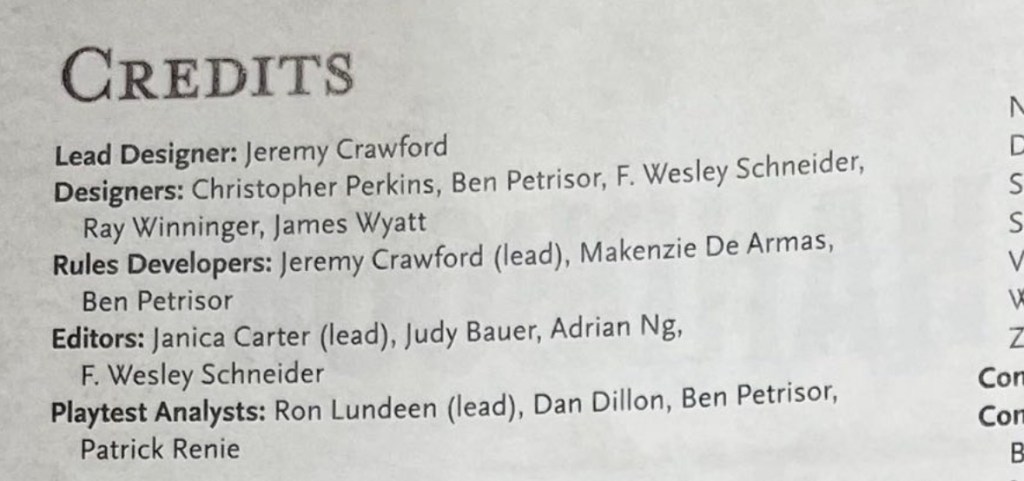
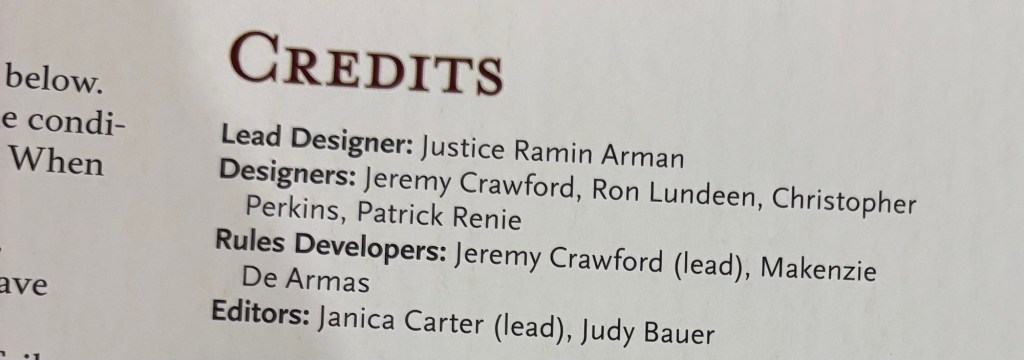
There’s a lot to love here: The chunky, thoughtful components. Splitting the areas of the module into 3 making it easier to reference and hence to run. A sandbox that players can approach it in any order. Rules being directed at players and referees differently, to lean way from overwhelming the players, and separate out the player-facing and referee-facing rules clearly, which does help to onboard players at least, although it continues the theme of not seeming to care about the load the referee takes on that D&D 2024 has folded embraced. But it all falls apart, truly, for a number of reasons: The lack of a product design direction that supports a transition from this “version” of the game to the one in the books. The absolutely abysmal module design, that feels like it was designed by people completely unfamiliar with the historical or contemporary hobby. The lack of insight into what the fans brought to the game by video games like Baldurs Gate 3 actually loved that game, or at least the abysmal failure to facilitate that kind of play. I think it really comes down to the same problems I had with the main books back in 2024, sadly: When let my partner unbox Heroes of the Borderland, she was incredibly excited by all the player-facing paraphernalia. When I read the referee-facing content, it was absolutely awful and unsupportive. At this point, poor prospective product design, a lack of regard for the load placed on referees, and a lack of vision for how D&D 2024 is different from the videogame RPGs that are so popular right now, is not inadvertent, but rather a recurrent and conscious choice by Wizards of the Coast.
Honestly before considering this, check out one of the many alternatives as a first choice: If you want big box starter sets, cool components, and a prospective product design strategy, check out Pathfinder 2e. If you want the drama of Baldur’s Gate 3 and also uses card decks, check out Daggerheart. If you want freedom to be and do whatever you want, and unlimited choice of modules that are actually well designed, check out Cairn (this also comes in a fancy boxed set!). If you want wilderness exploration and quests that don’t feel like they’re presented by a robot, check out Mythic Bastionland (Quinn’s reviewed this and he’s more famous than me anyway). If you’re partial to sci-fi, Mothership has an excellent boxed set. If you’re looking to get a friend into specifically D&D 2024 (I can’t imagine anyone looking to play it the first time would be reading my review of it), a second hand copy of Lost Mine of Phandelver would be a better choice than this — the rules there are not that different to 2024’s rules. If what you’re after is none of those things — but rather a box full of chunky tokens that board-gamifies the first few levels of D&D — then you are a mystery to me, but you should consider checking out Heroes of the Borderlands.
Idle Cartulary
Playful Void is a production of Idle Cartulary. If you liked this article, please consider liking, sharing, and subscribing to the Idle Digest Newsletter. If you want to support Idle Cartulary continuing to provide Bathtub Reviews, I Read Reviews, and other work, please consider a one-off donation or becoming a regular supporter of Idle Cartulary on Ko-fi.


 Playful Void
Leave a comment