
Bathtub Reviews are an excuse for me to read modules a little more closely. I’m doing them to critique a wide range of modules from the perspective of my own table and to learn for my own module design. They’re stream of consciousness and unedited critiques. I’m writing them on my phone in the bath.
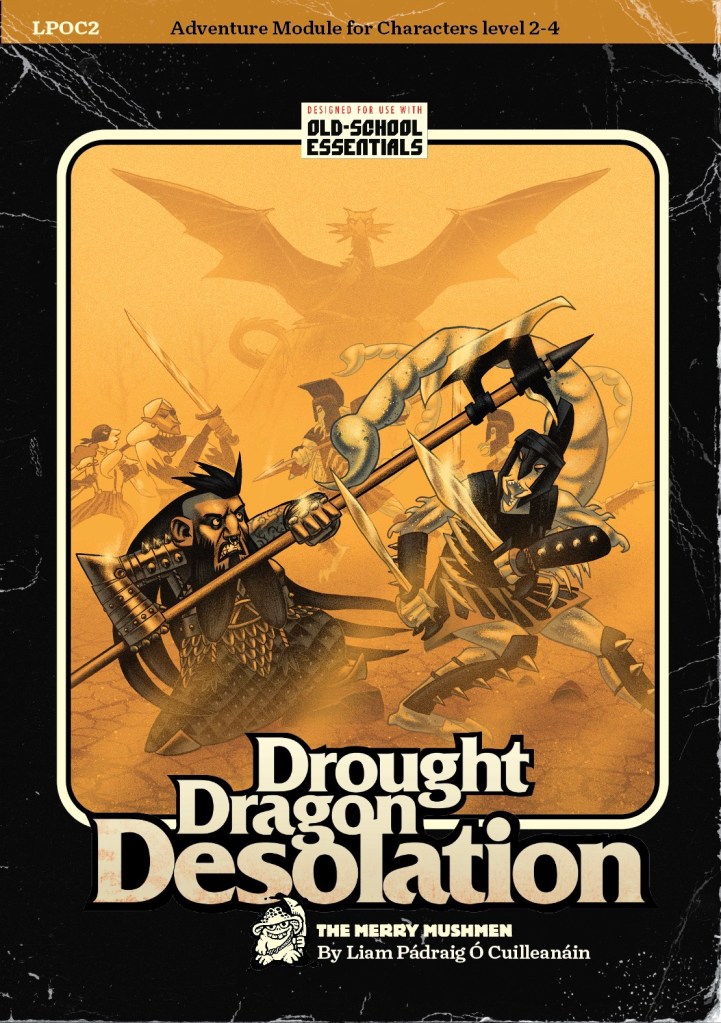
Drought Dragon Desolation is a 72 page module by Liam Pádraig Ó Cuilleanáin, with art by Bruno Prosaiko. In it you explore a dried sea for a dragon’s horde. I backed this on a crowdfunding campaign at some point.
Liam’s writing here (sorry, Liam, but your surname will extend my word count by a lot if I don’t refer to you by your first) doesn’t sacrifice great description, and characters are clearly differentiated (“lawful stupid” vs. “happily slit their mother’s throats for a copper”). It isn’t terse though, you want to like a fair bit of prose littering your module to enjoy this. Hooks here are excellent, with very juicy worms that change what the player characters are trying to achieve in a way that’s really meaningful in a sandbox like this. Rumours are perhaps less meaningful, but the completely unnecessary random happenings are amazing and I’d bend over backwards to include them; I’d regret the ones I didn’t roll. This book is dense; both positive and negative. The introduction is almost too much: A timeline, 5 factions and 2 rival parties in 6 pages (with most of that being stat blocks for those rival parties at OSE length). That density means it isn’t confirmed that “Lady Drybones” is the dragon in question for 5 pages, and even then it’s only implied. You’re left questioning a fair bit, but not so much you’re lost. It treads a fine line that would be disastrous if fully crossed and it plays with that line: Why did the bandits not take Tatiana’s money (or did they, in which case are you supposed to recover it)? Is one of many questions that are left unanswered, that don’t feel unintentionally so. Also, what the hell is Appendix 1? The weight of my experience this book falls heavily on the side of enjoyment and excitement rather than frustration, but the frustration with lapses like this are definitely present, and might impact your experience of the book.
In terms of locations, Drought Dragon Desolation overachieves; Sweetwater is incredibly interesting for a 4 location town. The 25-hex crawl balances the brevity and usefulness of short locations and larger expanded locations well. The encounter table combined with the rival party table makes the 60% chance you have of missing a location flavourful and compelling, although a few of them will cause problems, as they’re clearly not intended to recur, and the probabilities are high they will (this is why I did my little dice math series — you need to think about these things!). I think you may need to tweak a few more entries, but in the overall context of the module it’s a minor problem. The main issue with the expanded locations is that a lot of them have boring maps: Ships and towers just aren’t spatially interesting. It’s made up for with interesting keying and characters, and clever random encounters that change things up, but the exploration here won’t be the thing that keeps you engaged.
I don’t usually care too much about systems when reviewing modules, but this leverages OSE to the hilt, and you’d have to put a fair bit of effort into adapting it to another system. It has been a long time since I’ve felt that way. There’s not a single stat block here that isn’t meaningfully bespoke, and the additional rules work incredibly well to support the world. The only negative there is that you’ve got to like OSE (and be familiar with it) to run it.
I have the print edition of Drought Dragon Desolation, and it’s in the same format as recent Merry Mushmen modules; the detachable referee’s screen cover with single-colour accent printing. It’s a good format, if a little prone to damage when travelling. This one has a hex map, town map, and 1d12 dragons on the front cover, with maps of 4 dungeons on the inside. These maps are good quality, but the front-facing stuff has information I probably wouldn’t prefer showing my eternally curious players, so while it’s useful laid out flat on the table as the referee, it’s not really fit for purpose as a screen. The internal layout is solid, and if you liked previous work by the Merry Mushmen, you’ll feel right at home. The page referencing is something I appreciate, although a few of the references are wrong, which doesn’t help in the running, but luckily nothing critical. Bruno Prosaiko’s art is as stylish as ever, and the maps are clear and have flavour without compromising utility.
I’ve got to say that the previous books by Merry Mushmen I’ve read I all fell short in various ways significant enough that I’d be reluctant to run them. Drought Dragon Desolation is an exciting book to read, irregardless of its flaws. If you plan on converting it, it’ll take a bit of effort, so consider carefully before picking this up. If you want something with a very direct narrative drive that will fit in a short or predictable time frame, this probably isn’t what you’re looking for. If you’re looking for a hex crawl which you can run for a dozen or so sessions at least, you’re happy to run OSE, and you’ve got players who will delight in finding their own way, I’d pick Drought Dragon Desolation up.
Idle Cartulary
Playful Void is a production of Idle Cartulary. If you liked this article, please consider liking, sharing, and subscribing to the Idle Digest Newsletter. If you want to support Idle Cartulary continuing to provide Bathtub Reviews, I Read Reviews, and other work, please consider a one-off donation or becoming a regular supporter of Idle Cartulary on Ko-fi.


Leave a Reply