
Bathtub Reviews are an excuse for me to read modules a little more closely. I’m doing them to critique a wide range of modules from the perspective of my own table and to learn for my own module design. They’re stream of consciousness and unedited critiques. I’m writing them on my phone in the bath.
The Doom of the Dark is a 35 page module for Tunnels and Trolls by Patrick Stuart with illustrations by Amanda Lee Franck. A pitch? Bah humbug, who needs a pitch? Honestly, I backed it on Kickstarter just for the names, and I’m not even sure what I’m in for.
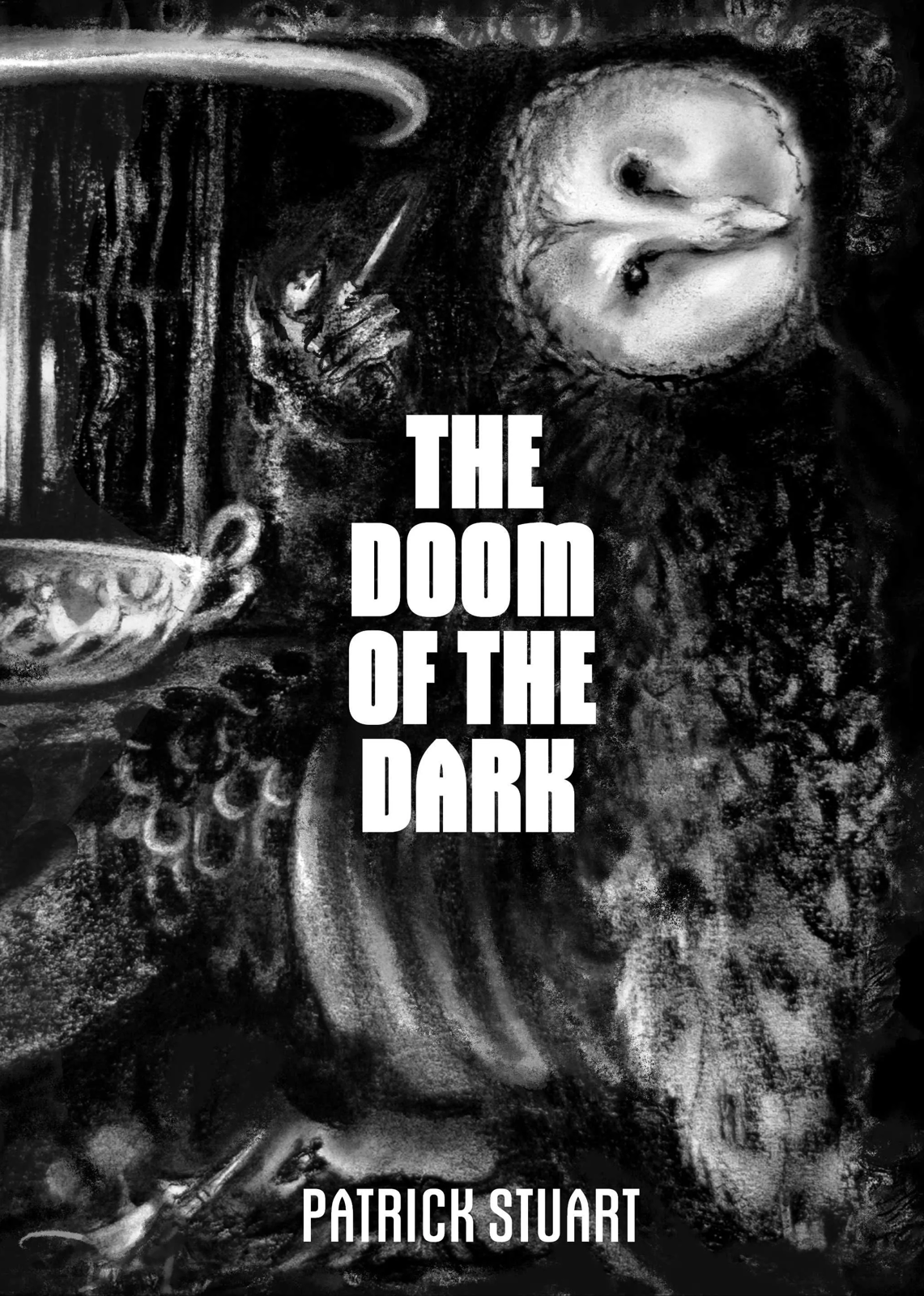
Who needs a pitch? Well, most players, I think. I’d pitch this to my players as a 2-3 session ticking-time-bomb dungeon delve that evokes dark fairy tales and the dream-logic puzzles fairy tale heroes face. The decision not to make a pitch or summary is intentional, with Stuart clearly falling in the camp that the reader should experience the module as they turn the pages. You’ll need to read this at least once, and perhaps take notes (it’s well page-referenced, though, and short, which would make running after a first read quite feasible). Perhaps how I (or you) pitch the Doom of the Dark is a rorschach for how you think about modules, but I do think that the lack of a pitch probably reflects on your local culture and how it plays. I guess if Patrick Stuart was my referee, I probably wouldn’t ask questions.
The structure here is avant-garde, which may be to your taste, or may grate dreadfully. Taking the first few pages for context: 2 pages of read-aloud, a referees interjection, another page of read aloud, the first location spread over 5 pages, including a 1 page story and a 1 paragraph story explaining two of the characters. That gets us to where lightly a quarter through the text, and this lack of discernible information structure continues for the rest of the book. One contributing factor is that the contents of the book kind of varies a lot: relevance dictates appearance rather than pre-set logic.
But I think a little more attention paid to pre-set logic would help with navigation. After all, it’s a single column, borders layout, with three levels of heading and 2 levels of highlighting — there’s a lot of loaded navigational information into this text, but it’s not always used consistently: For example, a creatures size sometimes gets 2nd and sometimes gets a 3rd level heading. Stuart is clearly attempting to deliver this text with a level of surprise and poeticism, and I think that use-switching actually undermines his own writing at times: Italics means quotations here, but it means a different location here, and it means emphasis there. Amanda Lee Frank here, despite doing good illustration work, gets kind of lost amongst her own dark, dense borders, and hence isn’t well utilised to assist with these navigation gaps.
Stuart’s writing is, in no surprise to anyone who has read his other work, stellar here. Especially through his constant use of conversational quotes, engaging the referee and the players in conversation, The Doom of the Dark is immensely immersive, and the characters and creatures inside (“Black-Ray King”, comet-haired maids, “Moon-headed Goblins”) are all incredibly fairy tale without, to my knowledge, being drawn directly from a particular myth. This is a beautiful, if disturbing, tale to read, and it sticks in your head in a way that will help you run it despite my misgivings about the structure. Stuart also regularly switches registers from descriptive and fairy-tale to designer directly talking to party, to designer directly talking to the referee, in ways which is, to me, pleasantly disarming and feels very natural rather than disjointed. (“I hope you didn’t follow them too closely; CRACK! SMASH! The stairs fall away before you.”) It feels like a habit that many authors of modules have trained themselves out of because it’s bad form in novels and screenwriting, but it feels like a missed opportunity in a format that is unique in many ways. One issue with the poetics of Stuart’s writing is that based on his afterword (which I’ll talk about more in a moment), it’s clear his sense of the physical places in play are for different from what is written down in the book. I think the focus is on the right stuff in the text, but if you’re running in Tunnels & Trolls the way Stuart recommends, you’re going to have to improvise more details about places like “..,courtyard of a mouse-bone castle, built by rats! Spread with slime, mouse giblets and three vile and sticky rugs”.
Finally, this very short, 11 room module is jam packed with gimmicks. It has a straightforward shrinking gimmick that works really well (I’m not wracking my brain to get it to function like in the recent A Familiar Tower) and the timer conceit is well simplified, creepy, and full of tension. It feel like the best open-ended kind of OSR challenge, rather than a tightly structured or complex construction. I like it a lot.
Just gonna pause for a second to think about what a wild decision it is to release a module for Tunnels and Trolls in the year of our lord 2026. For those of you who didn’t know, Tunnels and Trolls was released in 1975 and is a completely different rules lineage to D&D, meaning that, while you could call The Doom of the Dark OSR, if you do so it’s because you consider it more of a vibe than anything concrete. There’s no direct conversion from T&T to D&D, although of course you can fumble through it just fine if you’re running in another system. Its pretty clear from the afterword, that Stuart runs Tunnels & Trolls with a particular focus on speed and vividness, which means ignoring many rules, and expanding on the text in many places where the locations aren’t especially concreted. In the context of texts like Veins of the Earth, Deep Carbon Observatory, and Silent Titans, The decision to release this for Tunnels & Trolls feels like a re-statement of intent: In their time, each of Stuart’s texts requires a level of extension beyond the comfort zone of their contemporary reader, even as they went on to be popular and even classics in time. The Doom in the Dark, while the more restrained of Stuart’s works, still wants the players to be on their back foot.
So, the Doom in the Dark. This slaps, and feels to me in more a similar category to White Horse of Lowvale than Deep Carbon Observatory or Silent Titans, and is similar in approach to the Isle in that it explains itself in its own time. Would I run it? Yes, I think so, but only with a very specific group of friends with specific thematic tastes: It’s dark, dreamlike, and reminiscent of children’s rhymes, and you need to enjoy that particular blend of creepiness and children’s laughter. It’s full of opportunities for shenanigans and team-ups, and has some bizarre and interesting enemies and characters to interact with. If you’re ok with the former, and you enjoy the latter, it’s worth checking out the Doom of the Dark.
Idle Cartulary
Playful Void is a production of Idle Cartulary. If you liked this article, please consider liking, sharing, and subscribing to the Idle Digest Newsletter. If you want to support Idle Cartulary continuing to provide Bathtub Reviews, I Read Reviews, and other work, please consider a one-off donation or becoming a regular supporter of Idle Cartulary on Ko-fi.


 Playful Void
Leave a comment