Bathtub Reviews are an excuse for me to read modules a little more closely. I’m doing them to critique a wide range of modules from the perspective of my own table and to learn for my own module design. They’re stream of consciousness and unedited critiques. I’m writing them on my phone in the bath.
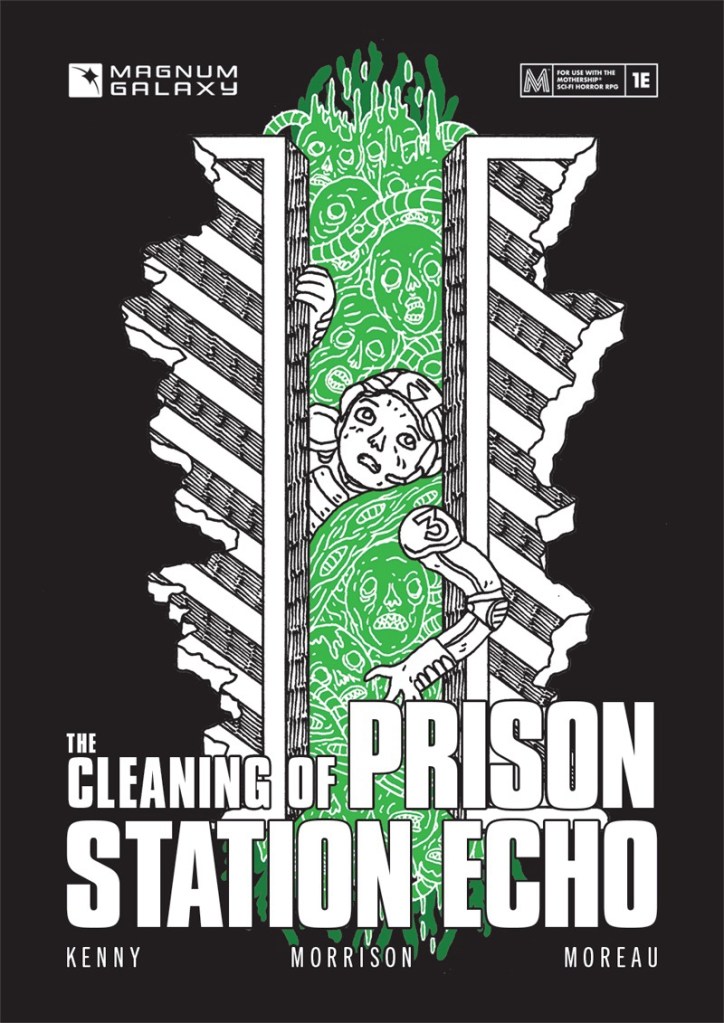
Cleaning of Prison Station Echo is a 51 page module for Mothership by D. Kenny & Haig Morrison and illustrated by Evlyn Moreau with maps by Guy Pradel. In it the player characters are unarmed janitorial staff on a prison full of zombie-like ex-prisoners. I purchased this myself.
The writing itself could easily have overextended itself: There are nineteen pages of set up alone, before the prison itself is described. Admittedly, some of this is optional, like the two additional starting scenarios, but most of it is necessary set up: Factions, the virus, and the like. These are individually, thank goodness, brief and punchy, with no single section (not description, but collection of all the faction descriptions for example) being more than half a page long. The descriptions aren’t pretty, but are juicy, and lend themselves to the sense of corporate farce that lead to a zombie outbreak that only a team of janitors can solve: “…failure means death if it interferes with XeroCorp’s public image.” and “I’m afraid I can’t do that, Dave…just kidding, I probably can.”
I really enjoy the location descriptions. They fun, and collect a fun situation in a nutshell, and they don’t outstay their welcome at only 16 rooms. It’s a fun romp across two levels, although the maps don’t leave much room for spatial or exploratory play and are largely playgrounds in which to place the admittedly compelling characters and scenarios. I don’t love the choice to place the two levels at opposite ends of the book, though, as I spent a significant part of my read-through thinking there was no map of the basement at all. I should add that this module is packed full of charming tables: Each level gets its own set of tables; there is a custom panic table; a bunch of unique backgrounds. This stuff is all great. Just great.
The last ten pages of the module are a “sandbox” for playing on Carnath, the planet that the prison is on. This extra section just screams Kickstarter stretch goal to me. I put sandbox in quotation marks, because honestly it’s not enough. It’s five well-described factions (two of them present in the core module), with a faction diagram that masquerades cleverly as point-crawl style map of the surface of Carnath. I can probably work with this; the factions and their characters are strong and interesting, the relationships really clear. This seems like an incredible basis for a sandbox that is missing from this module, and I’d love to see that sandbox actually developed into something a little more like Desert Moon of Karth, rather than tacked onto the end. It shows that the authors are capable of great things, they’re just not showing me in the scope of this module, so it feels like wasted space, especially as three of these factions don’t tie into the core dungeon.
Layout is colourful and clear, in A5 zine format, using a unique colour palette that complements the exceptional art which is also very unique in the Mothership line. I don’t love the heavy bullet pointing as an aesthetic choice, but I don’t think it affects the usability. I can never praise Evelyn Moreau’s art enough, it’s so characterful and charming. Evelyn, we have to collaborate on something one day! The maps are excellent and match the overarching style; especially the opening spread with incredibly charming isometric cut outs of the various areas of the station. Prison Station Echo at once has a spread-to-spread experimentation and an abundance of typefaces that feels recognisably Mothership but also has a voice of its own.
Overall, the core of Prison Station is an excellent module, more of a point-crawl than a dungeon-crawl. Highly recommended. It strays a bit from its primary directive, though, with a bunch of additional starting scenarios and an abortive attempt at a sandbox, which dilute the main product from a succinct and excellent one. That said, excise those from the module and use them as a basis for your own work, and they’re great. I know that from the creator’s perspective, this is bonus content, but from the readers perspective, it’s incomplete work. Aside from those additional concerns: This is a fun, corporate horror comedy take on Mothership, with a unique voice, that I’d enjoy running, and probably would run over the excellent Gradient Descent for something that sits in a similar ballpark if I’m pitching to my table.
Bathtub Reviews are an excuse for me to read modules a little more closely. I’m doing them to critique a wide range of modules from the perspective of my own table and to learn for my own module design. They’re stream of consciousness and unedited critiques. I’m writing them on my phone in the bath.
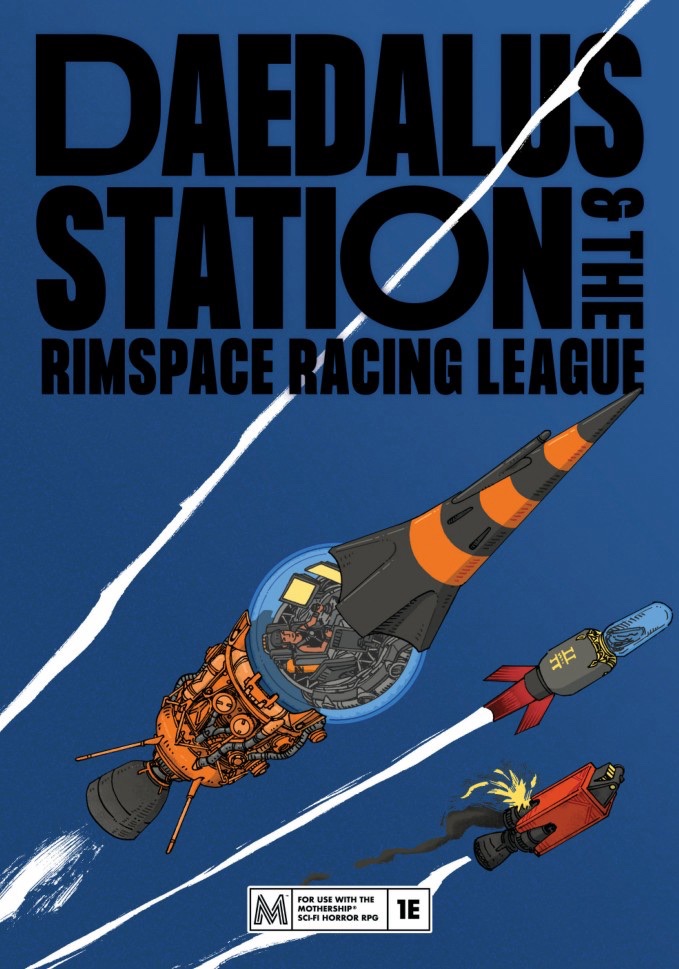
Daedelus Station is a 43 page module for Mothership by S. Murphy, with art by Guy Pradel. In it, you investigate a dark plot surrounding a space-racing league. I backed this during Mothership Month.
The module begins with a few reasons to be at the station in the first place. Sadly there’s nothing here that isn’t implied by the locations themselves, they don’t provide any personal connections or linkages: For example it suggests your ship suffers a mechanical failure so you need to go to the mechanic. I’d love for these to be juicy hooks, instead. From here we spend a page covering the Icarian League (the faction that runs the Rimspace Racing League), a page on the planet the space station orbits around, and a page covering security and the racing league itself. At this point I’m struggling to figure out where I am and what is going on. What I want out of a module is to be excited to turn the page and see what’s coming next — here, I’m not sure who Krule is or why I care, I don’t know why I need to know about security, or the planet Garrus, or the Racing League. The order of information here is doing the opposite of drawing me in. A pitch isn’t just your first paragraph: The whole zine needs to be the pitch. I should be gasping for more.
Then we get to the conspiracy proper, I remain confused: Why won’t it tell me what’s going on? The answer is that what’s going on is randomly generated. All four potential culprits have a spread devoted to it, but the decision to randomise here means my movement through the module as a referee remains directionless, and hence I’m a good chunk of the way in and I’m not yet excited to play, because I now have to choose one of these four factions.
I think this is a big misstep: The energy spent on describing multiple outcomes and methods could’ve been spent describing how they’re red herrings or how they’re involved. There’s potential here — particularly if you’re trying to make this into a campaign hub — for some incredible intrigue, but a lot of the work that is in here is ignored if you run it by the book. I want creators — especially ones with such excellent potential as Murphy has — to spend their energy digging into their ideas, not wasting them on things that are never to be used. If time was spent figuring out how these cogs interact rather than giving me as a referee choices, this political arena could be a firecracker waiting to go off. As is, we have four flat options rather than one that pops.
We then get into the locations proper. These are quite wordy, although well written in a colloquial voice I like — very different in approach though to In Carmine. There’s a little too much telling and not enough showing for me — the menu in the high class restaurant for example is over half description and less than half actual menu items. The character descriptions are universally excellent, though, and I wish there were at least 1 in every area — characters are the most compelling part of the module, with memorable personality traits and agendas: “…frog-like individual dressed in a 1930’s style suit…usually tries to go in for a hug…”
The module closes with the race itself — rules on how to bet, sabotage, and run the races. The race rules are fine. For me, the best racing rules are in Song of the Frogacle and they haven’t been beaten yet. The pilots get their own descriptions (weirdly different in structure to the rest of the NPCs) which is a nice touch, and they’re nicely manipulable. They’re each in a location, however frustratingly they’re not marked as being in those locations in the descriptions for those locations.
The layout here is straightforward, easy to read, but nothing flashy. It doesn’t feel like most Mothership, but that makes sense for the theme, and Guy Pradel’s art is exceptional at bringing out the golden age vibe of the Rimspace Racing League. The combination of “un-Mothership-like layout and golden age art makes this one stand out in the Mothership crowd, in a very good way. It’s really good stuff.
The concept for Daedalus Station is absolutely fun, but for me, it just doesn’t hang together. I’m being presented with a strange and unique situation — a space racing league with assassinations and betting and intrigue — but it doesn’t successfully guide me through how to run it, or make it compelling or exciting for me to want to run. I don’t have the time or energy to take the pieces presented in Daedalus Station and assemble them into something as explosive and compelling as they have the potential to be. I just wish it did that itself. It’s a disappointing outcome when the last module of Murphy’s I reviewed, In Carmine, spent a year being my recommendation for best introductory module to Mothership. They’re very different modules, and I’d put this down to teething issues with entering new, more social territory. I have not been soured to see Murphy’s future work.
That said, Daedalus Station is a very unique set up, unlike anything else available in Mothership: If you find this high class gambling crime scene compelling to run your campaign in, and you’ve got some time to piece things together (or perhaps are a master improviser), Daedalus Station & The Rimspace Racing League is a perfect place to start.
Bathtub Reviews are an excuse for me to read modules a little more closely. I’m doing them to critique a wide range of modules from the perspective of my own table and to learn for my own module design. They’re stream of consciousness and unedited critiques. I’m writing them on my phone in the bath.
In the Shadow of Tower Silveraxe is a 54 page module for Old School Essentials written and illustrated by Jacob Fleming. It contains the the 40 x 80 mile Gemthrone Wilderness, 5 settlements and 9 dungeons including the titular Tower Silveraxe (although that’s not what it’s called in the module). In 54 pages. This is going to be a challenge to pull off, as we have only about 3 pages available per location, if we’re lucky. I’m looking forward to either a trainwreck or a masterpiece. Which will it be? I bought this on Drivethru.
I don’t usually open with this, but the painted cover is really great. It brings very strong 1990s TSR vibes — Larry Elmore and the like. The art style inside is a much more cartoonish line art, which I also really like, and there is art on every spread and most every page if you include maps, but the cover in particular stands right out. Given I started with the cover, I’ll hit layout next, before getting into the meat: It’s a simple, 2 column layout with tight margins and claustrophobic spacing. I don’t love the font choices, but they do their job of differentiating and aiding in navigation, as does the art and maps in the absence of white space — and the art is clearly drawn for the available space, featuring some very interesting wrapping. It also uses a bunch of useful and interesting iconography, as well as appropriate use of text flagging (not overly complex or overused). It’s clear there were compromises made in order to pack this all into so few pages — it’s available in print directly from the author’s website for only $15, so perhaps it was worth it. It’s very functional, and feels heavily inspired by ‘90’s TSR yet again here.
We open with 2 pages introducing Gemthrone and its history, and then 2 pages covering the factions. While the factions have interesting twists each, they aren’t summarised very well, and I’d much prefer it in a terser, clearer format so I didn’t have to take notes about their goals or assets. In the rumours table, there’s a clever conceit of highlighting the falsified parts of rumours with italics, which is very clever and should be more widely adopted. We’ll come
back to the rumours later. I also really like the weather advice, which basically says “tell the party in advance, they’re experienced travellers they know when there’s a storm coming”. I can’t believe I’ve never received this advice before, but it’s startlingly obvious in retrospect. There is also a cipher puzzle hidden on statues across the wilderness, which is a great puzzle for the puzzle loving tables, and one that isn’t too challenging for the puzzle haters. Great little addition in my opinion.
And then, from page 9 we start with the key. The town designated your starting point, Karn Buldahr, reveals a few things about what to expect: Keying is brief, names are Greyhawkish, Character traits aren’t spelled out here at all — it’s just Lodwaelyn Kraghorn, raucous female dwarf and that’s all you’ve got. That’s enough for embodying them for the moment, but it’s not enough to engage her in the larger story without significant improvisation or expansion.
The second set of locations — Amethyst Lake Ranch — repeats some of the same scenes — long-written scenes in need of an edit or a summary, with a questgiver and a local problem that needs solving. In this case it’s associated with a dungeon — but there’s no hooks leading to the dungeon or even the lake, which apparently has a grim reputation (although there’s no rumour concerning it) and the only potential hook — the dwarf who owns the ranch — is too gruff to talk about his feelings so won’t tell you about the lake.
This kind of writing — uninspiring characters, incomplete or disconnected locations — is pretty emblematic of what we see throughout In the Shadow of Tower Silveraxe. It screams “I didn’t playtest” or “I didn’t hire an editor” or perhaps both, given no editors or playtesters are credited. It really leans into quantity as a selling point, hoping that nobody will notice that the only way to find them is to wonder aimlessly. Coming back to the initial rumours — none of them point the heroes to anywhere except for Amethyst Lake Ranch (the aforementioned location that goes nowhere) and the mage Myrya. Myrya doesn’t go anywhere — just pays a bounty on finding crystals. Of the 20 town rumours (across 4 towns), 1 points to the climactic adventure location, and 1 points to a treasure map. So out of 25 rumours, just 4 help the players find anything specific. What this is telling me, is that this module expects the players to wonder aimlessly in the home of finding treasure or gems based on rumours. I know we have a social contract that says “Adventurers adventure”, but I haven’t ever been at a table where the players didn’t like some kind of direction.
And that’s really disappointing, because for the most part the dungeons and other locations are a lot of fun. There are classic challenges like water termites that devour any wooden items you’re carrying, lots of beginner level traps, secret puzzle doors. The Tower of the Builders — the climactic location — has an appropriately looped design over multiple floors. One of the towns has political intrigue to engage in. It’s fun stuff. Drop in one of these locations and you’ve got a session or 2 of fun.
There are 3 physical map handouts for the players — very cool, if you find them, plus the cipher codes, which is a decent amount of props in a module this short, and at the back there’s a bestiary detailing all the creatures not in the basic OSE bestiary.
One big problem here is that the setting depends on wilderness travel, but the wilderness travel is just uninteresting as a whole — there’s nothing spicy or interesting in the random encounters. The random encounters with non-hostile NPCs are not detailed — are they a dwarf we know? No, just dwarves. If I were to run this, I’d have to either overhaul the wilderness altogether, or overhaul the rumours, or both, or I fear my sessions would be filled with the kind of awkwardness I haven’t experienced since I ran Horde of the Dragon Queen.
Coming back to the question at the top, is this a masterpiece or a train wreck? Well, honestly, neither. This is a whole setting in 64 pages! That’s a hell of an achievement! And to be honest, for the kind of low-stakes, beer and pretzels play that this aims for the simple keying, stereotypical characters and classically designed dungeons are kind of perfect. It doesn’t have space for faction play or much in the way of social play, which I favour. And it’s disappointing that with better developmental editing and more solid wilderness travel rules, it could have been rife with hooks and excitement, but instead the locations are simply there. It could’ve been a masterpiece, and probably without changing the word count. Regardless, In the Shadow of Tower Silveraxe is a strong value proposition if you’re looking for a generic fantasy mini-setting with a solid 10 or more sessions worth of play, so long as your table likes exploring the wilderness and dungeon-crawling as their primary occupations.
Bathtub Reviews are an excuse for me to read modules a little more closely. I’m doing them to critique a wide range of modules from the perspective of my own table and to learn for my own module design. They’re stream of consciousness and unedited critiques. I’m writing them on my phone in the bath.
Twinkle Twinkle Little Star is a 15 page module for Mothership by Marcus M. In it, you investigate a research vessel that has been trying to re-ignite a dying star. I was provided a complementary copy by the author.
Layout is minimalist and elegant; chunky text which is easy to read, clear headings, minimal and consistent use of highlighting. It’s simple, elegant. This is a zero-budget affair, so there’s minimal art here. Art always brings something extra, and it is missed here, but everything works in its’ absence. Certainly, familiarity with the genre that inspired the module — to me movies like Sunshine and Solaris and their very existential, character-driven horror are what it puts me in mind of — would give me images to work with to begin with, but also question precisely what kind of art would work best in the first place.
The key is a little confusing, and modifying it or providing additional instructions on start of play would make it easier for me to intuit how things will play out. How is the party docking with the ship? It’s implied you’re docking at the bridge from the order; if this is the case, a lot of the twists will be ruined through the approach through (2) very early in the session. I think the intent, though, is to enter through the airlock in (8), which is off to the side, and roughly in the middle of the ship. In a 10-room space, with almost no locked doors, it will be easy for the clues scattered across the ship to be short-circuited by access to the observation room with these spatial choices. You don’t need a linear spaceship for this to work, but simply placing the airlock at one end of the ship and the big reveal roughly at the other end, means the exploration is more likely going to encompass most of the space.
There are a bunch of missteps here that suggest to me that this was playtested by the author rather than by someone else; the ordering of the information is all over the place, to the point where it was hard to review because I kept taking notes that were then rendered inaccurate in retrospect. What that tells me, is that the information design here hasn’t been thought through: I kept having questions with no idea what the answer was. This is only 16 pages, but I would’ve given up on this myself largely because it would’ve been easy to answer those questions when they come up. There’s a corpse in (3) that isn’t mentioned in the key, just the crew descriptions. There are forsaken easter eggs in the crew descriptions. The main antagonist has no concrete location, and there is a random encounter table buried at the back. Advice for running the module is at the back, but honestly it should be at the front — the implication is that you’re likely to encounter the escape pods first, but this is buried at the end, and when you get the escape pod information, you aren’t sure why it’s there. Also hidden at the back is the fact that there’s a countdown until the star explodes (this feels essential), as well as hooks and incentives. There are more issues here, but it’s all out of order, and so it makes it very hard to follow.
Twinkle Twinkle Little Star appears inspired by a very different of space horror than what is most commonly written into Mothership, and I think that Twinkle Twinkle Little Star could have far more interestingly leant into that harder. I want a little more psychology in there. I want the antagonist and the crew to be untrustworthy narrators. I want the PCs, if they are infected, to be unsure whether or not what they’re experiencing is real, at least for a while. Of late, I’ve seen more Mothership modules exploring a wider variety of themes — I think there is an opportunity missed by making this effectively another monster-on-a-spaceship Mothership module, given the more introspective horror in the apparent inspirations.
Twinkle Twinkle Little Star is neat little module, with a unique antagonist, and it takes some directions that most Mothership modules don’t take. 16 pages isn’t very many pages to read through to figure out what’s going on. It’s just a little disappointing, because this could’ve been a great module, had more thought gone into the information design and perhaps more into playtesting or developmental editing. Just give yourself some time and have more patience with it than I had, and if you’re one of the many people who enjoy incorporating small one-shot or two-shot Mothership modules into an ongoing campaign Twinkle Twinkle Little Star is honestly a no-brainer to incorporate.
Bathtub Reviews are an excuse for me to read modules a little more closely. I’m doing them to critique a wide range of modules from the perspective of my own table and to learn for my own module design. They’re stream of consciousness and unedited critiques. I’m writing them on my phone in the bath.
Mana Meltdown is a 38 page module for Old School Essentials written, laid out and illustrated by Lazy Litch. In it you battle rivals to escape a collapsing psionic tomb. I backed this on Kickstarter (at first I said the recent Kickstarter, but let’s be honest, I’m playing catch up on modules a year old at this point).
The set up to Mana Meltdown is pleasingly old school. The players are dumped in this dungeon, equiped with their magical uniforms and a healing potion, and told to recover a red coffin and as many of the six living weapons as you can. You’re also told not to return that same coffin, in a nice touch, by an unknown hand, forcing you to struggle with your goals immediately. The set up feels very tournament: You’re immediately in competition with three factions, which are the key “characters” in the module.
These three factions, although you initially meet them at a distance during the dragonfly race (yeah, that’s right, a race between giant mechanical dragonflies across a magical desert), are just exquisite. They need detail to work, and you’re given it. Other authors take note. They have tactics, goals, likely alliances to form if they hit roadblocks, and most importantly 5 or 6 roleplay notes that make them easy to run: “ Occasionally fall out of sync with one another, need to speak out loud to restore psychic synthesis”, or “Upon seeing a construct die, whispers: “They made you wrong. Not enough iterations.”. You can just flip to their page if you encounter them, and it’s not too difficult to adopt the right mannerisms or choices.
Said dragonfly race isn’t as compelling as the one in Song of the Frogacle, but it’s not bad in the framework of Old School Essentials, featuring a series of actions resolved by ability checks, with a score for a success, which is compared to a set score for each of the competing factions. Your position in the race determines when you arrive in the timeline of the titular reactor meltdown — theoretically as late as the 4th item in the 12 item countdown. The reason your compared against a set score is because timeline itself assumes that certain factions are present at certain times — Myrioth for example, will always have been present for 3 “segments” by the time segment 5 activates, which is important because the timeline is how the factions are directed around the map.
My major issue with the writing here early on is the sheer amount of forsaken easter eggs buried here — a page on the hermit queen, a page on the dragonflies, a page on Myrioth, a page and a half on the Artificer — this is all in the front half of the module and I can’t see a clear way for any of this to be discovered by the players. It’s fine for things to be here simply for the referee to make sense of what’s happening, but this is over 10% of the whole page count. I’d prefer for this to be buried in the dungeon itself, and doled out to the players.
The dungeon itself is 4 levels, built in decreasing dimensions — the first 2 being 3-dimensional, the last being 1-dimensional. The special magical uniforms mentioned up top allow the players to traverse these dimensional “crunches” without being annihilated. Each level has its own random events, and its own objectives, as well as a series of if/then triggers when the players do specific things, as well as a risk of the Artificer’s ghost interfering…is this sounding like a lot? It is, especially when actually tracking the timeline. Luckily, there’s a spread of trackers and references that you can print out to attach to your referee screen or put on the tabletop. These are really handy, but the glaring problem for me is that I don’t know when to use them: There’s no indication regarding when to advance the timeline that I could find on a word search of the document. Typical OSE random encounters are replaced with a more complex and interesting random encounter table, but one that is rolled “when there’s a lull in the action”. I’d likely run it on a timer every 2 turns as per the OSE rules, although that may result in a higher incidence of encounters than the rules as written. I’d prefer greater clarity here — I’m happy to roll with my own vibes here, but I’d like to know with more clarity what was intended so I know if I’m making it harder or softer.
The dungeon itself, shows some learnings from Wind Wraith — each area has alternative routes in it, as well as the core puzzle. When Lazy Litch’s writing is on, it’s on, and as usual that’s in character and creature descriptions, filled with gems like “Its illusions are tinged with a complex sorrow.” and “Created to greedily eat the holy scriptures of enemy nations”. I find the keying itself a little hard to wrap my head around, though, partially because of the formatting (“Locked ornate red door [Symbol art on ground in front depicts the sun being cut in two by a sword, bleeding light] Inside [Stairs descend into a dissected shrine: stacks of cross-section cuts of holy marble pillars[…]”), and partially because what it’s describing is extra-dimensional and weird, so that format makes it even harder for me to describe something already very strange. Maybe that’s the point? You’re suppose to have trouble with what’s in these rooms? But as a referee, I would struggle to run these rooms. Add to that that that I’d expect the objectives to be hard to figure out — if they weren’t spelt out for the referee I’d have no clue, and they aren’t spelt out for the players. How are the players supposed to know the blue key is needed to open the Microscopic Museum? It’s not clear to me at all. This is a one-person module, and I think this is where it shows — it needed an editing pass to realise that, while the complexities are all-in-all good, a lot of it’s contained in the author’s head, and making it legible to another referee requires a little extra work that isn’t put in here.
In terms of information design and layout, I struggle a bit too. Each level starts its keying again from A, which means you can get confused if flicking through at speed, and it uses colour coding to tell these sections apart, which while thoughtful I think needs to be bolder to be effective. The page number positioning works just fine on single column pages, but when it switches to double columns it becomes unintuitive, particularly given I’m used to rooms being numbered and not alphabetised — once I realised what was going on it was fine, but I had to figure it out. Coloured highlighting is used for things like stat blocks and uncoloured for other points of interest, which is a clever way to avoid having italics and underlining all in the same text, which can make things harder to read for me. Italics are saved for quotations, which I like as an affect, although it’s overused in the early pages. The art, also as always by Lazy Litch, is exceptional, although sometimes it feels like it wasn’t drawn with the page it’s placed on in mind, feeling crowded out and uncomfortable. It needs more room to breathe, I think, and this module is very densely populated.
There are some things I’d need to do to make this work for me; Transcribe the text fragments to dribble in the interesting world-building, for example, and provide ways to let them know what the changing objectives are on each level. Honestly, this could be as simple as a sci-fantasy telegram when you hit each milestone, or some campfire moments with a different rival, who have little interest in you personally. And I’d need to come up with my own little descriptions for most of the spaces, so I’m not winging it. That’s no little amount of work. But it is the fun kind of prep: Pre-recording messages and burning the edges of calligraphy scrawled paper, daydreaming mind-bending descriptions. Is it worth it? That depends on how much you like the source material.
Mana Meltdown is a module filled with stellar writing, interesting characters and competition, fantastic art, and mind-bending concepts set in an off-kilter, science-fantasy world filled with clone-coffins, mechanical dragonfly races, and living nuclear bombs designed to destroy gods. But, in order to run it, you’ll need to put a bit of effort into annotating it, re-reading it, and adding in vectors for the players to realise important facts and objectives, as I mentioned earlier. I’m seeing huge improvements from one Lazy Litch product to the next, and they are in my opinion a creator that’s quickly developing into a powerhouse, so if you’ve enjoyed their previous stuff, I also wouldn’t hesitate to pick this up. I’ll definitely keep a close eye on what they make next. If the appeal of everything in that first list is strong enough, I wouldn’t hesitate to say that the work needed to make it legible is worthwhile, if you have the time to prep it. If you don’t want to do that kind of work, or if mind-bending spaces aren’t what you’re looking for in a dungeon, the concept might still win you over. Mana Meltdown is a flawed but interesting module, but I suspect for most the interesting heavily outweighs the flaws.
Make Dice Work For You is a series where I’ll regularly talk through a new way to use dice in your game. It came out of conversation surrounding What to randomise when you’re randomising, and what advanced techniques you can use for specific needs. I’ll where I know, but please help me out if you know a citation and I don’t have one, or if you know an example that I can add!
I just made up the term river dice. Let me know if someone else gave this table a name first.
The basic structure of a river table is a list of items that is larger than the die you’re rolling, and a trigger that adds +1 to future dice rolls whenever you trigger it.
The effect of this is a table that through encountering the trigger, you’ll be exposed to new items until you reach the final item.
Requirements: River tables can’t have a bell-curve distribution (i.e. are typically a single die roll), and their final item must be “X or greater”.
Example
Roll 1d4 whenever you enter a room. Every 10 minutes, increase the die by an additional +1 for future rolls.
1-2. You hear someone approaching.
3-5. Martha, goblin maid enters the room, dusting. She flees if threatened, but otherwise assumes you’re supposed to be here.
6-8. Rufus, goblin guard, stumbles drunkenly through the room. He may not notice anyone depending on whether you’re hiding. You don’t have to hide well. If he does notice you, he’ll raise the alarm to summon 2d4 additional guards
9-10. Gregory, goblin guard enters the room, performing a security screen prior to his boss returning home. He will raise the alarm to summon 2d4 additional guards unless you have correct identification.
11+. The Wizard Chartreuse arrives in the Foyer. They will walk swiftly by the most direct route to their study, and will recognise any intruders.
Considerations: The difference between the dice size, the size of the bonus, and the how long the list is, will determine how quickly the “climax” of the take is reached.
Alternatives: Increase die size when triggered instead of +1 if you want the earlier entries to remain available. Decrease the die size if you want the table to “hone in” on specific results when triggered.
You may have noticed that a common theme in my reviews is that I criticise people’s random tables: Their wilderness generators, their wandering monsters, their weather tables, their treasure tables. Why? Because often I see randomisation misused, particularly when taking the form of a random table. So, I’m going to break down a few of the ways that randomisation can be misused, and a few questions you can ask yourself to identify if you’re using it well. I’m writing this primarily for use in modules, but the principles can be easily generalised to broader TTRPG prep and game design.
Note: I’m numbering these “errors”, not because they have any type of hierarchy, but simply so I can refer back to them at a later stage. Also, I’m certain I’ll have forgotten to include some types of error, so I will come back and update this as I think of more stuff that’s relevant (or if you alert me to something I haven’t thought of that I think belongs here).
Randomisation is almost always a stand in for another, more complex system. If you identify what it’s standing in for, it’ll be easy to see if you’ve made a mistake. Some common things randomisation stands in for include:
The predictable daily movements of people through a lived in space
Unpredictable changes in weather conditions or other effects like mutagens
Knowing what a character you’ve never met before would do
The nature of a building in a large city
The infinite potential of a closed container
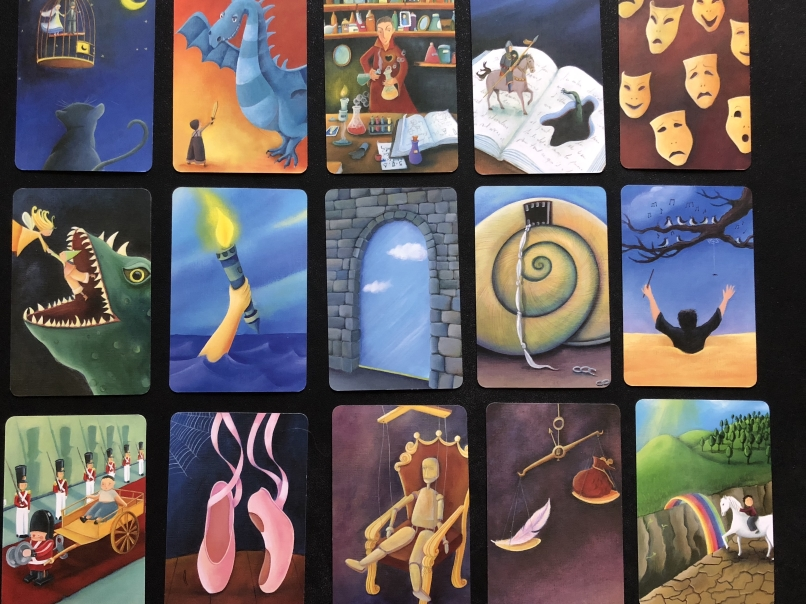
There are other common uses. One common other use for randomisation where it isn’t a stand in, is where it is used to introduce dramatic tension. For this, the players need to know what the results might be and need to be hoping for a specific one. The obvious example of this is, of course, the to-hit roll which might — just might — score a critical hit. But, that d6 you roll in Old School Essentials to find out if you’re going to have a random encounter? That’s also an example of this. Another common use of randomisation where it isn’t a stand in is in the form of abstract prompts. An example of this is a spread of Dixit cards because they have no intrinsic meaning but instead help you create meaning from nothing. Spark tables are another example of this. These kinds of randomisation don’t really play by the same rules, so these errors don’t apply there.
What about replayability?
A bunch of arguments for committing a bunch of the errors I’m about to list hinge around the fact that committing them might potentially increase the game’s replayability. Your argument is probably right: committing some of these errors may increase replayability. However, I don’t think that the value of that replayability is greater than the cost of the replayability. There are probably more costs than these, but certainly those costs include:
The verisimilitude of your world being compromised by the wrong things showing up too often, too rarely, or at the wrong times
Your carefully worded, thought out, and refined results not seeing the play or gravitational affect they deserve in the world you’re writing about
Referees or players that are less engaged by random tables than you, being turned off by the slow pace of your book, and never engaging with your module
As a referee, I have never experienced giving the same players playing the same characters the same scene twice and seen them acting the same way. There’s so much unpredictability inherent in this hobby, that I just don’t think replayability merits significant consideration when it comes to module design. Your module is probably immensely replayable without your putting any effort into it.
I suggest we focus, instead, on writing excellent tables.
Type 1 Error: Poor choice of distribution
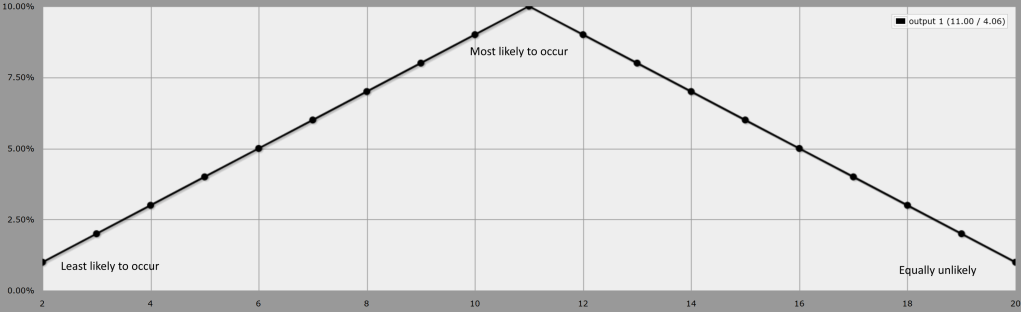
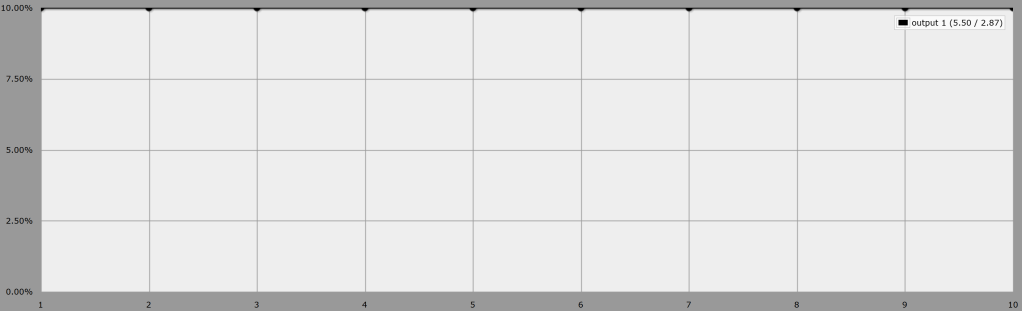
Be intentional about whether you’re utilising a flat or a bell-curved distribution in your randomisation. A brief refresher: If you roll 2 or more dice together, the probability of the numbers in the middle of your available “slots” being rolled are higher than the ones on the edges (the lowest and highest numbers).
From Anydice. This is 2d10, and will become relevant in the example, below. The edge cases are less likely to occur than the middle slots.Also from Anydice. This is 1d10, and as you can see, you can’t really see anything on the graph because all the results are the same.
So, if you’re choosing to roll 2d6, you need to consider how often things are going to show up — it’s not just a handy way to have 12 items (sic) when you only have d6s to roll. And, if you’re rolling 1d6 it’s important to remember that the 6th option is just as likely to show up as the 1st one.
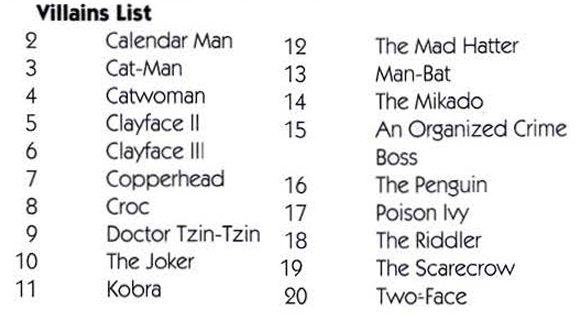
Batman Roleplaying Game (1989): Poor choice of distribution. The most likely villain to occur here is Kobra, followed by the Joker and The Mad Hatter, while classic villains are reserved for the higher scores which have chances of occurring as low as 1% (this is why I used d10s, above, feel free to refer back).
If you want more information about probability and distribution, I’d check Lyme’s primer or AnyDice’s articles. There are a bunch of advanced techniques you can use, but honestly knowing the difference between a flat and a bell curved distribution will cover most people’s needs.
Ask yourself if some items on this list are more likely to happen than others.
Type 2 Error: Poor choice of governance
A random table has to be specific to when it’s used. If you start using a single table to govern multiple circumstances, you’ll weaken the “power” (for want of a better word) of the random table in the circumstance in which it is used.
In my hypothetical module Dragon-Spearers, random encounters are used when moving around the wilderness, typically for most OSR-style wildernesses. But, in individual keys, it’s also used for filling monster lairs, if the party approaches the decomposing bodies, if you fail to cross the river fast enough, and on certain weather rolls. These circumstances really require their own bespoke tables or specific examples of what might happen. Why would bad weather trigger the same selection of encounters as a monster lair?
If you’re referring to a random table designed for another use, ask yourself if this circumstance warrants its own random table.
Type 3 Error: Poor choice of scope
When you’re building a dungeon with only 6 rooms, having 1d20 random encounters means a bunch of those will never occur in a single play through. If you’re building a dungeon with 30 rooms, having 1d6 random encounters means a bunch of those will recur in a single playthrough. If I’m super-generous and assume 3 rolls per room because the player characters are loud and dilly-dallying, a 6-room dungeon will still see only 12 rolls, and hence most likely only see 2 of your entries.
Basically, I’d suggest trying to intuit what your dungeon needs, and try to match the scope of your tables to the scope of your module, based on the instructions you’re using for rolling on it.
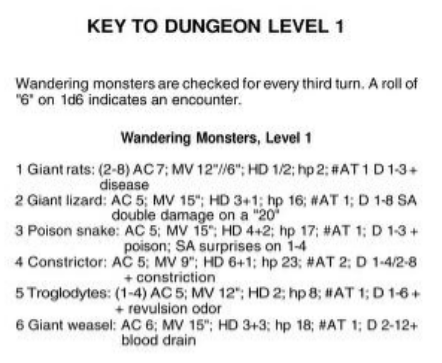
From Against the Cult of the Reptile God: This 6-item table is used for a 20-room dungeon (plus 10 subrooms). There’s going to be a lot of repetition, despite the instruction to roll every 3 turns, rather than the typical 2 turns for the era.
Ask yourself does this random table have insufficient items to satisfy the instructions I’ve given for rolling on it, or does it have too many?
Type 4 Error: Sub- and co-tables
If I have to roll multiple times on different random lists or tables to get a single result, it’s usually boring and time consuming. Almost all tables are better off being a giant array with very specific results, i.e. distributing all of those sub-table rolls into one extra-big table. Don’t forget, we have tons of options for weirdly numbered tables using the d100 method: d44 with 16 results and d88 with 64 results, plus you can combine any two or three dice for a unique number of entries. The reason there’s been a trend towards overloading random tables lately, is to reduce the number of rolls necessary to get results.
I6 Ravenloft: Unnecessary sub-tables. As the sub-table is used here to generate different chances of occurring, substitute this for a random table with a different distribution (see Type 1 errors).
Ask yourself if you have a good reason to be asking someone to roll on that second random table.
Type 5 Error: A concrete entry would be better
Intention and context is really important when identifying a type 5 error, which applies almost exclusively to when randomisation is used to generate content. If your wilderness only contains enough space for 3 villages, but you include a wilderness generator with enough information to generator 12 villages, most of the work you’ve done will be wasted at most tables that are playing your game. I strongly recommend in these cases, that you should put your best writing into just making 3 villages. The same goes for random character generators that will only be used once or twice.
In my hypothetical piracy module Black Tath’s Trove, all the islands are generated procedurally, by combining a list of 30 terrains and 30 features, requiring the referee to improvise a new island based on this huge number of potential combinations. However, in my wildest dreams I wouldn’t expect my campaign of the Black Tath’s Trove will last 900 islands, let alone my imagination remain capable of improvising new islands based on these increasingly repetitive combinations. The 30-odd pages I spent on these lists of things to combine to make islands could instead have been a significant number of unique islands based on exactly the same content — at least an isle per page or 30 islands — plenty to sustain any campaign for a decently long time.
Ask yourself what the benefit of this being a random table is, over it being a concrete thing, and weigh that benefit over the benefit of the concrete thing.
Draw the rest of the owl
One final thing before I conclude: I’m assuming through all of this that your baseline random table is a good one. That the writing is excellent. That it’s meaningful in context. That it’s tied into your world. That it’s evocative. If you write a random table that isn’t compelling, it doesn’t matter if you don’t commit any of these errors, your random table will still suck.
Here I’ve written a random encounter table for a small fortress of about 8 rooms, where some goblins live. Does this random table answer all the questions satisfactorily?
2d4
Encounter
2.
4 goblins
3.
3 goblins
4.
2 goblins
5.
1 goblin
6.
2 goblins
7.
3 goblins
8.
1 goblin boss, 3 goblins
Are items on this list more likely to happen than others?
What is the benefit of this being a random table, over it being a concrete thing?
Do you have a good reason to be asking someone to roll on that second random table?
Does this random table have insufficient or too many items to satisfy the instructions I’ve given for rolling on it?
Does this circumstance warrant its own random table?
I think it does. It’s just boring, nevertheless. Write more interesting stuff, if you want to fix it. Look for three cumulative features (although you might be looking for other things, based on the context or what you’re randomising):
Always make your entries evocative in some way (imply things about the world or the characters — all of these items try to do this)
Often make your entries interconnected in some way (items 2, 5, 6 and 8 all relate specifically to other characters or spaces)
Occasionally make your entries dynamic (items 2, 6 and 7 change depending on what has happened in other spaces or with other characters, or are impacted by them)
2d4
Encounter
2.
4 goblins, on patrol, wielding machetes. Their leader, Grug, has a magical whistle which summons the ferret in the walls, to activate the traps in rooms 2, 6, or 5.
3.
3 goblins, in clothes marked with a shark tooth, playing cards.
4.
2 goblins, patrolling but deep in conversation. They can be heard in the next room, arguing about whether the latest book in the Black Lotus series is as compelling as the earlier ones.
5.
Hermit, sketching still life. Actually his name’s Kulk, they just call him Hermit because he the other goblins won’t be his friend. They just don’t get art.
6.
Frannie and Herb, being intimate in a corner. If they notice you, they grab their clothes and flee to (5). They aren’t found on a second roll, and instead you find…signs.
7.
3 goblins, in clothes marked with a shark tooth, practicing machete-fighting with bamboo machetes. It takes a round for them to grab their actual weapons if they’re surprised.
8.
Shark-tooth the Bossblin (from 8), his graft-surgeon (from 9), and 2 guard-gobbos wielding stonefish-tipped clubs.
The goal here, is to make your random table immediately engaging, even when there are only a few items. Always evocative, often interconnected, occasionally dynamic.
Wrapping up
So, when you write a random table, consider asking yourself these questions:
What the benefit of this being a random table, over it being a concrete thing? If there isn’t one, or the benefit doesn’t outweigh the cost, replace the random table with a person, place, or thing.
Are some items on this random table are more likely to happen than others? If yes, consider a curved distribution. If not, consider a flat distribution.
Does this random table have insufficient items or too many to satisfy the instructions I’ve given for rolling on it? If so, kill some darling entries or write some new ones.
If you’re referring to a random table designed for another use, does this circumstance warrants its own random table? If it does, write a new one.
If there are co-tables or sub-tables, do you have a good reason to be asking someone to roll on that second random table? If not, shake and combine.
Of course all of this is awfully subjective, depending on the context of your module, your intent as the author, and a ton of other things. Being able to use randomisation effectively in your modules is but one tool I’m hoping to add to your toolbox. I hope you find a place to use it.
Bathtub Reviews are an excuse for me to read modules a little more closely. I’m doing them to critique a wide range of modules from the perspective of my own table and to learn for my own module design. They’re stream of consciousness and unedited critiques. I’m writing them on my phone in the bath.
Providers is a 38 page module for Mothership by Joshua Kramer, with portrait art by Sean McCoy. It describes the Shaletown colony and the galactic cult that controls it. I backed this when it crowdfunded, I think.
The first 26 pages cover the colony itself. The Church of the Providers and the law they lay down open the book, with 5 pages of mechanics on them. The Church here doesn’t appear to have any beliefs, but rather it is a scheme where the more you pay in donations the more privileges you’re afforded in the colony. It’s quite transparently capitalist; a fact pleasingly confused by the fact that the Invisible Hand appears (and is treated by the game) to be a supernatural force. The heat and retaliation mechanics mirror stress and panic, but instead relate to illegal activities. I quite enjoy the retaliation table: “Pacification trawler.W:3(60) AP:10. Wide, unwieldy, hovers at 10m up. Drifts slowly, floods the street with tear gas.” I imagine these will result in some really fun situations. I also love that this is, despite the despotic justice system, in many ways a utopia: Healthcare here is free, for example. Special skills bring a degree of interactivity to otherwise uninteresting locations, which is a clever choice. A rare misstep is the placement of the random encounter tables: Awkwardly located together after the locations. I’m reading in digital, so I hope these are cleverly placed in the middle of the zine, but I don’t think the page numbers quite add up. The random encounters themselves are really fun, and feature a lot of interesting but mundane encounters as well as more intense hooks, and being the chaos of a big colony well. Then we have 4 characters that I think will serve as points of disruption to the typical goings on of the colony, effectively the factions here. They are super compelling, easy to run, I love them. Other authors take note: This is how it’s done. And here, where most Mothership modules fall short on evocative writing, this one brings the thunder, with stuff like “What does he fear? As simple as it gets — death. There’s nothing after this for an android and he doesn’t intend to face it.” and “If you’ve caught heat, she can make it go away. If you need money, she can pay you. All she asks in return is some help.” I’m excited to bring these characters to life as a referee. What’s missing? Any other NPCs — I counted only 2, although I could’ve missed some, but I want far more to help me populate a city. The module comes with an additional bonus 10 peacekeepers, but I’m more looking for the people who simply live here. There is also a bonus set of cards for PCs that tie them into the world a little more — I really wish these bonus stretch goals had been incorporated into the core book better, though, as they gesture towards gaps I’d like filled.
The final 8 pages cover 2 scenarios, The Sale and The Tower. The Sale is just that: Smuggle something to a buyer in the Scrapyard for sale. It’s an introduction to the colony, very brief, and while it introduces themes and the atmosphere that the author expects, it’s a bit fluffy for me; an encounter more than anything else. It might not even take some tables an entire session, which could leave you scrambling. That said, it introduces you to the Peacekeepers straight off the bat, and you’re likely to get some heat, and also likely to get the attention of at least one of the core NPCs, which is a fun way to kick off your time in Shaletown. The Tower, on the other hand, is a heist on the most powerful organisation on the planet, to do damage to the Providers. This is a late-campaign type scenario, but it’s well set out, a really fun micro-heist. That said, by contrast with the core setting, both of these scenarios are slight and a little anti-climactic. I wish we had more here.
I don’t know if it’s intentional, but Providers leaves a lot of questions unanswered, that I’d like to see answered. Why do the Peacekeepers have divine powers? What do the Church of Providers actually believe? Why are there criminals in this abundant, utopian version of capitalism? These are all worth exploring, and make it a unique take on Mothership, but they are answers you’re left to ponder yourself. I think whether or not Providers is for you comes down to whether or not you think those questions are worth exploring and whether you want to answer them them yourself, or be provided with a canonical answer (you aren’t).
I love some of the layout choices here. Black highlighting is used for special skill related knowledge. The maps underlie the key, subtly reinforcing your navigation without you having to page back and forth or rely on section headers. Keying is highlighted and very clear. Page references are throughout, and underlining is used for all other highlights, much as bolding is used in the OSE house style. This isn’t a crowded layout; plenty of white space brings the aesthetic of the Church’s utopia to the page. The art works excellently for the page, despite being very abstract in nature, because of clever layout choices, and the maps being colour coordination to the pages, bringing a huge amount of visual interest without a huge amount of art (I count only 11 pieces of non-map art). This is smart visual design.
Providers is an excellent setting and colony, with a notable lack of NPCs filling it, and some lightweight scenarios attached. For me, while Providers has me excited for Joshua Kramer’s future work, the content here is not for me: I want more compelling scenarios to give me a reason to be in Shaletown; at the moment, its inspiration for me to write my own scenarios. I’m not looking for that, but if you are, and the concepts left hanging here are ones you want to explore, this is compelling: The nature of religion and the supernatural, the insidiousness of capitalism in a utopian society, what drives people to crime when healthcare and food are cheap, and how people respond when gods are real, are all pretty compelling questions posed and not answered here. You could make a campaign out of this backbone, if you were sufficiently compelled, and the characters that are here are ones you want to spend time with. If that is something that sounds like your jam, and you want to explore this twist on Mothership with your own expansions, I’d check Providers out.
I’m a sucker for these challenges. But, every day feels like an overcommitment. So I’m toning down the expectations, and I’m going to post something every week, here.My two favourite cities are Fever Dreaming Marlinko and of course, Duskvol. I want to try to meet Marlinko’s scale with Duskvol’s detail, which hopefully will be a good middle ground to create something meaningful in 52 weeks. I’ll use this and the lists by Joey and Boglins in their City26 posts to generate goals and a list of things that I can choose to create in a given week.
There’ll be a lot of repetition between these lists and the list in my process section later, so feel free to skip ahead. But based on reading through those 4 suggestions, my goals for this city are:
4-6 districts
4-6 locations each
A description of the district:
1d6 incidental scenes
1d6 streets and their descriptions
3-4 typical buildings in the district
a random encounter table (2d3 items, for night and for day) with descriptions
unique carousing in that district (potentially with 1d6 bad outcomes)
items and services for sale at the markets
2-3 NPCs with a 1-2 sentence description and a quote (major NPCs are a faction, but not all NPCs)
1-2 factions for that area (“their turf”)
A power level (I to IV)
3 NPCs
3 assets
1-3 quirks
A list of allied and enemy factions
A current situation
1-2 faction clocks indicating when their current goals are
The City:
Rumour table (36 items)
Things overheard (36 items)
Minor events (36 items)
Major events (12 items)
Some notes: Effectively I took what Duskvol has, and scaled it down to Marlinko size. Duskvol, however, has a whopping 4 factions per district, which even when I ran Blades in the Dark, meant a lot were left on the table. I scaled this down to 2. In Duskvol they’re separated into underworld, institutions, weird fringes and trade. Dice types used for different numbers: 2d3 for 5 items with a bell curve, d6 for 6 items, d6 with 2 options for 12 items and d66 for 36 items.
If I end up with free time, I’ll write some lore:
City history (1-6 events)
Cultures and associated languages (1-3 cultures)
A calendar with seasons and holidays (1-6 events)
Typical food: 1-6 for the poor, comfortable, and wealthy)
Law and order (1-6 paragraphs)
Academia (1-6 paragraphs)
Underworld (1-6 paragraphs)
Ok, so doing the math, basically it’ll take 14 weeks to write a district, so 4 districts will take me 56 weeks, if I don’t stray into lore or miss weeks. If I do bonus entries when I’m on holidays or have extra days off or am sick or whatever, I can get it done in a year. There are certainly options in the list that will be less time consuming than others. The goal, however, is to enjoy myself, not to complete it.
Themes and approaches
Wenya City is a stilted city, built on and around the hundreds of small islands in the Wenya Lagoon. It’s wracked by squalls and storms in the wet season. Wenya Lagoon is protected from the worst of the storms, and so it’s a major port, with endless caravans coming up the Drowned Highway that winds through the mangroves to the west, bound for the drunk and rich ships of the Thundering Sea.
System? Writing stats and mechanics is the easy part, and if I complete the city, I can go back and do that stuff afterwards. It’s the writing that’s harder, so let’s call this project tentatively system agnostic, but maybe not long-term.
The Weekly Process
Logistics: Open a new post. Copy the Loose Ends footnote from last week’s post to the bottom of this week’s post, and read it to remind you of what the loose ends are. Don’t feel pressured to pay attention to them. Don’t forget to put the number of the week in the title.
Write. If there’s a piece of lore that inspires you in the Loose Ends, write that. Otherwise, roll 1d8 to find out what. Ignore a result you can’t do, and do the thing that you need to do to do it. Otherwise:
Start a new district (needs a landmark, 1d6 incidental scenes, 1d6 streets and their descriptions, and 1d3 typical buildings in the district; up to 6 districts)
Write 2-3 minor NPCs in an existing district (needs a 1-2 sentence description and a quote; once per district).
Write a random encounter table for an existing district (needs 5 day and 5 night items; once per district)
Write a location for an existing district (if it’s a shop, needs 1d6 goods and services available with prices; up to 4 locations).
Write a faction whose turf is an existing district (needs 1 NPCs, 1 assets, 1 quirk; 1 current situation, and 1 faction clock, twice per district)
Add to a faction you haven’t yet completed (add up to 2 NPCs, 1 quirk, 2 allies, 2 enemies, and 1 faction clock; once per faction)
Write a unique carousing action in that district (needs a 1-2 sentence description, a unique NPC which you can add to the district list with a 1-2 sentence description and a quote, and 1d6 bad outcomes; once per district)
Write a physical secret connection between 2 existing districts (needs a lock and at least 1 key; twice per district)
Name the post after what you’ve written. Add it to the category “City26” and then hit “post”. Or, if you still have a moment, do some of these things first.
Update dynamic tables: If it feels relevant to the location, faction, NPC or whatever, add something to the relevant table.
Add a hook to the district’s hook table (up to 6 per district)
Add an item to the rumour table (up to 36)
Add an item to the overheard in the city table (up to 36)
Add an item minor events table (up to 36)
Add an item major events table (up to 12)
Map stuff. If you’ve added a district or a location, add it to the map, or say to add it to the map in “Loose Ends”.
Add to and remove from “Loose Ends”. Remove anything you’ve used this week. Add anything you haven’t completed (for example, a missing key to a physical connection). If you feel you need to break the maximum allowed for a space, make a note in the Loose Ends and say why, and see if you still feel that way in a year.
Like, I don’t like my chances of completing. My Dungeon23 lasted a month. But, wish me luck!
Everyone loves an informal end-of-year awards ceremony. This year, everyone’s doing it! I’ll join the bandwagon!
Best Single-location Module
Gold: Cyro-Siq (review here) is a tiny module, that hits so far above its’ weight you couldn’t believe. You’re trapped in a space-ship, and one of you is an assassin hired to murder the others. Will you find out who’s after you first?
Silver: Owe My Soul to the Company Store (review here) is a tour-de-force socio-political module, up there with modules like Witchburner for their depth and focus. If you’re interested in the interaction between exploited workers, unions, and corporations, this is a winner.
Bronze: Brackish(review here) is an investigation in a doomed spaceship with a dangerous force ready to destroy you. It’s inspired by videogames like Return of the Obra-Dinn, and does it better than anything out there.
Best Multi-location Module
Gold: Arkos(review here) is a vibrant, sparkling, overwhelming mess of a city and a module, and an absolute masterpiece of god-politics and music.
Silver: Isle of Hex(review here) is an odd cultish town full of fascinating characters and interesting interactions, feeling like you’re exploring an island where Wes Anderson shot the Wicker Man.
Bronze: Curious Creeps in Crimson Creek(review here) is a wildly illustrated and darkly humourous sandbox packed with interactivity and fun.
Best Roleplaying Game
Gold: Spine (review here) is absolutely the most unique, and the most emotionally affecting game I’ve played in a long time. It’s a solo horror journalling game, and you should check it out.
Silver: The Field Guide Handbooks(review here) are a series of unique games that you carry with you, and play in real time, potentially over a year. They each immerse you in a different aspect of your environment, and they’re absolutely fascinating roleplay.
Bronze: Chain X Link(review here) is the best revolutionary game I’ve read, with an incredibly compelling multi-layered take on dungeon-crawling, and a fascinating structure inspired by John Harper and Tim Denee’s work.
Best Podcast Episode
Gold: The Story of Over/Underon Between Two Cairns was a candid and eye-opening interview and interrogation into what will be remembered as the most significant gaming event of the year.
Silver: The First 30 Minutes on Dice Exploder was full of surprise insights for a series on Actual Play that I (arrogantly) didn’t expect to find much to learn from.
Bronze: Talking To Your Unconscious on Yes Indie’s Pod was a fascinating interrogation into how some people engage with solo games.
Best Videogame
Gold: Blue Prince is just an absolutely compelling, rogue-lite puzzle game unlike anything, with a story that you’ll be begging to uncover more of.
Silver: Balatro ended up being the game my partner and I played the most of together this year, and unendingly challenging puzzle, although stymied at times by the too-random randomness.
Bronze: Hades 2 was just so much fun, with so many challenges, and so many highs. I just wish the end-game was a little less prone to requesting you pursue extremely specific challenges, as it started to grow old, although it took a lot of playthroughs.
Best Book
Gold: The Keeper of Magical Things by Julie Leong is a lovely story of wizard romance in a basic fantasy world, filled with cosy feelings and deep history.
Silver: Little Thieves by Margaret Owen is an excellent con-girl story with fascinating world-building, small gods and political marriage and is the first in a series I look forward to digging into.
Bronze: A Rare Find by Joanna Lowell is a queer romance featuring a woman archaeologist set in regency England. Do I need to sell it any further?
Well, my life will get a lot harder next year, outside of the hobby, but I have a few goals for next year:
Playtest, find an artist for and finalise Lightfingers for publication
Playtest, find an artist for and finalise the Great Egg Hunt for publication
Edit, lay out, playtest, find an artist for and finalise the Cat Vats of Gatraxas for publication
Finish editing and laying out The Ratcatchers for publication
To those ends, I’ll be creating a small server where I’ll share these modules as they’re ready for playtesting, and then collecting feedback for those tests. Thank you to those who’ve already volunteered!
And, most of all, thank you to all of you who’ve voted for me in the Ennies, in the Bloggies this year and the last, and who’ve engaged with and read my reviews and other posts. I really appreciate all of your support!
I use affiliate links where I can, to keep reviewing sustainable! Please click them if you’re considering buying something I’ve reviewed! Want to know more?
Have a module, adventure or supplement you’d like me to review? Read my review policy here, and then email me at idle dot cartulary at gmail dot com, or direct message me on Discord!