Each holiday season, I review different modules, games or supplements as a thank you to the wider tabletop roleplaying game community.All of the work I review during Critique Navidad is either given to me by fans of the work or the authors themselves. This holiday season, I hope I can bring attention to a broader range of tabletop roleplaying game work than I usually would be able to, and find things that are new and exciting!
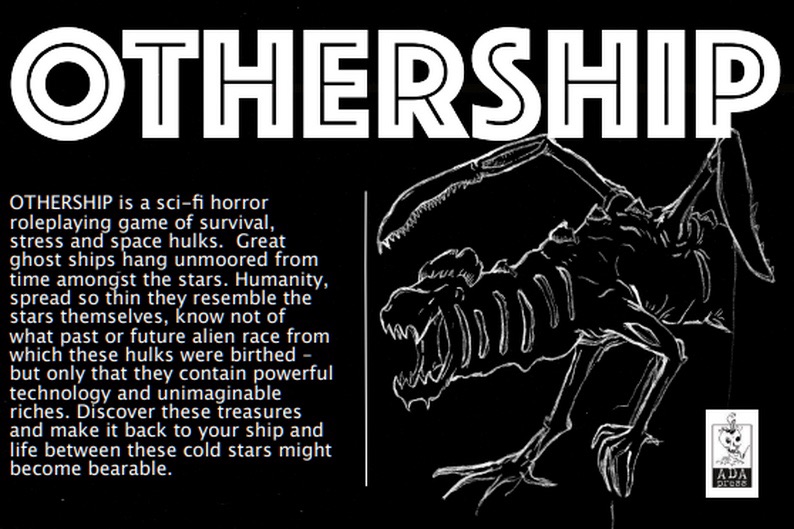
Othership is a single page, 2-sided game by Christopher John Eggett, where 1 side is the rules for a game of space horror, and the other side is a module called Belly of the Beast.
Let’s start with layout, because you can tell it’s intended to be important: This is designed to double-hotdog fold into a tiny, 8 page zine which includes the character sheet. It manages to be bold and evocative while still being minimalist as it must be. I like it, you can fit it into your pocket.
This is explicitly a minimalist take on Mothership, and hence features many similar concepts: Professions, stress, etc., just in 2% of the word count. That word count brings problems: You’re gonna have to add your own rules, as it implies when it mentions androids. That said, it’s (very) broadly compatible with Mothership, so if you think Mothership is too much, and you have an improvisational style, this will suit your style.
Belly of the Beast is an 9 area space hulk to explore. It riffs on Alien directly, and otherwise would be right at home in Mothership. It’s not highly interactive, but it’s meant to set scenes for being chased by the alien that pursues you. I like it alot — I’ve said before I’m a massive fan of a predator-centric random encounter table, I did something similar in Hell on Rev-X in fact.
This is a pocket-sized game to keep in your bag to play whenever you want. It won’t take long, it’s designed for 2 players, and it is truly familiar to fans of the genre. Othership is genuinely great for the specific use case of “meet someone who wants to play a space horror game with whatever I have to hand”. Honestly, this belongs in a series of other classic trope based modules so you can have a little deck of pamphlets to play based on a random acquaintances preference. You could definitely play other Mothership modules with it, but I think its strength is its form factor.
If you find yourself in a position where running a game spontaneously with a single other player is likely, this is the game for you. If you’re looking for simpler Mothership this might be for you as well, but it depends on your angle — this is unabashedly OSR in its minimalism, but Into the Blind which I reviewed last year is a competitor in the space that takes a more narrative approach, so I’d check that out as well, as they’re both pretty cool in different ways. Othership is precisely what it says on the label, and I’d love to see more capsules that adopt the same form factor, or try to tackle the same use case in a similar micro-capsule-game kind of way.
Bathtub Reviews are an excuse for me to read modules a little more closely. I’m doing them to critique a wide range of modules from the perspective of my own table and to learn for my own module design. They’re stream of consciousness and unedited critiques. I’m writing them on my phone in the bath.
The Moss Mother’s Maze is a 31 page module for A Dungeon Game by Chris Bissette. In it, you delve through a beautifully described landscape and encounter horrible creatures.
We open with an introduction to the landscape and the village itself. Bissette writes floridly and beautifully here, in their meandering style, and it works. I don’t love the intentionally vague village — I can sub in my own village without permission, but half-describing a village is in the middle ground where it’s hard to fold into an existing village , but also I can’t just drop it in whole. The notable residents are well-described and each have a hook leading deeper into the titular maze, however the combination of Bissette’s meandering style and lack of highlighting means I’ll have to come at this with a pen to make it easy to run.
The maze itself is a maze. In terms of design wisdom, it breaks a lot of rules. It’s endlessly looped and filled with dead ends, it’s not uncommon to have 3-5 entrances which is usually not the done thing. It is numbered top right to bottom left despite your starting in the center (likely a reason the hyperlinked map exists). The “boss” is only 4 rooms from the entrance, and the odds of the party stumbling straight there are actually pretty high — about 10% by available choices, which feels like a mistake, but could be intentional as finding that early will drive players towards the vault. Accessing the vault is difficult, though. It’s supposed to be like this, because it’s a maze, but mapping for the party would be very challenging (and this is explicitly what it recommends you let the party do), and it I think designing a maze that is enjoyable to actually play in is a hell of a task.
I love the random encounters here, which are split into 2 columns — you always encounter the first column first, and then the second is the real encounter, in the next room. Very nice work, for a maze, which will fill the players with appropriate paranoia and mess with their mapping. The Moss Mother here is presented to me as a slasher, hunting the players throughout the maze, which is a dynamic I really, really like in modules, rather than leaving her in aforementioned room waiting.
The keying itself is gorgeous, as usual, and I like that the exits typically have sensory descriptions to aid in decision-making. It’s all compelling, but often contextless and filled with forsaken easter eggs — for example, the Nightdarts are a monster you might encounter, with a tragic backstory that the players will never find out, and it’s not clear what in the maze actually caused the horror to occur. What caused the infection driving the nameless man in 18 to fight the Moss Mother? Is it the “fungal spores”? If so why do they not affect the player characters in the same way? Why is there a bed in 22? These questions don’t need to be answered, but having an answer rather than a random assortment of rooms to tour would make the maze more compelling as a whole. Rooms are mostly isolated with few connections, although some of the traps can be repurposed against your foes, most notably the titular Moss Mother. Some of the traps aren’t clear, though: Where do you end up if you’re trapped in Passage 1? And some questions are raised by the text itself: For example, where is the spear in 21 from if the vault is empty except for a certain substance? Overall, the maze itself presents as not fully thought through, or at least a more florid version of the classic “throw a bunch of unrelated rooms in order” dungeon.
In terms of art and layout, Bissette has been vocal regarding the high cost of art and how it impacts the price of modules and games. Accordingly, The Moss Mother’s Maze contains a total of 3 pieces of art (plus the cover) and 3 maps. These art pieces are pretty striking feature pieces, but the maps are workmanlike. The layout is simple; rooms are always kept to a single page, headings are clear but highlighting is non-existent, even the tables lack zebra striping for ease of scanning. One benefit is that time not spent on layout or art was spent on hyperlinking — everything is linked here, which is a huge boon to someone running digitally, although it’s far less accessible in print. I am not opposed to minimal art products, at all, but I feel like resigning modules to a visual design that feels like it was put together using Microsoft Word templates is a mistake. We can have beautiful, art free, and easy to read modules — it’s not a zero sum game.
The Moss Mothers Maze, then, is a gorgeously describe but perhaps not fully thought full dungeon. I think it serves best as a funnel, to be honest — you’ll die a lot getting to the vault, and then you’re likely to die retreating from the vault. If you or your players want cohesiveness — if you want to solve puzzles or think about why things are happening or expect to learn lore — this is not going to be at all satisfying. If you’re looking for a beer and pretzels type dungeon, one to occupy your players for a few weeks, kill a bunch of characters, and shock with a bunch of horrible, well described situations, the Moss Mother’s Maze will be an absolute pleasure.
Each holiday season, I review different modules, games or supplements as a thank you to the wider tabletop roleplaying game community.All of the work I review during Critique Navidad is either given to me by fans of the work or the authors themselves. This holiday season, I hope I can bring attention to a broader range of tabletop roleplaying game work than I usually would be able to, and find things that are new and exciting!
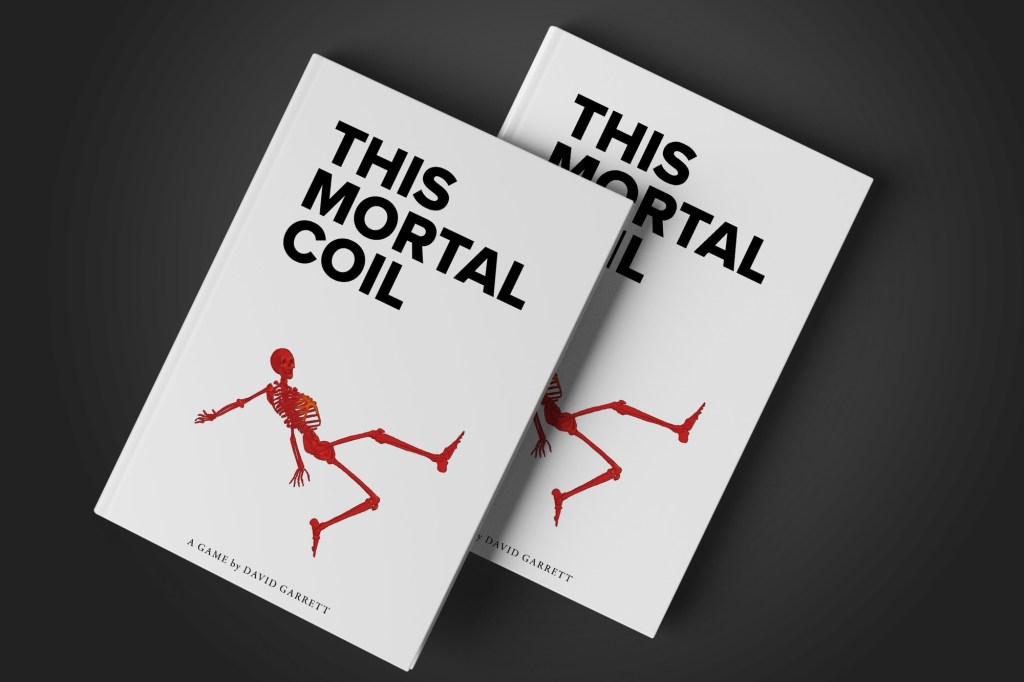
This Mortal Coil is a 140 page roleplaying game by David Garrett with art by Zach Vaupen, Its compatible with Liminal Horror. In it, you play a space traveler seeking eternal life and raising an army of undead thralls by harvesting aliens. This is ostensibly Liminal Horror, but separating it from the core line is sensible, because here you’re effectively playing the enemy in any other Liminal Horror module — this is filled with body horror, cosmic horror, and morally indefensible choices.
Right off the bat here, I’m seeing some conflict with the choice of an OSR chassis and the themes. I don’t feel like necromancers should work together! 5his is a pitch issue (“necromancer in space!” is a great mashup), and more up front legwork needs to be made to frame the pitch so that my expectations are either redefined or clarified. Here’s my understanding of the pitch: “This is set 3000 years into the future, in a distant star system. I’m not sure what happened in the intervening millennia, but there’s a heaven and a hell, and unless your funeral is on point, the forces of hell will animate your corpse as at least a zombie bit potentially a more powerful evil undead being, driven to devour all life. So, the companies that control all are funerary companies. And recently, a constellation appeared in the sky that made it possible to see and possibly control the forces of hell — and this is how you and your companions hope to avoid death.” That slaps, right? The pitch is technically right, but a half-decent summary of what’s actually going on skips the strange disjoint between pitch and system.
Next up comes character creation: You choose one of the backgrounds, and randomly generate your character from that page. It’s neat, although it’s still unclear on why you were suddenly “offered the chance for eternal life” — is this just the existence of the new constellation? Half way through the character creation chapter we get a hint of who offered you the chance: Each of you have a unique voice that speaks to you. But I’m still just guessing — my theory remains unconfirmed. Anyway, containing items and histories like “Never bring a gun to a proton cannon fight.” and “You sought to inhale the divine spores of the Mycelial Belt” these are pretty flavourful backgrounds with a good dose of humour. The whole game is filled with clever, fun writing, and that might just be enough for you to want to bring it to the table. The many random tables are really excellent: An adverse effect of hyperspace travel might be “Your name has changed, though all memories and records of it have changed along with it.”, or your interfering in the negaverse might cause “Your chest collapses, leaving a gaping void in the middle of your torso. You feel like you are suffocating, but you no longer need to breathe.”.
Your power in This Mortal Coil is souls, and that’s the driving force of play — to be more powerful, more people have to trade you their soul willingly (although it’s not clear if they then have to die before you can use it). This is a really compelling drive for the players to interact with the world actively, which I adore. There’s a direct relationship between fallout that fills your inventory and the number of thralls you can have — this is neat, as the more damaged your character is, the more powerful a necromancer they are. If you get 12 souls and all your ingredients, you get to be immortal, which is basically the core loop of the game. The game implies that the loop continues after you gain immortality, although I’m not sure what will drive play past that point, and I don’t get any clues.
While there is a lot of generic referee advice here, my favourite stuff are the specifics — we get a bunch of brokers to help guide the players to their ingredients, for example, and a character generator for NPCs willing to trade their souls to the players. We also get a flavourful bestiary of undead, and a flavourful list of items. These are all pretty cool. One regular issue with these capsule OSR games is the repetition of the rules — there are a lot of rules here, covering magic, space travel, crews and more. It’s comprehensive, but I really would’ve preferred a less is more approach — I get confused with what type of game this is intended to be, because the rules cover every outcome. Survival space horror and necromancy devils bargaining don’t feel like they belong in the same game with the same characters, to me? I struggle with the lack of support in the stranger mash ups here.
In terms of layout, this one is sparse, flavourful, and easy to read and navigate. I don’t love Zach Vaupen’s art for this particular game — I’d love to have had a more concrete suggestion for what the world looks like. Art really helps picture worlds, when they’re a little different, and this one is a very unusual mash up — and as I alluded to earlier, I struggle with the mash ups already. But it’s solid art in and of itself and you might prefer having the less concrete art yourself, to let your imagination go wild.
This Mortal Coil is a really interesting mash up, sort of Mothership meets Liminal Horror with an emphasis on negotiation. If you enjoy the Liminal Horror chassis, there are a lot of changes and you may be excited to add them into your game, if you wanted to take your investigators into space or have them turn coat. But when push comes to shove if the idea of an OSR style game that puts the spotlight on persuading NPCs to sell you their souls and having a cohort of undead minions as henchmen, you already know should check This Mortal Coil out immediately.
Bathtub Reviews are an excuse for me to read modules a little more closely. I’m doing them to critique a wide range of modules from the perspective of my own table and to learn for my own module design. They’re stream of consciousness and unedited critiques. I’m writing them on my phone in the bath.
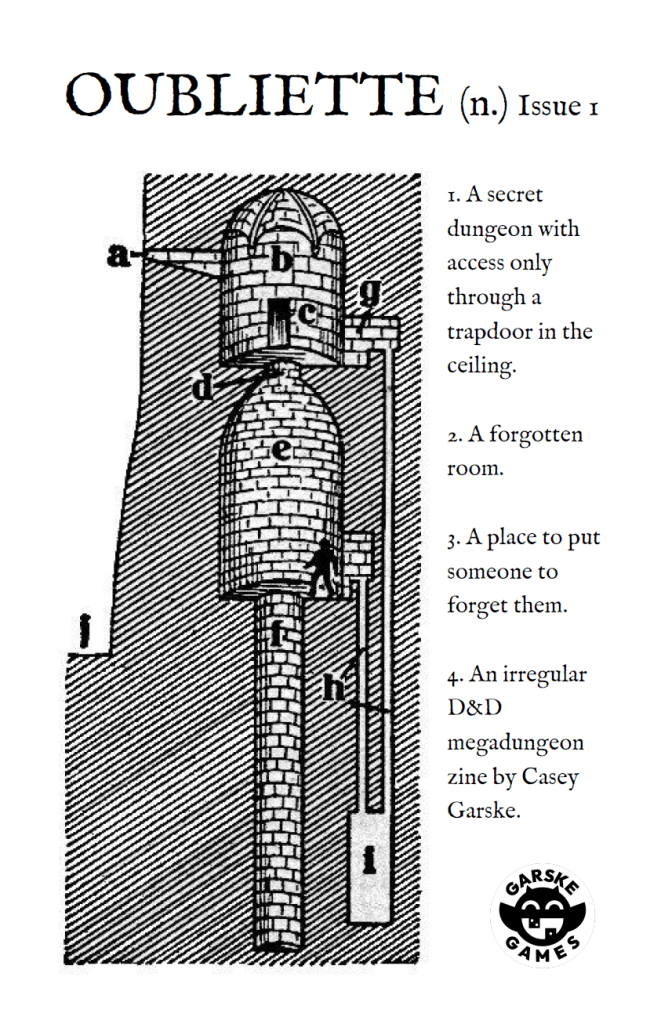
Oubliette is a serial megadungeon for B/X, written and with interior illustrations by Casey Garske. As it stands, the 0 and 1st issues have been released, and I’m looking at those 2 releases. In it (so far, at least), you’re trapped in a town on a rock in an endless grey void, and the only way out is by using raven statues to teleport into a deadly, endless dungeon. I bought this one on Drive Thru RPG.
Oubliette (n.) 0 is only 12 pages long, and covers the campaign rules and the village of Oubliville where the party will spend their downtime. The Rules: The Oubliette appears to be some kind of hellish afterlife, where you can collect Obols for more power. Raven statues act as fast-travel points that might reach deeper into the Oubliette or might return you to Oubliville. These two additions (as well as the additions of a supply die and equipment slots), effectively gamify this megadungeon, something I’ve been interested in in the past. There’s not much to it, but what’s there has a purpose. Oubliville is effectively 9 locations, their character, each with a specific purpose. Again, very videogamey, but in a neat way. A bunch of these introduce collectibles that need to be brought back to Oubliville — tomes and ingredients for potions, and the others all serve specific purposes. Obols being expended for all of these things as well as for experience, means that tough choices abound in the Oubliette. Overall, the rules included here are great, and make me excited to dig into Oubliette proper. Oubliette (n.) #0 is free, so if you’re not sure about this project, I’d look at this, and see if it guides your decision either way.
Oubliette (n.) 1 covers the first level of the dungeon, and packs 31 rooms into less than 20 pages. This runs a little differently: There are sewers linking most of the rooms if you choose to venture down there, and you don’t roll regular random encounters, but rather only when you enter an encounter room or “linger too long“. The event roll is loaded, and consists up to 12 unique random encounters, some of which are related to specific locations (as good random encounters should be). There are also environmental encounter tables (“gutteral voices from room 11“) as well as a level lockdown where you can be instantly locked up. Good stuff, pulling from popular OSR blogosphere innovations. The room descriptions also pull from Anne Hunter’s Landmark, Hidden, Secret in their keying, just as many other OSR authors such as Miranda Elkins, Yochai Gal and myself all do. I’d prefer the bestiary at the back have clearer descriptions, and potentially behaviours or goals. There are collectibles here — an ingredient and a tome, although I think the ingredient is unclear enough in the description that you might get players picking random stuff off the shelves — Yex the Apothecary might be a better source for something like the trading sequence in the Ruins of Castle Gygar to help with direction here. The room descriptions are terse, but rely quite heavily on hyperdiegesis. I’m not sure if Garske has deep lore planned for this megadungeon, but certainly I’d like to know as someone running this if there’s going to be, as the implications might grow in the absence of any canon here — I had similar struggles with episodic megadungeon, Through Ultan’s Door.
However, I struggled with some aspects. I cannot grasp the sewer layout at all: “Below the main floor of the dungeon is a sewer […] Dashed lines in the sewer indicate higher dry ground. The tunnels of the sewer pass beneath the upper rooms in straight lines[…]” Looking at the main map, I can see dashed lines, but otherwise I just don’t follow. I think this may be an issue with using Dungeon Scrawl as a mapping tool — maybe some lines are running beneath the main level, but it’s not at all clear. Certainly I could map out the sewer rooms (19 to 21, 25 and 27 at a glance) and figure out what they could connect to. This would be easily fixed though, simply by shading the lower sewer level or hand-drawing this map, which isn’t particularly complex. I recently read Cryo-Siq, which used a method of mapping which allowed for connections like sewers between rooms by using a secondary keying code (i.e. 13A might indicate all the As are connected). Something like this would work far better for me. I want more information for a lot of this stuff.
One interesting little impact of some of the keying choices is that the Oubliette feels like it might be some kind of time loop, with the players continuously turning up in a room with a jailer recently killed in it, for example. The dungeon also has no restocking method — given the author appears to be familiar with the OSR broadly, and given the keying choices, this also feels intentional, perhaps that the recurring monsters are supposed to be reborn each time you re-enter the Oubliette. Is it supposed to be a grim, violent, Groundhog-day like jail? It’s not clear. The mystery in this dungeon is plenty intriguing, but the lack of, for example, any information on what the Ghostly Preacher might preach, and things like it, concern me. It appears the Warden is chaining the Duke, and that the Duke guards the exit from the Oubliette, but that too isn’t clear. It might be that things will be revealed in future issues (certainly, at least, the Eagle Talisman doesn’t appear in issue #1), and I like that the exit is here on the first level, as it creates a pleasing loop, particularly if the Eagle Talisman is far deeper, but it’s disappointing that the tome titled “On the Nature of the Oubliette” gives you special magical powers, but no revelation about the nature of the Oubliette. Now, I am making these judgements based on an incomplete dungeon — more issues I’m assured will follow — but perhaps these zines would benefit from some kind of reassurance regarding what will follow and what the referee is expected to improvise herself, because because as it is it leaves me in a limbo where I’m not sure what’s planned and whether I’m undermining it and hence my players’ decisionmaking.
Oubliette (n.) 0 and 1 are both illustrated by hand, and are laid out in Google Docs. The layout suffers accordingly — I think you could do more with Google Docs, but Garske appears to be more interested in just getting this out there, which is super valid for a megadungeon project. I think the big thing I’d change, though, is some variable spacing, as I struggle to read the individual room entries, in the context of the only paragraph breaks being the ones between rooms.
There are a bunch of criticisms here, but I’d like to point out that many of them are similar to the criticisms I posed towards another incomplete megadungeon, Through Ultan’s Door, over a year ago. This suggests these criticisms are one of experiencing an incomplete part of a whole, and perhaps not a valid criticism of that whole once it exists. But, alas, it does not exist as yet. What Oubliette at this stage is, is a very compelling first floor or so of a megadungeon, filled with mystery, written tersely and with great flavour, with suggested house rules that are reminiscent of videogames. At this stage, it conjures the impression that this megadungeon is a hell of some kind, either a time loop or some kind of purgatory that you’re all trapped in along with these characters that may or may not regenerate each time you enter. But I’m not sure if those impressions are me reading too deeply into what’s here, or intent of the author. Irregardless, while I’d wait to run Oubliette, what is here so far is an incredibly compelling start to megadungeon, that I’ll be keeping a close eye on as future issues release. If you’re looking for a megadungeon that’ll kindle your imagination, Oubliette (n.) is the megadungeon for you.
A few months ago I decided to write a module live on Bluesky, from woe to go, to show my process and why I keep insisting it’s not hard. A few people asked me to immortalise it here, so I’m reproducing the thread with a few small edits so it makes more sense outside of the chronological nature of Bluesky. If you don’t want to read something very long, I’ll pull out major learnings and then put them right at the end. Click here to go straight to the end.
Image from WordPress Open Library
Start with an idea
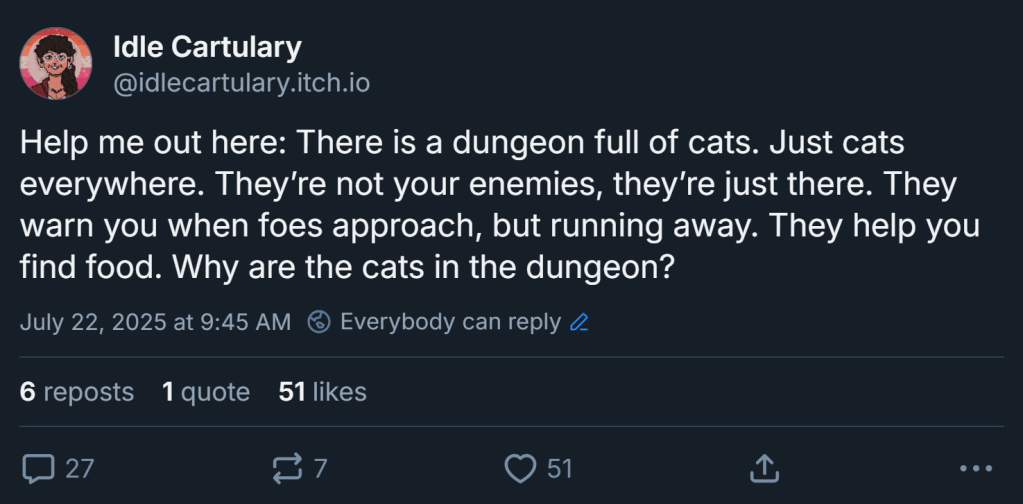
In this case, I don’t remember why I decided to have a tower full of cats, but I basically was taken by the idea that the cats would be a warning for a monster to be coming. I reached out on Bluesky for ideas as to why a tower would have so many cats, and the conclusion was: Cloned by an evil wizard.
Draft the space
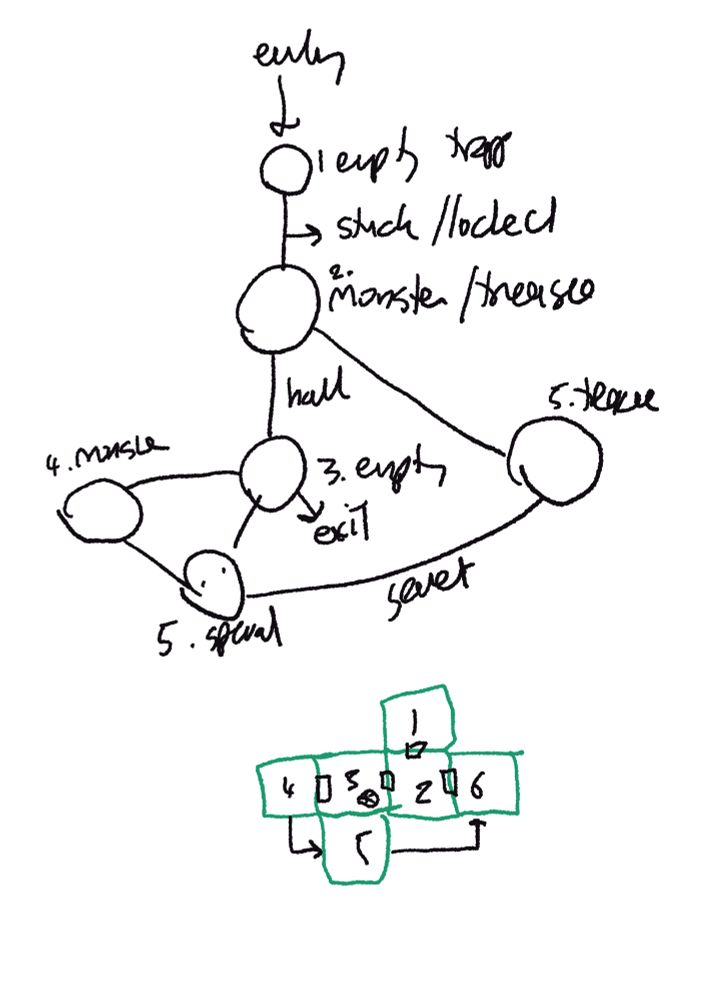
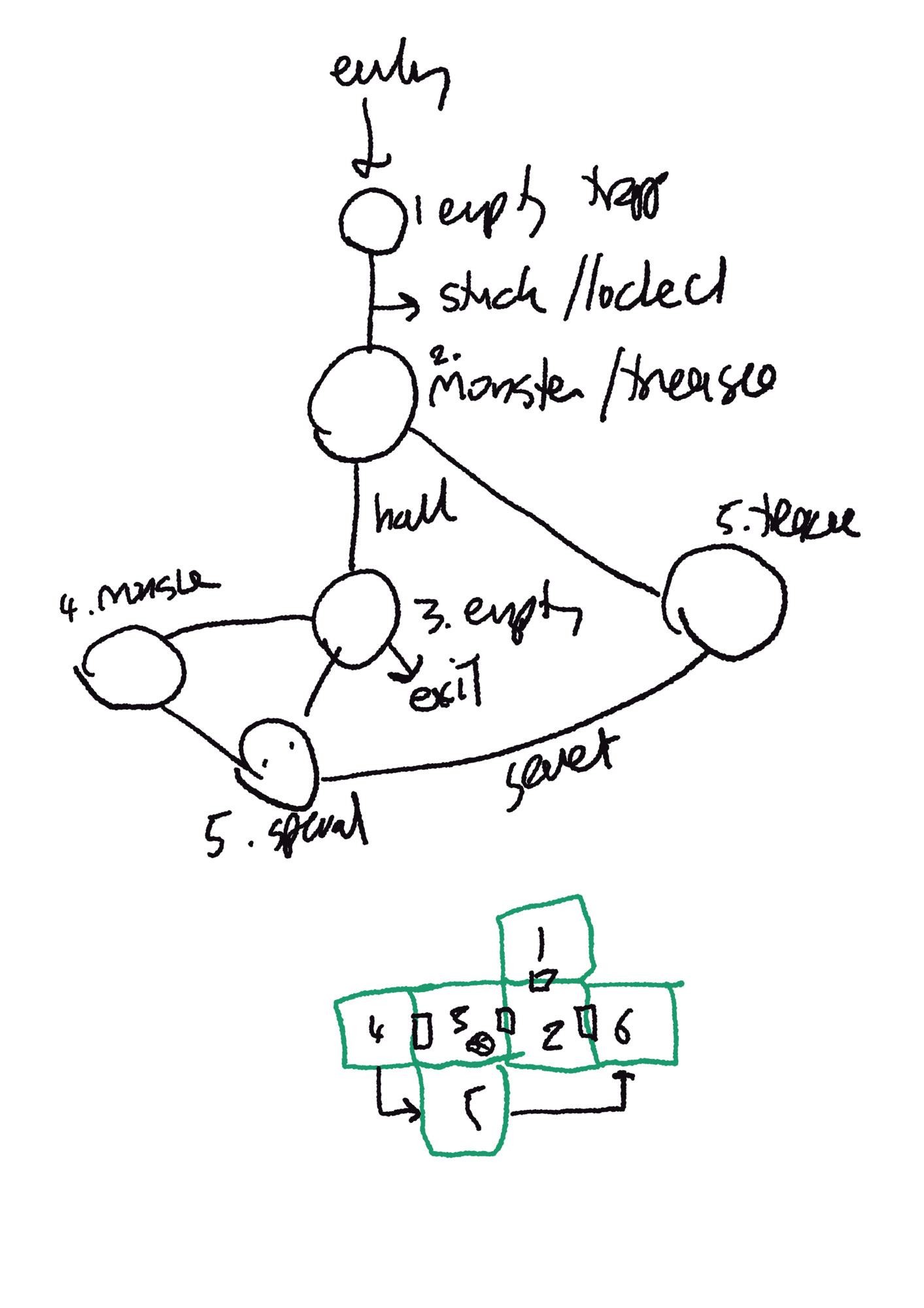
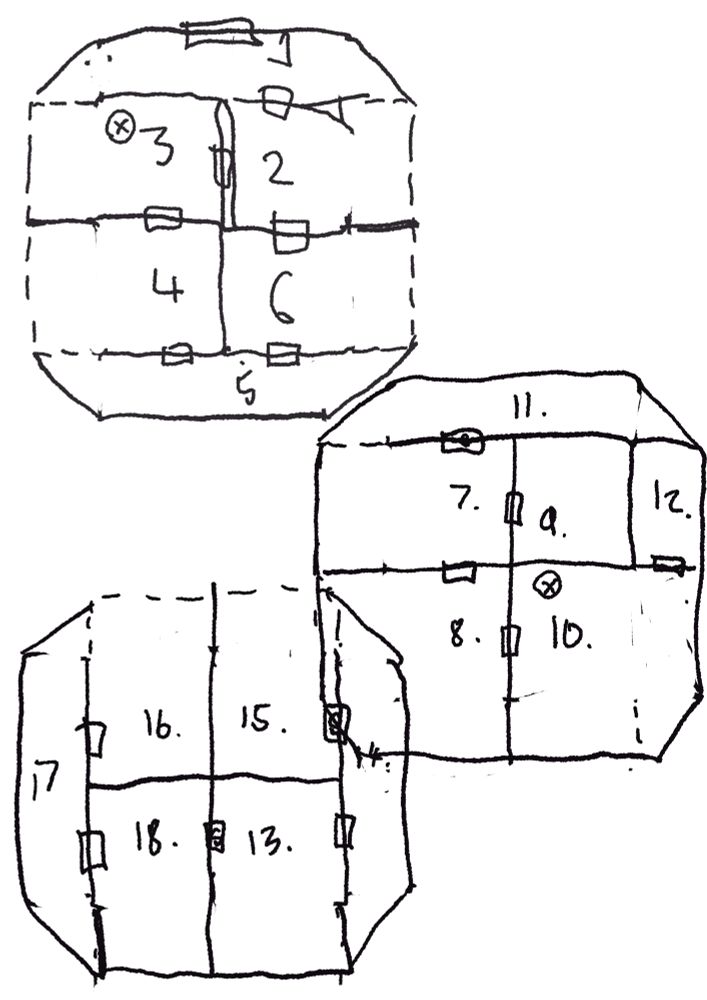
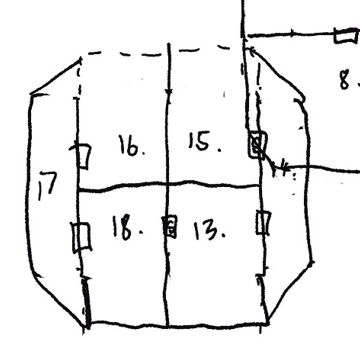
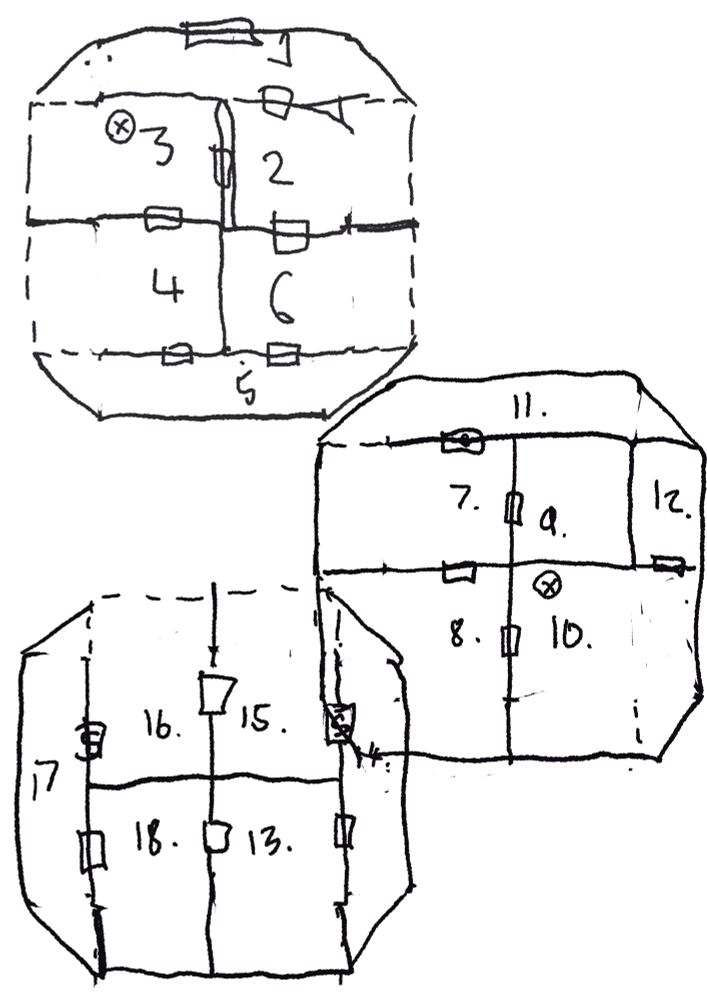
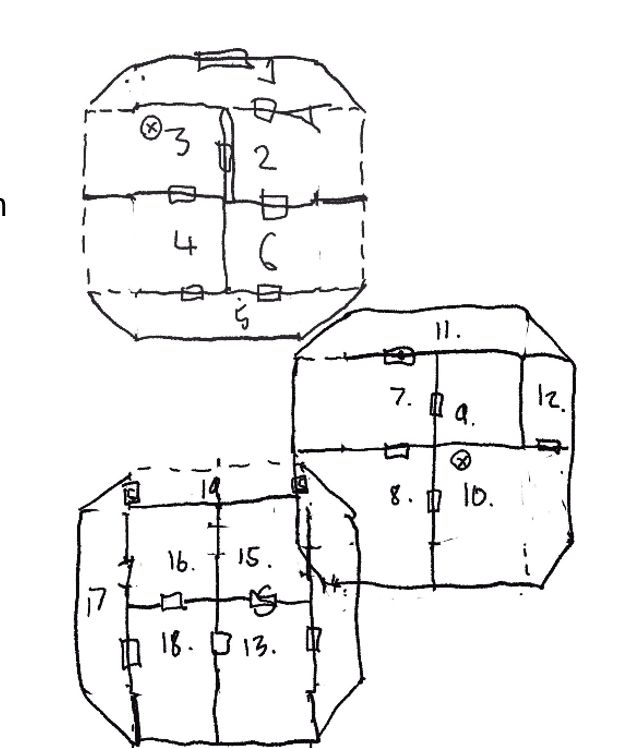
Ok, I’m writing a dungeon about cloned cats. It’s called the Cat Vats of Gatraxas. What’s next? Well, it’s a wizard tower. Let’s use that as a framework. I’ll randomly generate 3 levels. At the bottom is a more concrete layout. I drew these atop each other, cos towers should have a consistent plan. It’s a mess, but you can see the pattern, yeah? Because of this mess, I can quickly convert it to a real map, a circular ish tower. this one doesn’t have balconies. It’s been like half an hour and I have a full map.
Scroll through for the first draft map
Draft biomes
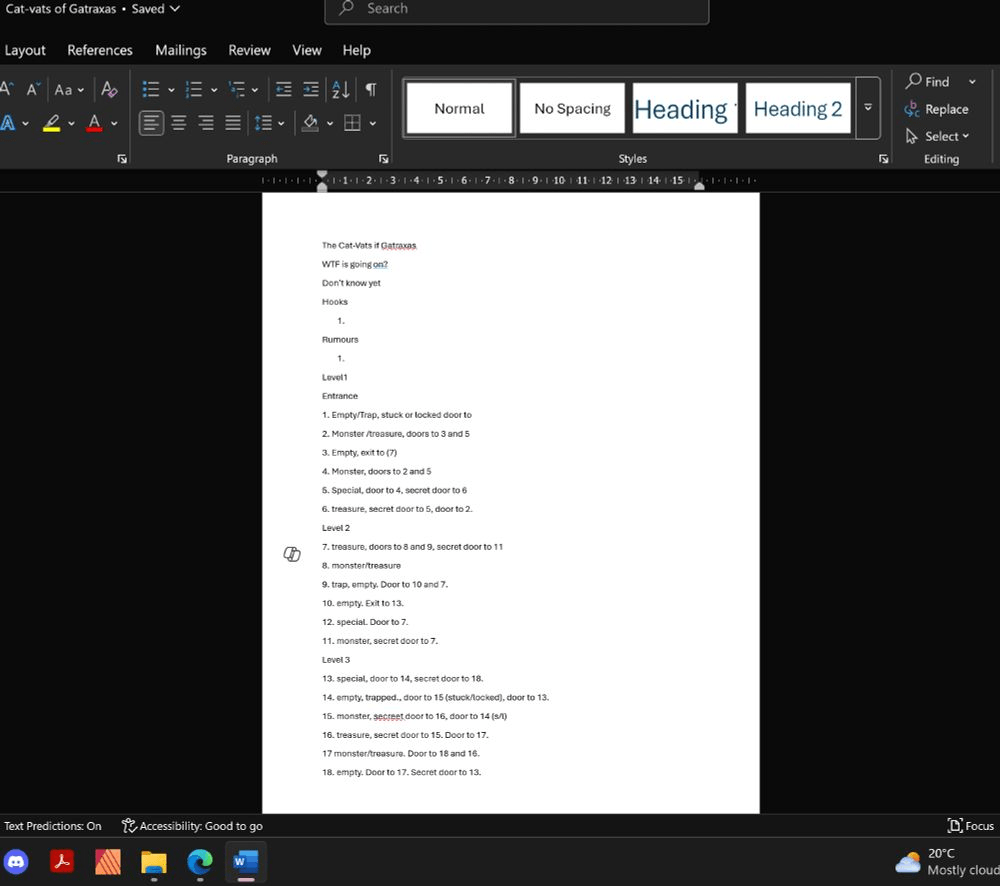
Now, I have to come up with what’s on the three levels. Give each a subtly different theme — a small dungeon, doesn’t need big thematic swings. level 1 is highwaymen in the library. Second floor is the imps that maintain the cat-vats. Third floor is the wizard’s quarters and like, ghosts maybe. Ok, so now I’m out of sketching mode, and I’m into keying mode. I have a framework already! So – this bit is the first boring part – I type it in so that I have something to work off of. I’ll also go back after this and mark interior and exterior rooms, which helps with windows and such.
Note: I don’t yet care what system this is for. That comes later don’t start at the finish line. I aint got no game, yet. Just a wish and a tower.
Write a bad first draft
Ok now for brainstorming. How do I go from this? Well, I have 3 prompts already – “What does the biome of the level suggest this room should be?”, “What does the content of the room suggest this room should be?”, and “What is stuff in a wizard’s lab tower thingy?” I always also keep in mind a 4th prompt, which is a Sean McCoy joint “What other room interacts with this one”. You don’t need to use all 4 prompts, but that’s a lot of prompts, you should be able to figure something out.
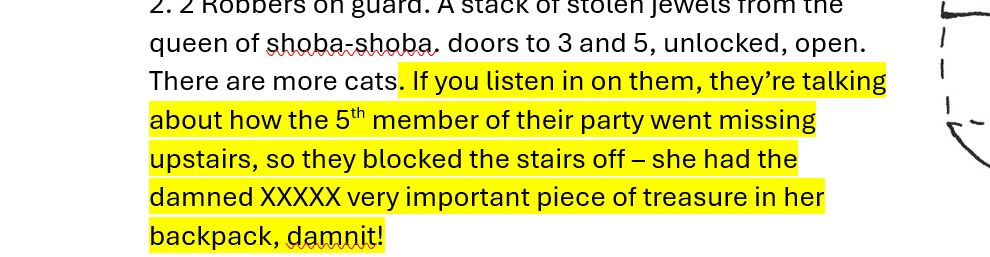
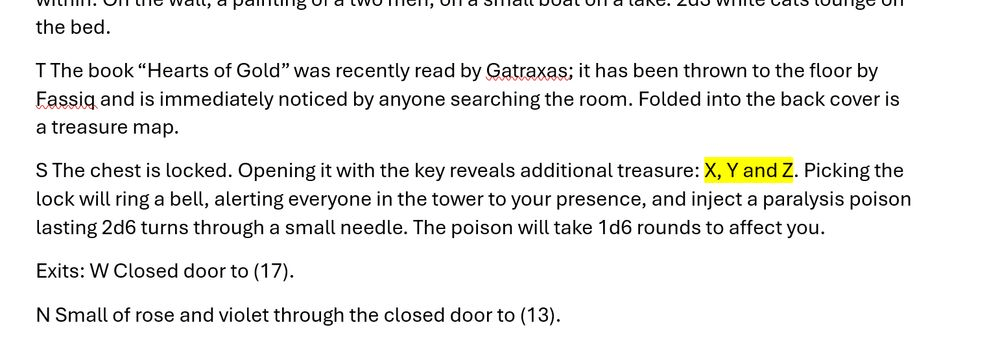
Ok, that’s level 1 outlined. I left out the special because I dunno yet, and that’s ok, because other rooms will relate to it, or give me ideas. You can leave blanks, knowing it’ll grow in the process. I also just put notes in here, like the highlighted one below: This is making the dungeon, not a final product. First drafts are always rubbish, yeah?
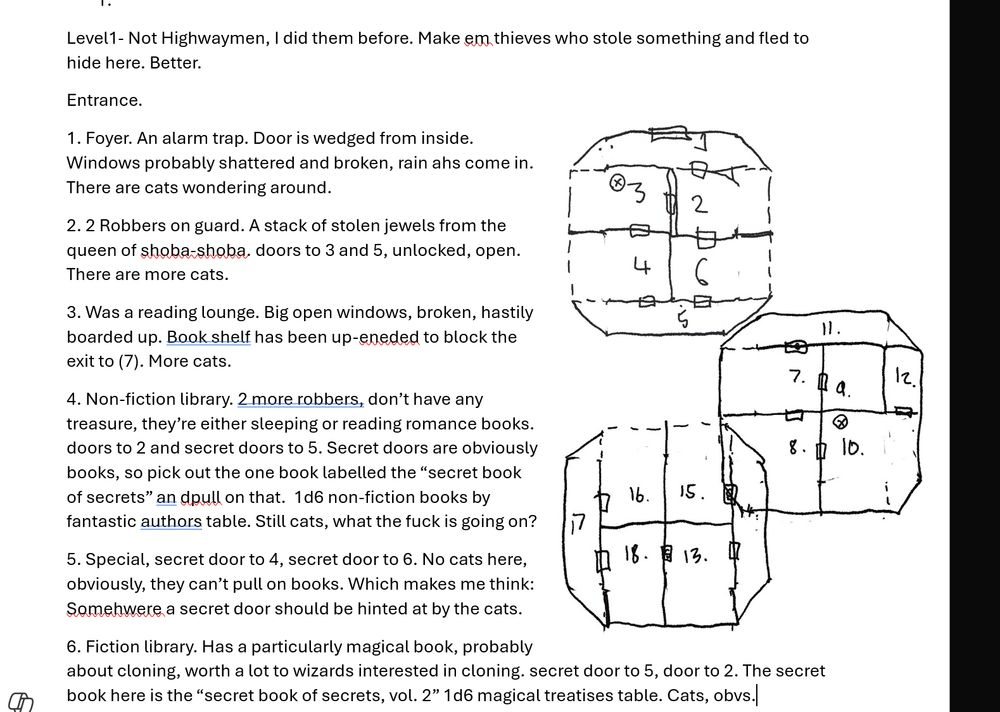
Ok, that’s 2 hours on the clock, I’ve gone from concept, to playable. I could run this for my friends right now – I already have a little hook in the robbers. That reminds me, I need to have a hook that leads deeper into the tower at this point, for the people who are just going for the robbers, to draw them in. I’ll put in fixes or notes to perform a fix, straight away when I have a thought, so I don’t forget later:
I’m now expanding the themes on level 2. I do a little more research, of course – what fish goes in the tanks? Sardines or pilchard, because they’re tiny fish that will fit in tanks. I think sardines are funnier, though. Start asking questions about the level, and see what the implications are for the other levels. Right now I’m thinking that the special room on level 1 is probably related to why there’s a monster, why the wizard is frozen, and why he didn’t get cloned. Is the wizard here, on level 2, or on level 3? As I write this, I’m starting to form an opinion of who the is bad guy on level 3.
It’s worth noting that this changed in the writing – initially, the human vats and cat vats were separate, but I decided to foreground the cat vats, to foreshadow the wizard and the discoveries the players might make. Also note I’ve started highlighting stuff, like I did with the notes earlier. I do this when I have an idea that I need to come back to later.
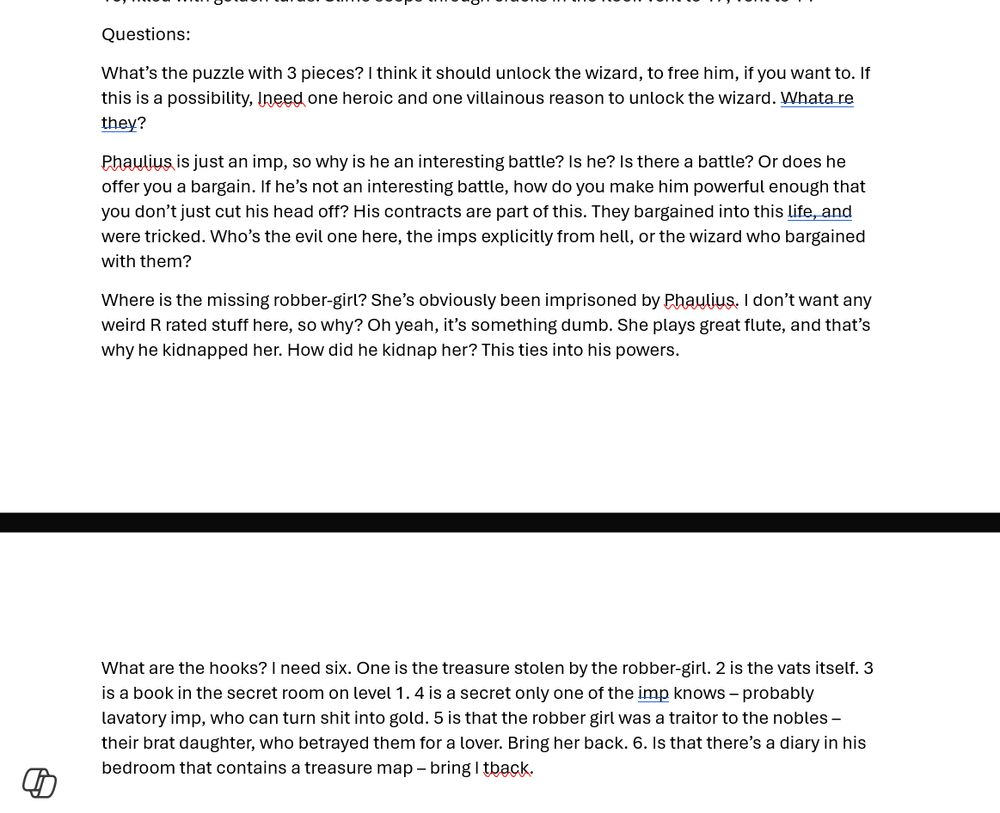
That’s hour 3, I think, but I stopped for lunch. Now to finish the story on level 3 – I’ve left two spare rooms so far, with only inklings of what’s there, and they’re specials, so maybe I want to put a puzzle where the third piece is on the third floor that answers one of our big questions. Puzzles are good for storytelling in dungeons, because they’re optional – you don’t wanna force lore, you want people to be excited to find it out. Oh, and by puzzle, I just mean “oh this doesn’t make sense until you find all 3 pieces” – it could literally be 3 fragments of a phrase or something.
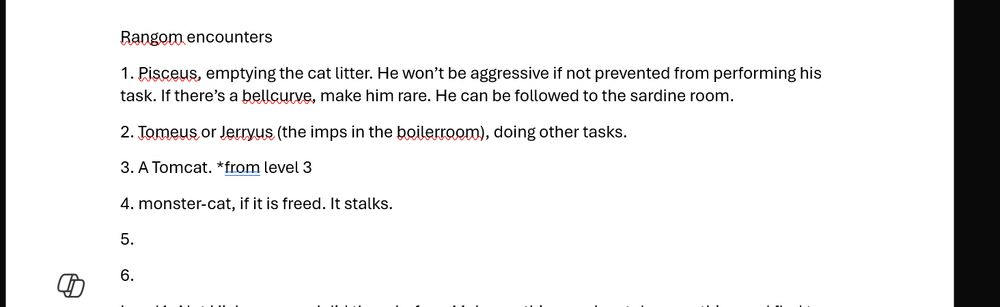
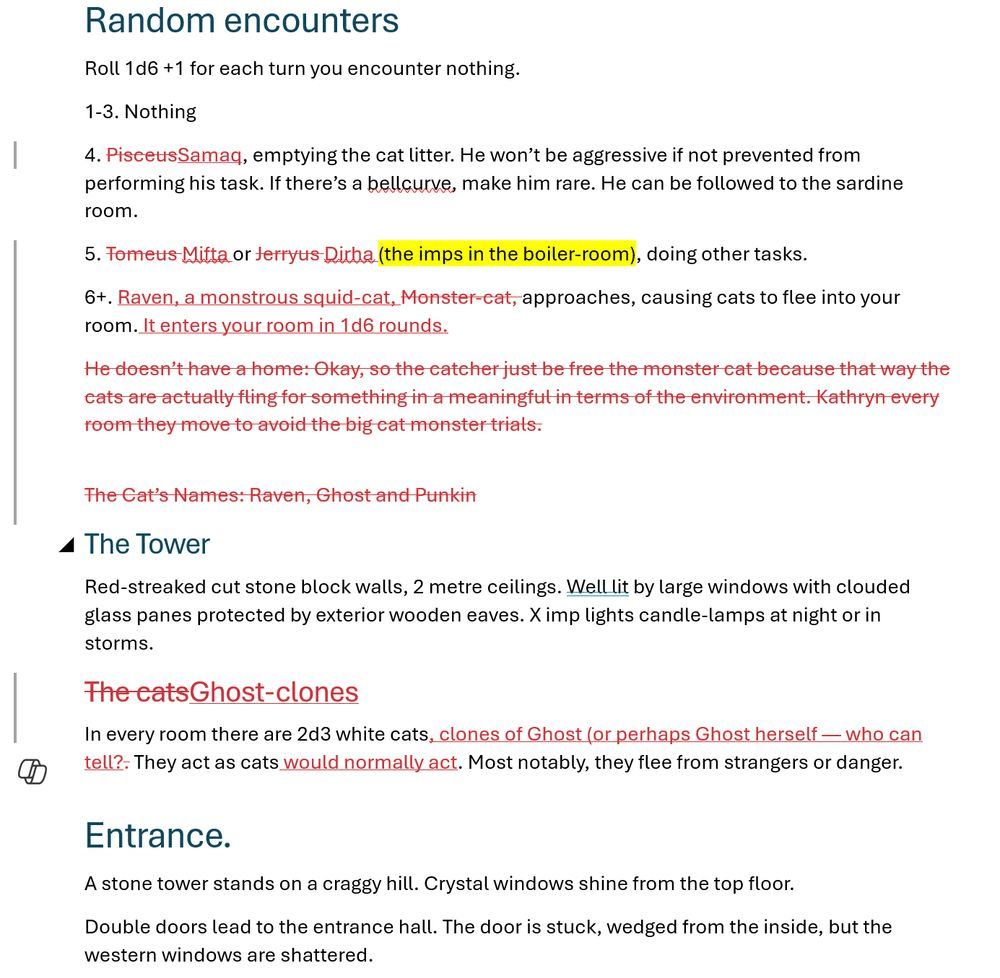
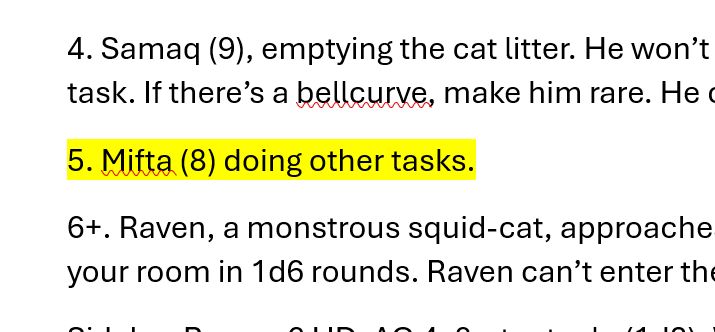
At this point I’ve started realising that random encounters are happening, so I’ve written some of those. It’s an 18 room dungeon, so 6 is probably a generous number of random encounters, keeping in mind a speed run of this dungeon would result in 9 rolls and only 1.5 random encounters occurring. Maybe I’ll make 5-6 something unique to different levels? Or just an environmental effect of some kind.
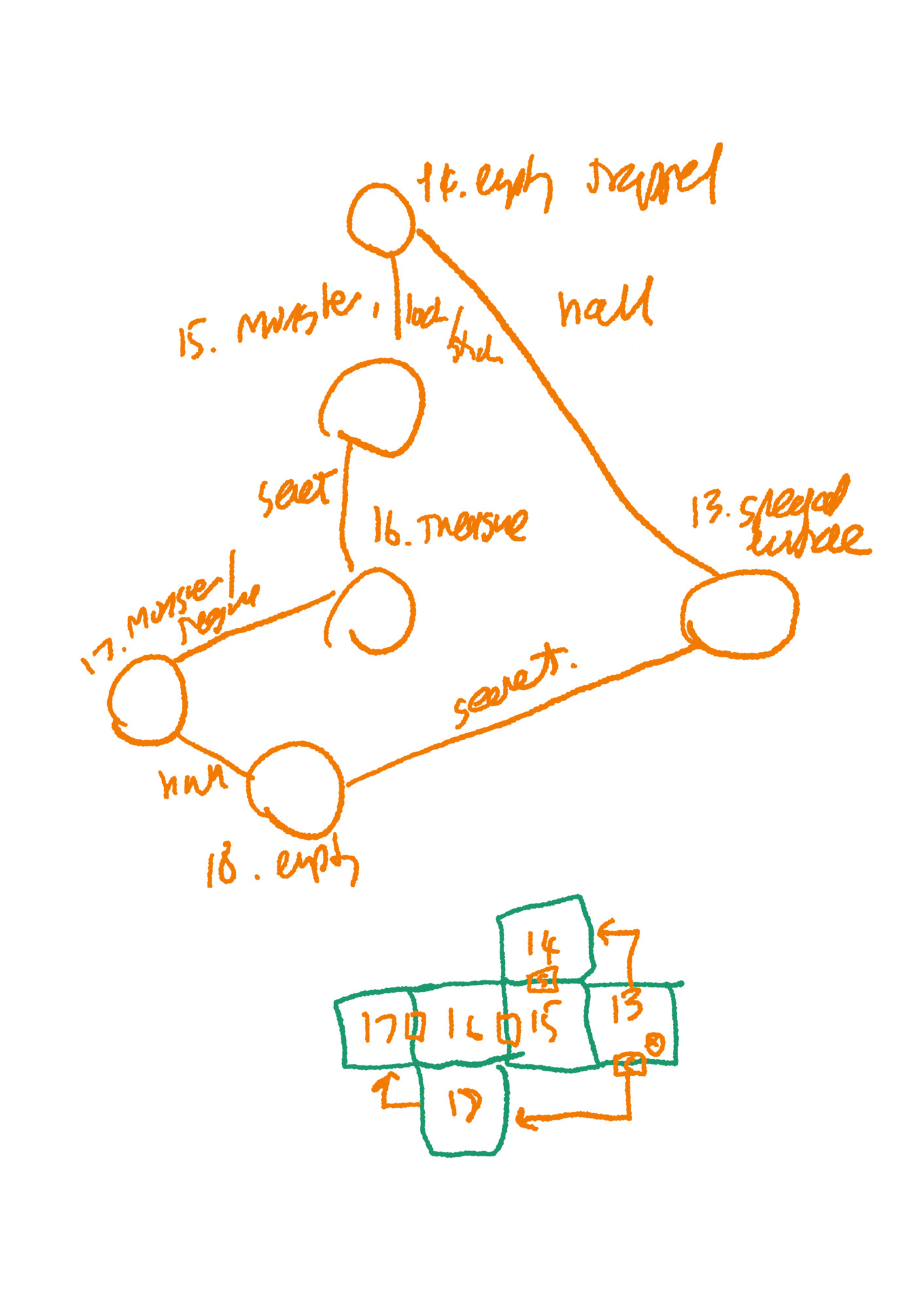
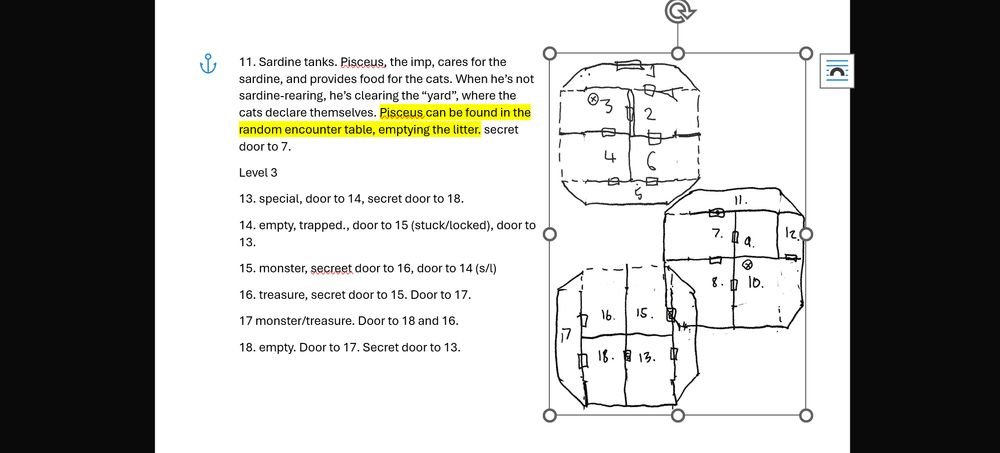
Note that I’m dragging the map down to each new level. I need to look at the map, to help me like figure out what makes sense. People talk big game about jaquaysing, but the important thing is that the space is a solvable puzzle, not that everything is connected.
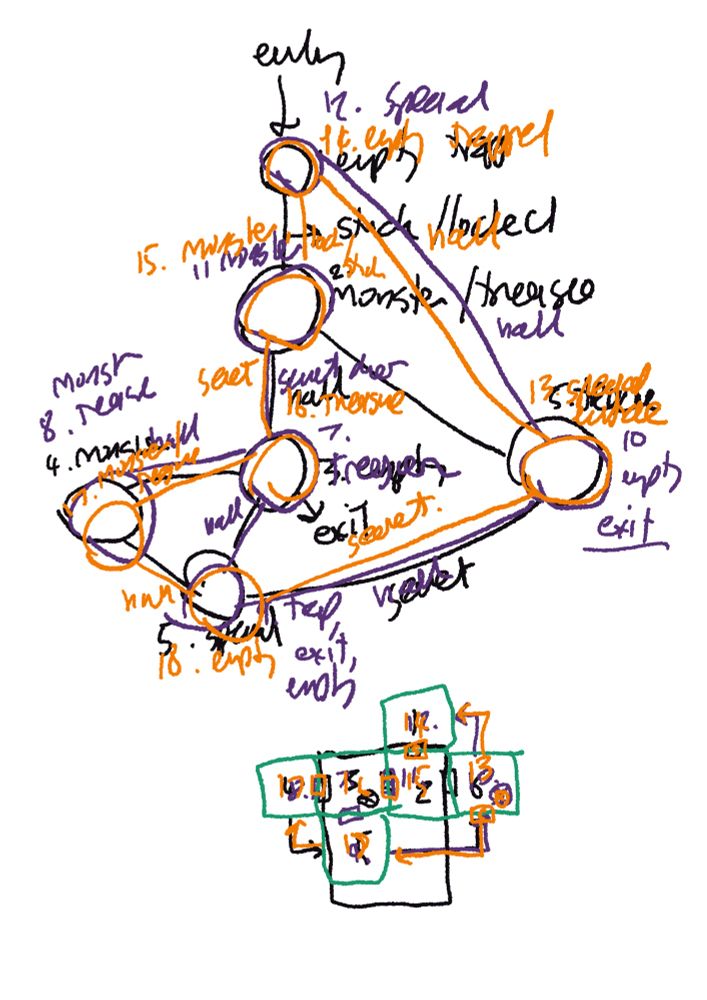
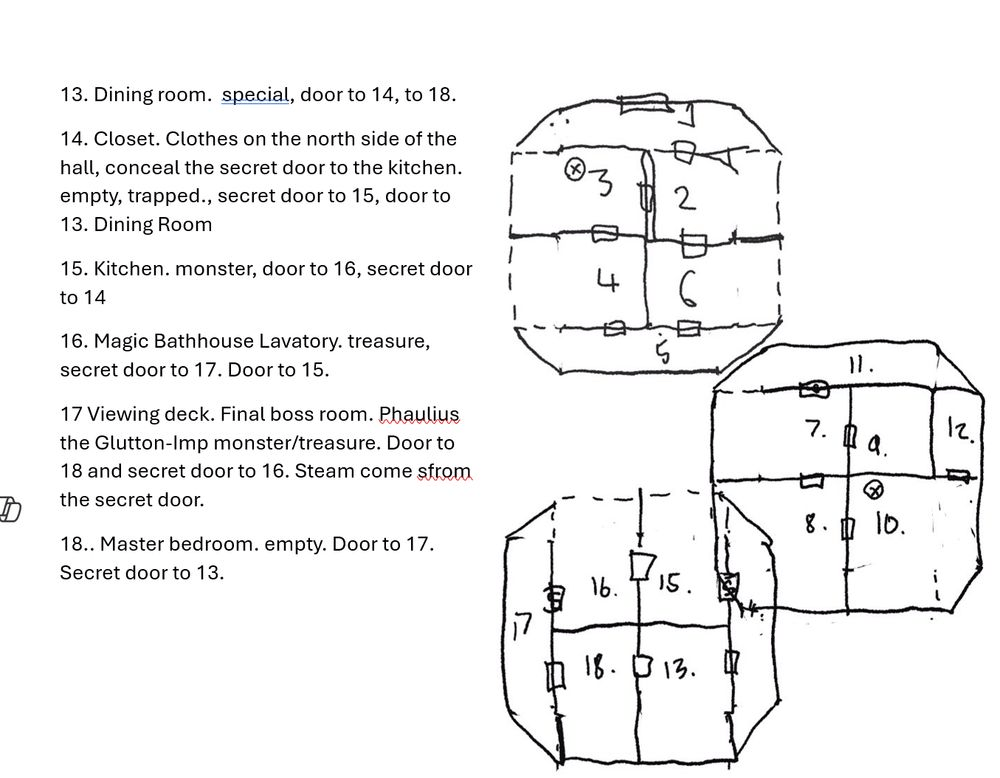
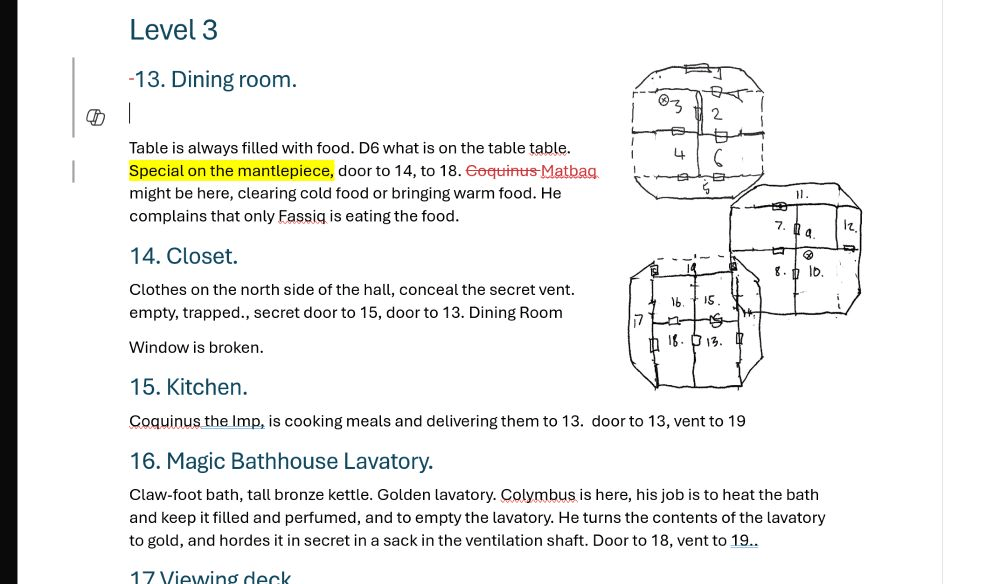
So, for this space: secret doors are in 13 and 14 (a loop), 11, and 5 (a loop). You can intuit these secret doors from the layout of the other levels. This is what you want in a map, not something that you can endlessly walk around in circles. Loops are for fun (“I sneak up behind them”), not for their own sake.
Starting level 3 keys, there’s a big question: Why are the secret doors here? That doesn’t really make sense, separating the entry doors in 13 from the final rooms with secret doors. The puzzle I just mentioned isn’t interesting in that context. Looking at the map, I might need to move them.
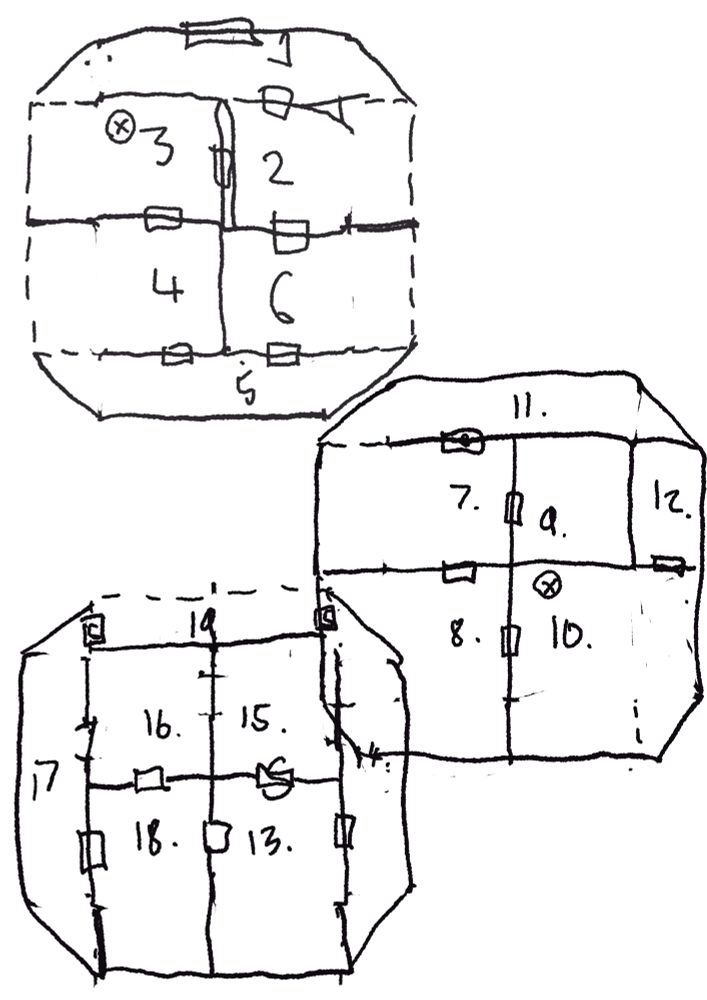
This is my change: it keeps a loop, gives you a chance to ambush the boss who’s in 17, and you can guess they’re there from the space. See how fluid the process is? Just do what feels good. This is the main problem with randomly generating your layouts: There’s no conversation occurring between the playfulness and the verisimilitude of the space. Back to keying.
So, this is a mundane level, but I know evil stuff has taken over. This means it’s got boring stuff in it. So, I’m now considering rearranging again. Yipes! In mundane spaces, you’ll wonder why there’s a secret door to the bathroom, or why the kitchen exit in the cloakroom, etc.
My solution: I added a crawl space to maintain the loop and add secrets, but connected the bathroom and kitchen more directly and sensibly. Hopefully that’s enough tweaks.
Ok, basic keying is wrapped up. You need to write a bad draft, then you polish it. Note that it got slower to write the further I got in, but also it got more interesting. I’m left with a bunch of questions, and the answers will make everything that’s here better.
Start asking questions
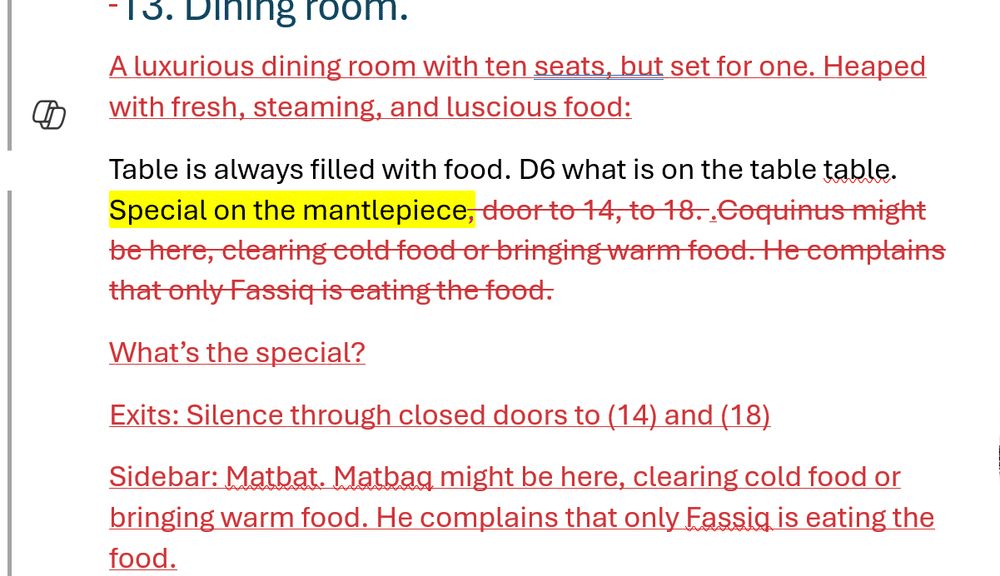
This is a finished first draft, so I start asking questions now. Below is my brainstorm. I ended up with enough hooks for the starter. What’s next?
What’s next? I have a format I’ve written Sharky, Mizzling Grove, Lightfingers and Ratcatchers all in – I’ll convert this draft to that real format. That will leave a bunch of blanks – Oh, I need a stat block here. Oh, is this a secret, or is it hidden? what belongs in a sidebar? Using my known formatting helps me recognise what isn’t here. I’ll re-read it once I’ve taken space (like, a few hours is all i need, but a break). Start writing in the gaps, answering my questions, putting them in. Then I’ll sit down and make it pretty. This is all outline right now. I can run an outline, but I won’t publish one.
What I like in my modules is good writing. The work we’ve done so far is not the sell. The writing will be the sell. I want to get Evelyn to illustrate this, so I’m writing with some whimsy here. Oh, and I probably need to lean into the cats, right. But, that’s our first, primary work on a dungeon module completed in about 4 hours. It’s that easy.
Honing your draft
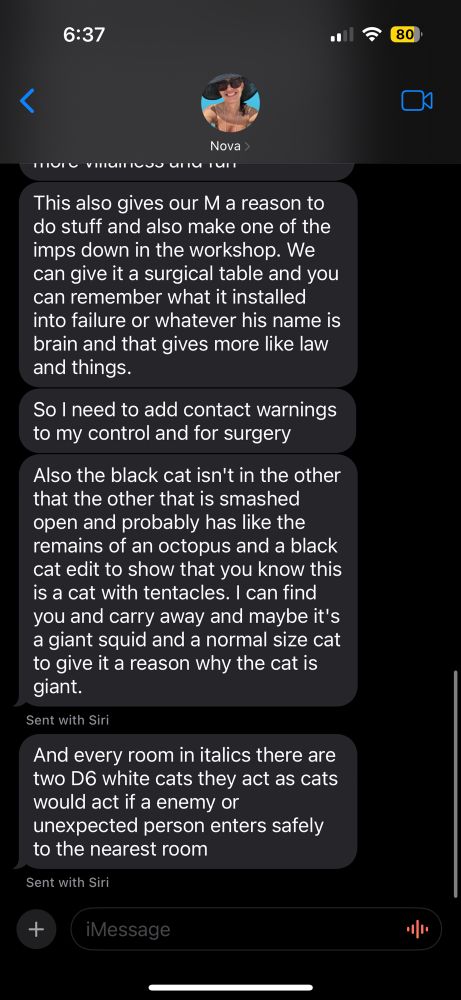
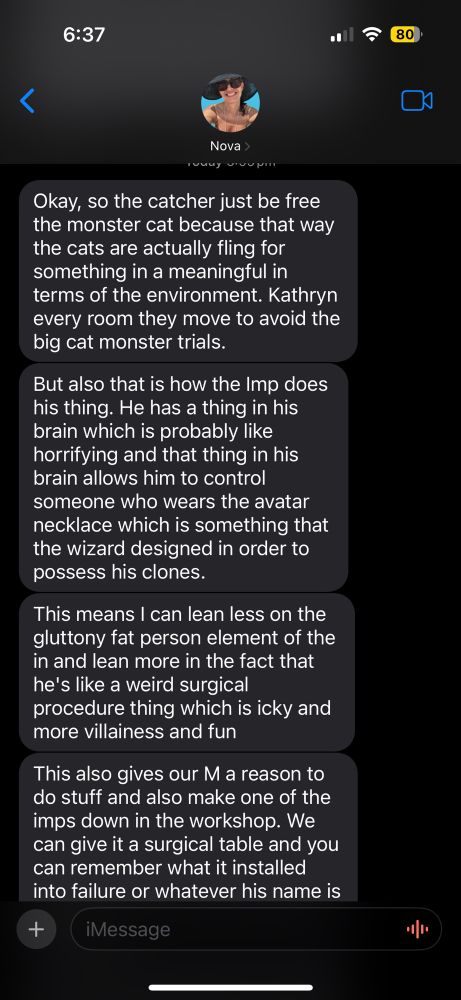
Now I keep percolating on the space while I do other things. I texted these thoughts to myself while driving, and will update the draft accordingly (also, siri can’t understand me which is why there’s some nonsense here— curse voice recording being designed for specific voices).
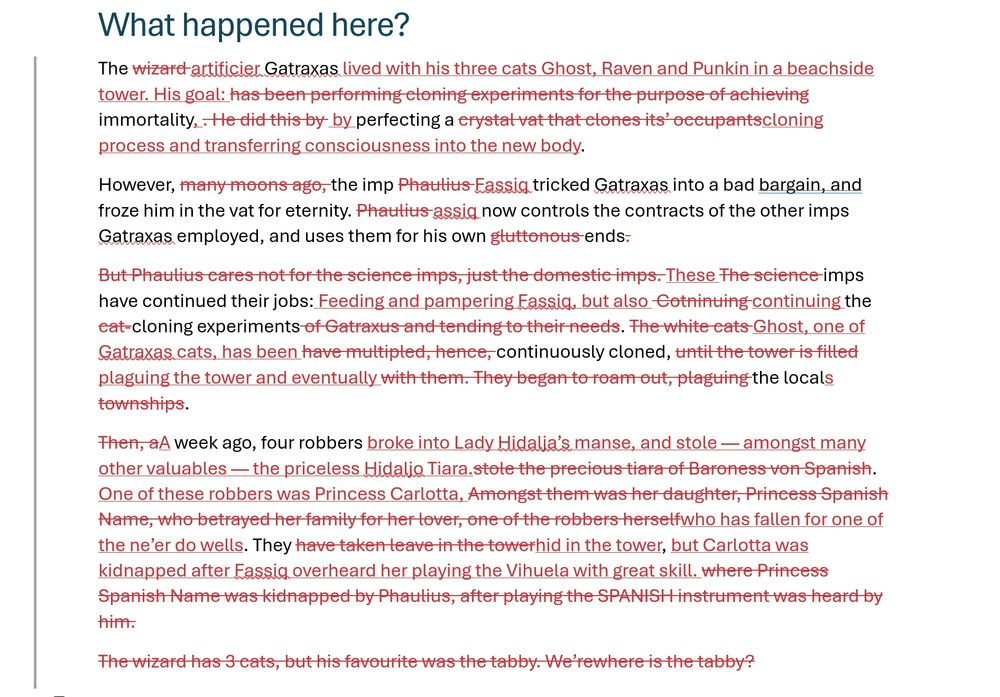
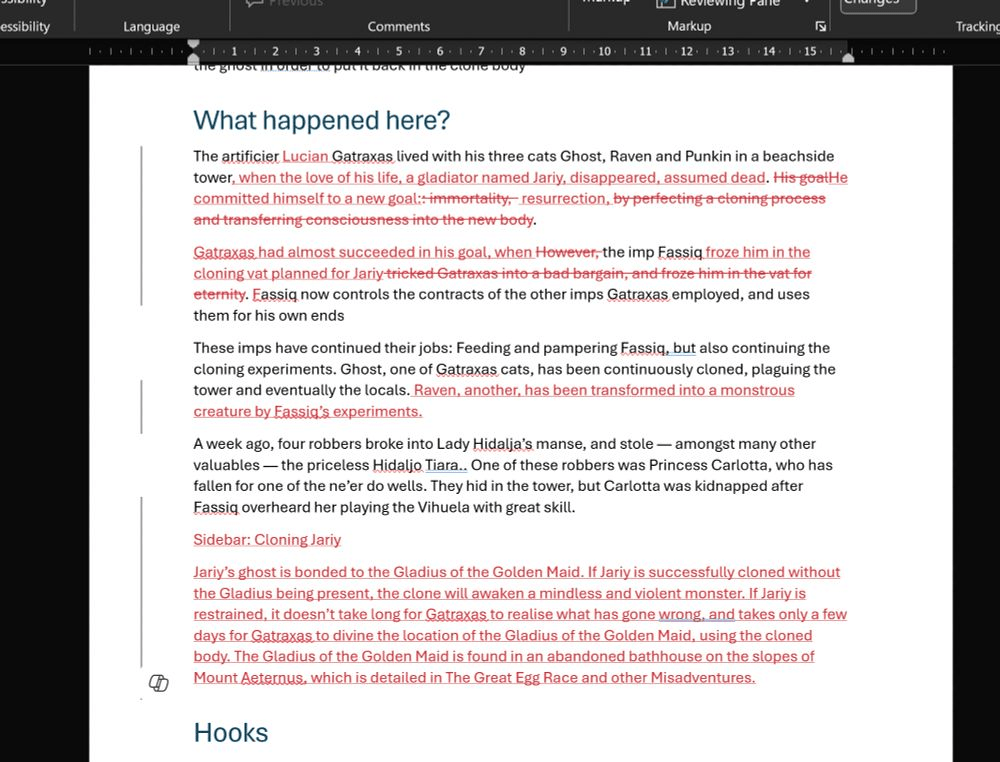
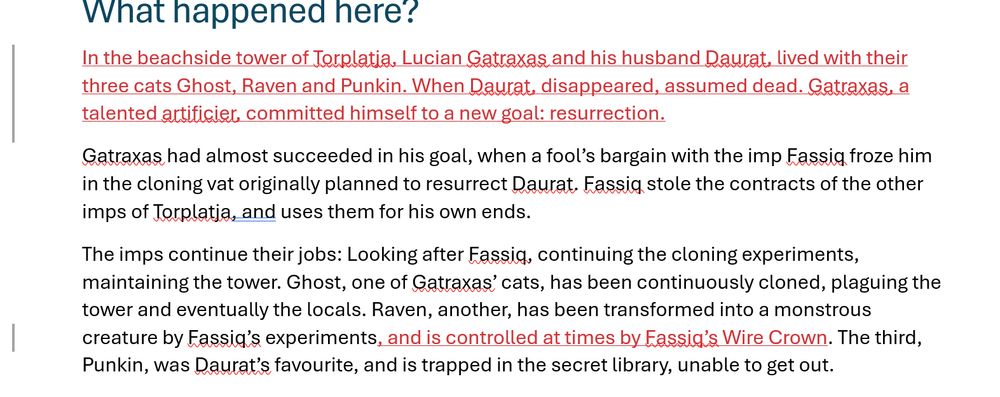
My next step was to bring things in line with the rest of my modules, which have a recurring list of characters and themes, so I started re-writing the “What’s going on section”:
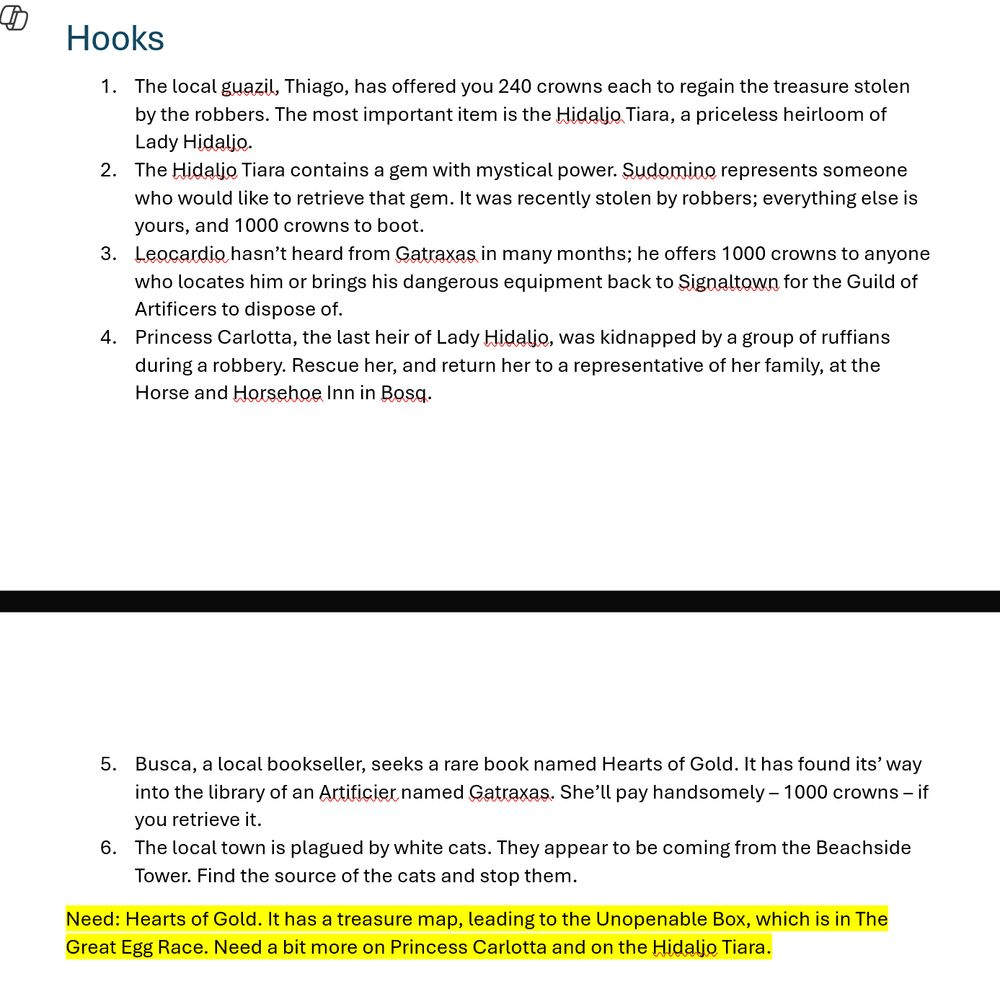
The goal with these re-writes is to increase the intertextuality, and hence the complexity of the world building. Names and concepts change to match the implied setting. I’ve written out the hooks early, because they need to be in the text of the module – the highlighted part is “hey don’t forget”.
I’m choosing these specifically to give the players different reasons to be interacting with the tower – maybe they want X, Y, or Z. All of these goals are deep in the tower, but you’ll be bargaining for different things depending on the hook. I wrote about this in Juicy Worms, Local Knowledge and Player Engagement.
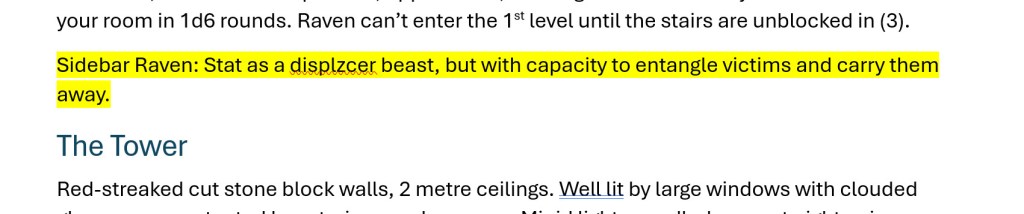
This honing process is much slower and more thoughtful, and involves a lot of scrolling back and forth in the document, things are gradually getting more personal, more specific, leaning the ideas from the first draft into actual scenes and concrete interesting stuff. I went back and added, for example, that Raven can’t come in yet.
I continued tweaking, after taking about a week of break:
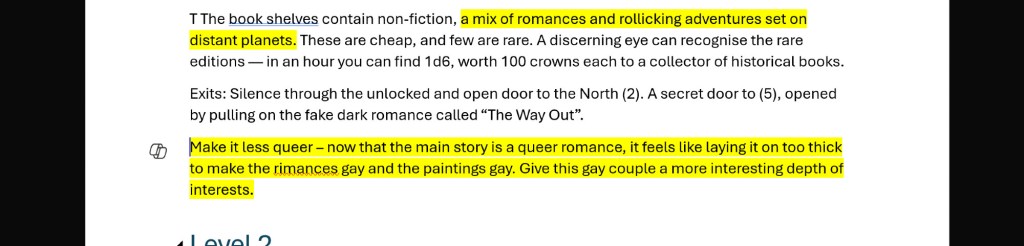
The incorporation of the romantic sub plot, though, gives me a clue what to put in one of the empty rooms, the one near the vats. This is why your outline and final product often diverge: Your writing benefits from iteration and breathing space, so that you can figure out what the themes are.
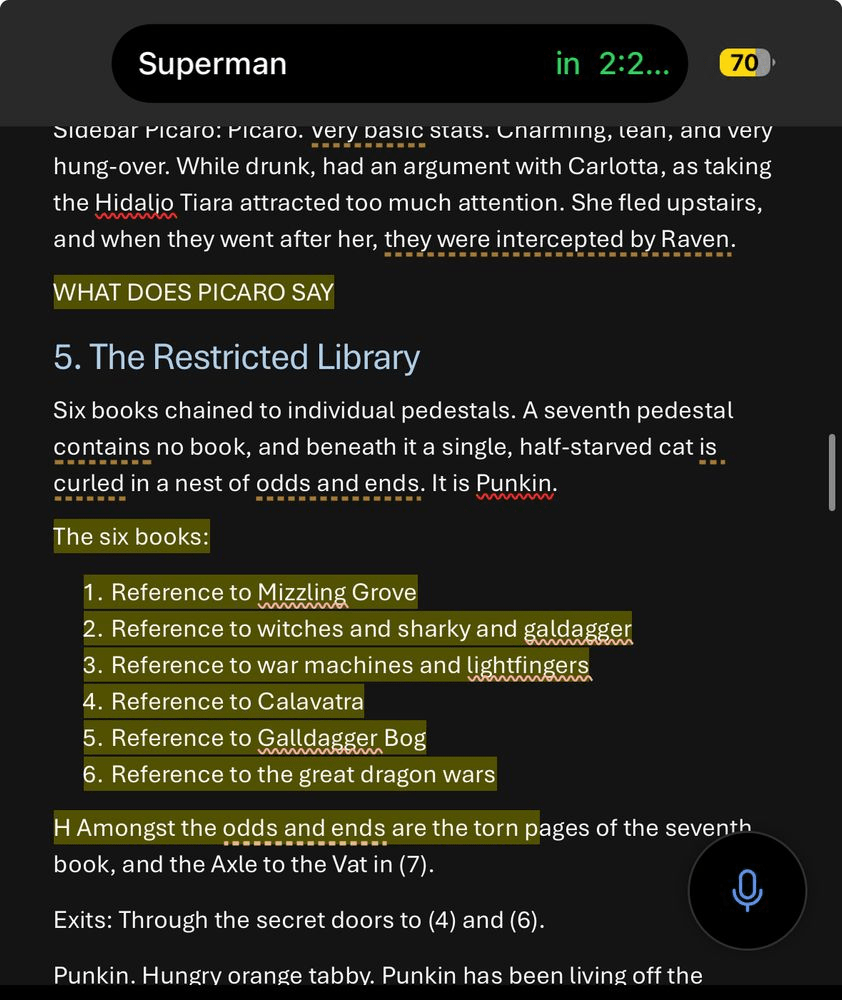
I continue to post in dribs and drabs, I wrote this while I was waiting for the trailers to finish on Superman, so I outlined small things on my phone. The work I did earlier enables this bite-sized work. I’m asking questions to make sure I remember to answer them, and just adding an outline for me to easily tap into later. Outlining is for every stage of your writing! Don’t know what it is? Write “write about this” in the space!
When I’m in this phase, I’ll scroll back looking for the first unfinished key or the first highlighted thing to start writing. I found this, and started writing there:
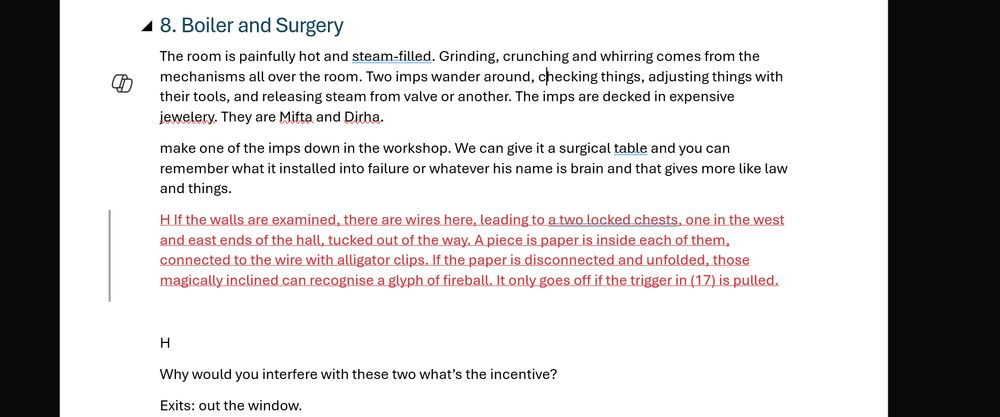
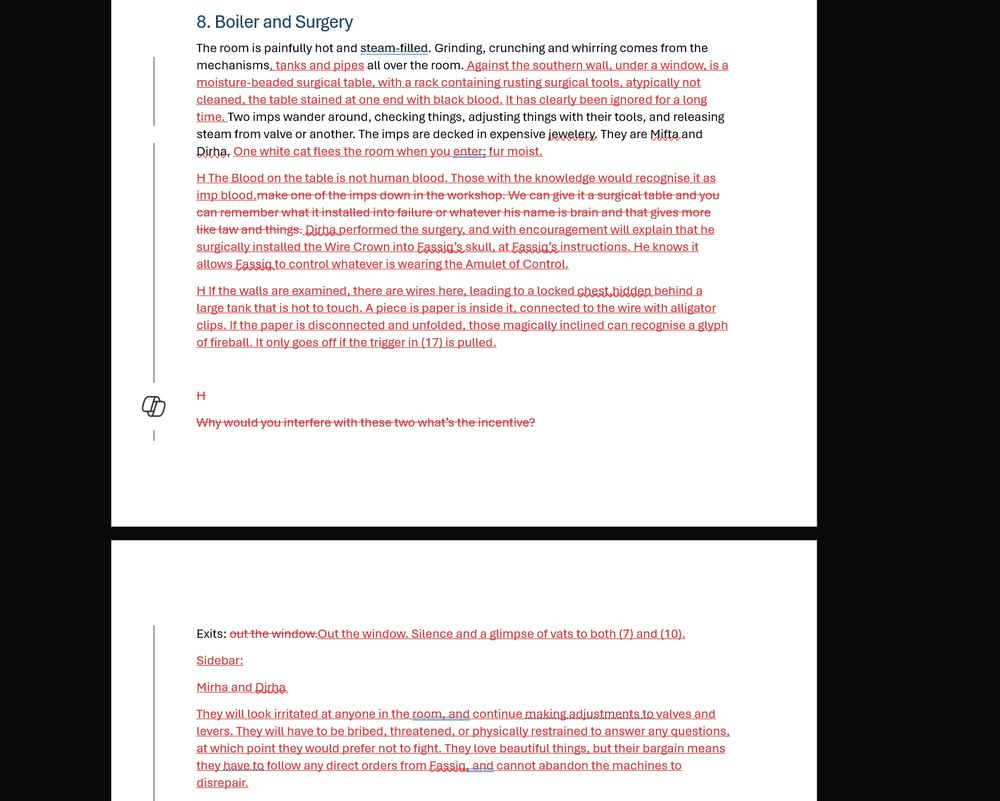
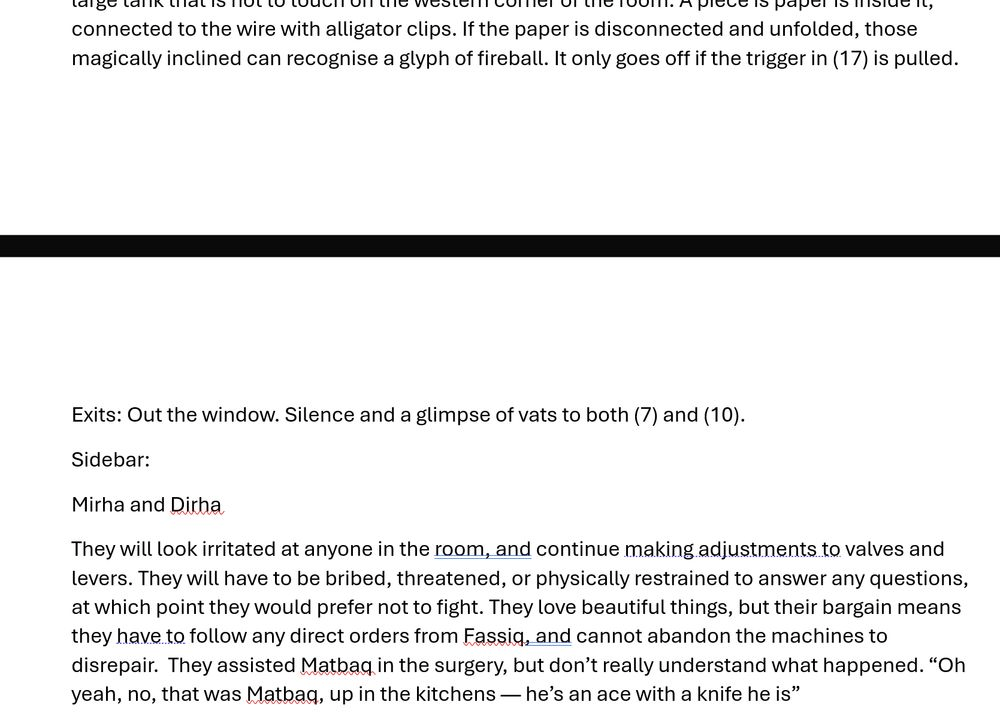
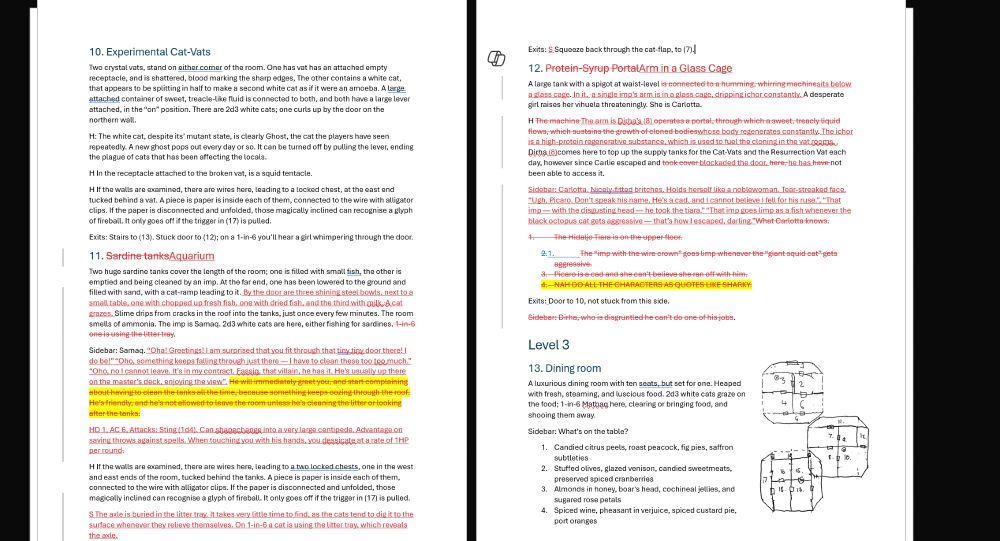
I did a few things here as I went – I scrolled about the rest of the text, and questions that were posed and answered, I stuck in those sections. I added a surgery and some body parts to other sections I’ll write those in a bit. While starting on the next room, I remembered I was supposed to be wiring this place to blow. So I’ve copied the existing “this room is wired to blow” text into the rooms that should have it, so I don’t forget in future. Then I’ll finish writing the room.
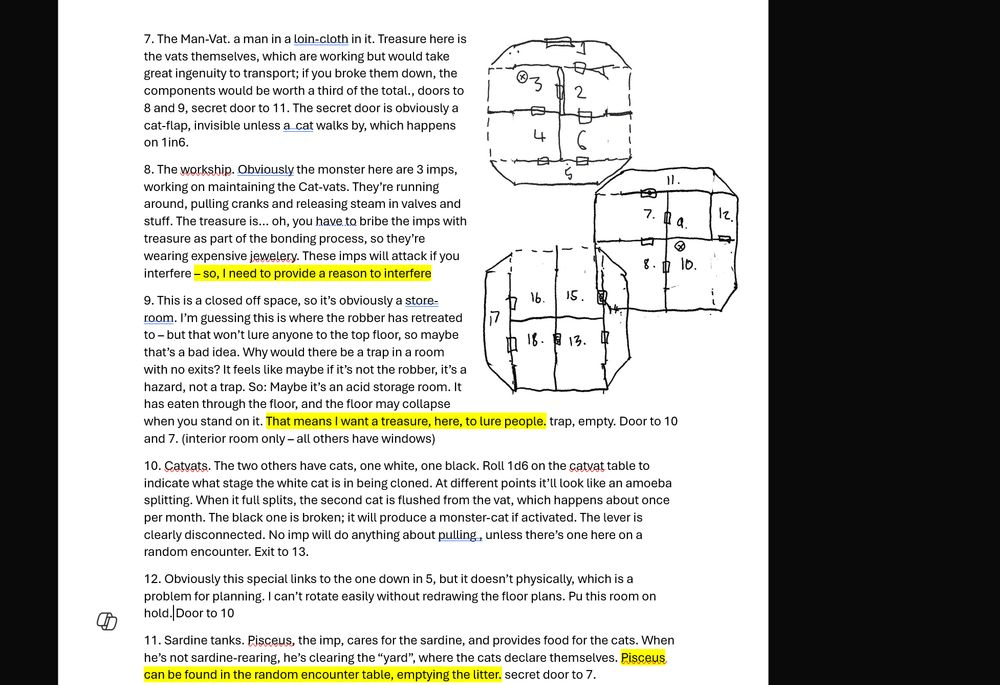
This is the finished room. You can see I changed the paste, and I added references to other spaces. I just realised that many of these doors are open, so you can see through them. I had to answer why the party might interfere with the imps at all. Always mention the cats!
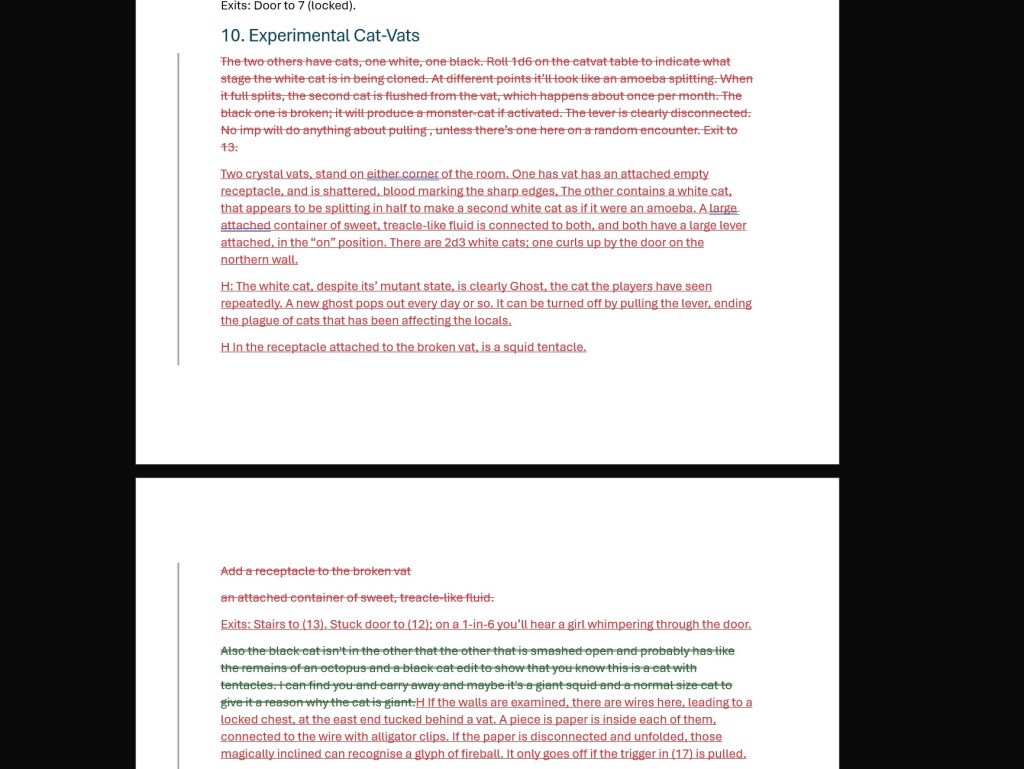
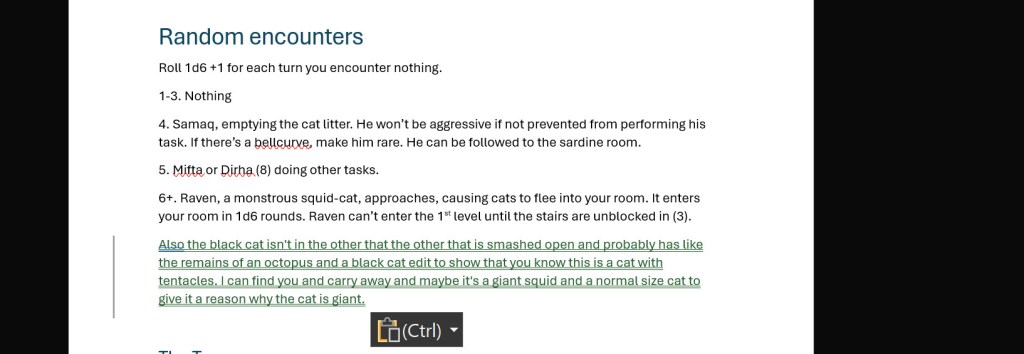
Skipped a room, as I’d already written it, and onto the next. I moved the Raven info to the raven section, and then finished up all the details here. It’s important to see how this is, while time consuming, relatively easy work: I know everything I have to write, I just have to write it.
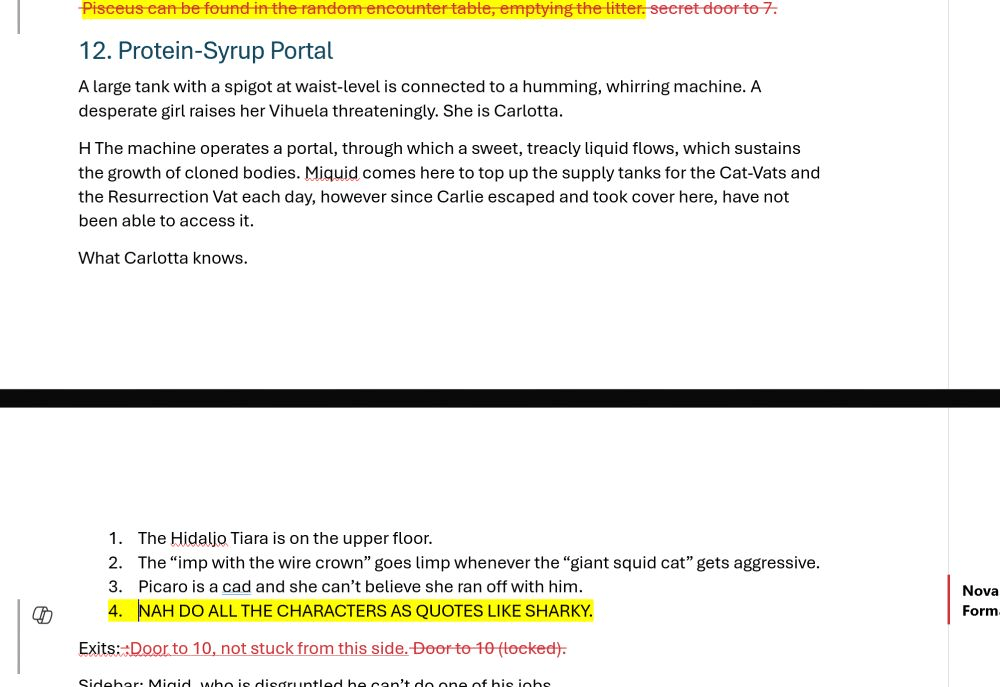
Here, you can see my note-taking. I wrote this room, and started to finish the character of Carlie, but then decided to change the way I’m writing all of my characters in the whole module. Do that now? Nah. I need to finish writing the rooms. Write a note to fix the thing, and highlight it.
The next thing (after a nap), is a new level. This is where I made a mistake earlier: This looks intimidating, compared to previously, right? I got cracking on the earlier parts quickly, so there’s heaps of scaffolding for me to write onto when I’m low on creative energy. But this next part is very empty:
How do I scaffold myself past this roadblock? I start off by writing the headings. I have exits, the special, the character. That leaves just the description. I delete the random table, because you don’t need randomness there (although you might have a table of changes in the sidebar – I’ll add that as a note).
Now, I could stop there, having scaffolded myself for room one, but I have momentum. It’ll be more effective to continue scaffolding while I can, and leave more hooks for me to write later. I didn’t have hours to write right at the time, I had to take the kids to the dentist.
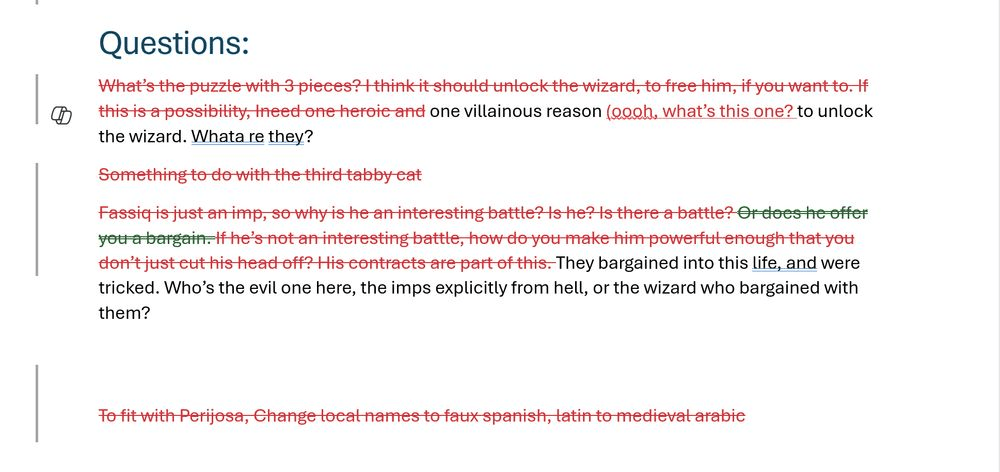
Ok, I’m at the end, now. I still have to write write the third level, but it was good to get to the end where I asked the big questions, it was satisfying to see I found most of the answers. the thing I’d not addressed was a second reason to actually free Gatraxas – I want a selfish one too.
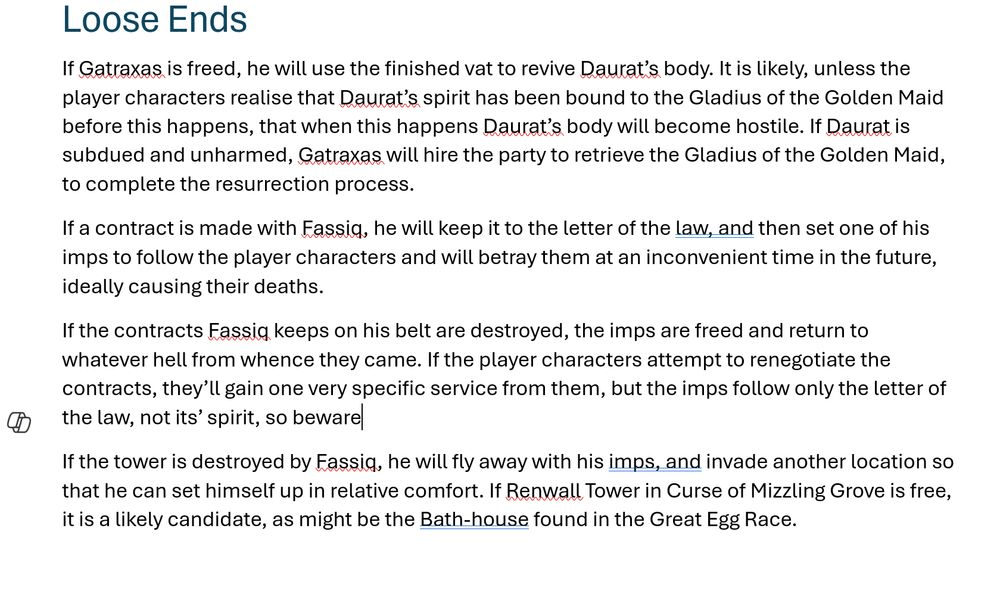
While I’m at the end, I’ll add the loose ends section, which I couldn’t think much about until this point. This basically is what will happen if certain consequences occur. I imagine there’ll be at least one more, maybe two, but this is a start, and a reminder to come back to it when I have a firmer grasp on the whole location.
Next: actually write level 3 through those scaffolds. I decided to tidy up while the kids were at sports – basically, saw some odd annoying paragraphing and keys out of order, so I start removing questions I’ve answered, trying to catch questions I’ve missed answering, leaving in highlights like these:
This is all stuff that is important thematically, but that I haven’t quite figured out yet. The process of figuring it out might change the overall module.
This whole process – figuring out themes and making sure they’re completed and feel cohesive, is part of making sure the cake is baked
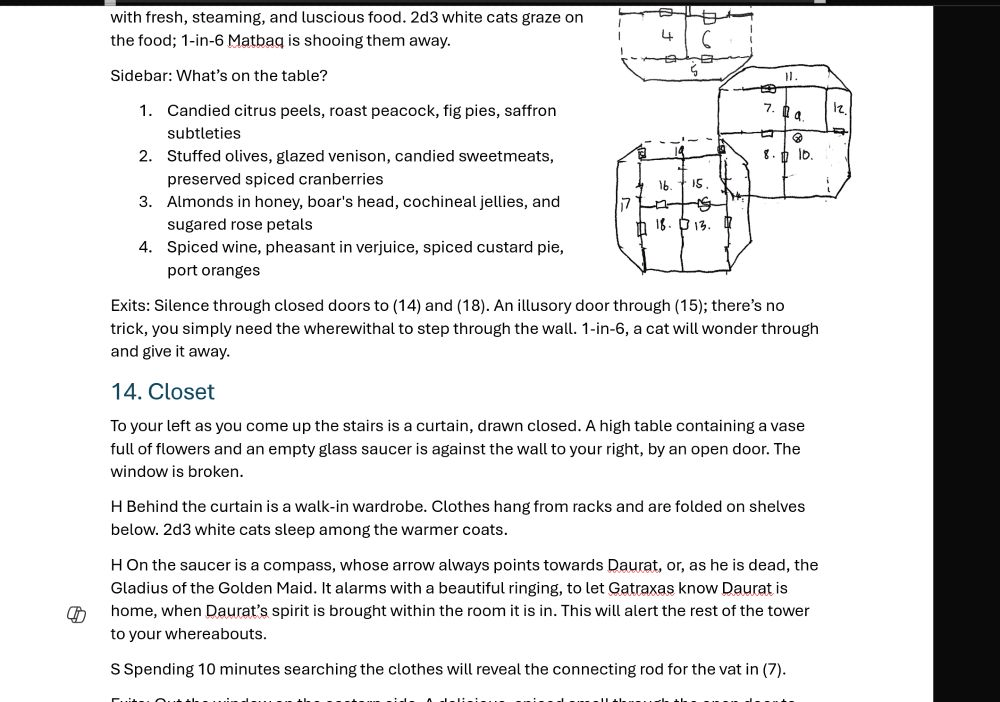
I continue, just trying to fill in as much as I can. There are no new questions in these two rooms, so no highlights. There WAS a highlight where the compass was – I don’t feel violent traps fit here, so I initially couldn’t figure what to put here. But any alarm will bring the attention of Raven.
I haven’t really talked about research — for small modules, like this, I don’t immerse myself in academic work, but I am constantly googling and using online uni libraries to find out small details that are nice — that’s where these dishes come from. I don’t care about historicity — I’m as happy with a kids show or book as a source as anything more serious — but providing interesting details is important. The area we’re in is in a kind of renaissance verging on industrialisation time period, and it’s very vaguely Spanish in inspiration, so I draw names from those sources where I am (the internet is a boon for lists of names), while acknowledging that I can do what I want.
For Sharky, for example, I grew up in an (ex) whaling town, so I used a lot of what I learnt growing up and then googled lots for appropriate terminology and tried to twist that with fantasy. This requires less, because I’m not in a town. For big works like Bridewell and Ratcatchers (neither of which are yet released), I tend to do lots of research, though – see this, for Bridewell.
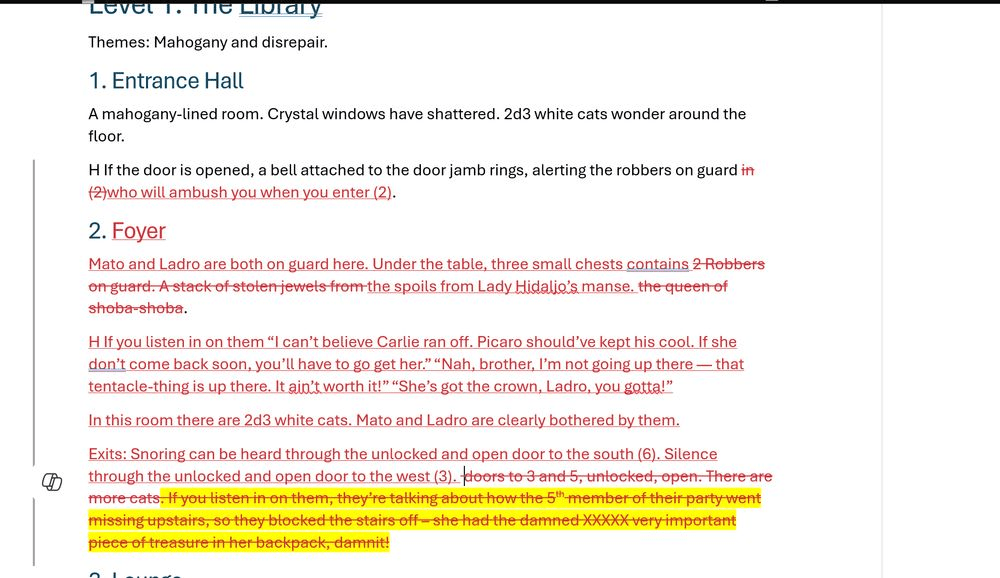
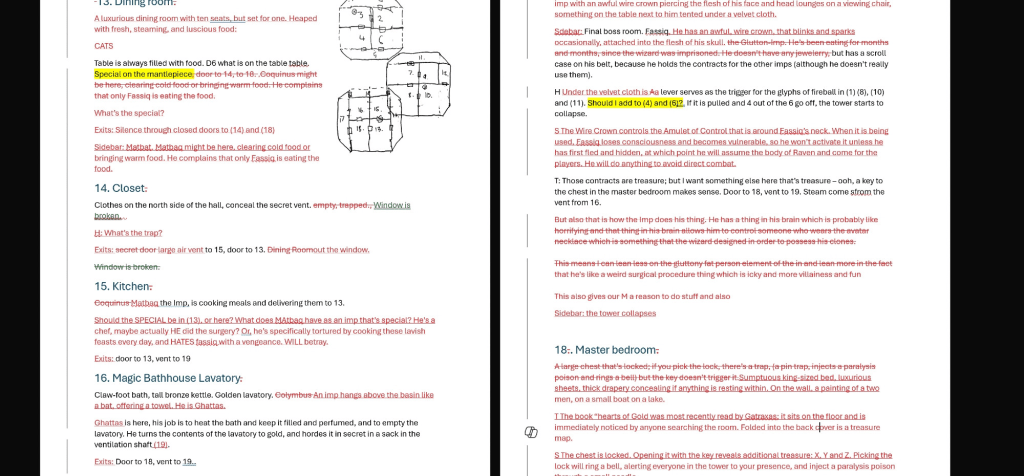
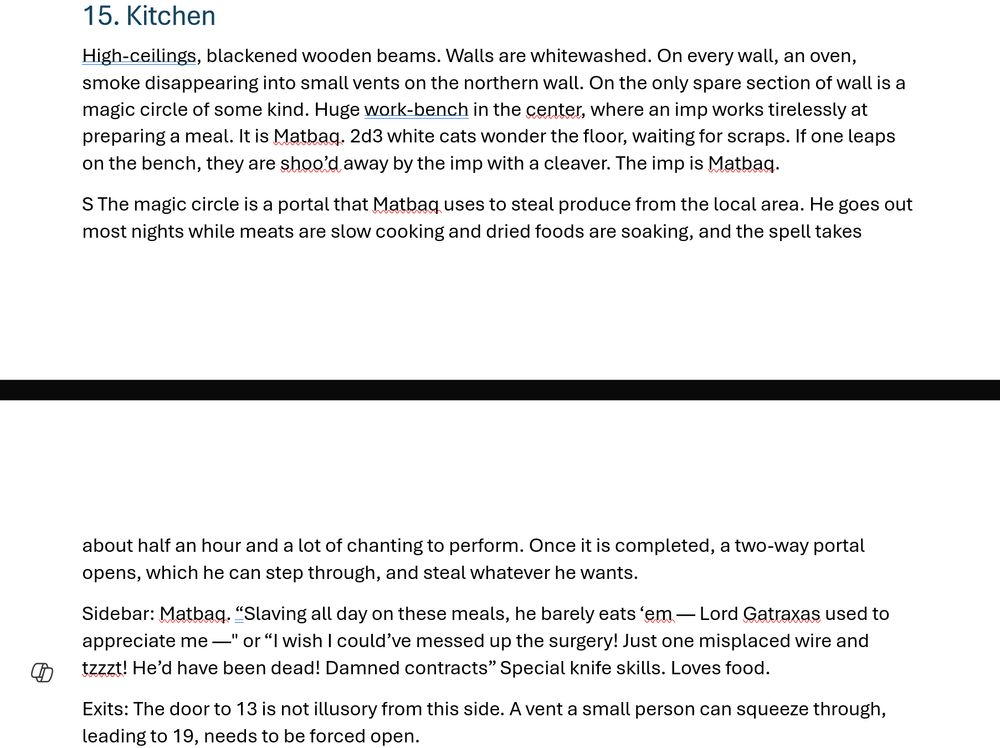
Here, I finally bit the bullet and started translating the character texts into quotes, a method which really worked in Sharky, but that I dropped in Lightfingers simply because it wasn’t as character-focused. As you can see, I’m just filling in the gaps. Note the surgery change — which necessitated a change to the earlier boiler room text (which I also made quotes, as now I’ve started doing that proper). The key is: As you write, if you add new pieces, they should impact other pieces.
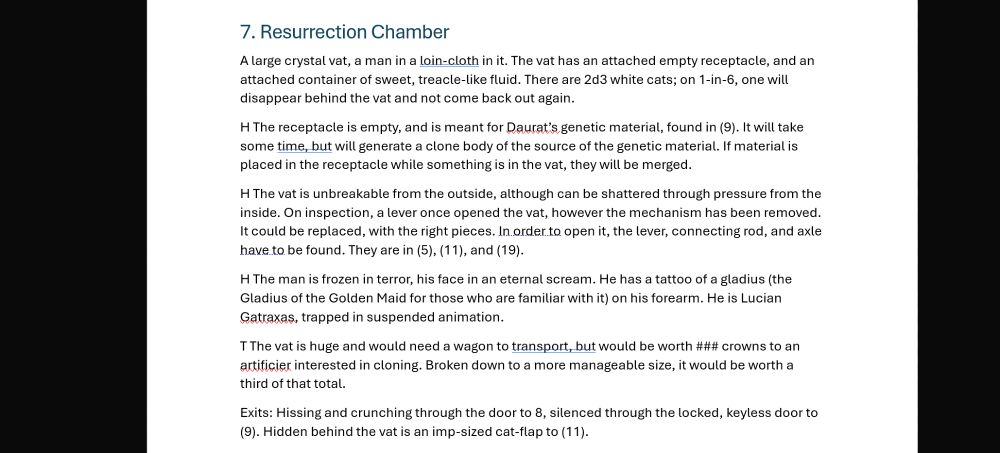
You may noticed during all this that the room numberings are not in an intuitive order at all. This is a result of the process, sadly, as rooms are added and removed. It’s easy to do on the map, but I need to do that first, and then I’ll track changes that in the text and double check. The changes will end up being such that 10 is 7, 12 is 8, 8 is 9, 7 is 10, 11 remains 11, 9 is 12, 14 is 13, 19 is 14, 13 is 15, 15 is 16, 18 is 17, 16 is 18, and 17 is 19. If you’re interested.
The main difficulty is double checking every instance of the old number – all of the exit lists and references need to be updated. Ugh. Thank goodness you can track changes.
Ok, so now the actual writing is done. Excellent. I need to go back, answer questions, fix up the character text. And then re-number everything. And do stat blocks. Then, take a break, let someone else read it, and then head in again. This phase is at least a week of not touching.
You can see if I didn’t have complex life commitments, or even if I had evenings free, this would all have been done in only a few days. But there are phases where you have to give it time, and come back with fresher eyes.
For me editing never ends. Once this is “finished”, I’ll lay it out (and notice things to edit, particularly order and sidebars), and then I’ll playtest (I always playtest in layout), and then I’ll edit it again. Then I’ll order a proof and edit again in the final proof.
So now I’m dipping my toes back in. This basically involves: Filling in the highlighted gaps, and then adding new highlighted gaps when I find them. This stage of writing is revision, revision, revision. Trying to see the inconsistencies, trying to make the damned thing make the most sense.
Here I have 7 hooks, and I only want 6 hooks, I aim to have the hooks sink into different parts of the plot: I have 1 Thieves, 2 An Imp, 3 Mystical Gem, 4 Princess, 5 Rare Book, 6 White Cats, 7 Missing Person. the least interesting one might be Gem, here: It overlaps with 1 and 4 already, so I’ll scrap that:
While I like having the heroes interact with the evil Sudomino, it’s not that interesting in and of itself. I can perhaps thread the needle by replacing Leocardio with Sudomino or giving the players Sudomino as a shiftier, higher paying option, as I did in The Great Egg Race (these are all recurring characters, as I mentioned earlier).
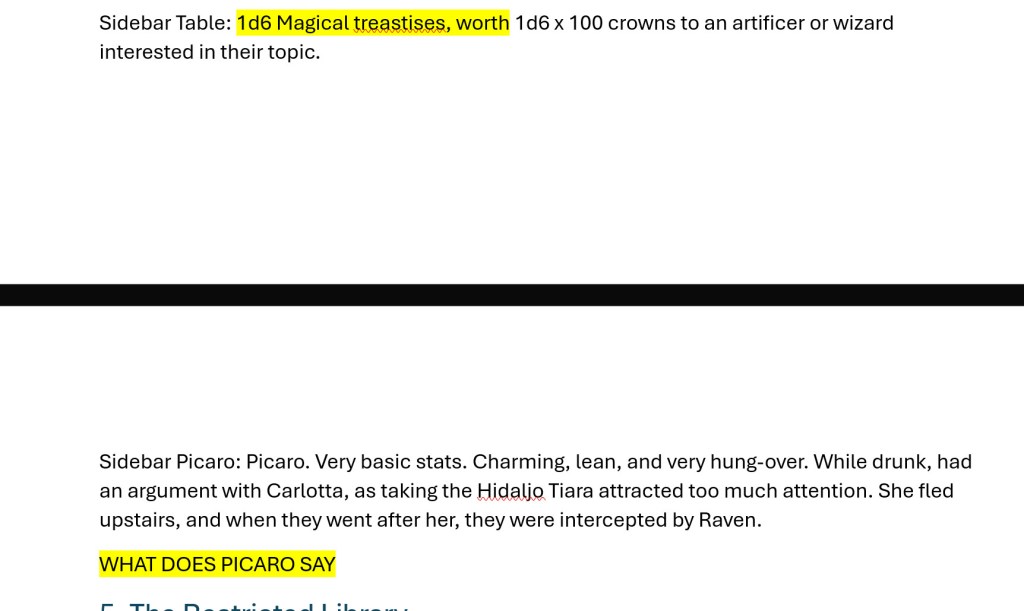
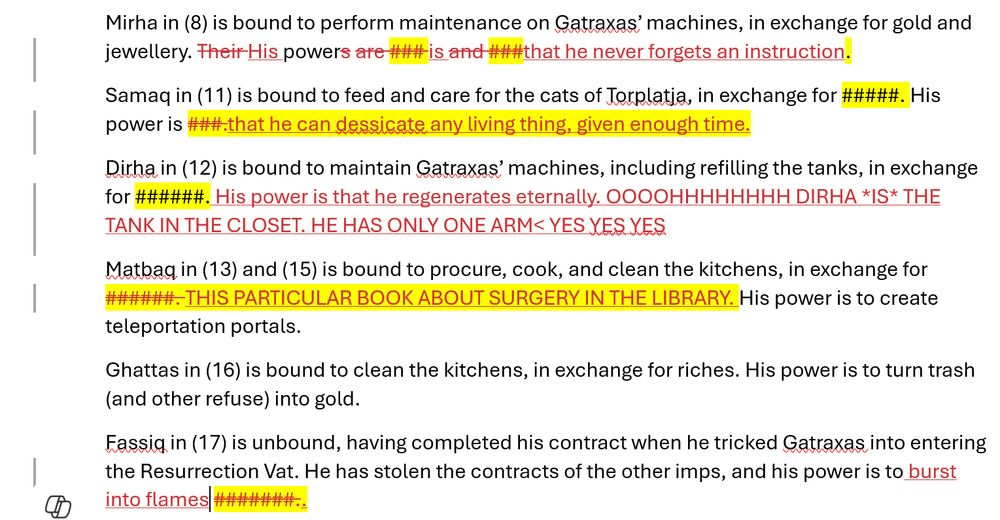
As I go through, I make lots of small clarity changes, like this, and small “ugh I can’t be bothered thinking this through right now” highlights, like this, as well as epic combinations of them, like the third screen where I cut out a later section (that was just notes) and wrote it into text here.
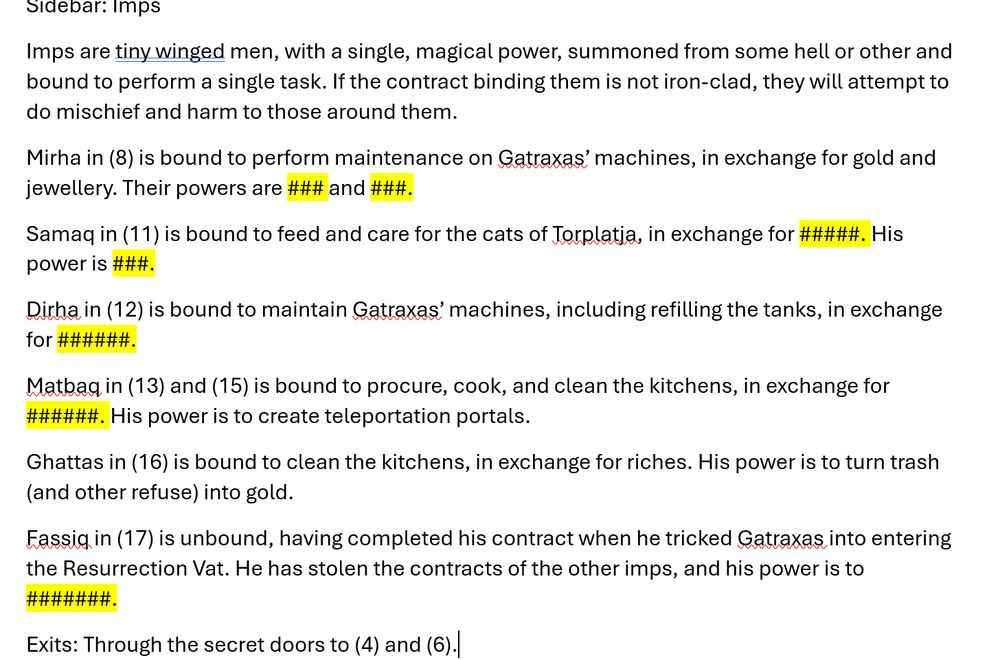
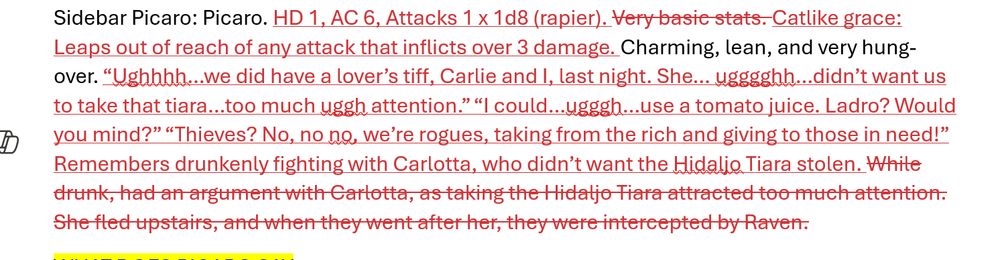
Also in this pass: write the damned stat blocks. Here, I wrote the first, then wrote the third, then realised I needed some personality in the first, so revised it. Smear it with personality!
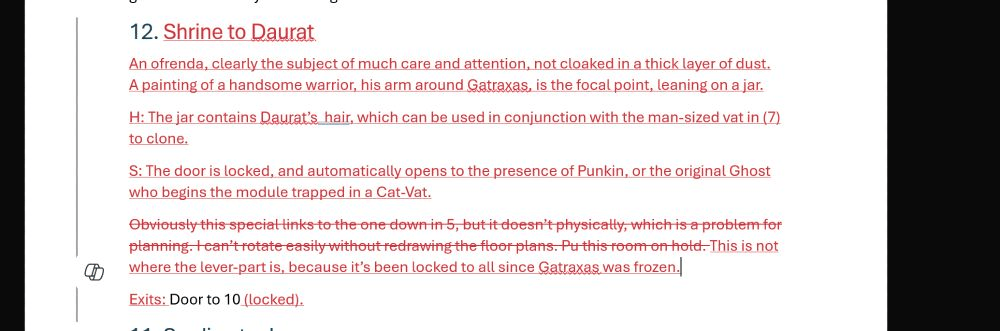
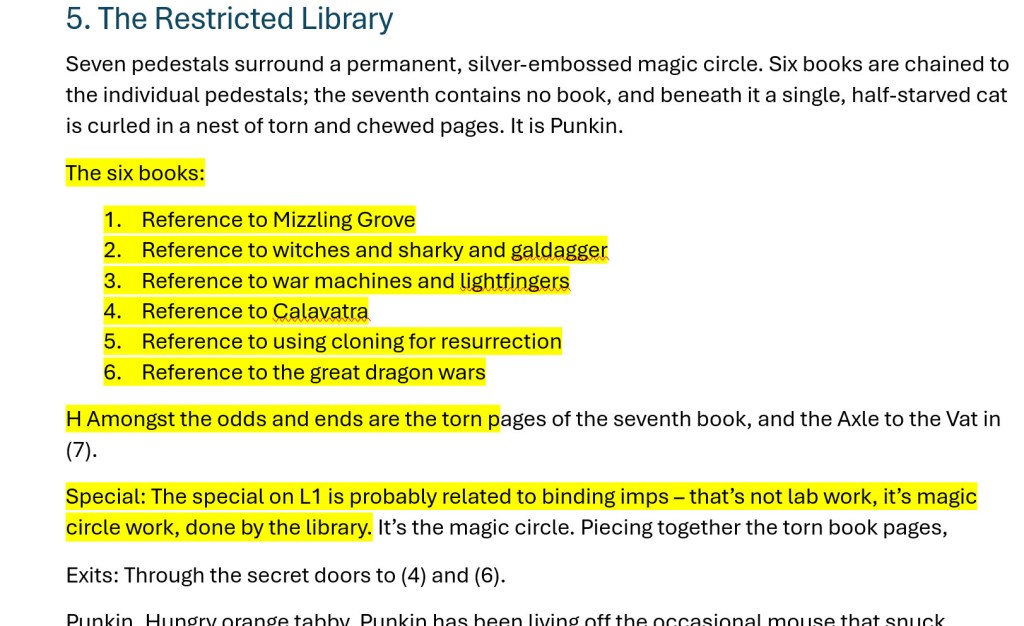
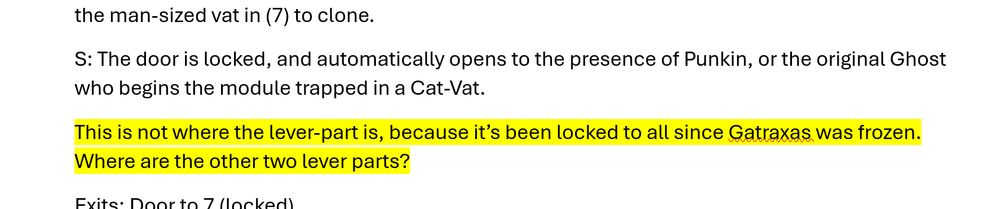
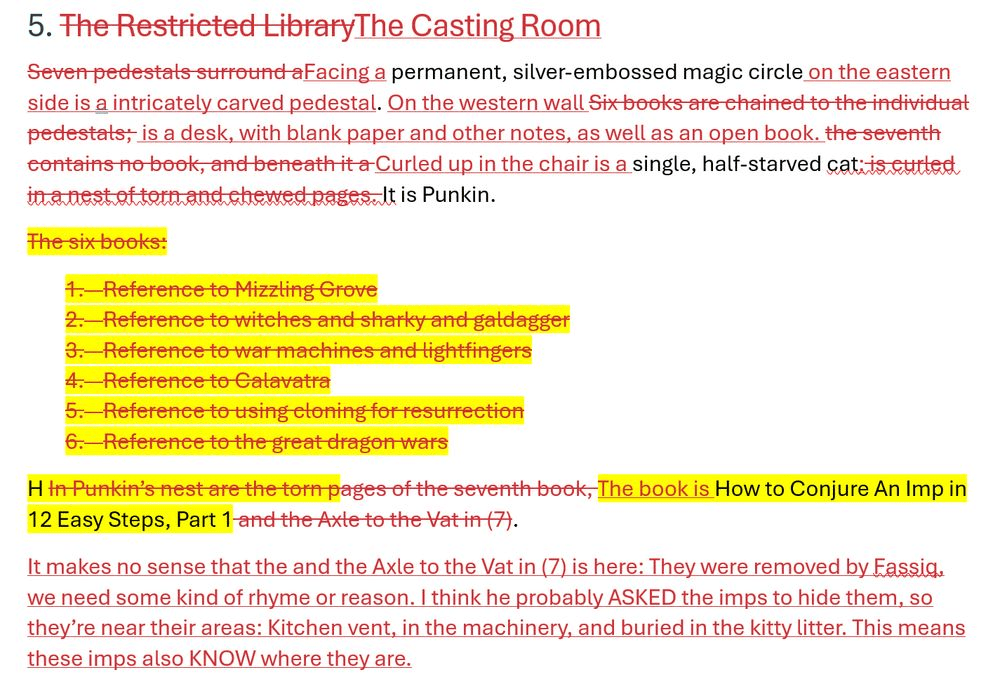
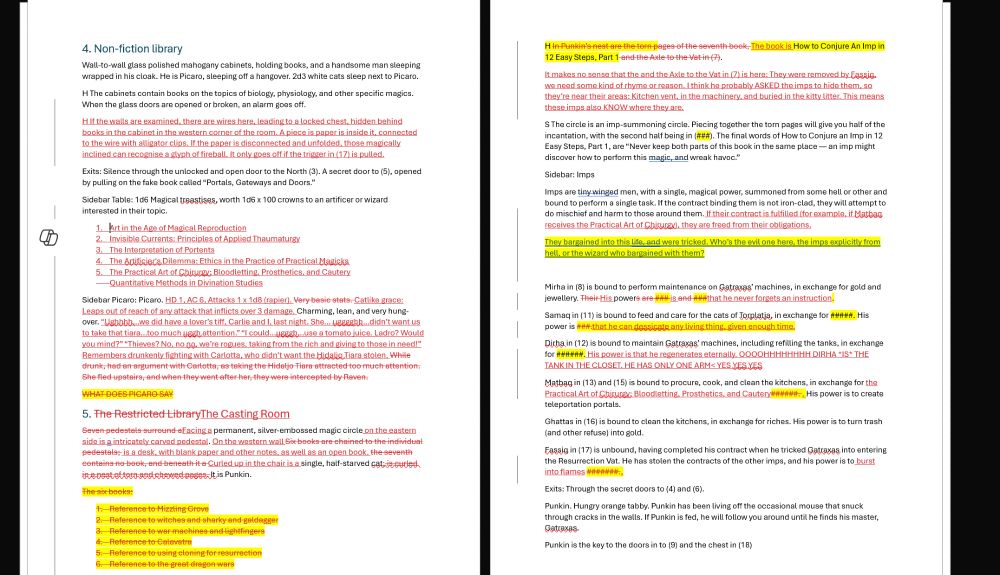
You’re also looking for logical inconsistencies: Why is Punkin trapped? Why is the axle here? I need to change this so it makes sense, or the players will never figure out the puzzle. Also: I just listed a bunch of books in two other libraries, why do I need to do it in a third library? Cut it.
It’s important to do this stuff and move on, for me, at least. Like, if I derailed my onward momentum to go and figure out where these pieces were on this pass, I’d get bogged down and lost. So I phrase the questions even though I could theoretically finish this section.
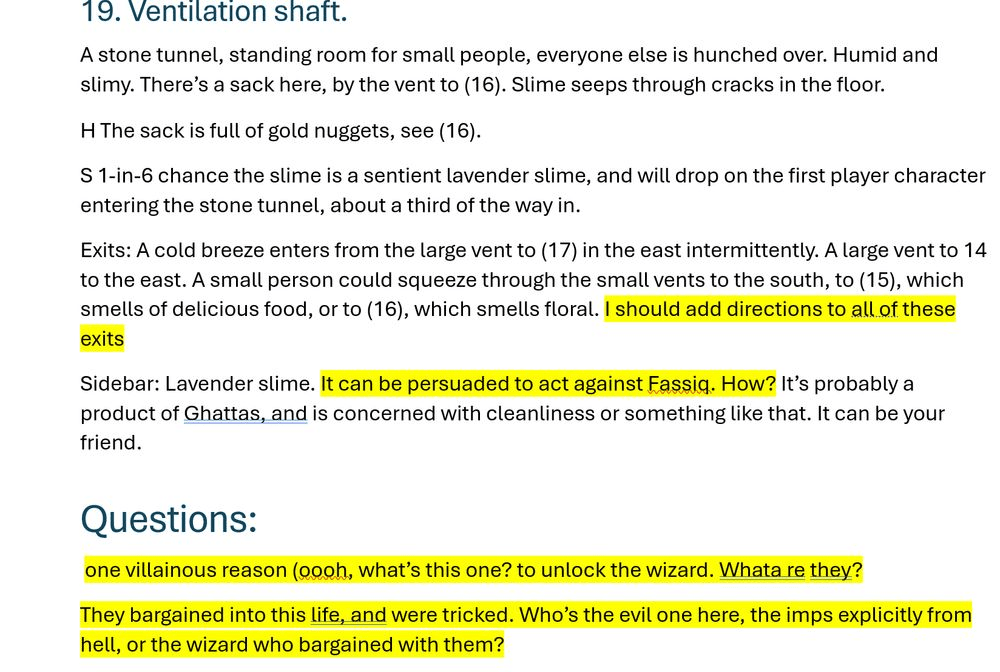
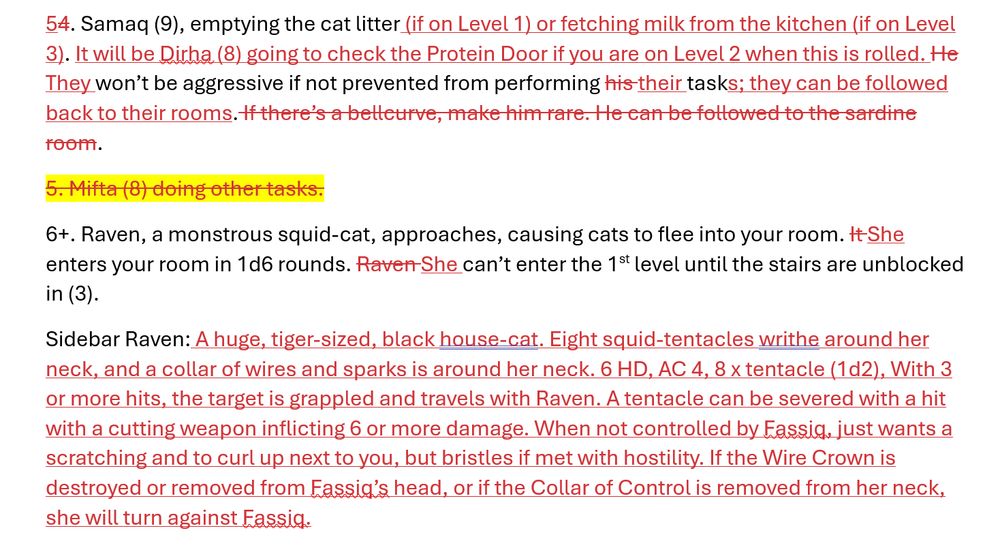
At this point I only have two major jobs – rekeying the map, and adding directions to the exits.
I’ve done one more pass, adding directions and tidying out highlights, and now I have to pick up the kids. I think this is the last thing that is incomplete. This shows the importance of using the same shorthands – if I’d used #### consistently instead of XYZ, I’d be able to search for the term. Somehow I forget every time to do this.
Conclusions
That’s the writing, done, effectively. Now the job is playtesting it, getting an editor to look at it, and laying it out, then getting an artist on the job. I think the important thing with this whole play by play is that it demystifies the process. You can do this. This is the whole thing:
Have an idea
Draft the space
Draft the biomes
Write a bad first draft
Start asking and answering questions
Hone your draft
Creating is for everyone. I hope seeing my process inspires you to write your own module. And, I hope you pick up Cat-Vats of Gatraxas, when I get it out to the public.
Bathtub Reviews are an excuse for me to read modules a little more closely. I’m doing them to critique a wide range of modules from the perspective of my own table and to learn for my own module design. They’re stream of consciousness and unedited critiques. I’m writing them on my phone in the bath.
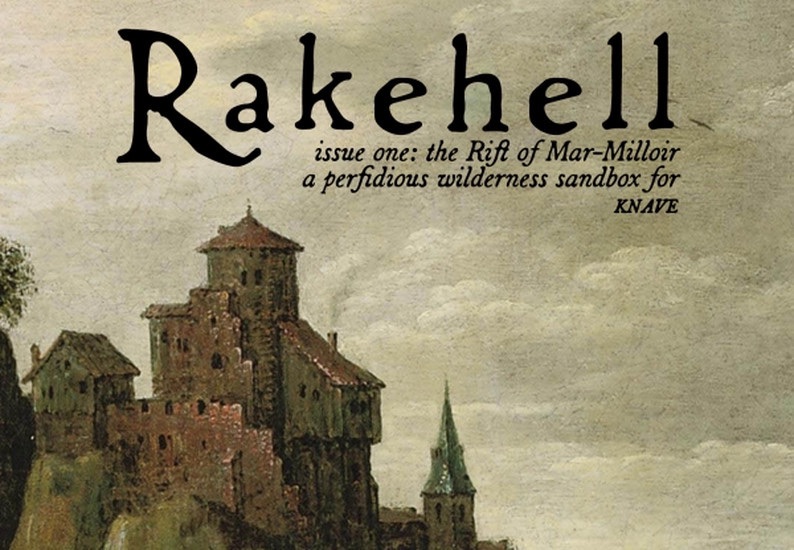
Rakehell: The Rift of Mar-milloir is a 96 page module for Knave by Brian Yaksha. I’ve heard grand recommendations for Rakehell before, but I remember bouncing off the generator-heavy Throne of Avarice, despite the stunning prose that Brian filled it with, and I’m hoping for a clearer insight into the creators mind here. This is a map and a setting, ostensibly the first in a series. I bought this myself on itch.io.
I’ll start with layout: It’s fine, and moody, with excellent art. It’s hard to make almost 100 pages of random tables look good, and it doesn’t succeed, but it does succeed in making them readable and easily findable, which is no small feat. The font choices are both legible and suit the aesthetic well. I like this layout and I love this art.
Yaksha’s writing here is as evocative and dripping with sauce as ever: “The Border Warden, his eye of obsidian and his rusted meat-hook of a hand made clear you were to go to the Rift. He told you how he’d peel you apart if you ever came back.” This kind of flavourful writing is consistent for almost 100 pages; it’s a really impressive feat. Even the title, is an evocative name if ever I heard one. Most of this writing is in table format, though. There are no villages, but there is a village generator. I could quite easily read, for example, the “Village in the rift” generator as just a village description, split in six. I’m unlikely to encounter more than six villages in my travels in the Rift of Mar-Milloir, and I tend to reuse places and people in my games anyway — connections build drama — so I’d keep it to six anyway. “A chain of homes, signs of exquisite masonry, built precariously upon a curving ridge. Small gardens are interspersed between the homes, and each chimney bustles with sweet smelling smoke at all hours of the day. The folk here don’t pay much mind to strangers, but keep their eyes on the weapons they carry.” (option 2) is an excellent village, especially when it’s called Slound-et-Muntag (also option 2) and are afraid of the wicked men in the nearby woods (also option 2).
The problem with this randomised table based approach — is that for me it’s hard to use. To find out about Slound-et-Muntag, I have to choose where it is on the map, flick through five pages of tables to generate it and then remember or write it all down. All this is a significant cognitive load in addition to the usual load of refereeing. Which is really disappointing, because for me the only approach I can imagine to prepare for that campaign is to copy the entire document into google docs and rewrite it myself. And I kind of want to: Like I said it’s absolutely dripping with sauce.
The crypts and caves generated here are one room affairs. They would’ve benefited from a page of wee random maps (just like MERP’s Barrow Downs, which I’m reminded of) to supplement them. It strongly suggests an intention for this to be centered around not dungeon play. And that implication made me realise I’m not sure exactly what play Rakehell actually leans towards: Wilderness travel, sure, but with a quantum map? That feels to me like it’s not the heart of it. Maybe, just maybe, the presence of random encounters and weird weathers indicate a survival game, but it doesn’t lean hard into that concept either.
To complicate matters, Rakehell finishes with the Brigand’s Manse and the Maw of the Mountain, and this is where my thesis is challenged: These two later additions to the module are traditional crawls, well designed and flavourful, but small enough to fit into a trifold pamphlet. I’d run either of these in a moment: They blend specificity where it’s needed with randomness in the right places. Because of the unique linguistic world building (it reminds me of Warhammer Fantasy a little, something I’m only fleetingly familiar with), I’d have appreciated names for the brigands, but their drives and what they’re doing, the dragon’s randomised horde, these are a perfect use of randomisers that are used less effectively elsewhere in Rakehell.
These aren’t the only places where Rakehell brakes free of the shackles of randomness, though. The ten factions are concrete and fascinating concepts in broad strokes; not specific but evocative: “You made a pact with the Rat-King and the Corvid Queen, to forgive old debts and to assign new secrets. They slither towards the Rift now, seeking to collect both.” Antevol, the gateway to the rift, has a concrete list of townsfolk and a black market both of which shine and take strong advantage of the sumptuous writing. But they still lack the concreteness of the two revised locations. It’s possible that — being a volume 1 — the second volume’s goal was to add more of these more concrete locations to Rakehell, or to fill out the map in a way that makes proceedings clearer. This seems like a great direction to take it in, and would likely ameliorate many of my concerns here in issue 1.
I realise that I’m both praising and criticising random tables here, and it makes me consider what I consider a strong or a weaker choice of randomisation in a module. There is a knife’s edge to walk, where too much randomness is a chore and a challenge to usability, and too little provides not enough surprise. Where you apply this randomness has a huge impact on the feeling (and ease) of refereeing the game, but also on the sense of risk and reward of playing in it. Villages and brigands and monsters are places where less randomness behooves them: You want to encounter these things and find something concrete, a window into a real place or a mirror upon something in the real world you can mimic or be inspired by. Treasure, encounters on the road, and incidental findings absolutely benefit from high randomness; you want these to feel serendipitous as a chance encounter does in our actual lives.
My struggle with Rakehell is that it does not differentiate the serendipitous and the concrete, and consequently requires me as a referee to do too much. It succeeds as a work of prose: Sumptuous and dripping with flavour. It succeeds as an aesthetic exercise: I understand the Rift of Mar-Milloir. Could I run it? It would take a lot of time that I don’t have. I don’t referee to sit at a table rolling dice while my friends share memes; nor prepare in advance for hours prior to my friends arriving at the table. How would I run it? I’d copy it out into a word document and pre-generate everything that wasn’t serendipitous. I’d use a Warhammer Fantasy name generator to name all the unnamed characters. I’d pre-populate the map with places and things. I’d pull a few gothic locations like Hound of Hendenberg or Beast of Borgenwold and drop them in as well. I think that would be a banging campaign.
If that sounds like a good time to you, then it’s worth doing the work to run Rakehell: The Rift of Mar-Milloir for your friends and your table. It’s gorgeous. For me, though, I want that all to have been done for me fromthe start, so I’ll have to wait for the sequel.
Bathtub Reviews are an excuse for me to read modules a little more closely. I’m doing them to critique a wide range of modules from the perspective of my own table and to learn for my own module design. They’re stream of consciousness and unedited critiques. I’m writing them on my phone in the bath.
Feast for a Sphinx is a 30 page module for Mörk Borg by Sofia Ramos and Evlyn Moreau, with layout by Luna P, the same team behind Goblin Mail which I thought was one of the best releases of last year. In it, you brave an ancient temple filled with the spawn of the Golden One, in order to win the favour of the wish-granting Sphinx. I backed this for its’ crowdfunding campaign.
We open with a page of in-world verse, likely the kind of information you’d hand to the adventurers. Then, we have a page of purple prose, describing the past and present of Kalldalen and the temple that stands above it. These are a little much for me, as a referee, but Ramos does some good writing here (where that almost makes up for it), and throughout this module (where it absolutely slaps). The village of Kalldalen is breezed over, consisting simply 4 reasons you might visit, and a page describing the inn and the 6 people frequenting it. I don’t love these hooks and rumours — I constantly harp on about my post on the matter and feel like a broken record — but 1 of them at least gives you an alternate reason to delve into the dungeon. If I were to run this, I’d just stick to that one rumour, offer a reward as honey, and give the players a dream to enter the dungeon as a stick. There’s a nice decription of the entrance, as well as a few things that might encounter you on the way. I’d love a little more there — perhaps just a little more from the characters of Syrus or Old Grin, or whose hair you find. These are nice hyperdiegetic additions, but this module is already feeling sparse enough that I want to know what the authors are thinking. Once we’re in the key proper, mini-maps accompany the descriptions (although not on every page), and most relevant information is contained on the page or rarely the spread. The key is perhaps too wordy for my liking, but comparing it to Goblin Mail I think that’s a stylistic choice, and one that plenty of people will appreciate. For me, I feel like I’ll be reading a page of text to the players in many instances, which isn’t my preference. The contents, though, are solid and interesting. I think the text could have been reduced easily, by adopting a process for particularly the exits, which are just tagged onto the end of the paragraphs, making things harder to read, but which contain important information about what lies through them. I like exit information, this just isn’t the ideal information design for it. The dungeon itself is filled with good rooms, and interesting hazards and monsters. It’s horrifying, as a Mork Borg module should be. It contains a bait and switch where you reach the goal and realise there’s another, deeper goal if you wish, that made me grin when I discovered it. There’s a secret history to learn. The only thing I struggle with is that it’s a dungeon with few interesting connections, and is fairly linear, and doesn’t take advantage of the geography of a dungeon to facilitate interesting play.
I really love Luna P’s layout here — the damaged, discoloured, textures, pages, the use of font in unexpected ways to highlight, mixing serif, sans serif and blackletter, the use of decorations, the creative use of colour both in the art and by contrast with the layouts, the gold and crimson palette. This is a step above the layout in Goblin Mail and it’s usable to boot. It’s a layout with humour, which is rare. It takes Moreau’s exceptional art and unique style, and manages to bring Nohr’s aesthetic together with it in a way that compromises neither. Some of the best work I’ve seen lately, hands down. I have no complaints. It was a mistake not to buy a print copy of this.
A Feast for a Sphinx is in many ways, stronger than Goblin Mail — the graphic design is top tier, much of the writing is florid and beautiful and feels mired in centuries of history, and the themes and concepts are much easier to understand and to engage players in. But the flaws, for me, mean that despite these strengths Goblin Mail is still the much stronger and more interesting module by this exceptional team. I’d need to work on the introduction village to draw my players into the dungeon, and I’d prefer a few more secret entrances and loops, rather than the linear dungeon we’ve got. That all said, the rooms are fun, and it’s a small dungeon — only 12 rooms — that will last only a session or two. If you’re looking for something to drop into a frozen hinterland, or your players are looking for someone to grant them a wish, this is for you.
Bathtub Reviews are an excuse for me to read modules a little more closely. I’m doing them to critique a wide range of modules from the perspective of my own table and to learn for my own module design. They’re stream of consciousness and unedited critiques. I’m writing them on my phone in the bath.
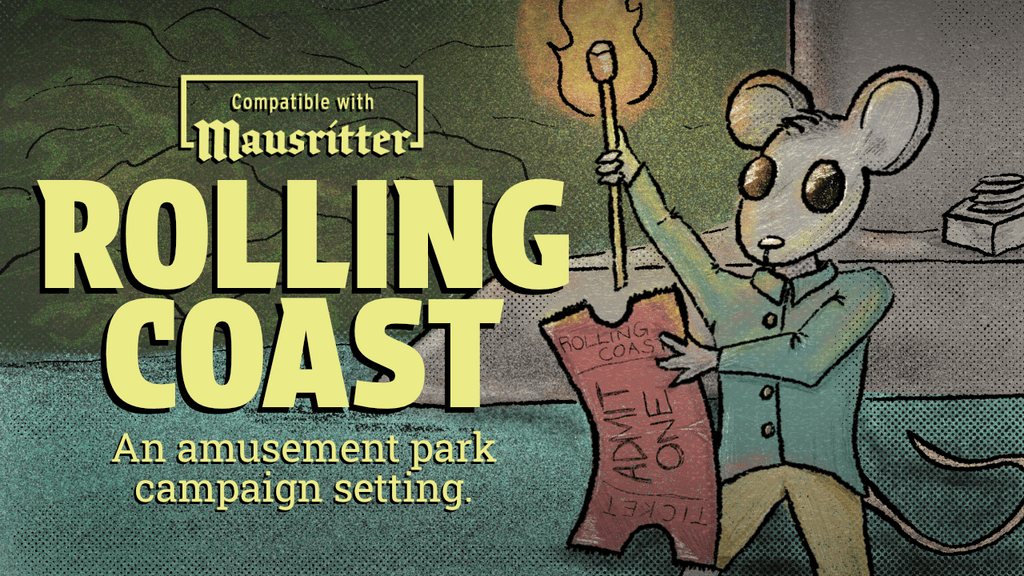
Rolling Coast is a 60 page module for Mausritter by Matthew Morris and Hugh Lashbrooke. In it you’ll explore a sprawling world of loud noises and bright lights as a young adventurous little mouse. I was provided a complementary copy by the authors; Rolling Coast is crowdfunding as part of Mausritter Month launching November 4th.
What we have here is a 19 part hex crawl, with 3 settlements, 9 locations, 11 factions, and a bunch of custom creatures and NPCs. The layout and formatting is very close to the Mausritter house style throughout. The art, mostly by Matthew Morris but with pieces by Piotr Kuberkiewicz, Fernando Salvaterra, Jon Morris, Rachel Lashbrooke, Penflower Ink, and Lux Taggart, is lovely monochrome line art, and plentiful. Headings are clear, and highlighting is kept simple, although as this is a longer book I’d prefer some section headers to help with navigation. Morris and Lashbrooke are big names in the Mausritter community, and I’ve reviewed a number of modules by both of them before – Stalls of the Blood Queen, Kiwi Acres, The Micery Keep, Whisker in the Wind, and What Lies Within The Pools. Kiwi Acres and What Lies Within The Pools are the largest of those modules, and neither them have the scope of Rolling Coast.
We open with the hex map and key, which relies on our familiarity as humans with the setting — an amusement park — to do the heavy lifting with regards to descriptions. You won’t be surprised if you’ve read other reviews of modules by Lashbrooke and Morris that the descriptions are excellent. “Large metal beasts coming through the day and night, only the bravest of mice venture into the blacktop sea.” is just one example how, even in these 1 sentence descriptions, this pair manage to bring a lot of implication into their descriptions, making the absolute most out of the familiar setting. In general, we get descriptions that are brief, rely on the referee for interpretation through their own understanding of an existing space, and minimise redundancy such that almost nothing is repeated. There are 11 factions in Rolling Coast, and they’re interesting, and feature additional stat blocks, special spells, or unique items that they might have. The hooks in the settlements and those in the adventuring locations are almost universally excellent. And in the Packratz Hideout, information is all packed together, so that you know the characters and their locations, and they’re related together. The adventuring locations almost universally slap for micro modules (which is what they are — each fitting into a set format of 3 spreads). The wishing well has an interactive, pleasingly looped semi-aquatic dungeon. The ambulance is a hallucinogenic nightmare (although I have trouble running these large rooms with many points of interest that often crop up in Mausritter more than I do with smaller dungeon-like spaces – the witch’s garden is another). The waste-dump is a combat arena you can compete in or bet on. Old Pantryville is a mini depthcrawl. Quillbane’s lair and the Sewer are traditional dungeons, and to top it off, there’s a mech-building building competition. There are 9 in all, all featuring the same excellent description, all with unique mechanics, twists and interactivities. It’s really good stuff and I’m excited to run many of them the same way I was with the Estate.
While I admire the craft here, I struggle a little with the information design consequences of the insistence on brevity and lack of redundancy. “Ferris wheel and park medic van – Home to an affluent settlement of 78 ice situated in the highest bucket of a derelict ferris wheel.”, for example, clearly refers to Wheeltop, whose description is on page 39, but it’s neither named nor referenced here on the map or its key. Similarly, the adventure location Perilous Excursion into Old Pantryville is clearly set in The Pavillion, but this isn’t mentioned in the key or map. When I’m exploring the factions, I find what I need spread between the Bestiary section, the Faction section, and the Adventure Location section for that faction. The characters in the Bestiary also suffer a little for the Mausritter style — because they’re all villains fighting for power, they come across very similarly. An excellent shortcut to avoid this is simply to add in a short quotation in their voice, and I wish that had been done here, simply so I could adopt their personas at a drop, or a list of relationships — this is done in a later settlement, The Packratz Hideout, but not in any of the other sections. Wheeltop is a major location, and hence has more spelt-out NPCs; this is great, and I wish it had been like this throughout the book. I do note, however, that while the hooks here, again, are excellent, they don’t belong in a random table, given they’re clearly connected to specific locations and characters in the space. The Adventuring Locations have floral names rather than descriptive ones, so I can’t see at a glance where they belong on the map.
I have found this incredibly brief Mausritter house style to be problematic in the past, and I’m seeing it again here, but it’s disappointing to continue seeing it after we’ve seen authors such as Josiah Moore going against this trend with significant success. This is the kind of module I want to pick up and play – I tend to play Mausritter a lot, because I have more time with my kids than I have with adult friends, but I don’t have any time for prep. I would struggle to run this in my typical format, because of this lack of internal referencing. This problem is clearly a decision of the authors that isn’t to my taste, because it echoes out into other areas – rumours for example, don’t provide any context or any idea where to find the context. They want the referee to absorb this module so they understand everything. But to run something like this the way I want to run it, I need a little more redundancy, or page referencing, or better organisation. I suspect 1 of those 3 would do the job, but without any of them, it’s hard to make sense of without reading it over thoroughly. It would be easy for this to have been arranged in such a way that things made more sense – the adventuring locations and factions being front-loaded so you understood the context of the broader map when it arrived, for example, rather than putting them at the back, and naming things for their locations rather than with floral names. If I run it — the kids will have to be old enough to appreciate the story from session to session — I’ll have to mark up page references at the least. The information design reflects in other ways, too. I don’t want to say the cake isn’t baked here — I think this is what the authors meant to put out, and it feels like a natural development of their past works. But I think that as their ambition grows, the consequences of that ambition require a rethinking of the information design because a 3 page or 20 page module is a different beast design wise than a 60 page one.
The most interesting thing about the Rolling Coast is the meta plot, something I don’t think I’ve seen in other large-scale Mausritter modules. There’s a cult here – the Fellowship of the Everlasting Wheel – who plan to restart the ferris wheel, which will bring disastrous consequences. As you play, the chances of progression on the clock increase (as the die gets smaller), until finally a major settlement is destroyed and the government with it. The tension of this major villain being initially and publicly friendly and supportive of the adventurers is a really fantastic addition to the module. To trigger these events, though, you have to roll the maximum on every size die to culminate, which is a fun way to increase the tension as the campaign goes on. But! I don’t think the math on the countdown to disaster works for this, and I suspect there isn’t enough content here — we’re talking a range of between 6 and 60 sessions, with an average of 33 sessions before the countdown finishes. I just don’t think there are 33 sessions here, let alone 60, unless you lean heavily into customising the campaign. The math problems also occur with random encounters. Mausritter doesn’t have rules for random encounters whole hexcrawling, but the 11 wonders encounters, will be exhausted quickly over 19 hexes and 33 sessions, whatever rule you use. The encounters don’t appear to be for use within the adventuring locations (as the official rules state) — they have their own. This suggests you’re not really supposed to be encountering them a lot, which in turn suggests the resource game in Mausritter (rations, foraging and the like), isn’t of great import to the authors. That’s fine – it’s not important to me, either. But, I think potentially these two birds could be killed with one stone, simply by incorporating the countdown into the seldomly used random encounter table.
There are a few odd things in this module that don’t really fit into the review neatly. There are a bunch of full page d66 tables, some of them containing interesting things. These are community developed tables, which is very cool, but they raise implications that aren’t really explained in the module itself. Are there a lot of taverns and villages in Snackburg? Is it the NPCs or PCs that have secrets? I think these should’ve been customised more for this particular location, as they raise questions and don’t bring answers. That said, the village traditions in particular are very cute. There’s also a very cute narrative short story that’s written out between the sections, illustrating the adventures of a party of mice in the Rolling Coast. I’m not a fan of authors writing their prose into their TTRPGs typically, but this comes across as very childlike and wondrous (it should be illustrated like a children’s book), and it brings a lot to the module to help newer referees get a sense of what the atmosphere is supposed to be.
Overall, the meat and potatoes of the Rolling Coast is really good mouse adventuring, in the lineage of the Estate. Those 9 adventuring locations are a lot of fun, and you could drop them into any Mausritter campaign. I like the meta-plot, too, although I’d speed it along a fair bit. I don’t think the tools are here to run the 11 factions and 2 of the 3 settlements, though, in a way that would be intuitive and easy, especially for someone new to running Mausritter, and they’re precisely the kind of people I feel would get excited about playing in an amusement park. There’s a decent amount of work to do to link it all together and I’d be doing a lot of marking up. I feel like the narrative frame is great for onboarding new referees, but the rest of the module doesn’t spend time coddling new referees at all. I’ll definitely be running those adventuring locations with my kids, even if I may not end up running the entire Rolling Coast despite the fun faction play it gestures towards. That said, if you’re looking for the backbone of a political intrigue-filled Mausritter campaign, with a location that’s filled with potential for expansion, and you’re willing to put in a little work (or are a master improviser), Rolling Coast is the mousy module for you.
I Read Games reviews are me reading games when I have nothing better to do, like read a module or write or play a game. I don’t seriously believe that I can judge a game without playing it, usually a lot, so I don’t take these very seriously. But I can talk about its choices and whether or not it gets me excited about bringing it to the table.
To review Spine, I’m going to have to break format. I was sent a complementary digital copy of Spine by the author, Asa Donald, and I tried to read it, and it turns out I can’t judge this game on the merits of the read, despite the fact that on the scale of book to game, it’s majority book. And I think Spine is impossible to play in digital. It is, by design, a book designed to be printed. So, I contacted the author, and asked for a pre-release printed copy, and I played Spine. Spine itself is a giant argument that reading and play could be considered analogous, and Donald has written a series of essays and interviews in support of its upcoming release, so I’m going to keep it in my I Read series.
Spine, or “Siderius Plug’s Spine: Immortality in 99 Endnotes”, is a solo horror TTRPG by Asa Donald. It is very difficult to review Spine without spoiling it, so I’m going to describe the mechanics of the book, and from there, I’m going to spoil it. The book is a series of texts — 5 in total. You read the excerpt, and when you get to an endnote, you can choose to flick to the back and read it if you’re curious (which, if you’re me, you generally are). When you find an endnote, you’ll find more text, and a prompt. If you see a symbol in the prompt, you must stop reading at the symbol, or else you must answer the prompt, and if there is no symbol, you can choose to follow the prompt or not. The prompts vary wildly, but most often you’re asked to add marginalia to the book.
This is the best solo game I’ve ever played. I couldn’t put it down. After I played Spine I felt shaken and emotional. It felt like the book was actively responding to my actions at times. To feel a game with horror themes this deeply is, perhaps, a deal breaker for some players. While I’m not deeply engaged in the solo TTRPG scene, of those that I’ve looked at it’s absolutely unique. It is a game that will benefit from going into with little knowledge regarding what is to come, so if my recommendation or a description of the rules are enough, I would encourage you to simply order it and play it, keeping in mind the content warnings of possession, loss of bodily control, and verbal and manipulative child abuse. You can get the print at home version here, and the print on demand version here. That’s the review for you. Go forth and play.
From here on, it will be all spoilers all the way in.
Bathtub Reviews are an excuse for me to read modules a little more closely. I’m doing them to critique a wide range of modules from the perspective of my own table and to learn for my own module design. They’re stream of consciousness and unedited critiques. I’m writing them on my phone in the bath.
The Witch of Drithwyn Weald is a 70 page module by Chris Bissette for their A Dungeon Game. Art-free, it’s one of a regular yearly series where they release an “advent module”, in 25 parts over the advent period, and a gradually increasing price. In it, you explore an endless forest in which, since time immemorial, a powerful witch has dwelt. I purchased this myself, in the first week or so of its release.
The module opens with weather and random encounters. Both of these are pretty run of the mill, although there are a few interesting random encounters that tie in with ongoing stories in the larger forest. The issue with most of the weather and the encounters here are that they simply happen, and aren’t particularly interactive. It ends with a bunch of appendices, some of which are pretty important and really should be at the front of the module. The cults of the forest, for example, are the 6 factions that drive a lot of what is happening; they’re given brief descriptions, but nothing on specifics (leaders or likely contacts) or specific agendas that might guide them any more than a specific madness that afflicts each of them. Other appendices cover how to make more forest, essays on disability and horror, a few short stories and poems set in-world, and how to travel the hidden paths of the forest known as the ways. All up, this is almost 20 pages of what isn’t particularly gameable content — almost 30% of the whole module. I just feel like this would have been better spent actually expanding on the content and making it more interesting and useful, rather than all being ancillary content.
Most of the module, though, are the hex keys — 25 of them. Most of these have 2-4 paragraphs of text describing them, with a few exceptions covering characters, a mid-sized dungeon (which unfortunately has the same number of rooms as the forest had had hexes up to that points by, rendering the key a little confusing), a small tower, and a walled off area with its own hexes (19 of them). That’s a decent amount of content, in my opinion — about 60 keyed locations.
Bisette’s writing is, as always, evocative and atmospheric, but here is often lacking in detail. The village, for example, has no named villagers; neither does the exorcist or their band. No motives, no personalities. It’s all very abstract. What does Fionnan want? I don’t know. What will Brynn do for food? Apparently anything, but no specifics. Stavforth wants nothing but to be left alone? What a fascinating potential encounter. Who is Agna? No way to find out. There are other big missed opportunities, like the circus — which is one major place where disability is foregrounded in this module, and despite the essay at the back, I don’t think it’s justified in the text, with the characters undeveloped beyond their disability; I think disability has a place in our fantasy worlds, but here it isn’t given the space to breathe or have a human face.
The dungeon here is a clever one that deserves a little more attention than the gimmick is given: The Ways, a secret way of travelling, connect many rooms, meaning there are areas with no doors you can access, or ways between rooms that aren’t spatial. This is very neat and fun; sadly there is no reason to venture into it, as nobody knows what’s inside.
The key is where the lack of layout and art really does this module a significant disservice. The text uses centered vs. left justified numbering to differentiate primary vs. secondary keying, but it’s not obvious that this is the case and it’s not super clear once you do. Art and a more thoughtful layout would remedy this, and the truth is, a more thoughtful layout would not actually have been more challenging to produce — just using headings, sections and pagination would have made it far easier to follow, and this stuff is very easy to set up in basic word processors. As it is, it’s not illegible, but it doesn’t do you any favours, and given the final product isn’t cheap, that’s a significant strike against it.
The Witch of Drithwyn Weald is missing so many things that it needs to be interesting or functional for me. I don’t know why you’d go there, and there are no rumours or reasons to visit, let alone juicy ones. The characters have no personality and often no agenda. It’s completely unclear why they are in this hellscape or, for that matter, why the player characters are. There are no reasons to interact with anyone, in a place explicitly filled with horrible encounters. There are no famed treasures. There is no reason to persist. I know there’s a social contract by which the players are obliged to adventure, but what’s the point of a module if not to throw them a bone? Despite this being a bunch of interesting hexes, all together they do not add up to more than the sum of their parts. Honestly, after Reivdene-Upon-The-Moss, a very compelling module that resulted from the same advent process a few years ago, I had high hopes, but this was entirely a disappointment for me.
The Witch of Drithwyn Weald is a forest hexcrawl filled with horrors, and if you are happy to fill in a ton of blanks with regards to characterisation, motivation, and agendas, and do the same with factions and monsters, and to come up with interesting reasons to be there, then this comes with Bissettes typical flair for evocative writing. But, it’s a lot of work, and I’d reach for Reivdene-Upon-The-Moss first, if you’re looking for art-free, or something like the White Horse of Lowvale if you’re looking for similar folk horror, but with a stronger aesthetic and more consistent drive to play.
I use affiliate links where I can, to keep reviewing sustainable! Please click them if you’re considering buying something I’ve reviewed! Want to know more?
Have a module, adventure or supplement you’d like me to review? Read my review policy here, and then email me at idle dot cartulary at gmail dot com, or direct message me on Discord!










 Playful Void