Each holiday season, I review different modules, games or supplements as a thank you to the wider tabletop roleplaying game community.All of the work I review during Critique Navidad is either given to me by fans of the work or the authors themselves. This holiday season, I hope I can bring attention to a broader range of tabletop roleplaying game work than I usually would be able to, and find things that are new and exciting!
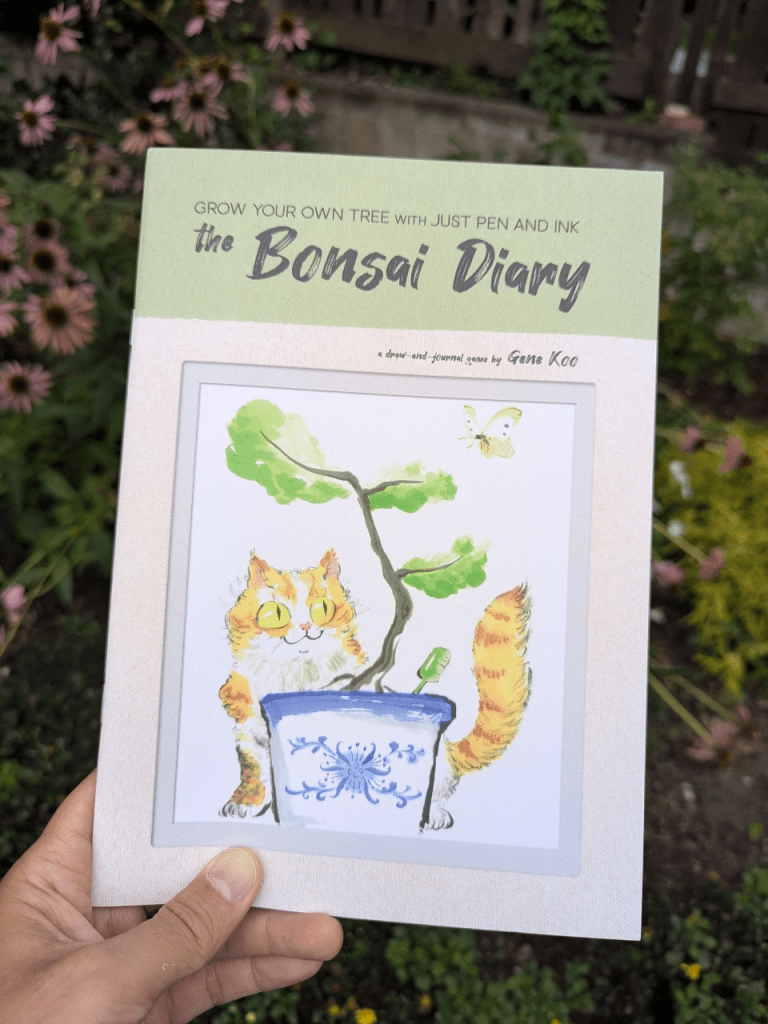
The Bonsai Diary is a 34 page journalling game by Gene Koo. In it you nurture and grow a Bonsai Tree, with pen and ink.
The mechanic is simple: You tract the previous page’s bonsai, and then add a line to make your tree grow. Each page, you’ll get a prompt, which will guide you to tell the story of yourself and your tree. Sometimes these prompts are a question, sometimes there are images to help direct what you draw, and sometimes they’re quotes. Sometimes they’re very specific, sometimes they’re ephemeral. I get the impression this is supposed to be a regular practice — you play a page every day for a month — but it doesn’t outright say that.
The layout is spacious — as it should be, as you’re supposed to be drawing all over the page — and conservative, but as it is played page by page as you progress, information design is straightforward here. It’s elegant, and lovely. You can buy a print edition; I had the print and play edition, which has clear instructions on how to reproduce it. I have a strong feeling that this game would benefit from being on higher quality, better bound paper. Like, it screams “I want to be on a textured, spiral-bound notebook”; that said, you could do that, if you wanted. There are instructions for creating your own diary, unique from this one, using a deck of playing cards, in the back. This would be, in my opinion, a project well worth the time.
Bonsai Diary is another game in this past year or two’s trend toward book play; Yazeba’s Bed and Breakfast, Triangle Agency, and most recently Spine, all have repositioned the book itself as the center (or at least a fulcrum among others) that the game spins around. This isn’t a new concept, but I think that designers are embracing it in newer and more interesting ways. It also plays with the oft-lauded destruction of a text — but in the opposite direction. You’re tracing your Bonsai from the previous page, so every page you have the opportunity to deface your page and your Bonsai, and you simply do not have to. There are pages that take advantage of the ephemerality of the tracing of your Bonsai, which is fascinating for the very same reason why other legacy games are fascinating in how they ask you to destroy things you previously wouldn’t have dreamed of replacing. It’s inventive and I love it.
Bonsai Diary is full-bent focused on providing a contemplative, mindful experience, but in a creative, surprising way. It’s really quite excellent. It’s also quite interesting. So many solo journalling games are instead full-bent on horror, or fear, or exploring your innermost feelings, and I enjoy this calmer, more measured pace. If you’re looking for some kind of meditative gaming practice, for a month, or for a day, I’d check out the Bonsai Diary.
Each holiday season, I review different modules, games or supplements as a thank you to the wider tabletop roleplaying game community.All of the work I review during Critique Navidad is either given to me by fans of the work or the authors themselves. This holiday season, I hope I can bring attention to a broader range of tabletop roleplaying game work than I usually would be able to, and find things that are new and exciting!
A Real Boy is a 1-page collaborative storytelling game, where players take turns telling the story of an artificial being struggling to become human. It’s technically for any number of people, but I feel like it would work best with 3.
The basic gist is this: You agree on a few basic worldbuilding prompts, and (in a neat simple worldbuilding technique), describe how the world you’re playing in feels about certain things.
The you take turns rolling on the encounter table and framing scenes for the player to your right, who plays the creature. At any point, another player will ask for your reaction, checking one of the four feelings you used to build your world. If the feeling gets too much use, it evolves into a new feeling, and the world changes. After 9 encounters, you look at the world, and decide what happens to the creature.
The meat of the game are the encounters, and these are pithy and metaphorical, effectively tarot-like, such as “The Crow and the Owl. The science. Why are they a danger?” I like them, but as I mentioned earlier in this year’s Critique Navidad, I like some specificity in my design: This being a 1-page game doesn’t have the space for that, so it’s going to appeal mainly to players who run on creative fumes.
A Real Boy is a lovely little game, that would benefit from being a little less little. I suspect simply expanding it to the back of the page would be sufficient to expand on the back or front end of the prompts, to add some space for the marking down you’re supposed to do, and to clarify the processes a little. It’s all here, though, and for the right table A Real Boy would honestly be a great warm-up before a similarly themed game, or perhaps even a whole evening if you were very comfortable improvisers.
Each holiday season, I review different modules, games or supplements as a thank you to the wider tabletop roleplaying game community.All of the work I review during Critique Navidad is either given to me by fans of the work or the authors themselves. This holiday season, I hope I can bring attention to a broader range of tabletop roleplaying game work than I usually would be able to, and find things that are new and exciting!
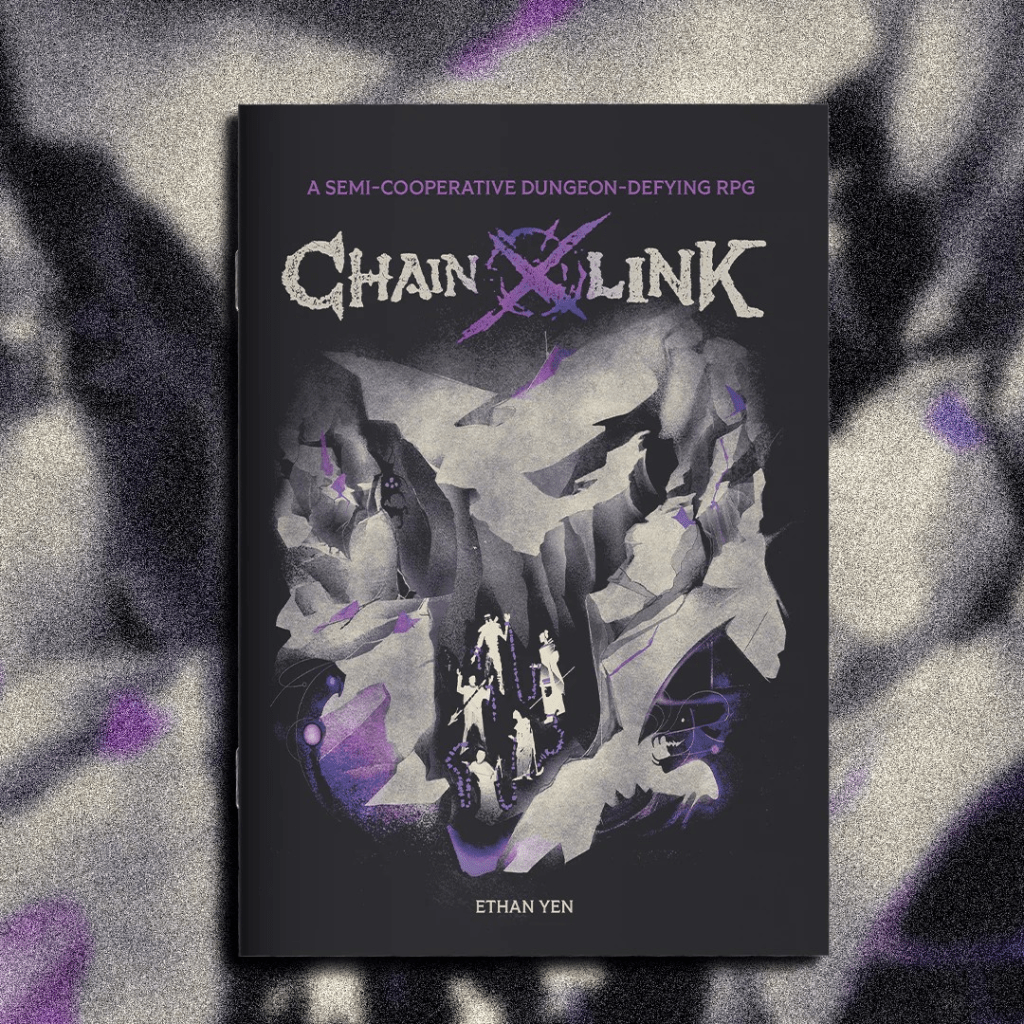
Chain x Link is a 64 page game by Ethan Yen, with art by Tony Tran and Andrew Beauman, with consultation by Spencer Campbell. In it, you are the leaders of revolutionary factions, that have been exiled to a dungeon deep beneath your civilisation. You work together to survive and escape, while plotting against each other to smuggle assets out of the dungeon to your factions above ground. Meanwhile, you also play your faction above ground, trying to seed their very own revolution.
Let’s talk visual design first, because it’s worth talking about but I suspect it’ll get lost if I leave it to the end. The layout, also by Andrew Beauman, is excellent. It’s full of visual aids and graphics, it has a lovely faded purple highlight palette. It’s clear and relatively easy to navigate; I think there are so many moving parts here, that choosing a larger page format would have enable concepts and procedures to be pinned more commonly to spreads, and that would have made it better again. Within the format chosen, though — looks to be A5 or half-letter — it works very well. The information design isn’t terrible, although it front-loads a lot of information. Later in the book, in Spadefront section, it starts walking the referee chronologically through what she needs to do to run that first session — I think the game as a whole would be better off to have been presented in that way, given that rules —are at least complex in their unfamiliarity.
So, those rules. There’s a lot going on here. Your core loop consists of entering a new level, completing a faction trial for one of the factions, and completing a grave trial for that level. If you can complete the ascension rite, you can enter the level above, or if you’ve ascended far enough, escape. If your faction has completed all 3 of its’ goals, you get to have a revolution. As a Breaker (what characters are called here), you have skills and assets, and those assets can move between your “chain” (that’s your party), and your faction on the surface (by smuggling). The goal is to both escape (and hence you need loyalty to your chain) but also to start a revolution, where the other breakers in your chain all desire very different revolutions to you. You also have equipment and experiences, which operate similarly to assets and skills, but are earnt or bought. Very neat way to represent a revolutionary leader’s acumen. When you ascend a level (or in a scene on the surface), you play out a trial. The trial has an objective, an opposition, and stakes, and the referee determines the difficulty of the trial, which the breakers are trying to beat. You each make a contribution adding to the dice pool for your various equipment, experiences, assets etc., and roll them all. You pick one die as your contribution score — the next player will have to pick a higher score, so best to pick a low one, or the others won’t be able to contribute. But the final breaker gets to be the leader next time, which is a powerful advantage. One of my favourite small mechanics in this game is opportunity: You’re all leaders of powerful factions, which means you’re masterminds, you bide your time. So each of you have a d10 which is the opportunity die. The longer you wait to strike during a trial, choosing lower contribution scores, the greater the number you can choose to substitute your choice for when you do choose to seize the opportunity. If total contribution beats the difficulty, you succeed, and the new leader distributes any rewards. If you don’t succeed, you suffer consequences. Then the leader gets to enlist someone in opposition during the trial, to smuggle an asset to their faction. The same rules apply to faction trials as to grave trials, which I appreciate very much. I love the tension in these relatively simple, 1-pass rules, between gaining leadership and risking danger. I appreciate that there’s this core complexity to the game, lots of fiddly parts, but it’s re-used in different contexts and features a lot of internal tension. It’s great.
There are a few things I don’t think are clear. I got the impression you’d face a maximum of 2 trials per level, but the Ascension Rite has me second-guessing that impression. If I fail a trial, do I repeat it again and again, unchanged? That may get repetitive. I don’t quite understand whether contributions are simultaneous or turn-by-turn — I think simultaneous would make more sense, with the push-your-luck of contribution score. What does revolution, or reaching the surface, entail?
One of my favourite touches in Chain x Link is the additional resources; it relies heavily on the breaker, chain and factions sheets in the rules, so they aren’t really bonuses, but the trial sheet structures the trials visually for the referee, which I appreciate, and more importantly it comes with a folder of pregenerated breakers, factions and chain, so you can simply skip that entire section of the rulebook. The rules in Chain x Link are unique enough — at least to me — that it takes a fair bit to wrap my head around, so reducing that cognitive load from 60 pages to 30 is a hell of a scaffold to get me to running the game.
The end of the book is the entire lowest level of the Grave. This slaps! It’s full of characters, interactions, it’s an absolute powder keg! And I love that it provides an example of what you’re supposed to be designing as the referee for future levels of the dungeon. One way this diverges from inspirations like Blades in the Dark and Agon is that the referee is expected to design the levels of the Grave. It’s a weak criticism to say that I want more of this, but it’s good. The same goes for the worldbuilding as a whole; there’s a gesture to collaborative worldbuilding in the character creation section, but I really feel this needs more information, even if brief, on the surface, and the specific contexts of the faction and the world. Certainly, if the book were twice as long, with 10 times as much of the actual location content, it would make my job as a referee a hell of a lot easier — the referee already has a lot of improvisational load in terms of the surface, so reducing the preparation load would make this more likely to hit the table for me, simply by virtue of my being time poor between work and children.
I like Chain x Link a lot. The feeling I got out of Chain x Link after reading through the book, felt a lot like the feeling I got out of Blades in the Dark the first time I read it — there’s a lot of mechanical heft here, but it’s elegantly presented, and while it might take a lot to wrap your head around, it’s going to result in a really compelling game filled with really compelling stories. One of the inspirations listed is Spire, and I always felt like Spire would’ve been better as a Forged in the Dark game: No. This is the game Spire should’ve been. It’s clearly inspired by John Harper’s work, but it really pulls things together in a neat and compelling way. I’m disappointed it isn’t organised and explained a little more clearly — it needs space to breath and it needs to be in a bigger format to do so — and I’m disappointed it doesn’t come with more information about this compelling world and the levels of the Grave. It also feels cut to the bone to fit the page count, leaving some end-game crucial elements uncovered. But those aren’t dealbreakers for many people, and if I can find time to do all the prep, this is a game I’m definitely going to try to bring to the table next year, despite those misgivings. If you’ve always had the same feeling as me about revolutionary games that fell short like Spire and Brinkwood, I think you should bring Chain x Link to the table as well.
Bathtub Reviews are an excuse for me to read modules a little more closely. I’m doing them to critique a wide range of modules from the perspective of my own table and to learn for my own module design. They’re stream of consciousness and unedited critiques. I’m writing them on my phone in the bath.
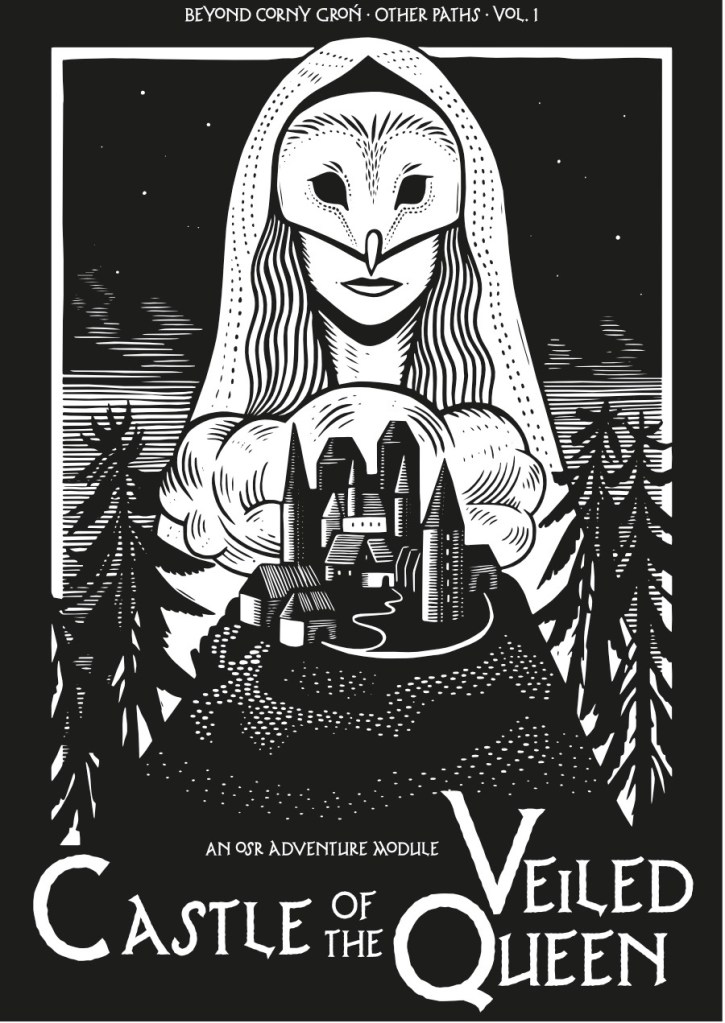
Castle of the Veiled Queen is a 45 page system agnostic module taking place in the Beyond Corny Groń setting — a setting that was very compelling, but was begging for some more concrete content. It was written by Kuba Skurzyński, with a number of art contributors. In it, you explore the castle of a princess, filled with residues of legends and wicked plots. I backed this for Zinequest.
Castle of the Veiled Queen opens with 8 long-form legends and plots, all of which are very compelling but not especially incisive; it then includes 6 rumours and 6 pieces of gossip that are more bite-sized. It feels on a first read that those first 8 long-form pieces of legend and plot are intended to be converted to something player facing, but I’m not sure that’s true: Many of the other 12 link into them in a meaningful way, and I think that the intent here is that the legends and plots are supposed to be the equivalent of “What’s been going on in the Castle”, so that the referee knows what the rumours all point to. This could all be clearer, and needs to adhere better to my Juicy Hooks suggestions to be a little more instantly playable. This would also benefit from some within text referencing — these hooks point to people and places in the text, but the referee has to know the castle well to know what’s going on. Despite all this, the actual content is really compelling and interesting, and there’s a lot going on — in a really good way.
Random encounters are good, tying directly into characters in the story, but again would benefit from references — they’re not all in the index at the front, but searching the digital format help you. Redundancy in these cases would be super useful, as the benefit of having this intratextuality is compromised by the referee’s lack of knowledge here. They keying is with an eye to location, rather than explicit gameability, which isn’t so much a bad move but a missed opportunity. There’s often no interesting single thing in any one keyed area; sometimes the interesting thing isn’t explicated, and is barely alluded to. This is the case with the gunpowder storage in the Barbican; it’s covered well on the separate gunpowder storage in the Eastern Wing, so perhaps it would have benefitted from a reference. They key is dense, but it’s dense in the way Keep on the Borderlands is dense: Not always with the things I want it to be dense with. The briefer character descriptions are pretty great, covering appearance, relationships and interests, but a few of the descriptions feel like they were written well before the author found this rhythm, and these aren’t as strong or brief. Keying often skips things that are on the map — aforementioned gunpowder storage — or the map doesn’t make clear which parts are the key — in the Moon Tower for example, it’s not clear which floor is which (I think, after some consideration, the third floor is the 1st floor, and the attic and roof are the top two floors, despite the map next to these being of the top four floors). Labelling the maps would’ve fixed this. The factions aren’t at the front of the module, which means they’re in the text. The issue with this, is that you have to extract the information in order to figure out how to incorporate them. The pixie gang in Moon Tower is very cool, and have some solid motives and ambitions. But it’s these aren’t explained, which means it’s hard to foreshadow them without significant foresight. This goes for most of the factions and plots — compelling, interesting, and difficulty to facilitate into play.
The Outlaw’s Path is a dungeon that sits beneath the entire castle. In and of itself, it’s an interesting dungeon — it loops in interesting ways, both in itself and with the castle above. It’s full of interesting characters. You’ve got reasons to explore it in and of itself, and also to use it as passage to other places in the castle. It compromises the layout of the castle, though, to a degree, as you can access five out of the seven castle’s locations through it. It’s a very cool little dungeon, though, and to be honest, it could stand on its own without the castle, largely because it’s a very gameable, interactive space — very unlike most of the castle.
There are lots of smaller issues, that to me make me feel that I likely missed more. You are given opportunities to blackmail the NPCs, but no specific NPC has any blackmail materials in their description, so what is this valuable or embarrassing information? There are a pile of forsaken easter eggs as well, mostly in the form of unique magical items that are very cool, but that I can’t foresee anyone figuring out how to use — the Judges Bench is one such magical item. There are a few egregious misuses of randomisers here, too — a soldiers of the castle generator, that will at most generate 10 soldiers (there are only 10 names), and hence could have been a 10th the size, or colourful descriptions like the other characters. Notable persons buried in the chapel could’ve been an opportunity to expand the history of the castle, either in terms of lore, or hyperdiegetically, but is rendered meaningless by a randomiser. Finally, there are some missed opportunities — time and effort put into the different time periods of construction of the castle and how it’s reflected in its’ architecture is very cool, but it doesn’t really impact either the folk living there, nor is it utilised as a puzzle, either of which would have made that information much more interesting and meaningful.
All of these misses are really disappointing, because in many ways the information design in this slaps. It opens with a full page index of every proper noun in the book. It refers out to Beyond Corny Groń with page references to save on space. Section headers could be clearer (they’re intentionally conflated with headings, a choice I don’t like), but they’re almost always present. Bold is used for all highlighting, except in world quotations, which are used very sparingly. Art complements layout, and is is extremely consistent with the existing works in the setting, as well as being unique and fun. There are a lot of maps by Jacek Kuziemski and they’re all pretty exceptional maps, but useable and pretty, with loads of cute touches like a rug pulled back to reveal a secret door.
Overall, The Castle of the Veiled Queen is a very cool location, and you’d be a fool not to pick it up if you’ve already got Beyond Corny Groń and plan to run it. For me to run it, I’d need to do a lot of legwork though. I want the faction (and character) interactions and agendas to be laid out for me from the get go. I want what will happen if the player characters don’t get involved to be clear. I want to know exactly what’s going on, so I can make connections on the fly. As it is, I have to extract all that information myself, and I just couldn’t be bothered. That said, everything in there feels worth playing with. Both the Castle of the Veiled Queen and the Outlaw’s Path below it are complex and compelling. I could see the castle being a base for a Corny Groń campaign, with individual sessions being ventures into Polish folklore based on the contents of that setting book, and things advancing in the background, between the politics and the folklore of the castle. It would really hold everything together used in that way. As a module in and of itself, I could jury-rig it with some work, but it’s not specific or directed enough for a heist even based on those hooks that suggest it: It’s a sandbox meant for immersion not a quick dip. But overall, I’m a little disappointed: It’s too close to Keep on the Borderlands, and I want something a little more like The White Horse of Lowvale. I am just starting to suspect, that’s the way they run, and they’re writing excellent support for that kind of classic style game.
If you’re after a dense home base for your Corny Groń campaign, look no further than Castle of the Veiled Queen, but if you’re looking for a one-shot, or something to dip your toes into in order to get a handle on Beyond Corny Groń after looking at that book and feeling a little lost and overwhelmed, I’m afraid this isn’t the right module for you. Nevertheless, the work that this team continue to do is super compelling, and I look forward to seeing what they do next.
Each holiday season, I review different modules, games or supplements as a thank you to the wider tabletop roleplaying game community.All of the work I review during Critique Navidad is either given to me by fans of the work or the authors themselves. This holiday season, I hope I can bring attention to a broader range of tabletop roleplaying game work than I usually would be able to, and find things that are new and exciting!
Void 1680AM is a 30 page solo, playlist building game, by Ken Lowery. You take the role of a radio broadcaster, play music as you see fit, and talk to people who call in to talk to you. It can be played in a single session, or it might continue over multiple broadcasts.
This game is a love letter to AM radio, a kind of radio that most people do not listen to anymore in a world of digital radio and streaming stations. The layout reflects this: Dirty, filled with what I assume are real electronic diagrams, written in type-written font inspired by electronics manuals from the 80s (or at least, that’s what they are to me). It’s simple, but effective. You’re not getting lost here.
To play, you need some way to record your voice, some way to build playlists with, and some randomisers – cards and dice. The love of AM transmission communicated here just screams that the designer wants you to be plugging in cassettes and recording onto tape, while actually broadcasting this, but most of us will find more ease using our phone’s voice recorder and streaming our songs. You begin by choosing the theme of your radio station, where you broadcast from, and then you start programming. A single turn is a block of 3 songs and some chatter before or after; before it’s an introduction; after, you have a conversation with the caller, and then you start again.
You choose your songs according to prompts that relate to the playing cards you draw; each block of songs, hence, has a place in a kind of emotional narrative, building with clubs, and crescendoing and then falling down to a conclusion with hearts. The prompts that accompany these playing cards – randomly drawn – are not particularly surprising, but they are well chosen. Who doesn’t have a song in response to the prompt “You’ve been out all night, and the sun is rising. What song reinvigorates you for the day?”.
The trickest part of the game is the stranger’s calls. You determine the caller’s age, whether they’re calling about a song that just played, are requesting a song in the next block, or whether they just want to talk. For each potential caller, there is a list of potential subject they’re calling about, and you can choose from two options. I do love that if you choose to continue the stories of your callers over multiple broadcasts, you’re provided with additional prompts for a second, third, and fourth call in. The text says “talk about your conversation with them”, but this is the one part where I don’t like how this game works. I know it’s a solo game; but I want these callers to be someone else, or at least, I want to be stepping into their voices and playing out the conversation. That’s how radio works, right? Unexpected, challenging conversations. Of course, the designer recognises this: You’re invited to record a call in for other players, and there’s an archive of calls at their website (although I couldn’t find the location of this archive when I searched). I don’t know why you wouldn’t use this, if you have the opportunity to. It feels the correct way to play.
This is a fascinating game. I like it a lot. I love that you can broadcast in on YouTube and on the designers real AM transmitter. I think the system is nice, for creating interesting, compelling playlists, and for creating compelling callers. I think that if I were doing this, and broadcasting, I’d want to be inviting guests so that it felt more like radio. The verisimilitude feels important to me. I don’t think it would be important to everyone: Building playlists is a fun way to play, as Ribbon Drive showed us over a decade ago. I love that this is using them in such a different way to Ribbon Drive, inspired by a different way of thinking about music. The modern internet guides us away from ephemerality, but I feel like perhaps the way to enjoy Void 1680AM would be to find a way to broadcast it, and let it disappear into the titular void. Then, the details matter less. The joy becomes in the choice of song, in more eclectic mixes, in wilder stories told by wilder callers. If you’re a music-lover, and you’re willing to put that little bit of effort in, or have an AM transmitter in your garage already, Void 1680AM seems like a no-brainer.
Each holiday season, I review different modules, games or supplements as a thank you to the wider tabletop roleplaying game community.All of the work I review during Critique Navidad is either given to me by fans of the work or the authors themselves. This holiday season, I hope I can bring attention to a broader range of tabletop roleplaying game work than I usually would be able to, and find things that are new and exciting!
We Three Shall Meet Again is an asynchronous 41 page game by my friend Sam Dunnewold. In it, you and 2 other players will play witches, all trapped in the same body, communicating through the written word. You communicate in each your own separate journals, as well as on a physical bulletin board where you clip post-it-notes and index cards.
You start the game together, in person. You first place your shared world-building to the bulletin board: Where do you live? What world are you living in? And then add any safety rules to the bulletin board. You make some decisions about your coven, describe yourself, and put it on the board too, and each a villager and a forest-dweller who lives in proximity to you. You do all this together, but scarcely speaking. Then, you decide together who cursed your coven, whose body you’re inhabiting, and whose home you live in.
If you found that paragraph a little meandering; it reflects this first section of the book. I found this book challenging to read, in terms of it feels like a long list of things you are to do, and things you need to get. The game is guided by the book, and there are secrets in the back of the book that none should read until instructed. In this way, it’s part of the movement of book-play (as coined by Asa Donald of Spine), that to me includes games like Yazeba’s Bed & Breakfast, Triangle Agency, and Spine. The meandering nature of the text is not bad, per se, but for me it makes it hard to get a sense of what has been done and what is to be done. I wonder if a game like this might be best a deck of tarot cards, given the theme, where each of these short paragraphs that run on from each other were each a numbered card, like the introduction to For The Queen.
While this is a game that in theory would work very well online – it includes instructions to that effect – but I don’t actually think it goes far enough with its’ journaling element: I think it would pack more punch, were me and my fellow players all sharing the same journal, and perhaps the bulletin board were collage in the front or back of it, and handing it to each other when each we meet in person once a week or so. The game is supposed to take a few weeks, and it’s likely to take longer like this, but I feel like the implied pastoral setting sets itself in opposition to the digital world, and that leaning into the analog-ness of it all would only enhance your experience, even if it made an already slow game slower. It also adds a trust element – if you’re all sharing the same journal, and spending large amounts of time with that journal, do you break confidence? I feel this reflects the reality of living in the same bodies and spaces.
Once you are cursed, you take turns living in the chosen witch’s body. When it’s your day to live, you read yesterdays‘ prompt, pursue and activity, and journal about it. Leave a brief bulletin board note (only 13 words~) and then write a new prompt for the player tomorrow. There is a prompt provided for the first day: It’s lovely, and sets the tone well. The activities are concrete moves you can make, there are only 4, and they involve you contributing to the bulletin board, breaking the curse, or doing something either magical or mundane that simply is what your character might choose to do. You add to the bulletin board when directed, but effectively if you meet someone new, learn something new about them, or gain a new item that the other witches might encounter on their days.
While you sleep, you often dream, together with the other sleeping witch, or alone. There are a set of dreaming prompts for dreams together, and you can write whatever you wish if you dream alone. There is no clear instruction about what happens to these dreams: I’d probably paste them in my journal on receiving or finishing them.
Your combined research into breaking the curse is hidden in a separate booklet, Research Results. You add the results of your research to the bulletin board, but cannot look further ahead. Honestly, these are the juicy, memorable things that are likely to happen and drive the story. I suppose they are related to the count of days in the front cover, although that wasn’t clear to me precisely how or when to use this count. Eventually you’ll break the curse and gather together in person again. You then share the answers to a few prompts – what happened that you were excited to share with your coven? What questions have you? And then you might resolve future threads together and narrate lasts moments.
This is a lovely game, but it feels like there’s a fog between it and I that I have trouble seeing through. Its procedures are obscured to me, even reading directly. The links are not always clear. I think it’s intentionally so, but I nevertheless struggle with it. My personal difficulty is something I’ve described before, although I can’t remember if I coined a term: When I’m answering prompts, I need a strong foundation to draw from. The designer might provide me with a very concrete and vivid character, and then vague prompts, and I find that easy to work with. Or, I might have a more amorphous character, who then emerges through concrete and vivid prompts. Either of these work well for me. Here, I and my friends must create the setting, the characters, the non-player characters, and the plot, as well as the prompts themselves for each other. I, and many people I play with, would struggle with that lack of redundancy. There are so many ways to fail, and then your friend is left with a journal and no idea how to proceed.
Thematically, though it’s really on point. The format itself has so much to say about fallible, disabled bodies. It has so much to say about relying on the people you live with for things that are essential. It has so much to say about the impacts of your actions not just on the people you live with, but on their relationships and loved ones. It has a quiet melancholy to it, that speaks deeply to those who rely deeply on others and their experience. In the aftermath of reading it, I feel like a witch, in a quiet, pastoral town, struggling with the relationships between my and my coven, while meeting the fae and mundane denizens around me, and trying to complete a ritual than might place me at odds with them, or fill them with fear. The writing fits that perfectly, even as it makes it harder for me to play. I feel like a different format of this game would be for me, or a future iteration, but I also think that there are a lot of people who could take this version of this unique, asynchronous game and produce something beautiful and memorable.
If the idea of an asynchronous, personal game that has things to say about disability and relationships, that is likely to bring out feelings in you and your friends about those things, is appealing to you, and you’re willing to put a few weeks into it, I wouldn’t hesitate to pick up We Three Shall Meet Again.
Each holiday season, I review different modules, games or supplements as a thank you to the wider tabletop roleplaying game community.All of the work I review during Critique Navidad is either given to me by fans of the work or the authors themselves. This holiday season, I hope I can bring attention to a broader range of tabletop roleplaying game work than I usually would be able to, and find things that are new and exciting!
A Stranger’s Just a Friend is a 38 page game for 2 players by Darling Demon Games. In it, you act out a romance between two men, one hired to assassinate the other. It’s an intensely queer and complex game with adult themes; even the cover is explicit, so fair warning in terms of content. I won’t be able to shy away from discussing adult content in this review.
This game is as much about sex between queer men as it is about romance; it is a period piece so it covers religious persecution and transphobia, there is consent play, there is animal death in some scenes, and there is a supernatural horror element as well. This game is a lot, and this one will require the players to be comfortable and care about each other given the subject matter. I really appreciate the safety section that opens this book, as if you’re playing this game that’s really what you should be here for, and I am a strong believer that art, even if it’s not for me, should be unashamed about what it is. That said, this isn’t for me – I have friends who really enjoy explicit sexual content in their games, but I’m someone who prefers to pass these scenes behind a veil, while I’ll play romance games until the cows come home.
Character creation is interesting and characterful. I love that the designer has strong opinions about who these characters are, but nevertheless leaves a lot of interesting space for the players to develop their own perspectives and unique traits. The writing here is universally interesting and awkwardly funny in precisely the way a queer period piece feels it should. You might “Lift a shoulder, dip your chin, and cast a glare that demands attention.“, or “Get more naked, more sweaty, or both.” Even the rules text is interesting and funny: “I’m sorry to hear that, Dullahan. At least you have your associates and employers to keep you sane!”. It’s good stuff. It’s fun to read, and I expect it would be fun to play together with a friend.
It’s an awfully tactile game; messy and sensual. You play with coloured stones, candles, and a block of chocolate. You start the game playing in alternating soliloquys, holding your chocolate over a candle’s flame and then filling an opaque bag with pebbles according to the results of the dice roll. When your chocolate is melted – your fingers sticky and likely thoroughly licked – you begin playing duets instead. You choose your soliloquys, but the stones you drew determine your duets. The result of a duet my cause a return to soliloquy, but the game ends if either one character dies or if they choose to be together. You can choose to play on even if this occurs, but I’m not really sure precisely what this might mean narratively.
Each scene – both soliloquy and duet – are quite detailed and complex, often 2-3 pages long. Your read through your scene, answer questions, you may roll dice, make decisions, narrate what occurs. It feels like a bit like a long drift from a Firebrands game, in a good way. There’s a great variance between the scenes, but the sex of it all is quite unavoidable. I don’t feel like there’s a long story here – we only have 5 soliloquys, and they feel less replayable than you’d expect, because of the choices you’re expected to make in them. I don’t feel like you’ll be moving to and from phases often, unless chocolate melts far faster than I expect it does (it might – I haven’t playtested melting chocolate over a candle). I do love how the scenes are broad in their topic though. There are shopping scenes, but also hunting scenes, as well as sex scenes. It’s violent and mundane and sexual. It feels very concrete and real, despite it also drifting into metaphysical and mythical at times. I love that at least the duet scenes, as they can’t be controlled, are going to lead to vastly different outcomes.
I find it hard to judge whether A Stranger’s Just a Friend is a good game, because it feels as if by design it’s supposed to be a little vague and abstract. It veers into cosmic horror, in a way, which is appropriate I think to the way it’s exploring queer themes. One of the player characters may never have existed; that isn’t even the one that is a mythical construct. Is it about romance, or is it about fantasy? Or is there some kind of mystical element to the world beyond the obvious? It’s really not clear. The art style and layout is clearly tongue in cheek, as is befitting such an explicit text. The layout and lack of page numbers make it a little messy. But even as someone who isn’t interested in explicit sex in TTRPGs, I find the text and the ritual of the game extremely compelling. I want to want to play this game. I think, with the right friend and the right level of comfort between the two of us, it would make a very memorable night, although potentially a risky one, filled with emotion.
A Stranger’s Just a Friend is a game you should pick up if you’re interested in sex in TTRPGs, and have someone else you want to spend a night with expressing your love for queer sex and cosmic horror together, and if you’re the kind of player who, as my friend Sam Dunnewold phrases it, is into “Emotional skydiving”. It’s deeply compelling, but also the kind of game that might be entirely outside many players comfort zone. I love that TTRPGs as an art form can contain such a multitude of kinds, and I’m very glad A Stranger’s Just a Friend exists, with it’s weird, messy, sensual tactility that reminds me so much of sex, and with it’s explicit, cosmic horror that is so symbolic of queer experience. It reminds me that roleplaying games are for everyone, even if every roleplaying game isn’t for me in particular. By this point in the review, you know whether or not A Stranger is Just a Friend is for you. If it is, I hope you check it out. I’d love to hear how it goes.
Each holiday season, I review different modules, games or supplements as a thank you to the wider tabletop roleplaying game community.All of the work I review during Critique Navidad is either given to me by fans of the work or the authors themselves. This holiday season, I hope I can bring attention to a broader range of tabletop roleplaying game work than I usually would be able to, and find things that are new and exciting!
Fear and Panic is a 43 page horror game by Lyme, who previously brought us the excellent Dawn of the Orcs, with art by Roxanne B, Roque Romero, Strega Wolf, and Chaoclypse.
Fear and Panic is a game that resolves the player characters actions primarily. The basic rules here are to roll a d100, lower than a skill to succeed. You also roll to gain fear when your character is scared, which you then you can spend to panic and gain bonuses. There are 7 ways to panic, each providing a different bonus. What’s the downside? Whenever you roll fear you may gain a scar, which changes your character in a tangible way, with mechanical as well as non-mechanical impacts. From there, the game delves into situations, advice on how to run horror, and finally some concrete examples of NPCs and categories of NPCs. This is all pretty solid.
Fear and Horror is one of those games that attempts to streamline what makes a certain category of game fun, when the classics of that genre are a little heavier than I appreciate. The skills selection here really feel like the target here is Call of Cthulhu, and a huge chunk of the back of the book is advice on how to convert adventure paths or modules to Fear and Panic from these systems with large module ecosystems. I really like this style of game – I have written a bunch of games that at least incorporate the same impulse. The issue, though, is that this desire to exist in relationship to these other systems and ecosystems means that it has no real character of its own. I can’t love Fear and Horror, because it is a lens I view other peoples’ work through, a tool to get things to my table I wouldn’t otherwise because I don’t like the system they’re looking for.
Fear and Panic is clever, and it does the job it’s designed to do. I’d honestly choose Fear and Panic over Liminal Horror as a horror game, particularly if I was going to run something that wasn’t written for Liminal Horror. But unlike Liminal Horror, it doesn’t have much of a personality of itself, and so I find it hard to get excited about it. It feels a bit like the weaker first editions of Cairn and Knave, which felt like experiments, but then came the stronger, more flavourful and specific second editions. That said, the elegant part of Fear and Panic is on the cover: Fear is the key to survival, and the loop of fear and panic here is likely to make basically every horror module better, in my opinion. If you’re looking for a streamlined, universal-ish system to run horror classics in that you’ve heard so much about, I think Fear and Panic is the game for you. If you’re looking for your horror game, though, something with a personality and ecosystem of its’ own, you might have to pray for a second edition. I’d love to see it.
Idle Cartulary
P.S. In the few weeks since publication, Lyme has published a module for Fear and Panic – No Easy Man to Kill, featuring Rasputin! Check it out!
Each holiday season, I review different modules, games or supplements as a thank you to the wider tabletop roleplaying game community.All of the work I review during Critique Navidad is either given to me by fans of the work or the authors themselves. This holiday season, I hope I can bring attention to a broader range of tabletop roleplaying game work than I usually would be able to, and find things that are new and exciting!
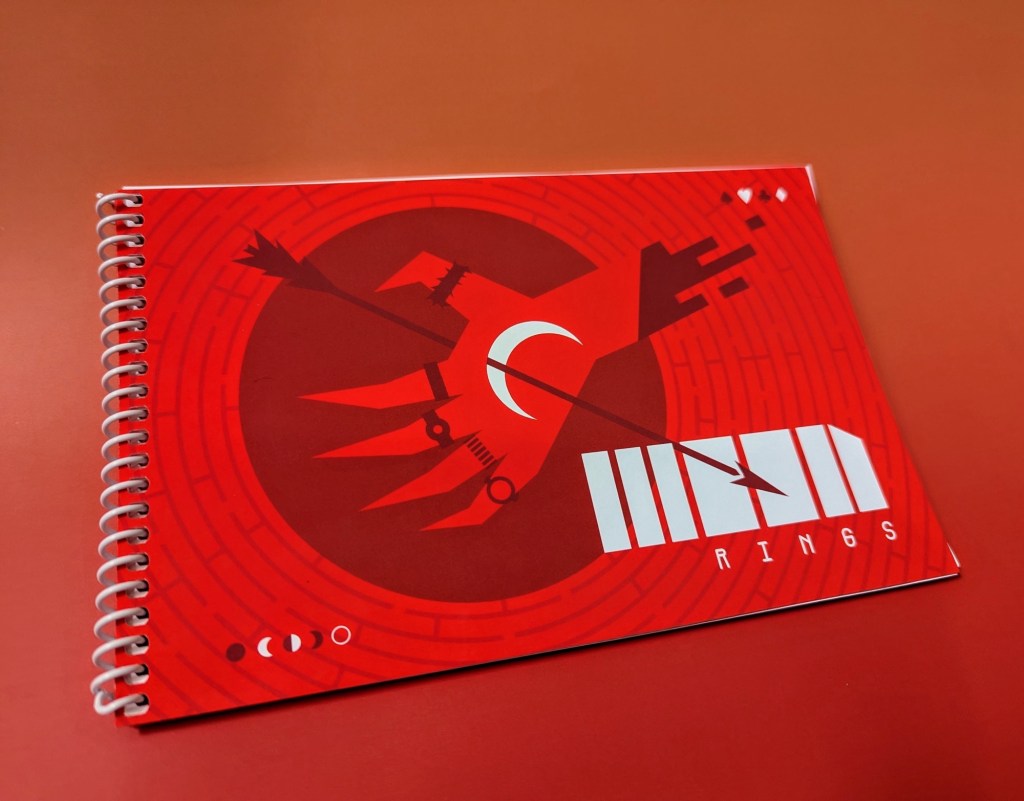
Moon Rings is a 57 page solo game by Chris Schneztler with art and layout by Tyson Whiting, where you play a witch who ventures into a deadly labyrinth to end the reign of a cursed moon.
I’ll start with layout. This is a striking game, with a bold black and red palette, strong visual aids and striking digital art, and it uses clever visual inversions and turnarounds to keep the layout interesting even when the pattern is mostly words and more words. Each page is 2 column in landscape, with a low word to page ratio for an easy read, and whats more all versions of a single rank of card are on a front/back spread, so it should be easy to navigate. It’s really good stuff, although it doesn’t quite scream “brave witch venturing into a labyrinth” in the way I wish it would – it feels extremely modern a layout.
I’ve played a game based on the Carta system before – Tea and Toadstools. The basic gist is that you generate a grid of cards, and move around the grid, experiencing prompts that drive your journaling experience. In Moon Rings, the grid represents a labyrinth, and as you explore it, you’re finding Moon Rings to complete your ritual, and the events are affecting your blood, which will kill you if you go over 20 or are reduced to 0. When you encounter something, you have to roll higher or lower than the card number on a 12-sided die (under if it’s 6 or lower, higher if it’s 7 or higher). You get a chance to roll again, but each time you’ll suffer a worse penalty, such as losing a finger and hence not being able to hold as many rings. You can also use magic to change the outcome of an encounter, but you have a limited number of uses. The game ends when you have 5 moon rings and reach the ritual site, which is the Ace of Hearts.
The bulk of the game are the prompts for each playing card, as well as what occurs when you succeed or fail at the roll. I’m kind of mixed on these prompts – they’re really surprisingly prescriptive, which makes it feel as if this is a game of wandering through a portion of a very intentionally constructed dungeon. I had expected more evocative, vaguer prompts, but it’s stuff like this: “You come across a marble wellspring overflowing with replenishing mana. It enticed you. A pack of moon goblins splash and fight in the cool liquid.” One nice touch is that the ritual you’ll complete is randomly generated from the first 5 moon rings you complete. I’m not sure how much replay value this game will have, but that personalisation is nice and thoughtful. The problem with this prescriptive approach, for me, this leaves me with very little to actually journal, particularly when the game is quite prescriptive in terms of its’ outcomes mechanically. But were this a dungeon, I’d like these locations! For me, then, Moon Rings feels like it’s a success as a solo dungeon crawl, but less so as a journaling game, because it feels like I want a little more space for my imagination to run wild if I’m trying to journal.
As a solo dungeon crawler? This is honestly a blast. I like the goals, I like the descriptions. Played without the journaling, it will feel a little more mechanical, and reminds me of Cavern Shuffle, a solitaire dungeon crawler that I keep in my bag at all times to play if I’m waiting at a cafe or whatever. The main reason I’d bring Cavern Shuffle rather than Moon Rings is because Moon Rings is a print and play booklet and not a deck of cards. There are, in fact, Moon Rings playing cards – but they don’t contain all the information in the booklet. I’m certain you could fit the entire text of these locations onto a Tarot-sized card. If that was the approach, rather than to have a book and a deck of playing cards, I think this would be more likely to get play for me.
Moon Rings is a good game. It’s a very good looking game. For me though, it doesn’t make me want to journal, it makes me want to explore. And for that, I want it to be in a different format – not a booklet or a pdf, but a deck of cards. I haven’t tried playing this on playingcards.io, but I suspect that would be the best way to experience the game as it stands, the way I respond to it. But it feels like a bring with you everywhere kind of game, not a sit at my computer and play kind of game. That said, if you bounce of more evocative, vaguer prompts, this more prescriptive approach might be exactly what you need to get into journaling games, and Moon Rings is interesting, compelling, and appealing to spend a few hours with. Moon Rings might be precisely the journaling game for you.
Each holiday season, I review different modules, games or supplements as a thank you to the wider tabletop roleplaying game community.All of the work I review during Critique Navidad is either given to me by fans of the work or the authors themselves. This holiday season, I hope I can bring attention to a broader range of tabletop roleplaying game work than I usually would be able to, and find things that are new and exciting!
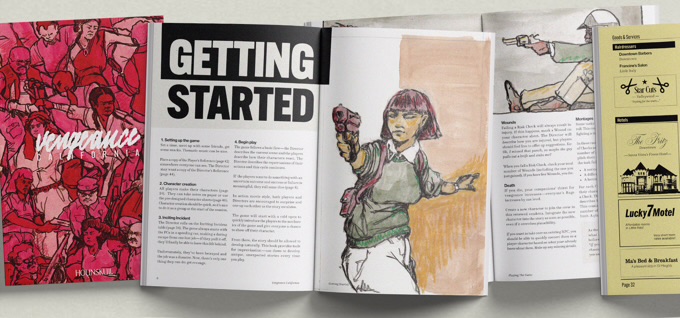
Vengeance California is a 49 page game by Houskull, where you revenge murder in 60’s California. It’s inspired by movies like Kill Bill, John Wick, and the Professional. This is refereed game for 3 or more players, played in a single session, with no prep.
Your only stat here is Rage, which can be high, medium or low, and how angry you are affects your 2 main rolls in an inverse manner: High Rage, harder safety checks, but lower risky checks, and visa versa. You roll up to 3 dice according to your prep and character, and then choose risk or safe depending on whether the action is dangerous or not. When you fail a risk check, take a wound, enough wounds and you die, causing everyone’s rage to go up. Nice, simple basics.
Now, we introduce Lines, a pleasingly cinematic mechanic: Player characters can say a line at any time to affect basically anything. Examples: “I know a guy”, or “It’s just a scratch”, or “I’m too old for this.” Well, actually, not the last one: This is a neat mechanic, but because this mechanic feels the need for balance, only the listed moves are “allowed” — these all come with a consequence. There are 8 official Lines, and I don’t feel like that’s enough, but I do think that the generic “complication” cost should cover you for improvising new lines, and I’d encourage this if I ran it. Honestly, this is the place for a mechanic like Devils Bargains — “hey, everyone, what’s the consequence of this line?”, if a complication doesn’t make sense. Complications are great, though: There are 6, randomly rolled, and each have 6 steps of rising and falling escalation. This mechanic is frankly genius for a game intended for a one-shot or a limited campaign. It brings a really elegant narrative flow to the game that reflective of the cause and effect of the movies that inspired it.
Character creation is fine, and thematic. I like the character sheets — basically all the important info is there. The player and referee advice is good, but I can’t imagine anyone reading it for a one shot realistically — if it were condensed and put on the character sheet and directors reference it might see use. It comes with a bunch of references a though, which is great!
The back half of the book is world building — and this slaps. There’s a map, factions, a phone book to help improvise fronts and the like, a bunch of inciting incidents and odd jobs, items and a non-player character generator. The non-player character generator is the weak link: I’d rather a list of them, just like the phone book and factions. These are mostly intended as prompts: This isn’t a sandbox of Santa Vista, they’re things for the referee to respond with and use in scenes. So the generator feels out of place here.
There are a few gaps though: I don’t know why the characters would take odd jobs, for one — detours for coin or favour seem to suck momentum from the game, but that’s a minor. More importantly, I don’t see a mechanism for ending the game or pacing it — it ends when the players get revenge. The referee is supposed to pace the game, but I really could see this ending prematurely aha being unsatisfying, or running long and losing momentum.
I find Vengeance California interesting in how it blurs the line between narrative driven and action driven play. You can see a lot of the choices have OSR roots, and this really clashes with the cinematic, narrative choices. But, this also fits: John Wick looks at the environment and responds, he doesn’t do what works for the story. The world reacts to him. John has a magic coin? He needs a mystical criminal sect to trade it to. This is the logic Vengeance California follows.
Layout is clear, bold, uses space and colour well. Art is in something like crayon or oil pastel, and while I like it and how it is balanced with the layout choices, I don’t think it’s reminiscent of the source material and it would be better if it were. There’s good reference material for in person and online play. Nice.
Vengeance California is a really good little one-shot game. It’s low prep, but it requires some decent improvisational chops from the referee, and I think the aids could improve a little, especially the NPCs, but also in terms of suggested connections, to ease the imbalance in cognitive load. The design choices are honestly great, and there’s a neat mechanical tension that would be fun to explore. If you’re happy being a referee who takes a heavy improvisational load, and would love a cinematic, violent one-shot or short campaign, Vengeance California is a great game for you.
I use affiliate links where I can, to keep reviewing sustainable! Please click them if you’re considering buying something I’ve reviewed! Want to know more?
Have a module, adventure or supplement you’d like me to review? Read my review policy here, and then email me at idle dot cartulary at gmail dot com, or direct message me on Discord!