Bathtub Reviews are an excuse for me to read modules a little more closely. I’m doing them to critique a wide range of modules from the perspective of my own table and to learn for my own module design. They’re stream of consciousness and unedited critiques. I’m writing them on my phone in the bath.
Tales from the Road is a set of 3 pamphlet dungeons for Old School Essentials by Eon Fontes-May. Each pamphlet is a postcard-sized bifold, and it comes in an envelope that itself contains 2 dungeon maps. I was sent a complementary copy by the author.
The three dungeons are “Something Sinister at Candlewax Cabin”, “Well Past Midnight in the Moonlight Kitchen”, and “Just Another Goblin Cave”, and they follow similar structures. They have a gorgeous cover and title page on the same fold as the “how to use this module” section. This section has a single, juicy hook, plus any specific rules for running the dungeon (“The moonlight kitchen is abandoned during the day”). The inside fold contains a gorgeous map, a brief bestiary, some treasures and a fairly comprehensive key given how short the modules are.
I really, like the art and graphic design here. It’s really cohesive and characterful, and the maps are clear and easy to use. The format makes a little art go a long way, too. The layout is crowded but legible, and makes good use of highlighting, background shading and headings to render itself legible. Some might find the minuscule point size a challenge, though.
While locations do sensibly limit their complexity to 1 juicy rule (“Swarm Countdown”, they still manage to have 15 or so locations each, and there are still at least some fairly complex trap rooms and battle set ups. The main thing it’s missing for me is a little more personality and agenda to the NPCs — we get concrete action suggestions, but much in the way of motivation or quirks. In some places this is cleverly implied — I think Dimkettle is likely unhappy with his lot in life — but it’s never said. I like this to be explicit; it’s definitely a valid choice to leave that entirely up to the referee’s improvisation and the reaction roll.
The density of the locations are but their greatest strength and weakness: It’s hard to understand the module unless you’ve read every word, but every word really counts. I like this. It’s a packed pamphlet, it uses every word for maximum effect, it doesn’t waste time with unnecessary randomness when we’re squeezing it all into so few pages. The writing is not at all dull despite the gestures towards familiarity with modules of the 70s and 80s, and while it’s not super evocative, it’s very funny: I laughed aloud, a few times, which is better than you can say about most modules.
Overall, if you’re looking for something to skip into the cover of your copy of your favourite dungeon game, so you’ve always got something to run, you’ll get better bag for your buck and better art than most here. It fits the same niche as Ruins of Castle Gygar: Perfect for a pick up and play that you can run anywhere and keep in your purse. If you’re looking for something compact of that nature, and you’re a sucker for good art and pithy text, I’d pick Tales from the Road up, particularly in the printed form factor if you’re given the opportunity (here is where you can get them in print, and nowhere else), because they’re gorgeous. They’re available individually in digital format for less than the price of a coffee.
Bathtub Reviews are an excuse for me to read modules a little more closely. I’m doing them to critique a wide range of modules from the perspective of my own table and to learn for my own module design. They’re stream of consciousness and unedited critiques. I’m writing them on my phone in the bath.
Wind Wraith is an 179 page setting toolbox by Lazy Litch, for Old School Essentials. In it, you travel around a post-apocalyptic ocean-covered land, filled with mysterious islands and powerful creatures. I picked this one up myself, although I missed the crowdfunding campaign.
Wind Wraith is a monster of a book, and it cleverly recognises that fact, opening with a starter island, setting a deadly survival tone to the world. I really like the 6 locations on the island, and the authors writing really shines here. It follows this up with a character creation section — 2 unique classes, a bunch of backgrounds, boons and curses to add some flavour to your characters, and an allusion to the fact that the crew of the ship as a unit are likely to go on even in the event of character death. My main issue with this opening is that the goal of the starter island is to build a raft to escape the island, but the items needed aren’t clear to the players — I’d like to see the players realise they’re looking to hunt snow bees and raid the vampire’s lair for furniture, but I’m not sure it’ll be as intuitive as it’s assumed, and the island is explicitly stated as having no other resources, which goes against basic principles of OSR challenges having multiple potential answers. If I were to run this island, I’d throw in some other ways to access them, using my simple approach to OSR challenges.
The next 60 or so pages are spent on world generation, covering the broader principles of the world, seas and islands, the factions that occupy them, and NPCs the players may meet. Now, this is all really, really juicy stuff — the author shows some exceptional writing here, and if you’re looking for a generator for a world drowned in a cataclysm, you’re in for a treat. But I can’t help but notice the best parts: The details of the Wind Wraith and the 3 other tyrants where the author gets to be very specific about what’s going on. The writing shines the more specific they get, but most of the writing in Wind Wraith lies in the more generic tables. I’m doing this an injustice by calling them generic though, particularly in areas like Sea Archetypes and in the NPC descriptions. There is no imagination lacking at any point in these descriptions. You’ll be generating with a grin on your face at the horrors your players are going to be meeting.
We get into more concrete stuff from that point on. Crew and ship rules are solid and weird (clamshell ship rigged on spiderwebs? I’m in). The rules and lore around the arcane contracts are weird and benefit from Lazy Litch’s art significantly (unique sigils? that the players need to decipher? lovely!). The random monster generator comes up with some weird results in terms of stats, but a plasma-breathing oarfish seeking love and collecting niche items is a pretty great monster prompt, and the seaweed dragons and parasites are really fun flavourful encounters. The book ends in a bunch of tools, treasure, potions, spells, and a set of quick reference rules, and sheets for printing. This all really works for at the table, or for the kind of lonely fun you’ll spend generating and fleshing out the world.
Lazy Litch is an absolutely stellar artist, and brings the thunder here, with the entire book being illustrated aside from the full-page tables. The illustrations are super evocative, and used in creative ways, and the character sheets, crew sheets and other play aids are all fully illustrated too. The layout, while bold and well suited to the art style and content, sometimes loses its way, though — there are no section headers, and in a book I’m flicking around in a lot, this makes it tricky to identify what you’re looking for at times. The pdf does have links, though, which adds a lot of access which is otherwise lacking.
Overall, this is a setting generator and set of sailing rules that feel on par to Seas of Sand, although very different and far less gamified. I like the different types of sand in Seas of Sand, I think it adds a lot — the sea depths here just aren’t quite as flavourful to me. But, this is an excellent setting toolkit, and the art is spectacular. I can’t help but wish, though, that I could see the actual setting that the author played in, rather than this tool kit: The specifics here are just so much cooler than the randomness, and, unlike the weirdness that is Seas of Sands setting, an ocean setting has been done before — my generated setting is likely to end up generic here, but I bet the authors, cherry-picked from the best of this book, would not be. The main negative here compared to Seas of Sands setting toolbox, is that there’s nothing built in to drive the players onto the next island. Seas of Sand added a deep trade layer to incentivise exploration and faction interaction. It feels like a post-apocalyptic scenario — and the starter island supports this — wants a survival layer rather than a trade layer — but as is, this is simply a setting you can play in if you choose. Social contract or no, I think this would benefit from a core hook like trade or survival so I have a clearer sense of what we’re doing here.
That said though: You want seafaring? You want a crew to serve as a source for your player characters? You enjoy a dark, dangerous, post-apocalyptic world filled with abyssal beasts you’ve never seen before? If you’re willing or enjoy spending time building a world, these guidelines are tables are absolutely flavour-filled and will get you what you need. As a seafaring, dark fantasy setting toolbox, Wind Wraith succeeds on all counts.
Bathtub Reviews are an excuse for me to read modules a little more closely. I’m doing them to critique a wide range of modules from the perspective of my own table and to learn for my own module design. They’re stream of consciousness and unedited critiques. I’m writing them on my phone in the bath.
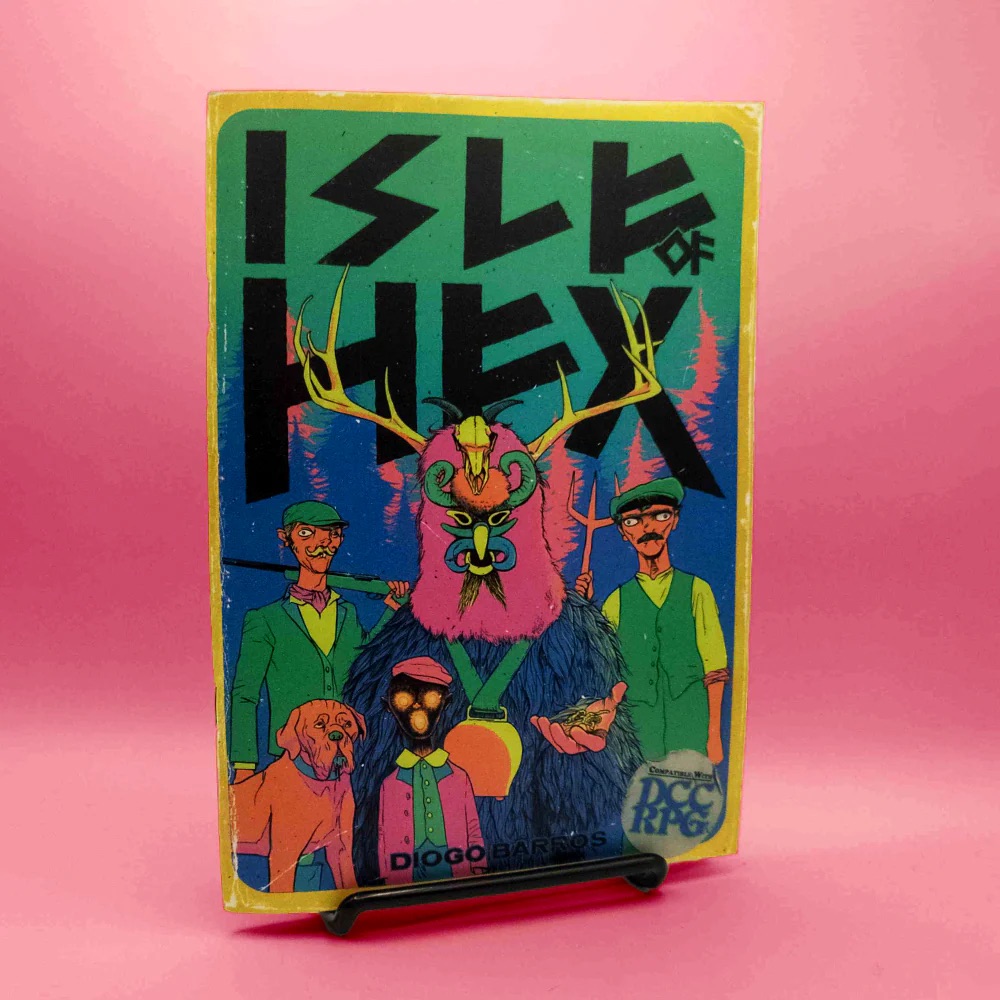
Isle of Hex is a 64 page module for Dungeon Crawl Classics, written and illustrated by Diogo Barros. In it, you explore an island full of terror and comedy, featuring a semi-modern setting filled with cults and class politics. I was provided a digital complementary copy; this one would be best in print, though.
My first impression of Isle of Hex is fun, and that’s driven by the art and layout, so I’ll start there. Its key and tables are sprinkled with diegetic content: letters, postcards, tourist maps and advertising. It doesn’t lean so heavily into it that it overwhelms the playability of the text though. The art outside of this conceit is of a pleasant, leisurely doodle style that feels scrawled in a notebook on a train. My main issue is that there are no section headers and very little in-text highlighting to help guide you through the paragraphs of text. This would help me with running things: Most locations on the island (there are 11 of them) are a page or over of paragraph text, which means unless I’m memorising things I’m marking it up with my own highlighting or lingering at the table while I figure out what comes next. It would be a better book in print than it was in digital because of this.
It’s good paragraph text though: It’s funny, “Séverin Crickard is nominally the law around here, but Hexians are beholden to an older, deeper power.”, its evocative, “A child lies on the middle of the cave floor, elbows and knees bloodied, whimpering softly. The body is lit by a single shaft of natural light” and it is also hyperdiegetic in a really compelling way: “The War left in its wake a long trail of orphaned children, left to fend for themselves in a cruel and unforgiving world. The community decided that this would not do, and promptly came together to dump them somewhere…”. It manages to communicate history and story without a lot of front loading, which makes the Isle of Hex is an absolute pleasure to read, but for someone like me, it’s a challenge to run. I’d have to take notes or else read it a bunch of times. Luckily, it tends to throw in page references for NPCs.
It has a fully illustrated bestiary, with a bunch of fun unique creatures in it. The random encounter table is excellent, almost universally featuring hooks to plots that are occurring in the background. There is a timer ticking along in the background, with festivals that tie into plots or trigger them, as well as impact the main enemy, the great Worm. This is all really cool stuff, with the main barrier to entry is that there aren’t any reasons to go anywhere: no hooks or rumours except those you extract from the paragraph text. There is an elegance to burying things in the text for the sake of a surprising and compelling read, but some front loading or other explanation of how things are likely to proceed in the absence of the players interference, and some ways to get them interested in the locations aside from wondering about, would be appreciated.
If you run paragraph text well, and you’re looking for an island adventure, most of what you need is here, although you’ll have to read it closely to extract it. It will be a pleasure to extract — imagine if the Isle was less dry and had more interesting secrets and characters. If this sounds like what you’re after, pick up the Isle of Hex. I can’t understate how excellent the writing and worldbuilding is in this. It feels like Wes Anderson shot the Wicker Man and turned it into a meat grinder for my DCC table, which is a vibe we don’t often get for DCC, but retains the necessary humour. For me, though, I’d prefer it feature hooks, rumours, and more internal flagging or summarising so that I don’t have to parse a fairly long text in order to put it into play. Irregardless, Barros’ writing and worldbuilding is compelling as, and I can’t wait to see what else he comes up with.
What’s a committee larp? Basically a game where the content of the gameplay is the discussion around a specific topic, and your characters all have conflicting opinions and perhaps secrets that inform how they are voiced in this conversation. Think Werewolf but with more roleplaying, basically.
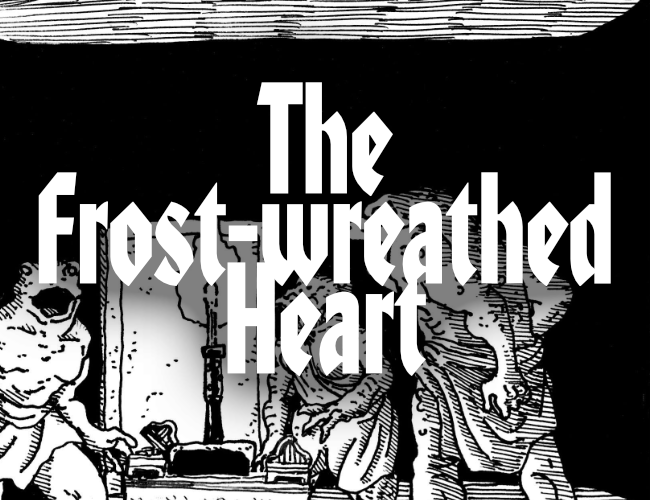
In The Frost-wreathed Heart, you’re all adventurers who’ve just reached the center of a dungeon, and it took everything out of you. Most of your spells, potions and much of your physical strength is expended. You’re barely holding on. Then the door locks. A little investigation reveals that the only way to get out is to leave two of you behind.
That’s where the game starts.
You light a candle when you start, representing your last torch, which sits in the middle of the room, warding off the frost-wreathed monsters outside the door. It’ll go out in an hour or so, and if it does, you all die.
Then, you talk. Maybe you hold your secrets close. Maybe you accuse. Maybe you use your last trick to betray someone, or to save someone being betrayed. But if you do, you leave yourself vulnerable.
It’s a nasty, drama-filled hour in a dimmed room with nothing but your character sheets, a candle, and some gold. It’s got art by Hodag. Check it out here.
There are also 50 other entries to the Hour or Less Jam. I haven’t checked any out yet, but if you’re looking for short games, your chances are high you’ll find something you like.
Bathtub Reviews are an excuse for me to read modules a little more closely. I’m doing them to critique a wide range of modules from the perspective of my own table and to learn for my own module design. They’re stream of consciousness and unedited critiques. I’m writing them on my phone in the bath.
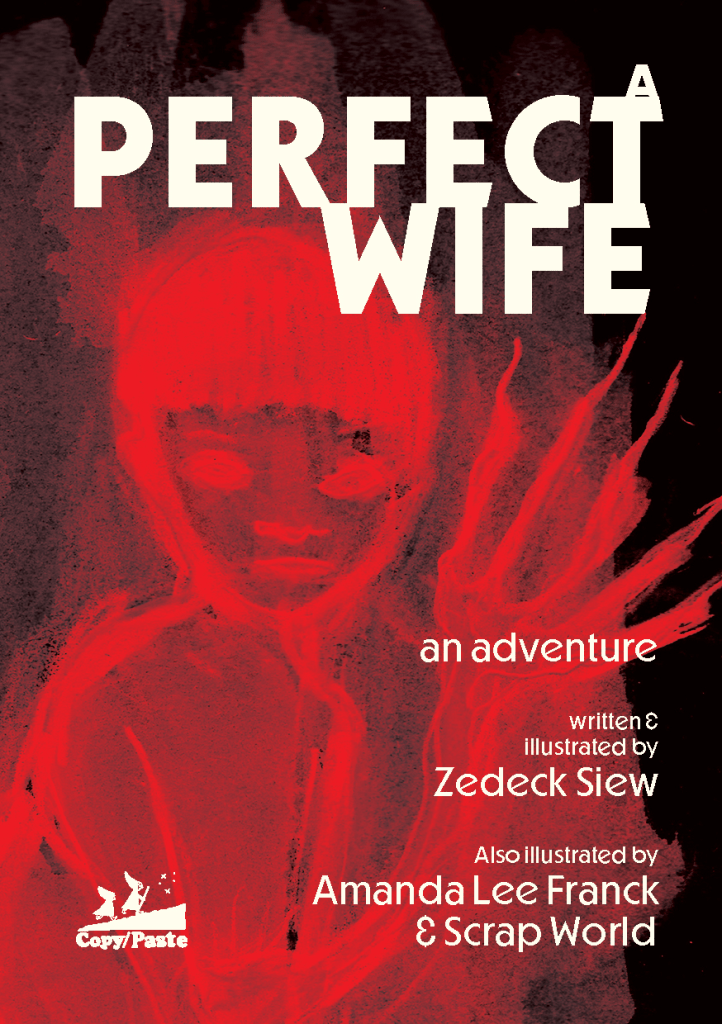
A Perfect Wife is a 46 page system-agnostic module written by Zedeck Siew and illustrated by Zedeck Siew, Amanda Lee Franck and Scrap World. In it, a supernatural terror haunts a modern day neighbourhood, murdering every fortnight, and you are asked to investigate. It is an expanded version of something published on Siew’s blog in 2024. I backed this in in the recent crowdfunding campaign.
This is a capsule game; it has some very simple rules that appear to be based on Chris McDowall’s Into the Odd framework. You choose your character according to how you know Sara, the titular Perfect Wife; that character has no physical prowess or special skills, but does have some connection or resource. These rules are designed to draw your character into spaces and situations that benefit them, and then place them at complete and abject fear when facing the supernatural horror that is plaguing the neighbourhood. They are scattered, however m, throughout the book. The book is well-indexed — hyperlinks and page references throughout the text, but as every opportunity for violence doesn’t link back to page 17 you have to find rules pages, scattered amongst the rest of the module. While the rules do occur when you’re first likely to encounter violence, my memory is perhaps too unreliable to remember where that was, particularly in digital. Given there are appendices, they may have been best placed there, given the decision to not forefront them seems very intentional.
The art here is gorgeous, and the eclectic combination of Scrap World and Amanda Lee Franck’s paintings, and Siew’s sketches, works very well in the otherwise minimalist layout. I think the layout could have benefited from a little more flash when the art isn’t present, although it works just fine, as the amazing art and content would have been better displayed in my opinion in a different frame, although exactly what that frame might have been is a more complex question. The information design is complicated by the aforementioned atypical organisation, but this is balanced to a degree by extensive referencing meaning that this approach doesn’t significantly impact play — you’d be flicking around a book anyway, in any ordering, and it’s easy to find what you want when you have hyperlinks or page references scattered throughout the text.
If you are a fan of Siew’s writing, this is amongst his best work. The only modern-set module I’ve read of his, it brings an immediacy and precision that makes this feel more imminently runnable and understandable from a thematic and geographic perspective. I am very, very keen to get this to the table, even though I don’t typically enjoy playing in modern settings. This feels like a real place the author has lived in filled with people he’s met, not something imagined. The supernatural feels as if I’ve missed something about the real world, and it’s integrated into real-world horrors in a smooth and very precisely targeted way. One consequence of that: perhaps you should check your table for content warnings around the precise horrors it portrays before running it. This is horror writing at its best, if you enjoy horror.
However, I think the precision, eeriness and mystery of the writing does betray the application to play in a few ways, which breaks my heart to see. The goal of the player characters, for example, is only obliquely referred to about half-way through the module, and why Sara chose to hire them when she did is not explained, and neither is why she’s suddenly interested in human trafficking at all, when the women being trafficked are quite explicitly not the women being murdered. A lot of secrets run parallel to the investigation, rather than draw the player characters closer to the solution; I can see how the player characters might find the monster, even before it comes to stalk one of them personally, forcing the issue, but I can’t see that the player characters will figure the mystery, or grasp how to solve it definitively, within the limits of the text. This module is full of what I’ve referred to in the past as forsaken easter eggs: Things only the referee is privy to, but are essential to progressing. In his previous work, Siew’s intentional restraint has been largely a book to imagination and to play; I think here, in a primarily investigative module, the opacity is not as beneficial.
The Perfect Wife — displaying typical Siew insightfulness — ends with some tools intended, I think, to help resolve this issue. An appendix talking about how Malaysian culture approaches the supernatural and monsters, and how magic works in the context of the story, to begin with. A second appendix talks about the pontaniak — the monster at the heart of the story — and its place in literature and the themes of the module. It tells us things about the module itself that the module never spells out, which will help the referee understand how to better run A Perfect Wife if they’re not of Malaysian culture, but won’t help the players understand some of the cultural and social strings pulling on the characters. Finally, the optional rules cover other spirits that might aid the player characters in their investigation: Some odd interactions with these spirits may be the only way you can find out how to defeat the monster. Portrayed as optional rules, I think they may be the only way provided by the text, for the player characters to defeat the monster.
That of course, assumes that the module is intended to be solvable. I’m not entirely sure that it is, and this might dictate how you sell this module to the table you intend to play it with. The real monster is a man, a man with connections and power whom your characters are not equipped to deal with. The establishment supports this man. You might prevent him from getting what he wants, but only at the risk of setting the supernatural monster free to do more harm, unchecked. This module, read as a story, has a lot to say about the nature of monsters, who the real monsters are, and what true power is. The horror in this scenario is the fact that we are helpless before the powerful, whether that power be supernatural, political, financial or societal. The horror here is deeply concerned with class and gender. These are all very relevant and painful horrors to be playing with, and that A Perfect Wife does not provide an answer or solution to the problem the player characters are hired to solve, speaks to a reluctance to treat the real world inspirations of that horror with the flippancy that, say, the modern superhero movie does.
One way that I can think of, to sidestep that flippancy and have a result that is familiar but still horrifying, is running this in Trophy Hold, softly holding to the rules obviously for setting and theme. The rules that exist aren’t a far reach, anyway, and provide the players ways to access the inaccessible information, in a way that might feel less against the spirit of the adventure. This is how I’d approach it, I think, rather than running it as the intended capsule.
A Perfect Wife is just a compelling, gorgeous, necessary piece of art, in subverting our expectations of success in modules like this, and by truly desiring for the horror to strike the hearts of the players, it fails to be a module that is easy to engage with. In my experience it’s rare to find the group of players seeking a module in this style who would respond to this subversion well, if they weren’t expecting it. This is the kind of thing I’d play in a day, and plan to have a discussion about the themes and ramifications afterwards, because there’s likely to be some bleed — culturally, that swings wildly to my “emotional skydiving” friends (thank you to Sam Dunnewold for that term I first heard on Dice Exploder), rather than my typical dungeon-crawler crew. That said, it would be wildly hypocritical of me to not feel like this kind of precision, subversion and communication of theme is exactly what I feel the module as an artform should be more widely recognised as being capable of. In that light: You’re a damned fool if you don’t read A Perfect Wife, and if you have that perfect mix of players, you’re a damned fool if you don’t play it. Art often isn’t fun, and is nevertheless worthwhile. If you want to dig deeper into the potential our little nascent art form has, are interested in modern horror, and are either willing to do some lifting in terms of system or improvisation and expansion, you can’t go wrong with picking A Perfect Wife up.
Bathtub Reviews are an excuse for me to read modules a little more closely. I’m doing them to critique a wide range of modules from the perspective of my own table and to learn for my own module design. They’re stream of consciousness and unedited critiques. I’m writing them on my phone in the bath.
Mouth Brood is a 35 page system agnostic hex crawl by written and illustrated by Amanda Lee Franck. It’s an ecological horror scenario, that feels clearly inspired by Annihilation to me, although perhaps there are other things in its Appendix N. System agnostic is code here for “for B/X”, which is fine in my opinion, but its interesting to me how much Amanda Lee Franck clearly subverts basically every system she runs in — this is a clearly modern-set module, but the monsters are still described “as chainmail”, for example. I purchased this myself.
Hex crawl is a misnomer, kind of: This hex crawl is unique in a bunch of ways. Hexes have vertical space (you can climb the jungle!), 60 feet (just 10 meter) hexes, and you can travel across the entire map in 3 minutes if nothing goes wrong, although if you’re careful it’ll take 15 minutes. You head into the “dome”, this 3 hex wide and 3 hexes high biosphere with a goal to recover 5 live specimens, and to that end it really revolves around the density of these hexes. The hex descriptions max out at about 6 lines, and the entire location description section takes 3 pages including the random encounter tables. What, how the hell am I supposed to run this?
21 pages of Mouth Brood is the Bestiary. This is the juice, and it’s upfront about this, to the point where it advises the referee to print off the hexes so you can focus on the bestiary during play. Most of the hexes are basically lists of entries in the bestiary with a few words of flavour; there’s really only one encounter in the whole dome. Random encounters are usually roaming predators, with some exceptions. The bestiary consist of a description, some exceptional art, a d4 list of what it might be doing, and a description one or more of what it will do if observed, if disturbed or threatened (and on one occasion, if eaten).
So basically our gameplay loop is: stumble through the wilderness, looking for live specimens to bring back, without them killing you, taking notes to safely retrieve specimens. Luckily, there are tools at your disposal: Each of the four team members have special equipment or knowledge that helps them trap, track, or predict the creature’s behaviours. Without this addition, I’d feel like this isn’t a strong enough framework for play, and there do seem to be a few flaws here.
For example, it appears that the most dangerous creature in the dome has escaped at the beginning of the module. Is not clear whether this only occurs after you’ve entered and opened the dome, but someone is already in the dome when you arrive. The blurb implies that you’ll have to make a decision about whether or not to release them, but if they can already leave, what does this mean? Poring through the bestiary, I hoped I’d get some clarity, but I never found it.
As with everything Amanda Lee Franck writes, it’s gorgeous and idiosyncratic. The bestiary particularly feels written by someone with an interest in zoology. It feels like an ecosystem. The problem is, it advises the referee to memorise as much as possible and the names — all scientific, and about 18 of them — are not really easy for me to remember. I’m not sure I understand all the implications and relationships in this ecosystem at all. Usually, I’d view this as a great jumping off point for improvisation, but here it feels like I’m missing something — what are the transparent yet otherwise identical beetles for example? For me, the very sense this module generates of a complex ecosystem makes me a little more hesitant to improvise.
And further, while there’s plenty of creepy monsters and a dose of body horror, for the most part it’s a murder simulator. If it was your jam, I could see multiple missions with different characters, recovering the last doomed mission’s logs. But what we don’t get is the weird existential horror that accompanies the ecological horror in books like Annihilation. That feels essential to me, to making this feel like something other than what it is: Because at it’s heart Mouth Brood is a dungeon crawl where you collect specimens rather than treasure, that has 21 rooms and 3 levels; and it’s really a version of a dungeon crawl where there are 2 or 3 big roaming monsters you’ll be fleeing, and most other encounters are traps you’re trying to puzzle out before you’re killed.
Overall then for me, Mouth Brood is a module with impeccable vibes and beautiful art, that isn’t afraid to innovate on form. But that form is challenging for me to run, and the lack of a certain existential je ne sais quoi means it doesn’t rise above its thinly disguised Tomb of Horror dungeon roots. That said, is it a module worth reading? Almost certainly. It’s a dungeon that does away with the colonialist trappings of dungeon crawling and replaces it with a Pokémon Snap meets alien Jurassic Park theme, which is an innovative approach. And it innovates on the hex crawl in an interesting way, which I adore, making it claustrophobic and three dimensional. Is it something I’ll bring to the table? Probably not, though.
A lot of people ask questions like “should I write a module as system-agnostic, or for a popular system?” or “if I write a module for an unpopular system like X, will nobody read my module?”. I’m about as deep in the module game as you can be, so I thought I’d talk about what it means to be a system agnostic module (or system neutral module — I’ll use them interchangeably) and try to answer these questions.
To be system agnostic? Or not to be?
In most modules, you are likely to engage in the types of actions that a specific genre calls for. Games have mechanics that tie into those actions: in Liminal Horror, advancing doom; in Mothership, panic and stress; in fantasy and most other roleplaying game genres, violence. In old school roleplaying there are actions which often don’t have rules — sociopolitical play, intrigue, or solving a riddle for example. Players are expected to play those aspects of the scenarios out sans rules. Whether you’re choosing system agnosticism for your module or not depends on whether you’re writing a module where you’re anticipating actions typical of the genre it’s in. Players do not read the module: The fact that I don’t write in 5th edition stat blocks does not mean my 5th edition players aren’t going to treat my monsters as 5th edition monsters. If you write something system agnostically, you’re just creating work for the referee unless the genre expectations are right there on the label.
That said, I’m going to break system agnostic modules down into 4 categories, dependent on why and how they’re system agnostic. When you’re looking at these, consider what your module fits into, and why it has ended up there.
Category 1: Freeform Modules
Some modules are system agnostic largely because they are almost entirely contingent on social interaction and investigation. You don’t need any rules to play them. You just go around talking to people, taking notes and making decisions. There isn’t any reason in the modules themselves for the types of actions that most games have rules for. Examples of this are Barkeep on the Borderlands and Trouble in Paradisa. These kind of modules need a familiar framework: Trouble in Paradisa relies on the players knowing how a soapy murder mystery works. Barkeep, a less familiar concept, suggests you play it using Errant or Cairn, despite not containing any other reference to those games, relying on those frameworks to support the content of the module.
Modules in Category 1 are often unintentionally in this category: The situation being presented simply never needed to have a system attached to it, and often modules that could be in this category aren’t simply because they started their life as a module for a specific system, or because naming them that way is simpler than having suggestions like Barkeep on the Borderlands does — Witchburner and Owe My Soul to the Company Store are examples of this.
Category 2: Experimental Modules
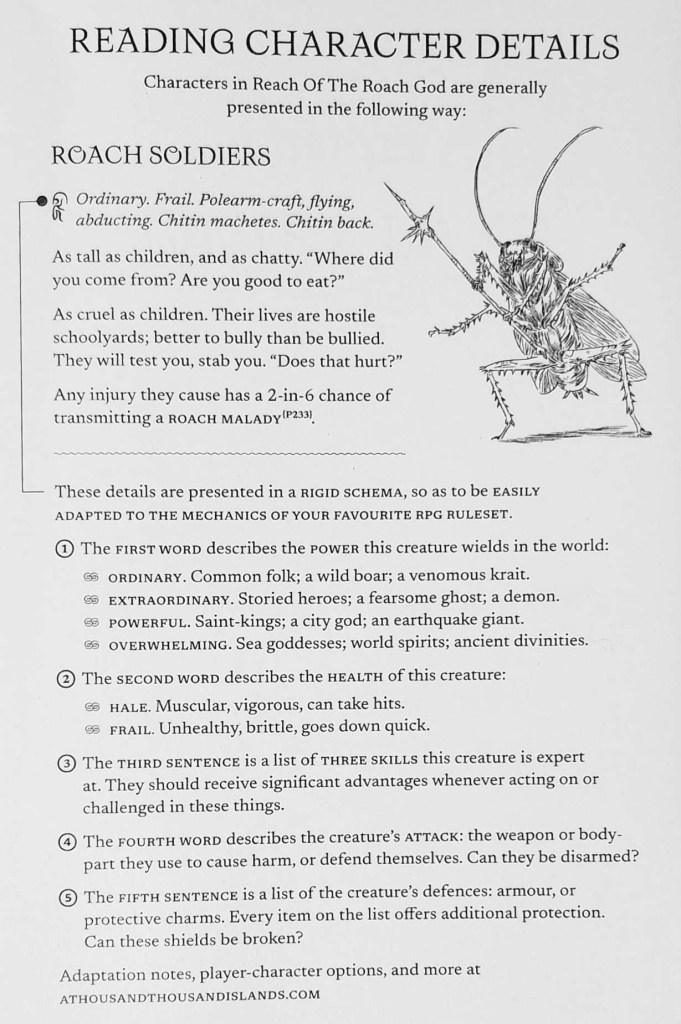
Some modules are intentionally avoiding using mechanics and numbers, at least visibly, in their text. This might be aesthetic, or it could be for the sake of being avant-garde. Typically, these are written with a deep consideration of all of the systems in the hobby. I did this with my Ludicrous Compendium, which is an English-language haiku bestiary, and in the upcoming Bridewell, my Curse-of-Strahd but in verse module. But it’s best exemplified by Reach of the Roach God:
From Reach of the Roach God by Zedeck Siew and Munkao
The 5 sentences here, map directly to items in most common fantasy stat-blocks, and are easily translatable, but they’re also thoughtful: They’re written this way to distance themselves from the cultural implications of phrases like “AC as chainmail”. If you write these kind of descriptions without a deep consideration of whatother fantasy systems need, you’re simply leaving work for the referee to do; they need to be both lyrical and able to be readily interpreted for play.
Modules taking this approach must be super intentional about their choices: They want a broad audience through a very specific non-mechanical lens. It’s challenging to do well and requires some experience playing the games your module is likely to be translated to.
Category 3: System Stealthy Modules
Most system agnostic modules are category 3: half of a stat block for something that’s familiar with a lot of people, usually B/X. When I casually say “No module is system agnostic”, which I from time to time do say, I’m referring to this category. An interesting example of this is Mouth Brood:
From Mouth Brood by Amanda Lee Franck
In Mouth Brood, you play modern-day scientists venturing into an alien habitat filled with of strange organisms. Nobody wears chainmail in a modern day science expedition. The “chainmail” of Ravus virosa just indicates how dangerous and sturdy the organism is relative to the player characters, in a common language. Mouth Brood and other Category 3 modules aren’t actually written for (for example) Old School Essentials, despite being directly translatable — it leaves out a lot and relies on referee familiarity with the commonly understood texts.
These modules are usually system agnostic through the specific intention of adopting a lingua franca. Authors who adopt a Category 3 approach want as many people to understand their module as possible. I personally think this is actually the best approach, assuming you’re not making a socio-political module — it’s very succinct, and leverages the knowledge of your readers in an efficient way that acknowledges their intelligence and familiarity with the hobby.
Category 4: Indifferent Modules
These modules aren’t system agnostic, but they are part of a venerable lineage that’s really “I wrote this for my own home game and it’s homebrew rules”, and rely on most of the same principles as Category 3: The familiarity and intelligence of the referee to interpret the text. Great examples are the first edition of Ultraviolet Grasslands, which is as written up for a system that wasn’t to be released for another 5 years, and You’ve Got A Job On The Garbage Barge and Neverland, both written for their authors homebrews of 5th edition. You could also include modules like Into the Cess & Citadel and Ave Nox in this category, as well as modules like the Dark of Hot Springs Island which assume you’ve got the statistics for all of the creatures for the game of your choice.
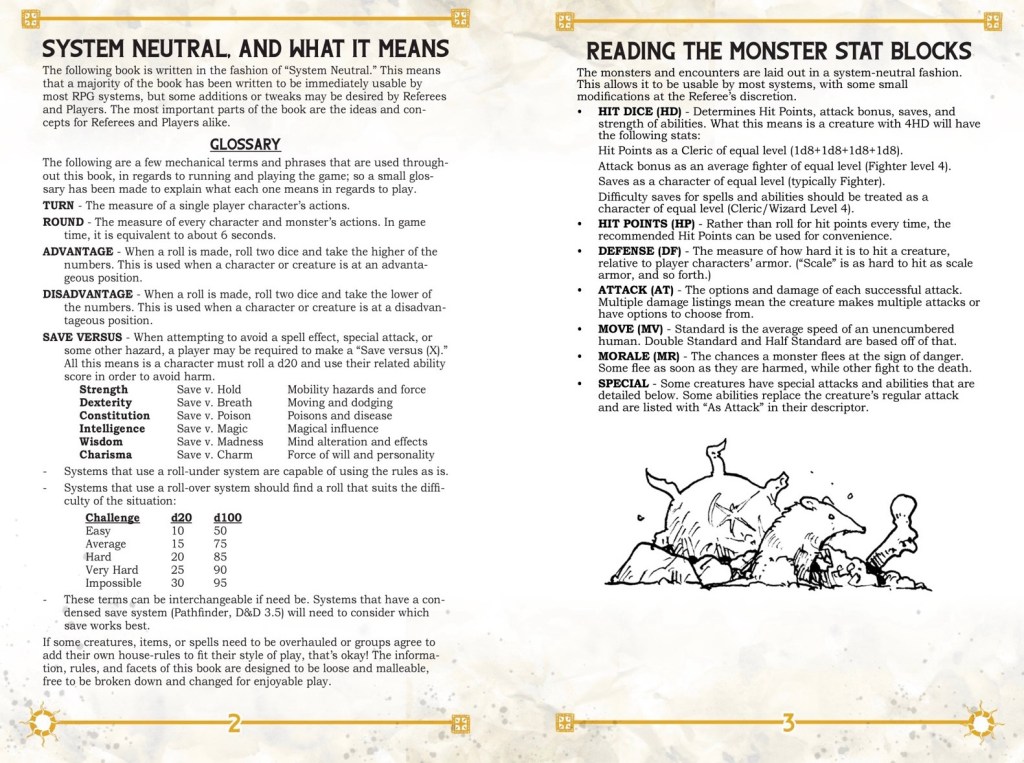
Ave Nox by Alex Coggon and Charlie Ferguson-Avery. Sorry, Alex and Charlie, this isn’t system agnostic, this is actually just a homebrew system titled System Neutral.
These Category 4 modules are most likely system agnostic through indifference: This is the system we played it in, here is our stats, we don’t consider putting the effort into converting them worthwhile. I honestly respect this: This goes back to the roots of the hobby, where duelling imaginary versions of D&D coexisted in the pages of Dungeon Magazine. Like category 3, it acknowledges the intelligence and familiarity with the hobby that the reader has.
Who cares about these categories?
Nobody, not even me. I don’t really consider category 4 modules meaningfully different than category 3 modules; if I ever use this categorisation I’ll probably say things like “this is a Category 3/4 module”, but I can’t imagine anyone will use these categories in this way. The purpose of going through these is to exemplify: There’s a range of ways to make your module system agnostic, some very intentionally, and some unintentionally. It’s a way of supporting you to answer the question of why you’re considering making a module system agnostic.
People will play anything, however wild.
Your first consideration should be whether your module is interesting or fun enough for people to want to play. People will play your module however wild the format. This entire post is moot, if you have something compelling.
Should I write a module system-agnostic, or for a popular system?
We return to the questions at the top of the post. Consider these two questions:
What did you playtest it in? Easiest to write it in that system. If that system is a homebrew system, it doesn’t matter. Good modules get played even when they’re for systems that don’t exist.
Can your concepts be briefly described in Stealth B/X terms? If so, that’s a lingua franca, use that, if you speak it as well. Good modules get played even though phrases like “armour as chainmail” are silly when applied to science expeditions.
Would my system agnostic module be better if it were written for a specific game? You could reframe this question as “Are the players of my system agnostic module likely to engage in the types of actions supported by a specific game?” In this post I’ve listed many modules and I think I might have a different answer for each, but a good module is a good module, irregardless of whether or not it is system agnostic, just as a good book is a good book, whether you read it or it is read to you.
If you’re answering these three questions with “no”, you might be writing a socio-political module or an object of undeniable beauty that would be regarded as art by anyone off the street. In these cases, do what you want. System agnostic is a great choice for you. You might also not know any games well enough to understand how to use their rules. If that’s the case, your research for this module is to learn to play those games. Even if you choose to go for system agnostic your familiarity with the games that people will be playing it in will help your module for better.
The insidiousness of marketing
I’m not a marketing expert, but some people might feel that writing your module for a popular system may make it more likely that your module is popular. I’ve released system agnostic and Cairn editions of Hiss, and they have almost identical numbers, so I’m not convinced this is true, but I understand how it might look that way. There’s undeniably an audience out there looking for Mothership modules and Liminal Horror modules etc. If you’re writing contemporary horror, you’ll probably get more eyeballs by participating in this years Liminal Horror jam than if you publish it system agnostically. But to be contrary, this post has listed a lot of modules that released system agnostic (Trouble in Paradisa, Witchburner, Reach of the Roach God, Mouth Brood, Neverland, Ave Nox, Ultraviolet Grassland 1st Edition, Vampire Cruise and Crush Depth Apparition) that nevertheless found popularity. While the fear that you’ve wasted your time writing something no one will read is very real, marketing is something to worry about after you have written your module, not before. If that’s compelling, people will come.
Should I write my module system agnostic?
If it’s an essential aspect of the identity of your module, definitely. Otherwise, do it if you want to. The important thing is that you make the module. The take home message here is not that it doesn’t matter whether your module is system agnostic or not, but rather that you must not talk yourself out of writing the module before you even finish, simply because you’re not sure which game suits it best. Don’t wait to create. Just do it, then answer these questions to decide whether you want to go system agnostic or not.
Idle Cartulary
Addendum: Symbolic City responds, arguing that choosing a game is standing in solidarity with the creators of that game, and particularly independent games need endorsement.
Bathtub Reviews are an excuse for me to read modules a little more closely. I’m doing them to critique a wide range of modules from the perspective of my own table and to learn for my own module design. They’re stream of consciousness and unedited critiques. I’m writing them on my phone in the bath.
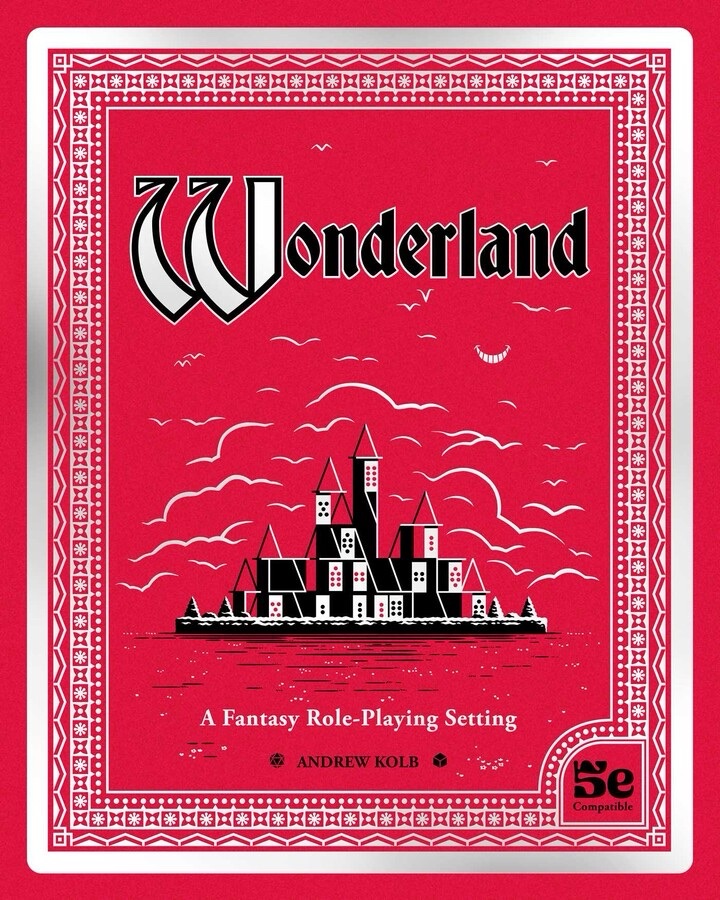
Wonderland is an absurd tome of a book — over 210 pages in A4 format — by Andrew Kolb, one of a series of public domain-based modules including Neverland and Oz. Wonderland, by contrast with the hex crawl that is Neverland and the city crawl that is Oz, is a megadungeon. In it you delve ever deeper, trying to find the secret at the dungeons’ core: The Sleeping.
Wonderland is a hard book to tackle. As with other Kolb books, my sense is that its scope exceeds its capacity, as it covers Wonderland, its mirror-realm Looking Glass Land, reality, and the realm of dreams. The latter 3 are all under-expanded, and the truth of the matter is that Wonderland alone is sufficient for many months of gameplay, There are 14 factions in Wonderland, and 4 levels, which is plenty. And a lot of that is modular: Meaning you’ll have to generate it either on the fly, or before time. What do I mean by this?
Well, each level has a potentially huge number of potential layouts, with each area being a tetromino (a la tetris), that is arranged within a chessboard. There are requirements when setting up the areas within a level — leaving a modicum of predictability — but otherwise the areas aren’t spatially related in any particular way. Within each area, the mapping is traditional in nature — there’s a dungeon map for each tetramino area. There isn’t a specific rule for when you “scramble” the tetraminos between a level — every time, or when “power level increases” are two suggestions. The presence of the level maps at the backpapers indicates a preference for Wonderland to change every entry, I suspect. This ever changing dungeon is reflective I think of the themes of Wonderland, but it undermines a core principle of megadungeon design: You get to know the spaces and manipulate them over time. Geographical knowledge is power.
Otherwise Wonderland is run like I’d expect a megadungeon to be run: 10 minute turns, an emphasis on gold and random encounters in resource management, an implacable hunter pursuing the player characters through the space, and an emphasis on using ingenuity to solve puzzles (with a big twist in this particular dungeon being an abundance of size-based puzzles, as you shrink your foes, grow to overcome traps and obstacles, or shrink to escape through tiny doors, etc.). There’s even a town — Dinah — for you to retreat back to.
There are a lot of small notes, rules, regulations and the like to follow in the “running the game” section of the book, but the truth is that they’re kind of Kolb trying to communicate the absurdity of Wonderland politics in a way the referee can implement. If you read through the books while running this, you wouldn’t need a note like “Royalty are likely to impose a tax just to obtain the specific treasure the PCs have”; that arbitrary pettiness is part of the world’s DNA. What I do feel is that the way all of this is laid out — front loaded in the first 13 pages — makes for a very overwhelming introduction to the world. Given the 3-column layout this book uses throughout, I think a lot of this stuff would be best spread out throughout the books, in sidebars or in the areas of the world that they occur. There’s already a lot of repetition in the keys — I’ll get to that — so placing this here or in the bestiary seems like a mistake, simply because there’s so much in the introductory chapter. That said: Kolb acts similarly in both Neverland and Oz, so it’s his preferred way to organise information. If you’ve run either of those, you have an idea of the kind of preparatory work you’d be required to do, which is similar here.
As with Neverland and Oz, Wonderland is written for Kolb’s own modified 5th edition ruleset. I’d probably run it in Shadowdark, now, as it’s an easy conversion. Familiarity with 5th edition will help a lot, and the stat blocks are pretty complex although self contained and usually appear they’d make for a lot of fun. The bestiary combines beasts and cast members, keeps individuals on a single spread or less (never crossing the page). Stats are separated from the personality of the characters, but it’s very evident you’re expected to be engaging with a fair bit of combat, and a huge amount of space is devoted to it. A lot of the bosses even have multi-phase forms — it’s videogamey and fun, although some fights have pretty pitiful manifestations (White Queen just cracks a little? Just don’t give her a second form). Pretty cool if that’s the kind of game you’re after.
The key itself follows a similar format to previous Kolb work: Full spread per area, with a focus on tables, and only a few paragraphs of text in most places. It’s a little less dense in general than most Kolb work, with a lot more space, likely because it’s hard to account for the shape of the tetraminos. If this worked for you in the past, it’ll work for you now. For a megadungeon, where you’re going to be revisiting the same spaces repeatedly, I think it works better than it did in, for example, Oz. The headings you get repeatedly are: Description, first impression, block specific mechanics, looking-glass differences, a counter, area quirks, door quirks, accidents waiting to happen, creatures, NPCs, conflicts, loot, in addition to 2-3 area unique tables. A few areas use depthcrawl rules to emulate a more complex space —one in each level, a mine, a forest, and a maze. These are all a simplification compared to the depth crawl in say Gardens of Ynn, but the carryover complexity from the standard layout works to fill out the very brief descriptions for each depth. Overall, it’s nice, and if I ran this the areas would grow in the telling, the book slowly filling with additional notes, but I prefer things to be a little more concrete in terms of the key.
There’s a short section — 4 pages — devoted to Pandæmonium, 1 page being summoning “draemons”, another being details on the 9 circles. As with the land of Fairy in Neverland, this is underwhelming and needn’t be there. Draemons take up 6 pages of the bestiary, and Lilith takes up another. I can’t really grasp how this factors into anything, though: I have the print edition, so I can’t word search, but Lilith doesn’t seem to factor into any of the locations, including pandæmonium. Her character description suggest she might be a key quest giver, but I can’t see how to locate her, and the draemons explicitly don’t do her bidding. This leads into one major problem with Wonderland: despite a 2 page “what’s going on” at the outset, I can’t for the life of me figure out what’s going on. I literally searched the text for mentions of Lilith to figure out where the potential story seed might lead: I couldn’t figure out how the players might find the seed, let alone where it might go. It appears the major factions — the four royals associated with playing cards — are factions vying for power, how and why and what they want are completely unclear, either in the introductory reactions or in their bestiary entries. The Sleeping is by design not defined, and what happens when they awake isn’t stated. It’s…shockingly unclear given how much I’m required to ingest and read in order to grasp it.
Small things worth noting: One unique thing about Wonderland, that’s worth noting, is really appealing at the table but wouldn’t work well online: It wants physical props. Encounters want to be associated with playing cards, treasure is held in your “treasure diamond”, you’re supposed to represent the level with a chessboard. If you leant into the physicality of the rules here, you’re going to see a lot of mileage in these aspects of Wonderland. The back of the book is packed with stuff: A few special locations, a bunch of random tables covering accidents (traps), adventures, rhymes if you need help rhyming a character, crimes for the Heart King to invent, draemon names, summoning circles and sigils, random encounters, and evidence if you’re taken to court, places in the real world you might exit to, flaws in looking glass creatures, what jesters charge, locations on specific levels and more. What I notice (I don’t know if you did) about these is that they all, every one of them, belong somewhere else: With the Heart King, with the Court, etc. Maybe 2 or 3 of these belong at the back of the book — loot and odds and ends for example. Plot hooks and rumours belong at the front!
The layout and art is consistent and easy to follow, largely because of the clever colour coding in the sidebars as section headers. It’s never hard to read, but you’re expected to know a lot of stuff across the book in order to run it. Some of this is easy to access — inside covers are the tetrominos and the level layouts — but much of it is not. Stuff that’s actually repeated on every spread — like the random encounter table and a few other pieces — might be best replacing the back cover level layouts. The table of contents is great, but I wish there were an index. And I’ve mentioned across this review a huge number of information design issues that really make this megadungeon harder to run than it should be. The collage art is fun, and feels very Wonderland, but it’s just not my jam. Aesthetically, the dungeon maps feel put together by an online tool, which clashes with the surrounding aesthetics and also feels a little cheap given the overall effort put into this book and previous efforts.
Having read (and I think reviewed) a few of Kolb’s previous books, I’d like to assume in good faith that he prefers to leave things vague and unsaid, as a way to provide the referee with additional agency in how they run the factions. But in this megadungeon, the lack of clarity in what the various factions want and how the act makes it feel arbitrary and frustrating to run. Players need predictability to enjoy a megadungeon campaign, and when I, the referee, don’t know who wants what and why they’re acting a certain way, that predictability is not present. If that information is there and I can’t find it despite searching, it’s a serious information design issue. If it’s not: I think you need to find reasons for the factions to interact with each other and with the players if you want this megadungeon to be interesting. If I’m buying a megadungeon, I want these reasons to be provided. Combine this with the randomised layouts, which are assumed to happen each approach, and you’re removing another piece of information that repeated delves into a megadungeon provide, and hence an element of predictability that make them fun to play in. You can make layouts change: Nightwick Abbey does so, successfully. But it’s too many aspects of the space unclear and unable to render manipulatable by the players. I can recognise that both of these may be present because Wonderland thematically wants to be arbitrary and unpredictable, but that simply doesn’t work for a megadungeon. It’s your job as the author of a Wonderland megadungeon to find ways to render the absurdity of the setting in a way that’s legible to the players and allows faction play and knowledge-building. Wonderland doesn’t provide this for me.
That said, I like so much of Wonderland. I want to run it, I really do. If I did, I’d have to do a few things: I’d need to figure out a network of politics between the factions, and they’d need to be dynamic actors in the space, rather than passive ones. That would be some work. I’d need to place Lilith and Pandaemonium at the forefront of the story, I think: I’d probably not make Dinah an entrance to Wonderland at all, but rather position Lilith as a quest giver that offers the player characters a portal in exchange for doing something for her. We don’t visit pandæmonium, but it drives things. Each of the factions want something from the player characters, too. I’d have to minimise the mirror world stuff, as well, or else change it: As is it just doubles the size of the dungeon, but in a profoundly uninteresting way. Perhaps I could I could make it a stable unchanging version of Wonderland, so there’s a reason to use mirrors, at the risk of exposure to the mirror monsters. This might mean I get rid of Almost Alice, the Wonderland hunter, in favour of her Looking Glass equivalent. See how this is blowing out in scope? There’s a core to this megadungeon that’s really compelling, but I’d have to give it a hell of an overhaul for me to consider it good.
So, Wonderland is super compelling. But it’s deeply flawed and I suspect it won’t function well as a megadungeon for long-term play. Look, when push comes to shove, the advantage of Kolb’s books is that they’re cheap. If you have the time to overhaul it — like thousands of referees do to thousands of published adventures — the bulk of this will result in a memorable time. It’s possible, if you’re the right type of referee, and if you applied the ongoing prep methods that I went through in Advanced Fantasy Dungeons or something similar, that you could wing it sufficiently that it would work. It’s possible. But it doesn’t feel guaranteed from the text in the way that I want it to be.
Wonderland is a hell of a piece of work, but flawed structurally and as a megadungeon. If you’re the kind of person in the market for a megadungeon with an surrealist angle, and you’re willing to either spend the time refurbishing it or feel confident that you’ll be able to wing it with the right tools, it’s a good pick for you. I suspect it’ll be a good pick if a megadungeon to you is more of a combat grind than a political playground: The creatures here are remarkable and surprising. If you want something you can just show up to at the table, week after week, without much forethought, though, it won’t work for your table. I think that while Kolb’s imagination translates these public domain works well in terms of writing and theme, conceptually the city crawl and hexcrawl was much easier fits for the subject matter than dungeon crawl is in Wonderland. I’ll still look forward to Kolb’s next release though.
Bathtub Reviews are an excuse for me to read modules a little more closely. I’m doing them to critique a wide range of modules from the perspective of my own table and to learn for my own module design. They’re stream of consciousness and unedited critiques. I’m writing them on my phone in the bath.
Fever Swamp is a 70-odd page module by Luke Gearing and Andrew Walters for OD&D. I’m reading the re-release, rather than the earlier 2017 version. It’s a location-based module, describing the fetid and inhospitable Fever Swamp and the people and creatures inside it. I think I got this through the Kickstarter.
The book proper begins with a rumours table that is profoundly uninteresting and provokes no interaction, and “Impressions of the Swamp” which consists of a list of hooks, cunningly disguised as a paragraph. We then have a repeat of the random encounter table —it seriously occurs twice in 4 pages — and a pleasingly brief list of the mechanisms that help the referee run the swamp. These instructions refer to the random encounter table — hence its repetition — but given a book filled with hyperlinked page references, I think one of the repetitions could have been avoided. Four pages are then spent on the local tribes — the People — although for the last two pages, due to layout choices, it wasn’t immediately apparent that they were actually related. While it stated that they’re all unique, they’re painted with a very broad brush in a way that’s definitely uninteresting, and not detailed enough for them to be compelling. There are no individual characters and this contrast with the colonisers who get 3 pages of characters and quest hooks, feels uncomfortable to me. It’s followed up by a list of Swamp Witches —these are the most common occurrence on the random encounter table at a little less than 2% chance per witch, and I think they’re supposed to be the crux around which the module turns. They’re certainly the only characters with interesting and wide-reaching goals in the module. However, they’re squarely situated as primarily combat encounters, tactics and all, and only one has something to offer the player characters, which renders bargaining with them or being given quests by them tricky. There’s also very little information about them elsewhere, which means identifying one to seek out is not really a feasible approach by the book.
The keying itself — 15 locations, with 3 being larger locations with their own keys — is presented in paragraphs rather than for points. For the most part, these paragraphs are limited to less than half a page, but I’ll admit that I struggle with the longer keys here in terms of structure and scanning. The locations themselves are interesting, for the most part, but almost nothing stands out as a location I’d be excited to pull out of this swamp and put into my home campaign, and similarly the connections between the locations aren’t compelling enough for me to use Fever Swamp whole cloth. The exception (note I said almost nothing) is the House of Banish, which features the best map and also is a fairly compelling 17 page dungeon. It’s cohesive in a way the rest of Fever Swamp isn’t, with secret doors, loops and characters to interact with. It’s a decent little dungeon.
Luke Gearing’s writing, as always, can witty and evocative, but oftentimes here it is a little too bloated. The character descriptions in Clink, for example, are meandering and difficult to use. There are examples of course of excellent prose: “This tight warren is the next of the mink, where stolen friends are eaten.” or “A corpse of something never living and terribly ancient, it sits poised, long head angled downwards, six insectile limbs ready to power it forwards.” But just as often it’s difficult to parse, surprisingly so for Gearing. In the entrance of the second location, for example, the ordering of information is incoherent, meandering into the history of the space in the third paragraph, mentioning 10 stilt walkers in the fifth, and finally describing the tomb in the last. While there are issues with the “micro” structure of individual keys such as this, the macro structure — something Gearing has shown that he can masterfully orchestrate in modules like the Isle — here is equally incoherent. I was, for example, waiting for a fun reveal regarding who Grandfather Rotte was, but there was none. There is a swamp-witch in hex 10, but it appears to be unrelated to the allegedly unique swamp-witches mentioned earlier. And there’s a great deal of inactionable information: “Destroying the stones frees her, but she cannot tell anyone.”, and “If this excavation was continued for a mile, a buried city of insectile sorcerers could be found. There is no indication of this.” for two examples. As a poetic turn, I love the first of these at least, but it’s more interesting rather than less to simply make a rumour that points to this, or a carving, or anything to make this gameable.
Before moving on from the writing, it should be noted that this is a module with a puerile sensibility in a similar style to the Isle, and is unashamedly horror, full of images of rot and bloat, with a set of rules especially for visually confronting diseases, and one encounter with a creature who sprays its anal glands at the player characters. It’s full of body horror and twisted creatures filled with misery, and a touch of gross-out humour. If that’s not your cup of tea, maybe sit this one out.
Fever Swamp’s layout apes recent Melisonian Arts Council books like Hand of God, and for me it’s neither pretty nor easy to read. Stat blocks, for example, are still semi-indented into their descriptions. The outer sidebar is saved exclusively for location numbering, which for my eye isn’t intuitive, although I recognise the advantage of it making the book more flippable. The choice to distinguish higher to lower level headings based on what appears at first glance to be colour alone isn’t intuitive to me at all; numbering is repeated, across tribes, swamp witches, locations and sublocations and more — which is startlingly unclear. Given it’s printed in full colour, I feel like it would’ve benefited from more colours to differentiate these different lists, which are otherwise undifferentiated visually. Upon examination I realise there’s also a font size and numbering style difference, but it’s small enough to not be readily apparent. There also are what appear to be inconsistencies — paragraphs changing column width, for example. I can see the logic behind some of the layout decisions, but to me they seem poorly thought out, with some pages causing what I think is an unintentional sense of unease in terms of legibility. See the example below, but example.
An example is page 25, where the cumulative effect of the inconsistent paragraph spacing, the slight misalignment of headers, and the fact that the headers aren’t breaking the sections because they’re off to the right and vertically justified down, all add up for a very visually uncomfortable page to read.
On the other hand, the book opens with a map and a random encounter table. In print, these each come with page references, meaning I can go straight from the location on the map to the right page in the book, or straight to where the creature is introduced. In digital, it’s hyperlinked! It’s the little things that add a lot to usability. I was a little disappointed, though, that it uses a bestiary for the creatures — I prefer where possible creatures be tied to locations in the swamp, even random encounters. I also love that the back of the book is full of player facing maps — easy to find and show the players at the table. These are some smart decisions, and I wish the eye for usability had extended a little further. Layout and information design, as I keep harping on about, is important.
I forgot to talk about Andrew Walter’s art, which goes to show how much a flawed layout compromises your experience of the art in a book. Most full page artworks are inconsistently centered, although there is one spread that is edge to edge. There are a few monochrome line art pieces jarringly thrown in with the gorgeous paintings, which are still beautiful but just feel jarring by contrast. The two dungeon maps are stylised but only one of them is clear enough in its stylisations that they yield an easier rather than harder to use map. But, that full spread is an amazing art piece, as are most of the paintings in the book. While the art is gorgeous, the layout places it in poor light, and leaves me with the impression that the the art budget ran out and they had to make do with what was done when they did so.
I’d heard such positive things about Fever Swamp — it’s popular enough for a remaster, after all — but overall this didn’t work for me at all. It was let down by its lack of connectivity, its incredibly flawed layout, its’ internal prose structure and its larger information design choices. And I was put off by the strange hesitation in terms of hooks — it’s a book full of them, but it’s so very hesitant to hand them to the players. I want a module, though, as I’ve mentioned a few times here, that I can play by the book. I don’t think, that was Gearing’s intention, though, with Fever Swamp. I think he intends for what I’m seeing as flaws, to be assets. That they’re opportunities to “make Fever Swamp” my own. I suspect this based on, for example, this series of play reports on Gearing’s running of Pariah — there’s a lot of improvisation there. But if I were deeply invested in writing my own material, I wouldn’t be buying a module. I don’t need your help to make it my own, I can do that myself. I want you to draw connections and create surprises that I wouldn’t be able to draw or create myself.
That said, if you’re interested in running a gross out, vaguely body horror swamp crawl — in the vein of, for example, Wet Grandpa — this is exactly that. I think it’s incomplete, but completeness isn’t wholly necessary for the kind of game where you’re wandering from place to place, just to see what happens. And while it requires the referee to do a lot of gap-filling and legwork, you could make it work. I think there’s a lot of play in Fever Swamp, if that fits your particular remit.
So Playful Void has been nominated for an Ennie this year. You probably know this is a pretty big deal, if you’re deep enough into the hobby to be reading this humble blog. I’m really proud to have been nominated, but of course, I’d love to win: Please vote for me!
If you agree, please, head on over to the Ennies, click down to the box for Best Online Content and vote for Playful Void by Idle Cartulary! Since Ennies voting is ranked-choice, I would encourage you to rank my friend Prismatic Wasteland as #2 if you are ranking me #1 (or vice versa), who won the Gold Bloggie last year for The Overloaded Encounter Table!
I use affiliate links where I can, to keep reviewing sustainable! Please click them if you’re considering buying something I’ve reviewed! Want to know more?
Have a module, adventure or supplement you’d like me to review? Read my review policy here, and then email me at idle dot cartulary at gmail dot com, or direct message me on Discord!






 Playful Void