• Critique Navidad: Cryptid Keeper

    Each holiday season, I review different modules, games or supplements as a thank you to the wider tabletop roleplaying game community. All of the work I review during Critique Navidad is either given to me by fans of the work or the authors themselves. This holiday season, I hope I can bring attention to a broader range of tabletop roleplaying game work than I usually would be able to, and find things that are new and exciting!

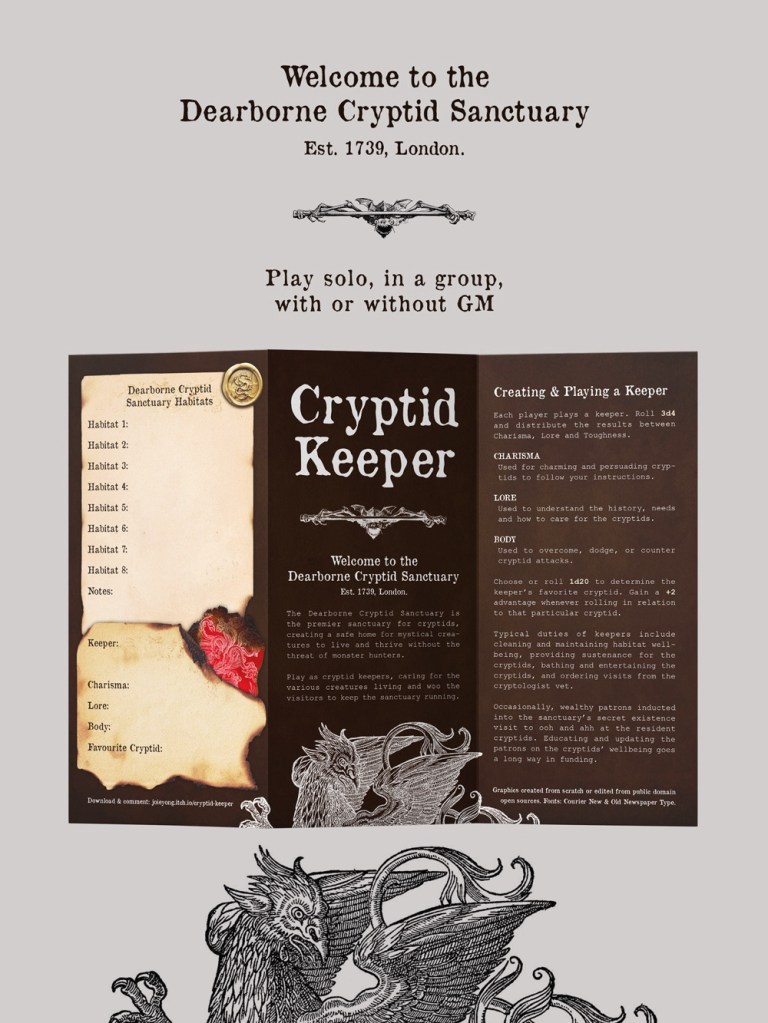
    Cryptid Keeper is a referee-less, trifold pamphlet roleplaying game where in you play zookeepers in a zoo for mystical creatures, by Joie Yong.

    Your keeper has 3 stats (charisma, lore and body), as well as a favourite cryptid. You roll against a random challenge rating, for any challenges you face facing cryptids, patrons or other NPCs. There is also a simple procedure to generate a zoo, filling it with between 8 and 20 cryptids, and identifying the biome filling the habitat. The zoo is obviously magical, to allow for this.

    The bulk of play itself is a generated by the event table, which contains 20 randomised events, of which you’ll experience 1-2 per day, depending on how many players you’re playing with. These randomised events or vague, but in a way that invites story-telling – for example, “A cryptid in Habitat 6 has found its way into Habitat 3” isn’t that interesting on the face of it, but with the relationships you’ve developed with the cryptids, your zoo design, and the randomness of the generation, you’ll liked get a unique situation out of it. Most of the prompts work really well like this – simple, but effective.

    That’s the whole game, which is interesting. Most of the play here is implied, which is something I generally dislike. For example, it’s implied that the moment-to-moment gameplay will include cleaning and maintaining habitats, feeding, bathing and entertaining cryptids, and meeting with the vet and also wealthy donors, punctuated by the events. It’s clearly supposed to be a “week in the life” kind of game, played for a maximum of a few days. It’s clearly implied that you’re supposed to collaboratively draw a little map of your zoo and potentially also your cryptid guests, which just sounds like a pleasure to do to me. It probably helps that I recently read a book about a cryptid zoo, The Phoenix Keeper by SA Maclean, which gives me a very clear picture of what I’d want this to be.

    This really makes me wonder about the role of genre or text familiarity as a form of scaffolding in games that we don’t talk about enough. Cryptid Keeper slaps, because it’s a very very specific homage to a niche genre. Could this be a very detailed genre-emulation storygame? Yeah, sure. Would that make it better? I don’t think it would be better for me, someone who reads this and thinks “Oooh I can play Phoenix Keeper”. I don’t think someone who has no magical zookeeper tropes in their head would benefit from those extra rules that would ensure a rigid adherence to the story beats, either. This is kind of the sweet spot for me. But I’ve played and read plenty of tiny games where it didn’t hit the sweet spot for me, perhaps because I didn’t have that familiarity. How much of the love, for example, for Brindlewood Bay, is borne from how many generations grew up on reruns of Murder She Wrote and Ms Marple, rather than the surplus of loving moves structured especially to replicate the story beats therein?

    The other thing I enjoy and love about Cryptid Keeper, is that I while it’s clearly a game that would be a joyful night of play with a few friends, it is also designed explicitly to also be playable solo. And I think it would be a pleasure to play solo. I have trouble doing things for me, at times, so I’d feel the urge to record it as an audio journal, or journal it, which I wouldn’t feel the need to in a group, but for those who enjoy solo games, it’s honestly a great one, and, unlike most solo games I’ve come across, it doesn’t copy one of only a few systems designed for solo play.

    I can’t imagine there’s a surplus of gamers out there looking for a cryptid zoo keeping game, but if that sounds like something adorable to you, either alone or with your friends, Cryptid Keeper is a no-brainer to me. It’s cute, it’s short, and would be a pleasure to play, and there aren’t many tiny games I feel like wouldn’t benefit from expansion.

    Idle Cartulary


    Playful Void is a production of Idle Cartulary. If you liked this article, please consider liking, sharing, and subscribing to the Idle Digest Newsletter. If you want to support Idle Cartulary continuing to provide Bathtub Reviews, I Read Reviews, and Dungeon Regular, please consider a one-off donation or becoming a regular supporter of Idle Cartulary on Ko-fi.
  • Critique Navidad: The Horrors Persist But So Do Aye Aye

    Each holiday season, I review different modules, games or supplements as a thank you to the wider tabletop roleplaying game community. All of the work I review during Critique Navidad is either given to me by fans of the work or the authors themselves. This holiday season, I hope I can bring attention to a broader range of tabletop roleplaying game work than I usually would be able to, and find things that are new and exciting!

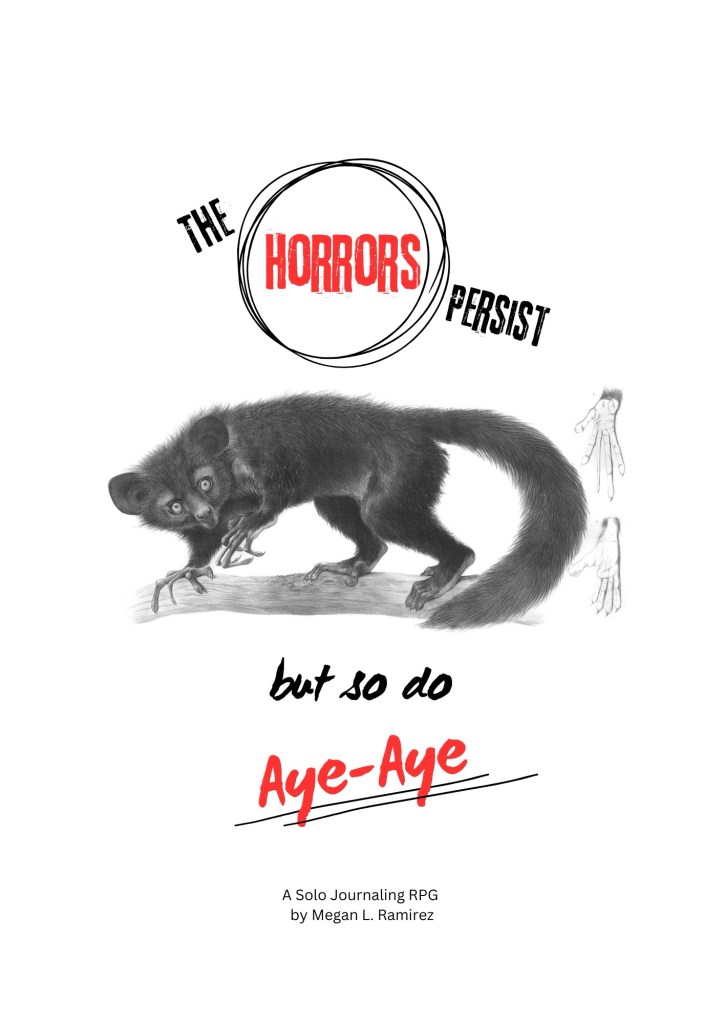
    The Horrors Persist But So Do Aye Aye (henceforth Horrors) is a 12 or so page solo journaling game by Megan Ramirez. In it you play an aye-aye with supernatural powers, seeking magical artefacts and consulting spirits to stem the destruction of your homeland.

    Horrors is based on Carta, much as Moon Rings was, so it shares some similarities, particularly the deck of cards laid out in a grid. This is a roll and move game, so each turn you move up to 6 cards, which on a grid this size is pretty close to complete freedom (and randomness). You consult the prompts dependent on which card you land on, journaling accordingly, until you collect 4 seeds or uncover all of the cards, in which case you access 1 of 2 secret end conditions. Before you do all of this, you generate your aye-aye, and choose its supernatural powers. Simple, right?

    Actually, Horrors has a few tricks up its’ sleeve. In most Carta games, you set aside the rest of the deck not in the 20 card grid and play without them, or perhaps refer to them occasionally. Here, you have an entire secondary deck, and that deck solely subsumes the original, meaning that the narrative evolves, opening new paths depending on your choices. Neat! In addition to that, both spirit and animal encounters are randomised, meaning that even within that sufficient amount of randomisation, we get even more surprises.

    Horrors opens with 4 colourful pages of in-universe texts, messages and images, which set the tone in an absolutely magnificent fashion. The game mixes the absurdity of the premise and the terrifying horror of environmental destruction with humour and a degree of subtlety. Even when we get to the prompts, the writing is just lovely: “Just beyond the blurring lies a towering baobab tree, its crown of finger-likebranches rigidly arched skyward like a hand in rigor mortis.

    The layout of those first 4 pages is really nice, and it’s fine throughout the main documents, until you realise that there aren’t any prompts here. But Nova, you say, didn’t you say the prompts were great? I did, but they’re in a separate document. I tend to download the main rules, and so I had to go back to the store to find the majority of the game text, which is in word document rather than pdf format. It’s fine, but a perplexing choice, and the word document abandons the formatting of the main text.

    I really, really like this little game. It’s clever in design, unique in its themes, and well written. It’s let down but some strange choices with its layout and product design, but that’s easily overlooked. If solo games, cosmic horror and cute animals are your thing, I’d check out The Horrors Persist But So Do Aye Aye.

    Idle Cartulary


    Playful Void is a production of Idle Cartulary. If you liked this article, please consider liking, sharing, and subscribing to the Idle Digest Newsletter. If you want to support Idle Cartulary continuing to provide Bathtub Reviews, I Read Reviews, and Dungeon Regular, please consider a one-off donation or becoming a regular supporter of Idle Cartulary on Ko-fi.

  • Critique Navidad: Mandog

    Each holiday season, I review different modules, games or supplements as a thank you to the wider tabletop roleplaying game community. All of the work I review during Critique Navidad is either given to me by fans of the work or the authors themselves. This holiday season, I hope I can bring attention to a broader range of tabletop roleplaying game work than I usually would be able to, and find things that are new and exciting!

    When I get a submission for Critique Navidad, I put them all in a big folder, so I can access them on the various platforms I write on easily. This means I lose the context of who the author is, the page the game was purchased on, etc. When I first opened Mandog, my response was “What the absolute hell is this”. What Mandog turns out to be is a 16 page module, primarily an investigation, written for OD&D, but set in 2018, in a suburban neighbourhood, by Gromb, with art by Wilber H. Force.

    Layout in Mandog is basic and works for the most part. Nobody likes a monospaced font, but here it works. Highlighting is left to bolding and italics, which works well as keying is kept simple. The keying is arranged by address, so it’s hard for me to flick easily through the key, and section headers (or some other way of identifying things at a glance) would be helpful. That said, this is an investigation module; I’m not sure the player characters are going to be crawling through this space, and even more to the point, I wonder if location was the right choice to separate this by at all given it’s an investigation. I’ll come back to this point later. One particularly egregious issue with the layout is that Mandog is completely unsearchable; this made the smaller issues I had with information design far, far more significant. For example, it’s not clear what the “Black Moon” or “Black Moon Syndrome” is and I can’t look it up; I don’t know who Bill “Brainiac” Quimee is and I can’t find them without scanning 20 pages of text. It renders this completely impossible to run on the fly, and difficult to run without printing it off and marking it up. There are page references in some places, but many things I need to reference don’t have page references — any of the random encounters for example. I don’t really see any good reason for a digital file to be unsearchable. The art is mostly limited to maps, but they all look scrawled out by someone taking their best guess, which honestly slaps and suits the subject matter perfectly; when it isn’t, it’s impressionistic charcoal and crayon stuff like the cover above that also slaps. Great choices.

    The basic gist of this investigation is that there’s a monster on the loose, and each night, it kills another victim, becoming stronger. The cops are useless, and so the responsibility of investigation falls to the player characters. The player characters take 2 investigation rounds per day and 2 per night, and might encounter specific characters or monsters. at a rate of 1 in every 6 rounds or so. There’s no invitation or suggestion of why the investigation falls to the player characters. I have no idea why the player characters might be here, whether they’re internal to the community or external, and without that, it’s pretty hard to intuit where to start here. In order to kick off the investigation, as a referee I’d have to do a fair bit of work developing the hooks, or else I’d have to do some collaborative worldbuilding with the table. The latter might work pretty well, but it’s definitely not supported in any way, so I’d still have to do a fair bit of work to make sure the worldbuilding doesn’t contradict the test. I’d far prefer if there was support for one of these options.

    Mandog’s writing is urgent to a fault. It’s good, though, and the terse and evocative word choices often work here where they don’t work as well in fantasy settings, because most readers have deeper hooks into what an imaginary town would look like than a musty cave. “A small crack in the basement floor opens to a chittering world of filth, a world that armies of pest exterminators fought and lost. The realtor considers a fire insurance policy.” is a pretty typical example: There’s humour, terseness, and more, packed into only a few words. It’s genuinely great. But, it’s filled with forbidden easter eggs, things like “Bobby does not know May prepares his body for possession after her death.” which just aren’t discoverable or interactable, even though they’re a hell of a vibe. In fact, that same home is a good example of the recurring problem with these locations: There’s no reason, really, to get to know these people, and similarly, there’s no mechanism beyond breaking into random homes to identify who’s been killed by Mandog; and there doesn’t appear to be any rhyme nor reason to Mandog’s killings, so there’s no way to anticipate them and stand in Mandog’s way. There are 15 locations before someone suspects anyone of anything. There are only 2 characters with any suspicions at all that might point you to Mandog’s lair. You find out some clue regarding what the Black Moon is on page 11; it’s in the single longest and sloppiest piece of readaloud text in the book, and would better have been directed at the referee non-diagetically, or parceled out somehow.

    Now, there’s the question of whether choosing a system other than 0D&D would have made these issues less meaningful. I think, in some ways, it would. Liminal Horror, for example, would be a good choice for this module, and it comes bit a bunch of presuppositions that would help breeze past some of the hiccups with initiating play. But, it wouldn’t eliminate enough of them, and I don’t think the built in rules would be better than 0D&D for many of the included rules. The issues here are primarily level-design, and not resolved by picking a different system.

    Overall, Mandog is a conundrum. This is a gorgeously realised and written suburb infected with evil and plagued with a demon in a relatively unique setting; this should be a super-compelling module. But it’s almost completely unplayable; there’s nowhere to start, there are few clues to find out what’s going on; it’s difficult to navigate to a fault. This is not a playground, and that’s a mistake for a module, because nothing works together. There’s very little level design here. I would never run this, because the preparation just to get started is way more than I can justify when there are so many other modules out there; I’d need to mark everything up, develop hooks, and figure out what the characters know so that the investigation will lead somewhere. It’s too much for me. That said, if an investigation set in an alternate demon-haunted 80’s American suburb is your jam, or you’re a sucker for stellar evocative writing, I’d jump on Mandog without hesitation, so long as you have a lot of confidence to fumble through the gaps, or would enjoy building on what’s here in your spare time.

    Idle Cartulary


    Playful Void is a production of Idle Cartulary. If you liked this article, please consider liking, sharing, and subscribing to the Idle Digest Newsletter. If you want to support Idle Cartulary continuing to provide Bathtub Reviews, I Read Reviews, and Dungeon Regular, please consider a one-off donation or becoming a regular supporter of Idle Cartulary on Ko-fi.

  • Critique Navidad: Boys Don’t Cry

    Each holiday season, I review different modules, games or supplements as a thank you to the wider tabletop roleplaying game community. All of the work I review during Critique Navidad is either given to me by fans of the work or the authors themselves. This holiday season, I hope I can bring attention to a broader range of tabletop roleplaying game work than I usually would be able to, and find things that are new and exciting!

    Boy’s Don’t Cry is a 12 page solo game by Markus M. In it, you explore the experiences of growing up as a young cis/het boy between the ages of 10 and 17, with traditionally feminine interests, using the “The Wretched” framework. That framework utilised thusly: Build a tower, draw a card, journal the scene indicated by the car, and pull a block. When the tower falls, the game is over.

    Boy’s Don’t Cry Cover

    Each card in the deck features a scene from your character’s life. The four suits here are horses, fashion and beauty, performance, and romance stories. Many of these scenes are, I think, pretty realistic situations to be in, but I struggle with the writing choices: Namely, there’s a lot of commentary in them: “The guys used to give you a hard time about your pimples. You made the mistake of trying to solve this by putting on concealer, forgetting that to them, make-up is for girls.” I think this commentary misses one purpose of the journalling game, and that’s to imagine and explore the world that’s set up. I could imagine a similar scene: “You are having an acne break out, so you went to the pharmacist to get some pimple cream and concealer. But Theo was there with his mum and he saw!” This leaves what you’re feeling and what the bullies are feeling and how they’re acting there for you to explore yourself. These scenes are iconic; the descriptions over-editorialise, for me. Why is this different to what I spoke about when I reviewed We Three Shall Meet Again a few days ago? I think in this case, every person reading this game already has a very strong foundation to improvise off: Their own childhood. If this was instead set in a world of teenaged dragons, dealing with dragon analogies to dragon gender roles and dragon bullying, I think the additional editorialising would be absolutely essential. But here, you don’t have to explain: Every reader knows what a cat-fight being an adolescent was.

    The Wretched has a difficulty toggle — how many cards you draw indicates how “easy” your adolescence is. I find this a very, very strange addition to the game, given it’s essentially an autobiographical game. I also find the metaphor of the Jenga tower to be wanting in this game; if it falls, you choose to conform. I understand the choice, but when you’re choosing a physical act to represent something, I feel it should — for want of a better terminology — feel right. Earlier this month, I reviewed A Stranger’s Just A Friend. The metaphor for sex there was melting a chocolate over a candle. That feels messy, dangerous, and sexual. And messy, dangerous, and sexual was what that game was trying to communicate. A falling Jenga tower does not feel like choosing to confirm; to be honest, I wonder if the opposite metaphor is more apt: Building a wall or a tower, for putting up a mask and changing yourself for others.

    This mismatch between physical action (or mechanic) and theme, I think, is a recurring concern I see across a lot of TTPRGs that are based on certain systems or mechanics. Earlier this month, I saw this mismatch in This Mortal Coil. I can see that there’s an appeal in taking something like the Jenga Tower, popularised in TTRPGs in the horror game Dread, and subverting it to mean something else. But in Dread, and in the Wretched and Alone, it is a tension-building mechanism, a metaphor for rising doom. Instead of adopting systems designed for specific purposes, even if the intent is to subvert, we should be considering what feelings we’re trying to evoke and build a game from that. I think, particularly for designers starting out, using a system that you’re familiar with can be a really helpful scaffold to getting design done at all. But I do think that where there’s a mismatch between theme and physical action or mechanic, as designers we playtest the game, meditate on the mismatch, and then consider how we can change our design so that this mismatch is minimised, or at least used for maximum effect.

    Boy’s Don’t Cry is an effective journalling game, with some iconic choices of scene that will be familiar to most adults who defied gender stereotypes as children, if not in the specifics, in the generalities. But it does fall apart in its translation of the system it uses to telling that specific story. If you’re interested in spending time exploring your own childhood and your struggles with gender stereotypes and bullying, and honestly, I’m not aware of much else that explores this territory, aside from the autobiographical Logan, which does it from a completely different perspective. If that’s interesting to you, Boy’s Don’t Cry is a good place to start.

    Idle Cartulary


    Playful Void is a production of Idle Cartulary. If you liked this article, please consider liking, sharing, and subscribing to the Idle Digest Newsletter. If you want to support Idle Cartulary continuing to provide Bathtub Reviews, I Read Reviews, and Dungeon Regular, please consider a one-off donation or becoming a regular supporter of Idle Cartulary on Ko-fi.

  • Critique Navidad: Carved in Stone

    Each holiday season, I review different modules, games or supplements as a thank you to the wider tabletop roleplaying game community. All of the work I review during Critique Navidad is either given to me by fans of the work or the authors themselves. This holiday season, I hope I can bring attention to a broader range of tabletop roleplaying game work than I usually would be able to, and find things that are new and exciting!

    Carved in Stone, subtitled “A Storyteller’s Guide to the Picts”, is a 160 page setting guide, by Brian Tyrell and Lizy Simonsen, with research by Dr Heather Christie. This is a massive book, with a huge number of other contributors, particularly illustrators. This is, effectively a historical sourcebook, in the guise of a setting guide to a fantasy game, from the perspective of a 7th century Pict (who are, for what its worth, the people who lived in Scotland in the 7th century). Or, perhaps, it’s a setting guide to a fantasy game, in the guise of a historical sourcebook? I’m not really certain — although if the concept of either compel you, or you’re a historian yourself perhaps you should skip the review.

    I’m going to choose to breeze over part 1; this is the evidence, and an exploration of what academic choices and work went into this massive book. The mere existence of such a massive collaboration between academia and the roleplaying hobby in the form of such a well-illustrated and well-evidenced book, is absolutely phenomenal, and this section talk about that. But that’s not something I need to recap in detail, and so I’ll move on to the first section: Landscapes.

    In Landscapes, we start to talk about the actual locations in Scotland. I like the highlighting choices here. Effectively we have a bolded sentence, the summary of the paragraph that comes next, so you have the short and long description of a feature. This is the first half of a spread; on the second, there are 3 detailed encounters, and 8 less detailed encounters. These are gorgeous, and evocative: “A goatherd finds the remains of a fire by the mountain trail, along with a few iron tools and bits of cloth. While gathering the scattered items, they pray for the soul who left them.”, for example. They conjure questions about the world, and the characters, lots for a referee to improvise and work from. Weather is expressed as an illustrated cycle, again, with both a more technical description and a poetic one. This is solid, if perhaps overly detailed, incorporation of the unique Scottish geography into gameable form.

    Next up is Kingdoms. This is a combination of factions and the map and key, with “regions” being by specific people. It follows the same format as Landscapes, to excellent effect. It’s also often funny (at least to those a little familiar with the subject matter): “York. An up-and-coming town that bishops and merchants are keen to support. Perhaps in a decade it might be worth a visit.” Languages are covered, and are shown through colour and symbolism on the maps. I adore how bilingualism is expected, but that examples are given of what that would look like in everyday life. Trade and value is covered, but also the rules of negotiation and trust are discussed, as our power, responsibility, and the specifics of royalty.

    Next up is Perspectives, which covers time, traditions, storytelling, celebrations and the like. Less concrete cultural considerations. These abandon the easy-to-run structure of the earlier chapters, mainly because the topics are a little more difficult to define. Most importantly to most referees, this covers magic, which covers spirits and the rules around them, how Christians think these are demons, how sorcerers weave magic into quartz stones and brew potions, Magi and their more powerful magic, as well as the role Christianity has in magic and in politics, including miracles, magic and saints. This implies a lot of potential magical complexity, that isn’t explored in depth here.

    The final and longest section is Lives. This is the real stuff of the world, which you’ll be preparing yourself: Travel includes pros and cons of different methods of travel, random landmarks you might encounter while travelling, people you might meet. Then there are settlement generators. Then 7 detailed locations, to show what things could look like for the various types of settlements. Then lots more things that I honestly feel belonged in perspectives: Skills, food, medicine, fashion and art, more time on the symbol stones mentioned earlier, equipment and entertainment.

    The appendices are a mixed bag; I think the text itself is meandering enough that many of these things could’ve been incorporated in their relevant sections. There’s more on law, medicine, trade and magic here that simply should have been in the main text. But there are also useful things that definitely belong in the appendices: Lists of names, for example. I get the overall feeling the appendix is a bunch of detail that they didn’t want to bog down the reader with, but thought were interesting enough to be “further reading”, and it ends up being just a little clumsy.

    The layout is stellar; the art is vibrant and interesting. I’ve often opined the fact that there are too few roleplaying game books designed like children’s history books: This is that book. While it could be more navigable from an information design perspective — this is a curse that I suspect comes from the desire to communicate academic as well as game design information — I think the layout is just stellar; this is by far the most readable roleplaying game gazette I’ve ever read. It’s gorgeous. You could leave it on your coffee table.

    My preference is for a more detailed and intertwined world; this isn’t that. But what it is, is a huge step up in detail in the best possible way, from most worlds designed to be mostly evocative and improvised upon. A recent example of the style is Empire of Hatred; but the detail here is far more supportive, and if you wish modules like that one were more detailed, this is an excellent choice.

    Carved in Stone is strictly system agnostic, which may work for some people, and may not work for others. My own style, I could run this as easily as anything, with a little prep for stat blocks. That may not be as compatible with every referee’s style. Certainly, I think this would be extremely compatible with something like Wulwald which I reviewed last year and seems a no-brainer for the kind of world set here. The main clash with popular systems is the ambiguity with which Carved in Stone treats magic here. The big challenge, for me, is that there are loads of implied systems of complexity: Language, trade and negotiation, and reputation are examples. These are things that are often mechanised in OSR style games, but here are simply described. I think I’d need to develop my own systems for these, if I were to run Carved in Stone, which is a not insignificant commitment. But, if you have an abiding love for the subject matter, you might also consider that just a bit of fun. One massive, implied subsystem here is tale-telling, which gets a section with lots of detail, but that I really feel should be a significant mini-game — it feels a lot like boasts from Wolves Upon the Coast. Overall, I can understand the choice not to put this to a system, but I think it is far weaker for it. That said, I can see a world where the community crowd-sources a system to play this in, and if it gains popularity, I’m excited to see what the community does with all of these fascinating implied systems.

    If you’re interested at all in the history of the British isles, Carved In Stone is probably one of the better books I’ve seen on said history. It’s also an excellent setting guide for an OSR style roleplaying game (or, I suppose, a traditional system like 5th edition), although the kind that leaves a lot of room for your own interpretation. If you love to take worlds and build your campaign around them, this is a hell of a world to build around. But there’s a lot of gaps by virtue of this being system-agnostic: A lot of important concepts here that you’ll need to figure out how to explore, a lot of things you’ll have to decide whether you consider important regardless of the import the book places on it. It’s a game that seems designed really well to take advantage of specific systems that you could adapt to its use: Wulfwald or Wolves Upon the Coast come to mind. It’s a book that you’ll want to study if you’re going to run it, but if you do, there’s so much power in the minutiae you’re going to be able to describe, and the writing is often gorgeous and assists you in communicating a lot of the strengths of the texts. This is a complex one, I think in terms of the tension between the academic or historical, and the game design or gameability, and every referee will fall in a different place. But if the concepts here are exciting to you, Carved in Stone will be a beautiful book to have on your coffee table, filled with great historical communication, even if you choose not to take the effort that is likely required to bring it to your table.

    Idle Cartulary


    Playful Void is a production of Idle Cartulary. If you liked this article, please consider liking, sharing, and subscribing to the Idle Digest Newsletter. If you want to support Idle Cartulary continuing to provide Bathtub Reviews, I Read Reviews, and Dungeon Regular, please consider a one-off donation or becoming a regular supporter of Idle Cartulary on Ko-fi.
  • Critique Navidad: The Lady, the Tiger and the Accused

    Each holiday season, I review different modules, games or supplements as a thank you to the wider tabletop roleplaying game community. All of the work I review during Critique Navidad is either given to me by fans of the work or the authors themselves. This holiday season, I hope I can bring attention to a broader range of tabletop roleplaying game work than I usually would be able to, and find things that are new and exciting!

    The Lady, the Tiger and the Accused is a 80 card game for 3 players based on For the Queen, by the Horned Sphinx. It’s inspired by the short story, “The Lady Or The Tiger?” By Frank Stockton. I’m reviewing the art-free ashcan edition; all money earnt is to go towards a series of art pieces and a physical deck. While it’s troublesome to print your own cards from a digital file, the game also comes with files to play on playingcard.io.

    It’s hard to describe this game without replicating most of the rules text: Suffice to say, this is a conversation between three distinct characters, being overseen by an omnipotent princess who will decide their fates. You create your characters together, talk basics, and then you pose questions to your fellow players, until you are forced to answer your final question, and the everyone fates are revealed.

    There are some flaws here: The concept is hard to wrap your head around. The Princess’ decision has to be abstracted, by the nature of the design. The phrasing, particularly of the final card, is a little confusing, at the moment when it should be clearest. I think the worldbuilding should contain a little more guidance than it did. And of course, it’s entirely art free, and I’d like to see art — it might reduce the need for that extra guidance, if well curated.

    On the other hand I think The Lady, the Tiger and the Accused is probably the best twist on For the Queen’s format I’ve seen. Having 3 concrete characters, with concrete relationships to each other, and concrete threats and histories, maximises the impact of the format in a way I haven’t seen before. It takes the tension of a short form committee larp and democratises it by providing more prompts and support for players unfamiliar, but it comes preloaded with far more drama that For the Queen ever did for me.

    If you’re a fan of small group games, short games, or For the Queen style games, you should check The Lady, the Tiger and Accused out. I’d love to see this actually get the art and physical print it deserves, plus so minor layout or rephrasing in some places. In my opinion, The Lady, the Tiger and Accused deserves to be on my shelf more the For the Queen does.

    Idle Cartulary


    Playful Void is a production of Idle Cartulary. If you liked this article, please consider liking, sharing, and subscribing to the Idle Digest Newsletter. If you want to support Idle Cartulary continuing to provide Bathtub Reviews, I Read Reviews, and Dungeon Regular, please consider a one-off donation or becoming a regular supporter of Idle Cartulary on Ko-fi.

  • Critique Navidad: The Bonsai Diary

    Each holiday season, I review different modules, games or supplements as a thank you to the wider tabletop roleplaying game community. All of the work I review during Critique Navidad is either given to me by fans of the work or the authors themselves. This holiday season, I hope I can bring attention to a broader range of tabletop roleplaying game work than I usually would be able to, and find things that are new and exciting!

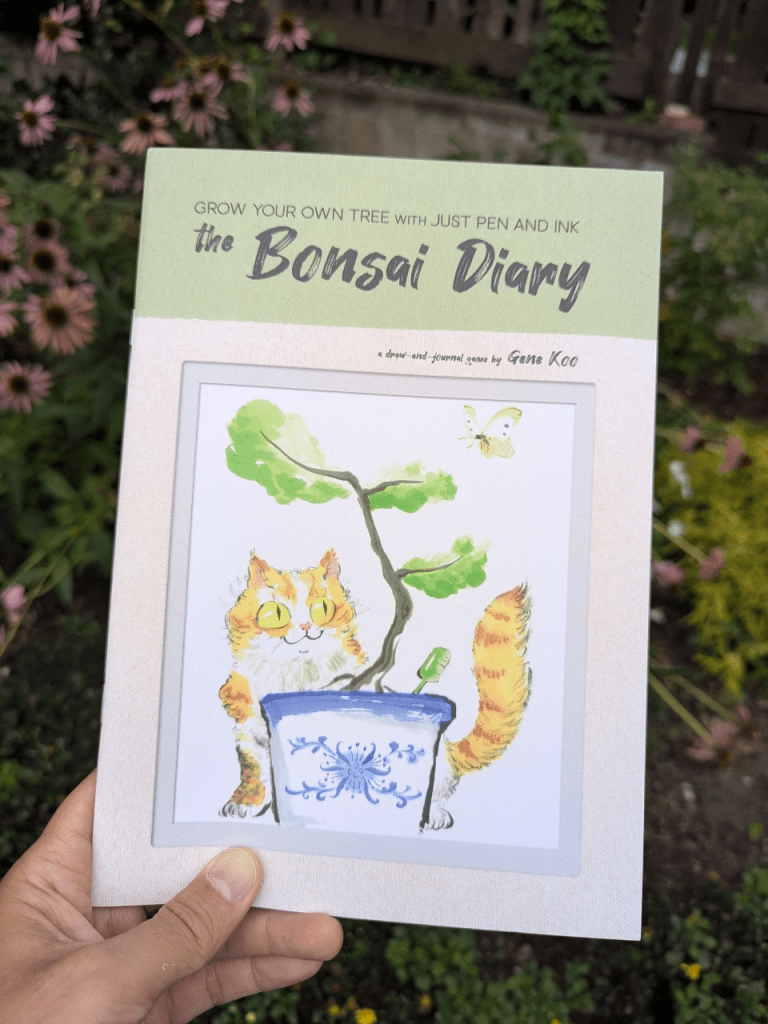
    The Bonsai Diary is a 34 page journalling game by Gene Koo. In it you nurture and grow a Bonsai Tree, with pen and ink.

    The mechanic is simple: You tract the previous page’s bonsai, and then add a line to make your tree grow. Each page, you’ll get a prompt, which will guide you to tell the story of yourself and your tree. Sometimes these prompts are a question, sometimes there are images to help direct what you draw, and sometimes they’re quotes. Sometimes they’re very specific, sometimes they’re ephemeral. I get the impression this is supposed to be a regular practice — you play a page every day for a month — but it doesn’t outright say that.

    The layout is spacious — as it should be, as you’re supposed to be drawing all over the page — and conservative, but as it is played page by page as you progress, information design is straightforward here. It’s elegant, and lovely. You can buy a print edition; I had the print and play edition, which has clear instructions on how to reproduce it. I have a strong feeling that this game would benefit from being on higher quality, better bound paper. Like, it screams “I want to be on a textured, spiral-bound notebook”; that said, you could do that, if you wanted. There are instructions for creating your own diary, unique from this one, using a deck of playing cards, in the back. This would be, in my opinion, a project well worth the time.

    Bonsai Diary is another game in this past year or two’s trend toward book play; Yazeba’s Bed and Breakfast, Triangle Agency, and most recently Spine, all have repositioned the book itself as the center (or at least a fulcrum among others) that the game spins around. This isn’t a new concept, but I think that designers are embracing it in newer and more interesting ways. It also plays with the oft-lauded destruction of a text — but in the opposite direction. You’re tracing your Bonsai from the previous page, so every page you have the opportunity to deface your page and your Bonsai, and you simply do not have to. There are pages that take advantage of the ephemerality of the tracing of your Bonsai, which is fascinating for the very same reason why other legacy games are fascinating in how they ask you to destroy things you previously wouldn’t have dreamed of replacing. It’s inventive and I love it.

    Bonsai Diary is full-bent focused on providing a contemplative, mindful experience, but in a creative, surprising way. It’s really quite excellent. It’s also quite interesting. So many solo journalling games are instead full-bent on horror, or fear, or exploring your innermost feelings, and I enjoy this calmer, more measured pace. If you’re looking for some kind of meditative gaming practice, for a month, or for a day, I’d check out the Bonsai Diary.

    Idle Cartulary


    Playful Void is a production of Idle Cartulary. If you liked this article, please consider liking, sharing, and subscribing to the Idle Digest Newsletter. If you want to support Idle Cartulary continuing to provide Bathtub Reviews, I Read Reviews, and Dungeon Regular, please consider a one-off donation or becoming a regular supporter of Idle Cartulary on Ko-fi.
  • Critique Navidad: A Real Boy

    Each holiday season, I review different modules, games or supplements as a thank you to the wider tabletop roleplaying game community. All of the work I review during Critique Navidad is either given to me by fans of the work or the authors themselves. This holiday season, I hope I can bring attention to a broader range of tabletop roleplaying game work than I usually would be able to, and find things that are new and exciting!

    A Real Boy is a 1-page collaborative storytelling game, where players take turns telling the story of an artificial being struggling to become human. It’s technically for any number of people, but I feel like it would work best with 3.

    The basic gist is this: You agree on a few basic worldbuilding prompts, and (in a neat simple worldbuilding technique), describe how the world you’re playing in feels about certain things.

    The you take turns rolling on the encounter table and framing scenes for the player to your right, who plays the creature. At any point, another player will ask for your reaction, checking one of the four feelings you used to build your world. If the feeling gets too much use, it evolves into a new feeling, and the world changes. After 9 encounters, you look at the world, and decide what happens to the creature.

    The meat of the game are the encounters, and these are pithy and metaphorical, effectively tarot-like, such as “The Crow and the Owl. The science. Why are they a danger?” I like them, but as I mentioned earlier in this year’s Critique Navidad, I like some specificity in my design: This being a 1-page game doesn’t have the space for that, so it’s going to appeal mainly to players who run on creative fumes.

    A Real Boy is a lovely little game, that would benefit from being a little less little. I suspect simply expanding it to the back of the page would be sufficient to expand on the back or front end of the prompts, to add some space for the marking down you’re supposed to do, and to clarify the processes a little. It’s all here, though, and for the right table A Real Boy would honestly be a great warm-up before a similarly themed game, or perhaps even a whole evening if you were very comfortable improvisers.

    Idle Cartulary


    Playful Void is a production of Idle Cartulary. If you liked this article, please consider liking, sharing, and subscribing to the Idle Digest Newsletter. If you want to support Idle Cartulary continuing to provide Bathtub Reviews, I Read Reviews, and Dungeon Regular, please consider a one-off donation or becoming a regular supporter of Idle Cartulary on Ko-fi.

  • Critique Navidad: Chain x Link

    Each holiday season, I review different modules, games or supplements as a thank you to the wider tabletop roleplaying game community. All of the work I review during Critique Navidad is either given to me by fans of the work or the authors themselves. This holiday season, I hope I can bring attention to a broader range of tabletop roleplaying game work than I usually would be able to, and find things that are new and exciting!

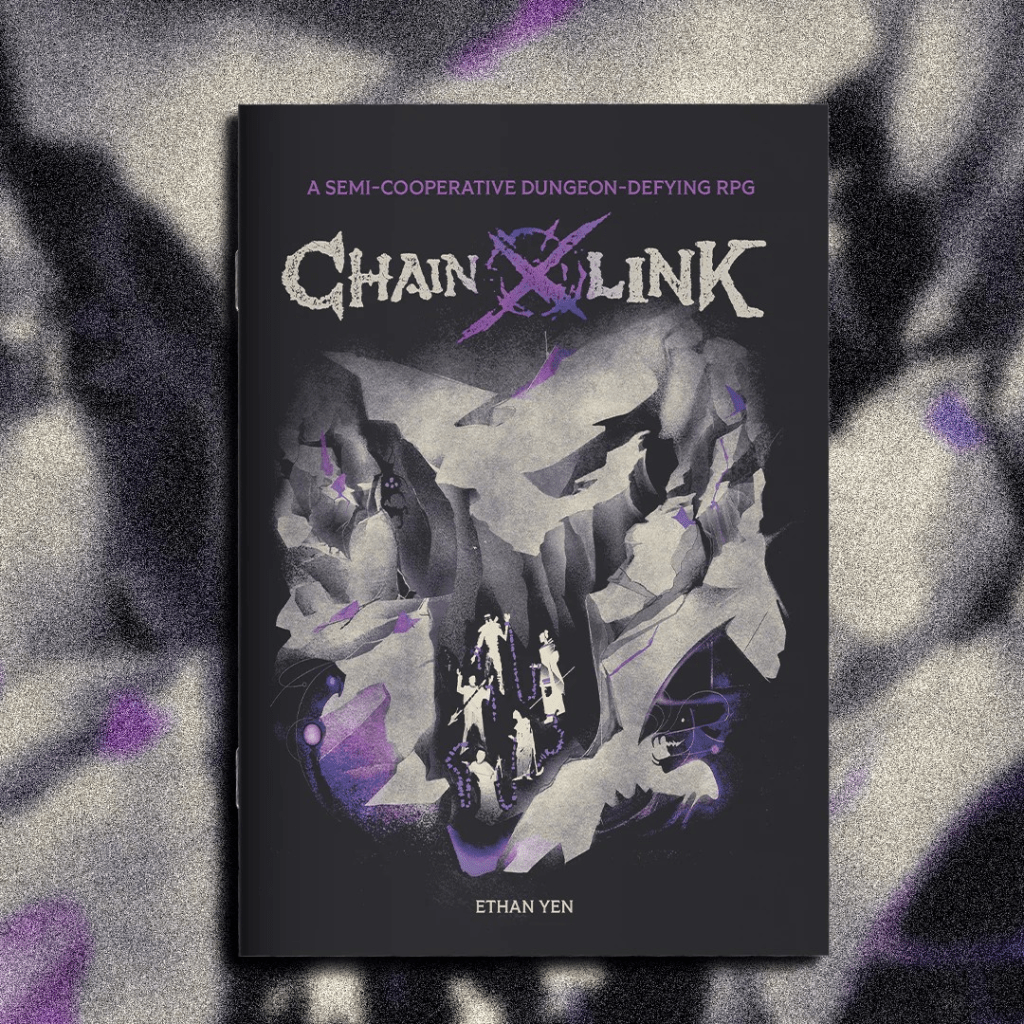
    Chain x Link is a 64 page game by Ethan Yen, with art by Tony Tran and Andrew Beauman, with consultation by Spencer Campbell. In it, you are the leaders of revolutionary factions, that have been exiled to a dungeon deep beneath your civilisation. You work together to survive and escape, while plotting against each other to smuggle assets out of the dungeon to your factions above ground. Meanwhile, you also play your faction above ground, trying to seed their very own revolution.

    Let’s talk visual design first, because it’s worth talking about but I suspect it’ll get lost if I leave it to the end. The layout, also by Andrew Beauman, is excellent. It’s full of visual aids and graphics, it has a lovely faded purple highlight palette. It’s clear and relatively easy to navigate; I think there are so many moving parts here, that choosing a larger page format would have enable concepts and procedures to be pinned more commonly to spreads, and that would have made it better again. Within the format chosen, though — looks to be A5 or half-letter — it works very well. The information design isn’t terrible, although it front-loads a lot of information. Later in the book, in Spadefront section, it starts walking the referee chronologically through what she needs to do to run that first session — I think the game as a whole would be better off to have been presented in that way, given that rules —are at least complex in their unfamiliarity.

    So, those rules. There’s a lot going on here. Your core loop consists of entering a new level, completing a faction trial for one of the factions, and completing a grave trial for that level. If you can complete the ascension rite, you can enter the level above, or if you’ve ascended far enough, escape. If your faction has completed all 3 of its’ goals, you get to have a revolution. As a Breaker (what characters are called here), you have skills and assets, and those assets can move between your “chain” (that’s your party), and your faction on the surface (by smuggling). The goal is to both escape (and hence you need loyalty to your chain) but also to start a revolution, where the other breakers in your chain all desire very different revolutions to you. You also have equipment and experiences, which operate similarly to assets and skills, but are earnt or bought. Very neat way to represent a revolutionary leader’s acumen. When you ascend a level (or in a scene on the surface), you play out a trial. The trial has an objective, an opposition, and stakes, and the referee determines the difficulty of the trial, which the breakers are trying to beat. You each make a contribution adding to the dice pool for your various equipment, experiences, assets etc., and roll them all. You pick one die as your contribution score — the next player will have to pick a higher score, so best to pick a low one, or the others won’t be able to contribute. But the final breaker gets to be the leader next time, which is a powerful advantage. One of my favourite small mechanics in this game is opportunity: You’re all leaders of powerful factions, which means you’re masterminds, you bide your time. So each of you have a d10 which is the opportunity die. The longer you wait to strike during a trial, choosing lower contribution scores, the greater the number you can choose to substitute your choice for when you do choose to seize the opportunity. If total contribution beats the difficulty, you succeed, and the new leader distributes any rewards. If you don’t succeed, you suffer consequences. Then the leader gets to enlist someone in opposition during the trial, to smuggle an asset to their faction. The same rules apply to faction trials as to grave trials, which I appreciate very much. I love the tension in these relatively simple, 1-pass rules, between gaining leadership and risking danger. I appreciate that there’s this core complexity to the game, lots of fiddly parts, but it’s re-used in different contexts and features a lot of internal tension. It’s great.

    There are a few things I don’t think are clear. I got the impression you’d face a maximum of 2 trials per level, but the Ascension Rite has me second-guessing that impression. If I fail a trial, do I repeat it again and again, unchanged? That may get repetitive. I don’t quite understand whether contributions are simultaneous or turn-by-turn — I think simultaneous would make more sense, with the push-your-luck of contribution score. What does revolution, or reaching the surface, entail?

    One of my favourite touches in Chain x Link is the additional resources; it relies heavily on the breaker, chain and factions sheets in the rules, so they aren’t really bonuses, but the trial sheet structures the trials visually for the referee, which I appreciate, and more importantly it comes with a folder of pregenerated breakers, factions and chain, so you can simply skip that entire section of the rulebook. The rules in Chain x Link are unique enough — at least to me — that it takes a fair bit to wrap my head around, so reducing that cognitive load from 60 pages to 30 is a hell of a scaffold to get me to running the game.

    The end of the book is the entire lowest level of the Grave. This slaps! It’s full of characters, interactions, it’s an absolute powder keg! And I love that it provides an example of what you’re supposed to be designing as the referee for future levels of the dungeon. One way this diverges from inspirations like Blades in the Dark and Agon is that the referee is expected to design the levels of the Grave. It’s a weak criticism to say that I want more of this, but it’s good. The same goes for the worldbuilding as a whole; there’s a gesture to collaborative worldbuilding in the character creation section, but I really feel this needs more information, even if brief, on the surface, and the specific contexts of the faction and the world. Certainly, if the book were twice as long, with 10 times as much of the actual location content, it would make my job as a referee a hell of a lot easier — the referee already has a lot of improvisational load in terms of the surface, so reducing the preparation load would make this more likely to hit the table for me, simply by virtue of my being time poor between work and children.

    I like Chain x Link a lot. The feeling I got out of Chain x Link after reading through the book, felt a lot like the feeling I got out of Blades in the Dark the first time I read it — there’s a lot of mechanical heft here, but it’s elegantly presented, and while it might take a lot to wrap your head around, it’s going to result in a really compelling game filled with really compelling stories. One of the inspirations listed is Spire, and I always felt like Spire would’ve been better as a Forged in the Dark game: No. This is the game Spire should’ve been. It’s clearly inspired by John Harper’s work, but it really pulls things together in a neat and compelling way. I’m disappointed it isn’t organised and explained a little more clearly — it needs space to breath and it needs to be in a bigger format to do so — and I’m disappointed it doesn’t come with more information about this compelling world and the levels of the Grave. It also feels cut to the bone to fit the page count, leaving some end-game crucial elements uncovered. But those aren’t dealbreakers for many people, and if I can find time to do all the prep, this is a game I’m definitely going to try to bring to the table next year, despite those misgivings. If you’ve always had the same feeling as me about revolutionary games that fell short like Spire and Brinkwood, I think you should bring Chain x Link to the table as well.

    Idle Cartulary


    Playful Void is a production of Idle Cartulary. If you liked this article, please consider liking, sharing, and subscribing to the Idle Digest Newsletter. If you want to support Idle Cartulary continuing to provide Bathtub Reviews, I Read Reviews, and Dungeon Regular, please consider a one-off donation or becoming a regular supporter of Idle Cartulary on Ko-fi.

  • Bathtub Review: Castle of the Veiled Queen

    Bathtub Reviews are an excuse for me to read modules a little more closely. I’m doing them to critique a wide range of modules from the perspective of my own table and to learn for my own module design. They’re stream of consciousness and unedited critiques. I’m writing them on my phone in the bath.

    Castle of the Veiled Queen is a 45 page system agnostic module taking place in the Beyond Corny Groń setting — a setting that was very compelling, but was begging for some more concrete content. It was written by Kuba Skurzyński, with a number of art contributors. In it, you explore the castle of a princess, filled with residues of legends and wicked plots. I backed this for Zinequest.

    Castle of the Veiled Queen opens with 8 long-form legends and plots, all of which are very compelling but not especially incisive; it then includes 6 rumours and 6 pieces of gossip that are more bite-sized. It feels on a first read that those first 8 long-form pieces of legend and plot are intended to be converted to something player facing, but I’m not sure that’s true: Many of the other 12 link into them in a meaningful way, and I think that the intent here is that the legends and plots are supposed to be the equivalent of “What’s been going on in the Castle”, so that the referee knows what the rumours all point to. This could all be clearer, and needs to adhere better to my Juicy Hooks suggestions to be a little more instantly playable. This would also benefit from some within text referencing — these hooks point to people and places in the text, but the referee has to know the castle well to know what’s going on. Despite all this, the actual content is really compelling and interesting, and there’s a lot going on — in a really good way.

    Random encounters are good, tying directly into characters in the story, but again would benefit from references — they’re not all in the index at the front, but searching the digital format help you. Redundancy in these cases would be super useful, as the benefit of having this intratextuality is compromised by the referee’s lack of knowledge here. They keying is with an eye to location, rather than explicit gameability, which isn’t so much a bad move but a missed opportunity. There’s often no interesting single thing in any one keyed area; sometimes the interesting thing isn’t explicated, and is barely alluded to. This is the case with the gunpowder storage in the Barbican; it’s covered well on the separate gunpowder storage in the Eastern Wing, so perhaps it would have benefitted from a reference. They key is dense, but it’s dense in the way Keep on the Borderlands is dense: Not always with the things I want it to be dense with. The briefer character descriptions are pretty great, covering appearance, relationships and interests, but a few of the descriptions feel like they were written well before the author found this rhythm, and these aren’t as strong or brief. Keying often skips things that are on the map — aforementioned gunpowder storage — or the map doesn’t make clear which parts are the key — in the Moon Tower for example, it’s not clear which floor is which (I think, after some consideration, the third floor is the 1st floor, and the attic and roof are the top two floors, despite the map next to these being of the top four floors). Labelling the maps would’ve fixed this. The factions aren’t at the front of the module, which means they’re in the text. The issue with this, is that you have to extract the information in order to figure out how to incorporate them. The pixie gang in Moon Tower is very cool, and have some solid motives and ambitions. But it’s these aren’t explained, which means it’s hard to foreshadow them without significant foresight. This goes for most of the factions and plots — compelling, interesting, and difficulty to facilitate into play.

    The Outlaw’s Path is a dungeon that sits beneath the entire castle. In and of itself, it’s an interesting dungeon — it loops in interesting ways, both in itself and with the castle above. It’s full of interesting characters. You’ve got reasons to explore it in and of itself, and also to use it as passage to other places in the castle. It compromises the layout of the castle, though, to a degree, as you can access five out of the seven castle’s locations through it. It’s a very cool little dungeon, though, and to be honest, it could stand on its own without the castle, largely because it’s a very gameable, interactive space — very unlike most of the castle.

    There are lots of smaller issues, that to me make me feel that I likely missed more. You are given opportunities to blackmail the NPCs, but no specific NPC has any blackmail materials in their description, so what is this valuable or embarrassing information? There are a pile of forsaken easter eggs as well, mostly in the form of unique magical items that are very cool, but that I can’t foresee anyone figuring out how to use — the Judges Bench is one such magical item. There are a few egregious misuses of randomisers here, too — a soldiers of the castle generator, that will at most generate 10 soldiers (there are only 10 names), and hence could have been a 10th the size, or colourful descriptions like the other characters. Notable persons buried in the chapel could’ve been an opportunity to expand the history of the castle, either in terms of lore, or hyperdiegetically, but is rendered meaningless by a randomiser. Finally, there are some missed opportunities — time and effort put into the different time periods of construction of the castle and how it’s reflected in its’ architecture is very cool, but it doesn’t really impact either the folk living there, nor is it utilised as a puzzle, either of which would have made that information much more interesting and meaningful.

    All of these misses are really disappointing, because in many ways the information design in this slaps. It opens with a full page index of every proper noun in the book. It refers out to Beyond Corny Groń with page references to save on space. Section headers could be clearer (they’re intentionally conflated with headings, a choice I don’t like), but they’re almost always present. Bold is used for all highlighting, except in world quotations, which are used very sparingly. Art complements layout, and is is extremely consistent with the existing works in the setting, as well as being unique and fun. There are a lot of maps by Jacek Kuziemski and they’re all pretty exceptional maps, but useable and pretty, with loads of cute touches like a rug pulled back to reveal a secret door.

    Overall, The Castle of the Veiled Queen is a very cool location, and you’d be a fool not to pick it up if you’ve already got Beyond Corny Groń and plan to run it. For me to run it, I’d need to do a lot of legwork though. I want the faction (and character) interactions and agendas to be laid out for me from the get go. I want what will happen if the player characters don’t get involved to be clear. I want to know exactly what’s going on, so I can make connections on the fly. As it is, I have to extract all that information myself, and I just couldn’t be bothered. That said, everything in there feels worth playing with. Both the Castle of the Veiled Queen and the Outlaw’s Path below it are complex and compelling. I could see the castle being a base for a Corny Groń campaign, with individual sessions being ventures into Polish folklore based on the contents of that setting book, and things advancing in the background, between the politics and the folklore of the castle. It would really hold everything together used in that way. As a module in and of itself, I could jury-rig it with some work, but it’s not specific or directed enough for a heist even based on those hooks that suggest it: It’s a sandbox meant for immersion not a quick dip. But overall, I’m a little disappointed: It’s too close to Keep on the Borderlands, and I want something a little more like The White Horse of Lowvale. I am just starting to suspect, that’s the way they run, and they’re writing excellent support for that kind of classic style game.

    If you’re after a dense home base for your Corny Groń campaign, look no further than Castle of the Veiled Queen, but if you’re looking for a one-shot, or something to dip your toes into in order to get a handle on Beyond Corny Groń after looking at that book and feeling a little lost and overwhelmed, I’m afraid this isn’t the right module for you. Nevertheless, the work that this team continue to do is super compelling, and I look forward to seeing what they do next.

    Idle Cartulary


    Playful Void is a production of Idle Cartulary. If you liked this article, please consider liking, sharing, and subscribing to the Idle Digest Newsletter. If you want to support Idle Cartulary continuing to provide Bathtub Reviews, I Read Reviews, and Dungeon Regular, please consider a one-off donation or becoming a regular supporter of Idle Cartulary on Ko-fi.

Want to support Playful Void or Bathtub Reviews? Donate to or join my Ko-fi!


I use affiliate links where I can, to keep reviewing sustainable! Please click them if you’re considering buying something I’ve reviewed! Want to know more?


Have a module, adventure or supplement you’d like me to review? Read my review policy here, and then email me at idle dot cartulary at gmail dot com, or direct message me on Discord!


Recent Posts


Categories


Archives

July 2026
M T W T F S S
 12345
6789101112
13141516171819
20212223242526
2728293031  

Recent Posts